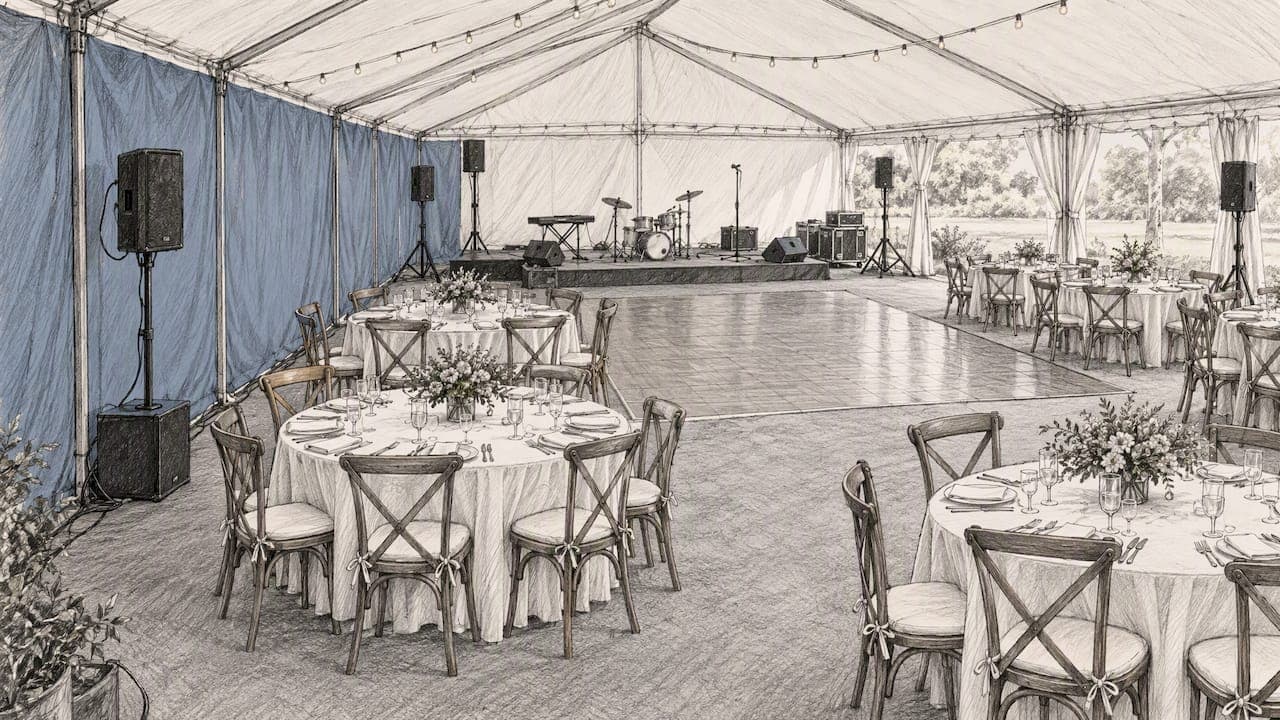
Music for a tented wedding works when you plan it around the tent itself: its size, its zones, whether the sides are up or down, and what the venue allows you to plug in. Pick the songs second. First decide where each moment happens (ceremony, cocktails, dinner, dancing), how sound will reach each zone, and who controls it. This guide walks through that order, with the song and ensemble choices that suit each stage.
TL;DR
- Map the tent into zones (ceremony, cocktails, dining, dance floor) before choosing music or equipment. Each zone needs a different volume and a different sound.
- Ask your venue first what it requires: house speakers, set inputs, volume limits, power circuits. Some venues dictate all of it.
- Sidewalls change how a tent sounds. Plan sound checks for the moment they go up or come down.
- Live ensembles suit ceremony, cocktails and dinner; a DJ or hybrid set keeps the dance floor full late in the night.
- Put the whole music plan in one written document and share it with every performer and the emcee.
Table of Contents
- Why a tent changes the music plan
- Start with the venue's rules
- Map the tent into sound zones
- Sidewalls, weather and equipment
- Music for each stage of a tented wedding
- Live band, DJ or hybrid under a tent
- Playing music without a DJ
- Write one music document for everyone
- Our perspective
- Hire live music for your tent
- FAQ
- Sources
Why a tent changes the music plan
A ballroom gives a musician walls, a ceiling and a predictable room. A tent gives you fabric, open air and weather. Sound escapes through open sides, bounces hard off a taut vinyl or canvas ceiling when the sides are closed, and can fade quickly at the back tables. The same trio that sounds warm and full in a hotel can sound thin on a lawn, or boomy once the sidewalls drop for an evening chill.
That is not a reason to avoid a tent. It is a reason to treat sound as part of the tent design, next to lighting, flooring and the layout of tables. Three questions shape everything that follows:
- What does the venue require? Many venues have rules on equipment, volume and end times.
- Which zones need sound? A single tent can hold a ceremony, a dinner and a dance floor, sometimes with a separate cocktail area.
- Who runs it? Live musicians bring their own gear and skill. A playlist needs a person assigned to run it.
Start with the venue's rules
Before you rent a speaker or book a band, ask the venue what it permits. Rules vary widely, and some are strict. One U.S. example: Connemara House Farm's vendor guidelines require that audio in its dinner-and-dancing tent run through the venue's own speaker system, fed by XLR inputs, with built-in limiters controlling outdoor noise. A band or DJ at that property plugs into the house system rather than bringing mains of their own.
You may not be at a venue like that, but the lesson applies everywhere. Ask these questions in writing:
- Is there a house sound system, or do performers bring their own?
- Is there a decibel limit, and where is it measured (at the tent, at the property line)?
- What is the amplified-music cutoff time?
- Where are the power outlets, and are they on dedicated circuits separate from catering and lighting?
- Can performers load in and sound check before guests arrive, and on what schedule?
- Where do performers set up if it rains?
If your tent is on private property rather than at a dedicated venue, also check local noise rules with your town or county. Those vary by municipality, so confirm them with the local authority rather than assuming.
Map the tent into sound zones
Sketch the tent floor plan and mark where each activity happens. A typical tented wedding includes:
- Ceremony area, sometimes outside the tent, sometimes under it.
- Cocktail area, often open-sided and social.
- Dining area, where guests need to hear toasts and each other.
- Dance floor, where energy and volume peak.
- Overflow areas, such as a bar corner or lounge seating.
The goal is even, comfortable sound at the back tables without a wall of volume at the front. In practice that means speakers distributed around the space, aimed at guests, instead of two large speakers pushed hard from one end. Tables near the dance floor will always hear more music, so place older guests and anyone who wants to talk a little further away if the layout allows.
Hand your planner or musicians a marked-up floor plan. A good performer will tell you immediately where they need to stand, how much floor space they need and where speakers should sit.
Sidewalls, weather and equipment
Sidewalls are the most overlooked variable. With the sides open, sound disperses and the tent feels airy. With them closed, the space gets louder and more reverberant, and conversation at dinner can become tiring. Many couples start a reception with sides up and drop them as the evening cools or rain arrives, so the acoustics change in the middle of the party. If you are deciding whether to add them, this guide to tent sidewalls, rental costs and planning is a good place to see what the choice involves. Then tell your musicians when the sides are likely to change, so they can adjust volume and placement at that point rather than discovering it mid-song.
A few practical rules:
- Plan a sound check with the sides in their likely final position. Check again after any change.
- Keep cables off wet ground and out of guest walking paths. Taped or covered runs are safer.
- Protect electronics from rain and humidity. Ask performers what they bring for weather cover, and where they will set up if a storm comes through.
- Expect wind and heat. Light stands need weights, sheet music needs clips, and acoustic instruments such as pianos and violins are sensitive to temperature swings. Tell your ensemble the forecast and the time of day.
- Separate the circuits. Audio, lighting, catering and any heating or cooling should not all share one circuit. Ask your tent company or venue to confirm what is available.
If you need a generator, confirm with the tent provider who supplies it and where it will sit. Noisy equipment placed near the ceremony ruins the quiet moments, so keep it well away from the guests and the musicians.
Music for each stage of a tented wedding
Think of the day as phases, each with a different job. The same arc works under a tent as anywhere, with a few tent-specific tweaks.
Ceremony: prelude, processional, recessional
Ceremony music usually has four parts: a prelude as guests arrive, a processional for the wedding party and the couple, any interludes during the ceremony, and a recessional as you exit. Strings and solo piano are classic choices for formal ceremonies; an acoustic guitarist or a curated instrumental playlist suits a relaxed one.
Tent-specific tips:
- Acoustic instruments carry well in the quiet. A string quartet or a solo piano often needs little or no amplification for a small ceremony. For larger groups, add a small, discreet speaker and a microphone for the officiant.
- Pianos need a flat, sheltered spot. If a real piano is not practical, a quality stage piano is a common live solution. Ask your musician what they recommend for your site.
- Mind the aisle length. Time the processional to the walk. A long lawn aisle needs a longer piece or an extra cue.
For song ideas, our guides cover prelude songs for a ceremony, the processional and how to choose it, and a role-by-role processional song list. If your ceremony is secular, see our nonreligious wedding music cue sheet; if it is Catholic, the Catholic wedding music order lays out the sequence.
Cocktail hour: light, social, easy to talk over
Cocktail hour is where a tent often shines, especially with the sides rolled up. The music should sit comfortably behind conversation: jazz standards, swing, bossa nova, and acoustic arrangements of familiar songs. A jazz trio or a solo pianist is a natural fit, with softer dynamics and no drum kit competing with the chatter. Our piece on cocktail hour soundscapes explains why live music creates a better mood than background noise.
If cocktails happen outside the tent while the staff flips the space for dinner, make sure the musicians are not directly beside the crew, and that your sound is not leaking into the ceremony or setup area at the wrong moment.
Dinner: keep speech clear
Dinner is where tent sound most often goes wrong, because the people who want to talk sit at tables far from the speakers. Keep volume lower than you think you need, and distribute small speakers so the back tables hear the same level as the front. The goal is a room where guests can talk across the table and still hear toasts clearly. See our overview of what dinner music at a wedding is for song and pacing ideas.
Toasts need their own plan. Ask who is providing the microphones, test them at the toast position, and make sure someone is cued to hand them over. Wireless handhelds are easier than a fixed mic on a stand in a busy tent.

Dancing: build energy in stages
Once dinner clears, the tent becomes a dance venue. The usual opening moves are the grand entrance, first dance, parent dances, then an energetic open-floor set. To bring in guests of different ages, mix decades. Inside Weddings suggests opening the floor with crowd-pleasers such as "September," "I Wanna Dance With Somebody," "Crazy in Love," "Hey Ya!" and "Can't Stop the Feeling." For a sense of what working DJs get asked for most, Billboard's survey of 37 wedding DJs across 13 American cities compiled commonly requested wedding songs, though it dates from 2016, so treat it as a classic-staples list rather than a current chart.
A few reliable principles for the floor:
- Start with songs almost everyone knows, then let the tempo and style move.
- Avoid long gaps. Silence in a tent feels bigger than silence in a ballroom. Transitions between sets should be planned.
- Give the DJ or band a do-not-play list alongside the must-plays. Our do-not-play list guide and must-play songs are written to be shared directly with performers.
For the full reception sequence, our reception music checklist walks through every moment.
Live band, DJ or hybrid under a tent
The choice is less about taste than about how the night is structured.
| Option | Best for | Tent considerations |
|---|---|---|
| Solo piano or string quartet | Ceremony, cocktails, dinner | Light gear, low volume, sensitive to weather and temperature |
| Jazz trio or quartet | Cocktails, dinner, early dancing | Needs more floor space, a power plan and a sound check |
| Swing or party band | Dancing | Large footprint, high volume, needs venue limits confirmed |
| DJ | Long dance sets, wide song range | Compact, flexible, easy to switch genres |
| Hybrid (live musicians plus DJ) | Full evening | Handoffs need planning, one shared system works best |
A hybrid is often the most practical answer for a tent. A live ensemble plays through ceremony, cocktails and dinner, then hands off to a DJ for the late dance floor, or a saxophonist or violinist plays on top of a DJ's set for peak moments. Because it uses one speaker system and one schedule, it reduces setup and avoids a second crew arriving at the tent. Our DJ and hybrid music page shows how that works.
Playing music without a DJ
If you are handling music with a playlist, treat it like a performance, not a background task:
- Download every track for offline playback. Mobile signal and wifi in a field are unreliable.
- Assign one person to run the music for the whole event, ideally a friend who is not also in the wedding party.
- Build a single ordered sequence covering the prelude, processional, any signing music, the recessional, then cocktails, dinner and dancing.
- Hire or rent proper sound. Phone speakers do not fill a tent, and the wrong equipment can fail in a damp, dusty environment.
- Test everything on site at the time of day you will use it.
A playlist can work for a small tented dinner. For a larger reception, the timing, announcements, microphones and reading of the crowd are where a professional pays for themselves.
Write one music document for everyone
Whoever performs, the plan should live on a single shared page: the timeline, song titles for each moment, cues, special announcements, who introduces whom, and what to avoid. Send it to the planner, the emcee, the band and the DJ at least a few weeks ahead. When a live band and a DJ share the evening, the document should also say exactly when the handoff happens and who controls the main speaker system at that moment. Our list of common wedding music planning mistakes covers the issues this prevents.
Our perspective

We play a lot of tented events in and around Philadelphia and New York, and the pattern is consistent: the best-sounding tented weddings are the ones where the couple asked about sound as early as they asked about florals. The tent is not a hurdle for live music. It is a very good room, as long as someone has decided where the music lives.
Our advice is to book live music for the parts of the day where people listen: ceremony, cocktails and dinner. A trio or quartet turns a fabric room into a place with atmosphere, and nothing replaces the way a pianist reads a moment. Then plan the dance floor with the same care, whether that is a band, a DJ or a hybrid. We speak with the planner and the venue before the first note, we ask for the tent layout, and we like to arrive early enough to sound check with the sidewalls where they will be at showtime. Customization matters more than any set list: the best music plan reflects the couple, the guests and the space.
— Alex
Hire live music for your tent
We provide live music for the whole day: ceremony music, cocktail hour music and reception music, each from $3,000, plus DJ and hybrid music from $3,000. Ensembles include jazz trios and quartets, string quartets, solo piano and swing bands, and we serve Philadelphia, New York and beyond. Tell us your tent size, venue and timeline through our site, and we will recommend a lineup that fits the space.
FAQ
Do live musicians need amplification in a tent?
It depends on the ensemble and the guest count. Solo piano, string quartets and small acoustic groups can often play a small ceremony with little or none. Jazz groups, swing bands and any group playing for a large dinner or dance floor will need sound reinforcement. Ask your musicians what they bring and confirm it fits your venue's rules.
What if it rains during the ceremony?
Ask your tent provider and your musicians for a rain plan before the day, including where performers will set up and how equipment will be covered. Moving the ceremony under the tent may change the acoustics, so schedule a quick sound check once the layout is set.
Should the sidewalls be up or down for the music?
Up gives you a lighter, more open sound and a longer sound path to the back, while down makes the space louder and more reverberant. Choose according to weather and comfort, and tell your musicians when the sides will change so they can adjust.
How early should musicians arrive at a tented wedding?
Earlier than for a ballroom event, because setup, power and sound checks happen on site, often on grass or temporary flooring. Agree on load-in and sound check times with your venue, planner and performers well before the day, and confirm them again the week of the wedding.
Sources
- Connemara House Farm vendor guidelines
- Inside Weddings: 21 songs to play when opening the dance floor
- Billboard: The 185 most popular wedding songs
- Party Perfect America: tent sidewalls rental guide