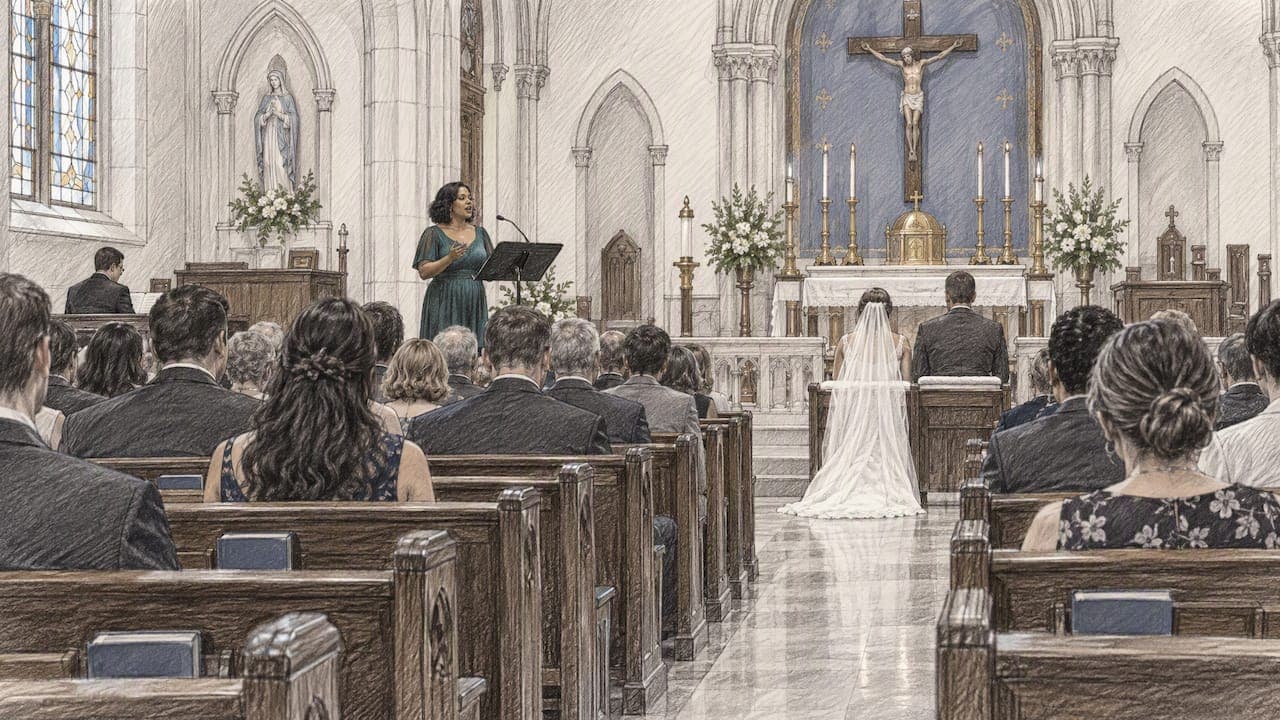
A Catholic wedding Mass has a fixed shape, and the music follows it: prelude, entrance procession, Gloria, responsorial psalm, Gospel acclamation, offertory, Holy, Holy, Holy, Communion, and recessional. You choose some of these pieces. The Church prescribes others, and your parish music director has the last word on all of them.
This guide walks through the music in the order it happens, says which moments are yours to personalize, and explains how to work with a parish when you bring in outside musicians.
TL;DR
- The sequence is prelude, processional(s), entrance song, Gloria, psalm, Gospel acclamation, offertory, Mass parts, Communion, recessional. Not every slot is open to personal choice.
- Since December 30, 2016, the Gloria is prescribed at all U.S. wedding Masses, even on weekdays in Advent and Lent.
- Your parish music director approves everything, including music from musicians you hire. Meet them about 6 to 8 weeks out, or earlier if the parish asks.
- Live music is expected. Recorded tracks are generally not allowed during the Mass.
- Instrumental classics (Pachelbel, Bach, Handel) work well for the processional, prelude and recessional. Pop songs rarely pass for the sung parts.
Table of Contents
- The order at a glance
- Why the order is not a free-for-all
- Step by step through the music
- What your parish will and will not approve
- Who to hire, what it costs, and when to ask
- Our perspective
- Live music for your Catholic ceremony
- A sample program to adapt
- FAQ
- Sources
The order at a glance
Parishes differ in details, but a typical outline of a Catholic wedding Mass runs from the entrance procession and greeting through the Liturgy of the Word, the marriage rite, the Liturgy of the Eucharist and the dismissal. The table below maps the music onto that frame.
| Moment | Music | Who decides |
|---|---|---|
| Prelude (about 15 to 30 minutes before) | Instrumental, organ, piano, strings, or soloist | You, with parish approval |
| Seating of family | Short instrumental | You |
| Bridal party processional | Instrumental | You |
| Bride's entrance or entrance song | Processional hymn or instrumental | You, within parish norms |
| Gloria | Sung by the assembly with cantor | Prescribed; setting chosen with the music director |
| Responsorial Psalm | Sung, with a response the guests can sing | You choose from approved settings |
| Gospel Acclamation | Sung | Parish setting, as in the liturgical season |
| Offertory | Instrumental, choral, or congregational hymn | You |
| Holy, Holy, Holy; Memorial Acclamation; Amen | Sung | Mass setting from the parish |
| Lamb of God | Sung | Mass setting from the parish |
| Communion | Hymn, psalm or solo piece | You, with approval |
| Recessional | Joyful instrumental or hymn | You |
A wedding celebrated without Mass drops the Eucharistic elements. One parish guide notes plainly that a wedding outside Mass has no Communion and so no Communion song, which shortens the list.
Why the order is not a free-for-all
The guiding idea in Catholic liturgy is progressive solemnity: the more central a piece is to the rite, the more it should be sung. In practice, dialogues and acclamations such as the Gospel Acclamation, the Sanctus and the Amen come before hymns, and hymns come before solos, according to the Cathedral of the Risen Christ's guidance. That is why a beautiful vocal solo cannot replace the congregation's singing.
The same guidance describes musicians at a wedding Mass as ministers who serve the assembly's prayer, not performers. The cantor leads, and the guests join in. If you picture a concert with a ceremony inside it, adjust the picture. The ceremony is the point, and the music carries it.
One diocesan document puts the principle simply: because the wedding is a celebration of a sacrament, the music must reflect that sacramental character.
Step by step through the music

Prelude and seating
The prelude sets the tone while guests arrive. It is the most flexible part of the day, and it is usually instrumental. Some parishes offer a list of acceptable pieces. Canon in D, which is also commonly used as a prelude or offertory piece, appears on St. Bede's planning list in Williamsburg, Virginia, as one example.
A good prelude runs 8 to 12 pieces of varied tempo, enough to cover guests arriving without repeating. We lay out a practical prelude song checklist for couples if you want a starting list. Just run any non-sacred titles past the parish first.
Processional
Many parishes expect a processional for the bridesmaids and another for the bride, though some use a single entrance. St. Francis of Assisi Parish describes the usual set as two processionals, one for the bridesmaids and one for the bride, followed by the psalm, offertory and other pieces.
Commonly accepted instrumental choices include Pachelbel's Canon in D, Bach's Jesu, Joy of Man's Desiring and Handel's Air from Water Music, according to one parish's wedding music guide. The same guide notes that only one processional song is typically chosen for the entrance. The final choice must fit the dignity of the rite.
Two cautions. First, the famous bridal march from Wagner's Lohengrin is a frequent request, and many parishes have their own policy on it, so ask before you commit. Second, if the priest and servers enter first, as in the Mass's usual first form of entrance, the entrance song may be the hymn the whole assembly sings while the wedding party takes its place. Ask the music director which form your parish uses.
For the mechanics of who walks to what, see our guide to choosing processional music and the processional list by role. Those pieces cover both religious and general weddings, so filter the options through your parish's rules.

Gloria
This is the change many couples miss. The ritual book now prescribes the Gloria at wedding Masses, even on weekdays of Advent and Lent, which effectively raises the nuptial Mass to feast-day level. The Church life article dates the requirement to the 2016 U.S. implementation of the Order of Celebrating Matrimony. If an older website or a friend's memory says otherwise, trust the current rite. The Gloria is sung, so plan for a cantor, choir or strong lead voice and a setting your guests can follow.
Readings, psalm and Gospel acclamation
The responsorial psalm is sung, and the guests answer with a short refrain. Print the refrain in your program so everyone can join. A parish outline from St. Anthony of Padua specifically asks couples to print the people's response so they can take part.
The Gospel Acclamation is also sung. If you are choosing scripture for the readings, a collection of Bible verses for wedding ceremonies can help you see which passages carry the right weight before you meet the priest. The readings themselves come from the approved lectionary choices for marriage, and your priest will guide you.
Offertory
While the gifts are brought forward, you can use instrumental music, a choral piece or a hymn. This is a good place for a piece that matters to the two of you. Some parish guides suggest keeping offertory and Communion music to a small number of carefully chosen pieces. One diocesan-minded guide says two to three songs is enough for presenting the gifts, offertory and Communion combined, but treat that as a parish-by-parish matter and ask yours.
Holy, Holy, Holy, Memorial Acclamation, Amen, Lamb of God
These Mass parts must be sung when musicians are present. The Our Father is normally recited, so everyone can pray it together, not sung as a performance. The nuptial blessing follows, and nobody sings over it.
Because these parts come from a Mass setting, your parish usually supplies the setting. You pick what is open to you and leave the rest to the music director.
Communion
Guests who are Catholic and properly disposed receive. Everyone else often prays quietly or comes forward for a blessing, depending on parish practice. The Communion song should be one the assembly can sing or one that deepens prayer. A solo is possible, but a solo on its own should not take over the whole assembly's role.
Recessional
The recessional reflects the joy of the conclusion. Mendelssohn's Wedding March and Handel and Bach favorites are traditional, and a brass-flavored or lively string piece works well. Some parishes allow a congregational hymn of praise. A strong recessional also gives the photographers and your guests a cue that the celebration is moving outdoors or to the reception.
What your parish will and will not approve
The single most useful fact is that you do not choose alone. At one cathedral, couples consult first with the pastor and then with the parish organist, and only music on the diocesan list or otherwise approved may be used. Other parishes will set their own approved list, and the music director generally holds the final veto.
Three patterns come up again and again:
- Pop songs that mention God. A song that references God in passing is not the same as a text drawn from the liturgy. Music directors regularly decline these for the sung parts. They are more likely to accept an instrumental arrangement for the prelude or processional, so ask.
- Recorded music. Parishes generally require live musicians during the Mass, and backing tracks are typically prohibited. Plan a live cantor and live instrumentalists.
- Soloists replacing the assembly. A solo can enrich Communion or the offertory. It cannot take the place of the guests' sung responses.
The approved-list approach explains why a playlist built on a streaming app, like some of the Catholic wedding playlists that rank on search, is a starting point for conversation, not a final program. Take it to your music director with the question, "Which of these fit our parish?"
Who to hire, what it costs, and when to ask
Most parishes have an organist and a cantor on staff or on call. At one Washington, D.C. church, music fees start at $550 and up, with a cantor and organist required, and the church asks couples to arrange music about three months ahead. That figure is one parish's, so confirm your own. At a university chapel, the suggested donation for the space does not cover the cost of musicians, which are arranged through the chapel's music director.
A timeline that works:
- Three to four months out: Ask the parish for its wedding music policy, approved list and fee schedule. Ask whether outside musicians are allowed.
- Two to three months out: Book your preferred instrumentalists. Share the parish's rules with them.
- Six to eight weeks out: Meet the music director with your draft program. Diocesan music ministries commonly recommend this window, according to the cathedral guidance.
- Two to three weeks out: Send final selections and sheet music or recordings to every musician. Print the program, including psalm refrain and any hymn texts.
- Rehearsal: Walk the processional with the musicians cued, not just the wedding party.
If you would like help avoiding the usual traps, our notes on wedding music planning mistakes cover timing, cues and communication with the venue.
Our perspective
We play a lot of ceremonies, and the Catholic ones are the ones where preparation pays off most. The couples who enjoy the day are not the ones with the longest song list. They are the ones who met the music director early, understood which slots are open, and handed their musicians a clean, approved program.
Our advice is to treat the parish as a collaborator. Ask for the approved list first, then bring us the pieces you love and we will fit them into the slots that allow them: prelude, processional, offertory, recessional, and sometimes Communion. We would rather arrange a Bach or Handel piece beautifully for the room than push a song that the parish will strike a week before the wedding.
We also hold a strong view about live music. A living ensemble can follow the pace of a procession, wait for a bride who is a minute late, and breathe with the room. That is the reason we are glad that Catholic liturgy asks for it. If you are weighing options, our piece on why live music beats a playlist explains what that looks like in practice.
— Alex
Live music for your Catholic ceremony
If your parish allows outside instrumentalists, we can supply the prelude, processional, offertory, and recessional music, arranged for a trio, string quartet or solo piano, and coordinated with your music director's list. Our wedding ceremony music service starts from $3,000 per event. If the same musicians will play the cocktail hour afterward, see our cocktail hour music page, and for the party that follows, reception music. We serve Philadelphia, New York and beyond.
A sample program to adapt
This is a plan to take to your music director, not a prescription. Your parish may reject or swap any item.
- Prelude: a mix of instrumental classics, such as Bach and Handel arrangements.
- Bridal party processional: an instrumental piece, such as Handel's or Pachelbel's work.
- Bride's entrance: a different instrumental or the entrance hymn, depending on the form your parish uses.
- Gloria: parish setting, led by cantor.
- Psalm and Gospel acclamation: approved settings, with the refrain printed.
- Offertory: instrumental, such as Jesu, Joy of Man's Desiring.
- Mass parts: the parish's setting.
- Communion: a hymn the assembly knows, or an approved solo.
- Recessional: a bright instrumental.
If you also plan a non-Catholic or nonreligious celebration, such as a separate civil ceremony, our guide to nonreligious wedding music cues covers every moment from the walk to the exit.
FAQ
Can we use secular songs at a Catholic wedding Mass?
Usually not for the sung parts of the liturgy. Parish music directors typically filter out pop songs that only mention God in passing, and they have the power to refuse songs they consider secular. Instrumental versions are often accepted for the prelude and processional, but ask your parish.
How many songs do we choose?
Not as many as you might think. Many pieces, like the Gloria, psalm and Mass parts, are set by the rite and the parish. You usually choose the prelude, the processional or processionals, the offertory, the Communion music and the recessional.
Can we hire our own musicians?
Often yes, but only with parish approval. You must consult the parish music director on every selection even when you hire professional outside musicians. Ask early about fees, rehearsal rules, and whether the organist or cantor is still required.
Can we play recorded music during the ceremony?
Generally no. Catholic liturgy expects live music, and parishes typically prohibit backing tracks or pre-recorded accompaniment during the Mass. Recorded music is more likely to be fine at the reception.
Sources
- What's New in the Marriage Rite? (Church Life Journal, University of Notre Dame)
- Cathedral of the Risen Christ: wedding music guidance
- Cathedral of the Risen Christ: Online Wedding Packet
- Wedding Music Parts and Details
- Diocesan Guidelines Concerning Music for the Celebration of Marriage
- A typical outline for a Catholic Wedding Mass (St. Anthony of Padua)
- Planning your Ceremony (Saint Bede Catholic Church)
- Wedding Music Suggestions (St. Francis of Assisi Parish)
- Marriage (Saint Peter's, Washington, D.C.)
- Chapel of the Holy Spirit at Duquesne University