A wedding ceremony music timeline is the curated sequence and timing of every musical moment from the first guests arriving to the final recessional chord. Get it right, and music becomes invisible architecture that carries guests through joy, tears, and celebration without a single awkward pause. Get it wrong, and you get silence during the processional or a jarring genre shift mid-ceremony. This guide covers every segment, practical planning steps, and the coordination details that separate a polished ceremony from a stressful one.
What is a wedding ceremony music timeline?
A wedding ceremony music timeline is the formal term professionals use for what couples often call a wedding music schedule or ceremony music flow plan. It maps every musical cue to a specific moment in the ceremony, assigns approximate durations, and identifies who triggers each transition. According to TheWeddingPlanner.ai, a well-planned music timeline mirrors the guest journey, smoothing flow and maintaining engagement from arrival through exit.
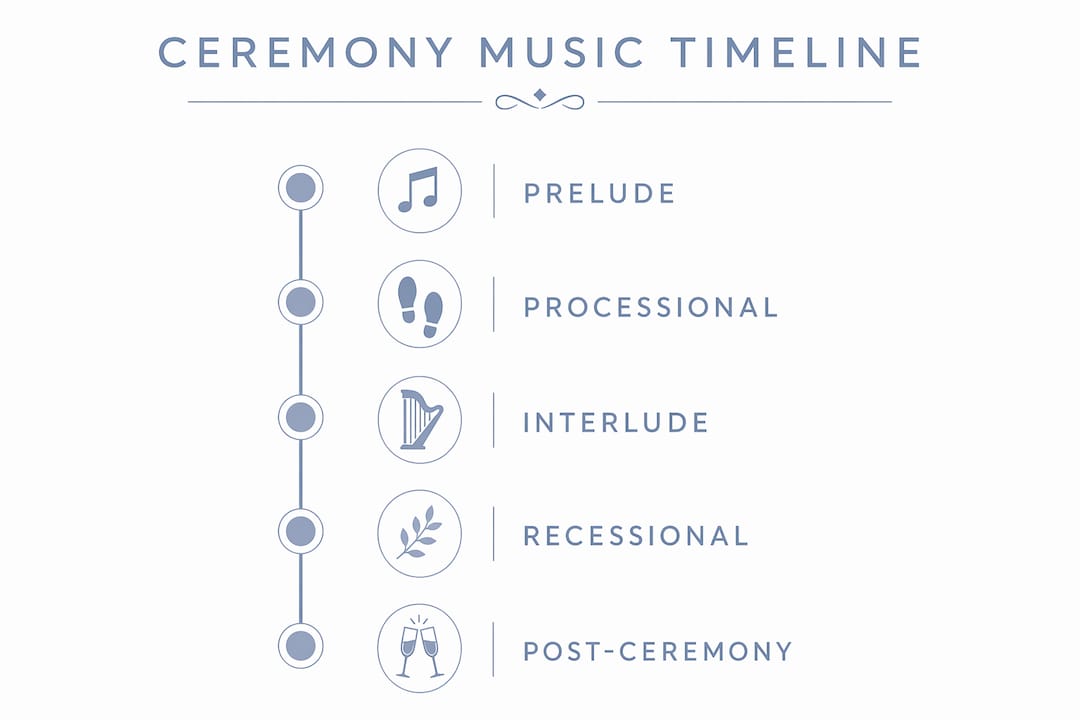
The timeline typically covers five segments: prelude, processional, interlude, recessional, and post-ceremony music. Each segment serves a distinct emotional purpose. The prelude sets the atmosphere before anything official begins. The processional carries the wedding party and couple down the aisle. Interludes fill moments like a unity candle ceremony or ring exchange. The recessional releases the energy of the moment. Post-ceremony music holds guests in place while the wedding party takes photos.
Understanding this structure before you pick a single song makes every other decision easier. You are not just choosing music you love. You are choosing music that does a specific job at a specific time.
Key components and timing of a typical ceremony
The prelude is where most couples underestimate the work involved. Prelude music typically runs 20 to 30 minutes, covering roughly 8 to 12 songs that average three minutes each. That range gives your musician or DJ room to stretch or compress based on how quickly guests are seated. A playlist of 10 to 12 songs provides the flexibility needed to handle a late-arriving family member without dead air.
Here is how the full ceremony music schedule breaks down by segment:
| Segment | Typical Duration | Song Count |
|---|---|---|
| Prelude | 20 to 30 minutes | 8 to 12 songs |
| Processional (wedding party) | 3 to 5 minutes | 1 to 2 songs |
| Processional (couple) | 2 to 4 minutes | 1 song |
| Interlude (unity/signing) | 3 to 5 minutes | 1 to 2 songs |
| Recessional | 2 to 3 minutes | 1 song |
| Post-ceremony | 10 to 15 minutes | 3 to 5 songs |
Total ceremony music typically runs 20 to 30 minutes across the processional, interludes, and recessional, with the prelude sitting outside that count as its own standalone block. A full wedding requires roughly 5 to 7 distinct songs for the ceremony alone, not counting the prelude playlist.
Pro Tip: Build your prelude playlist with one or two extra songs beyond your minimum estimate. Ceremonies rarely start exactly on time, and having buffer songs prevents your musician from looping tracks or sitting in silence.
The post-ceremony segment is the one couples most often forget to plan. Guests mill around, hug family, and wait for direction. Five to fifteen minutes of thoughtful music here prevents the energy from deflating before the reception even starts.
How to create your ceremony music timeline step by step
Building a personalized wedding ceremony music timeline takes about two focused planning sessions. The process is sequential, and skipping steps creates gaps you will only notice on the day itself.
-
Set your ceremony start time and guest arrival window. Most guests arrive 15 to 20 minutes early. Your prelude music starts the moment the first guest walks in, not when the ceremony officially begins.
-
Calculate your prelude start time. If your ceremony begins at 4:00 PM and guests arrive 20 minutes early, prelude music starts at 3:40 PM. Build a playlist that covers 25 to 30 minutes to account for early arrivals.
-
Map the processional sequence. Decide the order: parents and grandparents, wedding party, then the couple. Each group needs a distinct musical cue or a clear moment within a single song. Communicate this order in writing to your musician or DJ.
-
Identify interlude moments. Does your ceremony include a unity candle, ring warming, or signing of the marriage certificate? Each of these needs 2 to 5 minutes of music. Choose songs that feel intimate rather than dramatic.
-
Select your recessional song. This is the emotional release of the ceremony. It should be upbeat, celebratory, and loud enough to signal that it is time to cheer. Plan for 2 to 3 minutes.
-
Plan post-ceremony music. Choose 3 to 5 songs that maintain the celebratory mood while guests transition to the cocktail hour or photo location.
-
Write a cue sheet and share it. Your musician, DJ, officiant, and wedding coordinator all need a copy. The cue sheet lists each segment, the song title, the artist, the duration, and who signals the start.
Pro Tip: Ask your officiant to give a physical signal, like a nod or a hand raise, rather than relying on verbal cues. Live musicians watch for visual signals, and ambient noise during a ceremony can make spoken cues unreliable.
Coordinating with your performers during a rehearsal is not optional. Rehearsal coordination with musicians is critical to avoid awkward pauses and confirm that timing cues, volume levels, and song selections are all aligned before the ceremony day.
What are the best practices for managing music transitions?
Transitions are where ceremony music either holds together or falls apart. The most common failure point is the gap between the last prelude song and the first processional note. The final prelude song should be quiet and intimate, designed to feel like a deliberate landing rather than an abrupt stop. This prevents the silence that makes guests look around in confusion.
Key practices for managing transitions effectively:
- Sound check at least one hour before the ceremony. Live musicians need time to test levels in the actual space, not just during setup. Acoustics in a church differ from a garden, and a sound check that happens 15 minutes before guests arrive is not a real sound check.
- Assign one person as the music coordinator. This is usually the wedding coordinator or a trusted family member. Their job is to relay timing signals between the officiant and the musicians.
- Give live musicians a flexibility window. Unlike a recorded playlist, live performers can extend or shorten a song based on real-time cues. This is one of the core reasons live music outperforms playlists for ceremony timing.
- Rehearse the processional walk. The speed at which the wedding party walks determines whether a song ends too early or runs long. Walk the aisle during rehearsal with the actual music playing.
- Prepare a backup plan for technical failures. If you are using a DJ or recorded music, have a secondary device loaded with the same playlist. Equipment failures happen, and a two-minute silence during a processional is memorable for the wrong reasons.
Avoiding common music planning mistakes during the coordination phase saves couples from the most stressful moments of the wedding day.
How do you select music genres and moods for each segment?
Matching music genre and tempo to each ceremony stage is what creates emotional pacing rather than just background noise. The right tempo at the wrong moment breaks the spell entirely. A 140 BPM pop track during a unity candle ceremony will feel jarring regardless of how much the couple loves the song.
Here is a practical breakdown by segment:
| Segment | Recommended Genre | Tempo and Mood |
|---|---|---|
| Prelude | Soft instrumental, ambient, jazz | Relaxed, 60 to 80 BPM, conversational volume |
| Processional (wedding party) | Classical, acoustic pop, cinematic | Moderate, 70 to 90 BPM, building emotion |
| Processional (couple) | Iconic ballad, orchestral, acoustic | Slow, 60 to 75 BPM, full emotional weight |
| Interlude | Acoustic, chamber music, soft jazz | Intimate, understated, 50 to 70 BPM |
| Recessional | Upbeat pop, jazz, soul, orchestral | Celebratory, 100 to 130 BPM, high energy |
The prelude is your first impression. Soft instrumental music, ambient piano, or a jazz trio playing at conversational volume sets a sophisticated tone without demanding attention. Guests can talk, find their seats, and settle in. The prelude is not a performance. It is a welcome.
The processional for the couple carries the highest emotional weight of the entire ceremony. Slow tempos around 60 to 75 BPM give the moment space to breathe and allow guests to absorb what they are witnessing. Iconic choices like Pachelbel's Canon in D or a stripped-down acoustic version of a meaningful song both work because they are recognizable and emotionally loaded.
The recessional is the one moment where volume and energy should spike. This is the musical equivalent of a standing ovation. Upbeat jazz, soul, or a celebratory orchestral piece signals to every guest that it is time to cheer, clap, and feel the full joy of the moment. Do not underestimate how much the right recessional song shapes the memory of the entire ceremony.
Pro Tip: When selecting prelude songs, think in terms of a curated playlist rather than individual favorites. Choose songs that share a tonal quality, tempo range, and instrumentation so the prelude feels like a cohesive listening experience rather than a shuffle of unrelated tracks.
Key takeaways
A structured wedding ceremony music timeline, built around five distinct segments with defined durations and clear transition cues, is the single most effective way to control the emotional pacing of your ceremony.
| Point | Details |
|---|---|
| Start prelude early | Begin prelude music 20 to 30 minutes before the ceremony to cover early guest arrivals. |
| Plan 5 to 7 ceremony songs | Cover processional, interlude, and recessional with distinct songs matched to each moment. |
| Use a written cue sheet | Share timing and song details with your officiant, musicians, and coordinator before the day. |
| Nail the final prelude transition | Choose a quiet, intimate last prelude song to create a smooth landing into the processional. |
| Rehearse with your performers | Sound checks and walkthrough rehearsals prevent timing gaps and technical failures on the day. |
Why the music timeline is the most underrated part of ceremony planning
Most couples spend months choosing their wedding dress and about 45 minutes choosing ceremony music. I have worked enough weddings to know that this imbalance creates the most avoidable problems of the day. The processional song that nobody practiced walking to. The silence after the last prelude track because nobody told the musician when to start. The recessional that faded out before the couple reached the end of the aisle.
What I have learned is that the music timeline is not a checklist. It is a script. Every cue is a stage direction, and the performers are actors who need to know their lines before opening night. The couples who treat it that way have ceremonies that feel effortless. Guests tell them the music was perfect, which really means the music was invisible. It did its job without calling attention to itself.
The other thing I push back on is the idea that personal taste should drive every decision. Your favorite song might be a 120 BPM dance track that you love deeply, but if it does not match the pace of a processional walk, it will feel off. The best ceremony music choices balance what you love with what the moment needs. Those two things can coexist, but only if you plan with both in mind.
— Alex
Plan your ceremony music with Alexlevinmusic
Planning a wedding ceremony music timeline is far less stressful when you have experienced musicians who understand ceremony flow, not just song selection. Alexlevinmusic specializes in live performances for weddings across Philadelphia, New York, and beyond, with ensembles ranging from jazz trios and string quartets to solo piano and full DJ services.
Every Alexlevinmusic booking includes timeline consultation, so your prelude, processional, and recessional are coordinated before the day arrives. Explore the full range of wedding music services or browse soloists and ensembles to find the right fit for your ceremony style. Live music transforms a ceremony from a scheduled event into a memory. Alexlevinmusic makes that happen with precision and artistry.
FAQ
How long should wedding ceremony music last?
Total ceremony music typically runs 20 to 30 minutes across the processional, interludes, and recessional, not counting the prelude. Add a 20 to 30 minute prelude for guest arrival, and your full music program covers roughly 45 to 60 minutes.
How many songs do you need for a wedding ceremony?
A ceremony requires 5 to 7 songs covering the processional, any interludes, and the recessional, plus a separate prelude playlist of 8 to 12 songs for guest arrival. The exact count depends on whether you have multiple processional groups and optional ceremony moments like a unity candle.
When should prelude music start?
Prelude music should start 15 to 30 minutes before the ceremony begins, timed to when the first guests are expected to arrive. Starting early prevents any guest from walking into silence and sets the tone from the first moment they enter the venue.
What is the best song for a wedding recessional?
The recessional calls for an upbeat, celebratory song with a tempo around 100 to 130 BPM that signals joy and release. Classic choices include "Signed, Sealed, Delivered" by Stevie Wonder, "Here Comes the Sun" by The Beatles, or a live jazz arrangement of a meaningful song that the couple loves.
Do live musicians or DJs work better for ceremony music?
Live musicians offer real-time flexibility to extend or shorten songs based on actual ceremony pacing, which recorded playlists cannot match. For couples who want precise timing control and the ability to adapt on the fly, live performers are the stronger choice for ceremony music coordination.