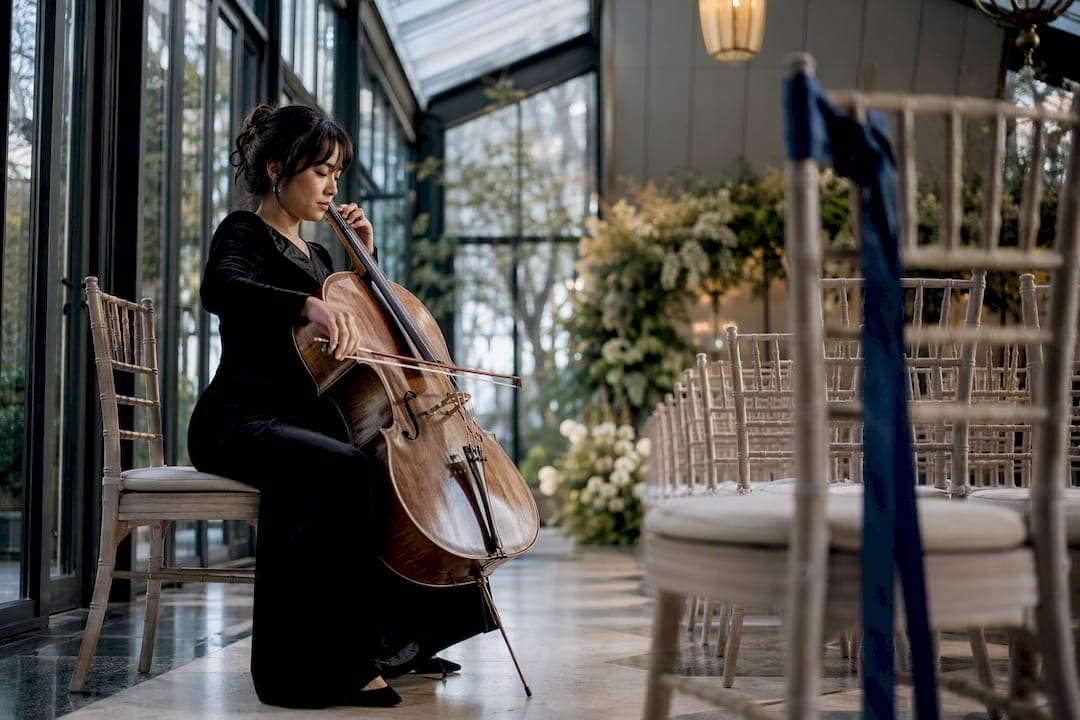
Ceremony prelude songs are the background music playing as guests arrive and take their seats, usually running 20 to 30 minutes before the processional begins. The immediate move: build a playlist with roughly 8 to 12 songs that leans instrumental or soft acoustic, then brief whoever is playing it on mood, must plays, and how to close it out. Skip that step and you risk either dead silence or music that fights with the room's energy right before the biggest walk of your life.
TL;DR:
- Most wedding preludes last 20 to 30 minutes, with 8 to 12 songs, and should include a buffer for delays to prevent awkward silence.
- Instrumental, classical, or modern arrangements typically suit the mood, with specific pieces like Debussy's Clair de Lune or Pachelbel's Canon in D being popular choices.
- Providing clear instructions to musicians or DJs, including mood, must-plays, do-not-plays, and cues, helps ensure the playlist or performance matches your vision.
- Live musicians offer adaptability to timing issues and room energy, making them a reliable option over fixed playlists, especially when delays occur.
- Sacred music requires careful vetting with clergy or venue staff, and hybrid setups can combine live performance with recorded tracks for flexibility and control.
Table of Contents
- How Long Should Ceremony Prelude Music Run?
- How to Choose Prelude Music (and Brief Your Musician or DJ)
- Classic and Classical Prelude Songs That Never Miss
- Modern Songs Arranged for the Prelude
- Acoustic and Folk Picks for an Intimate Ceremony
- Country Prelude Songs for a Relaxed, Rustic Feel
- Religious and Sacred Prelude Music
- Live Musicians vs. Recorded Playlists: What Actually Works
- The Week-Of Checklist for Your Musician or DJ
- A Musician's Take on What Makes a Prelude Actually Work
- Bringing In Live Music for Your Ceremony Prelude
- Where to Listen Before You Decide
- Sources
How Long Should Ceremony Prelude Music Run?
Most preludes run 20 to 30 minutes, timed from when the first guests are seated to the moment the processional starts. That window is standard enough that most wedding music guides build their song counts around a typical prelude window, and for good reason: it covers typical arrival straggle without dragging on so long that guests start checking their phones.
For that stretch, plan on roughly 8 to 12 songs. Many couples prepare about 10 to 12 to give performers flexibility because it gives a DJ or live musician room to stretch a song or drop one if seating runs faster than expected.
A few practical notes on making that math work:
- Build in a 10 to 15 minute buffer of extra, unassigned music. Guests are late, photographers run behind, and a buffer keeps the room from going silent while you wait.
- Live musicians can stretch or loop a piece almost invisibly. Recorded playlists cannot, so pad the track list rather than relying on one song to cover a gap.
- Set fades generously between recorded tracks. A hard cut between songs is one of the fastest ways to make a curated playlist feel like a waiting room.
- Save something quiet and intimate for the very last song. That final piece is the bridge into silence right before the doors open, and an abrupt or upbeat closer breaks the mood you just spent 25 minutes building.
The difference between a live set and a recorded one matters here. A pianist or string quartet reads the room and adjusts on the fly. A playlist just runs in order, so the burden of pacing falls entirely on how carefully you build it.
How to Choose Prelude Music (and Brief Your Musician or DJ)
Choosing prelude songs comes down to five variables: mood, instrumentation, lyrical content, who's in the audience, and how the venue sounds. A string quartet in a stone cathedral behaves nothing like a solo guitarist on a beach, and a mostly older, formal guest list calls for different choices than a room full of your college friends.
Lyrics deserve more thought than most couples give them. Words that are too on the nose, or that reference themes that don't belong at a wedding, pull focus fast. That's part of why instrumental arrangements of modern songs are recommended so often: they give guests the comfort of a familiar melody without any risk of a lyric landing wrong in the room.
Once you've picked a direction, the real work is translating that into something a performer can actually use. Here's the order that works:
- Write a one-line mood statement. "Warm and understated, leaning classical with a couple of modern touches" tells a musician far more than a strict track order does.
- Give 5 to 8 sample songs, not a rigid script. Professionals generally prefer a genre or vibe brief over a locked playlist because it lets them read the room and adjust pacing in real time rather than forcing a song that isn't landing.
- List must plays and do not plays. If Grandpa's favorite hymn matters, say so. If there's a song you associate with an ex, say that too.
- Note pacing preferences. Some couples want energy building toward the processional; others want it to stay flat and calm throughout.
- Confirm arrival and setup logistics. Ask when your musician or DJ arrives, what amplification they need, and what their backup plan is if a string breaks or a speaker fails.
For DJs specifically, add a few more details to the brief: how much flexibility they have to reorder songs on the fly, your preferred crossfade length, target volume for a room full of mingling guests, and the exact cue for the last track before the processional song starts.
Pro Tip: Hand your musician a Spotify or Apple Music link with your sample songs starred, plus one sentence of context per song ("this was our first dance at another wedding," "keep this one low key"). It takes five minutes and saves a dozen back-and-forth emails.
Classic and Classical Prelude Songs That Never Miss
Classical prelude music earns its reputation because it's built to sit in the background without demanding attention, which is exactly the job a prelude needs to do.
- Clair de Lune (Debussy) — Best on solo piano; delicate enough that it can get lost with too many instruments layered on top.
- Canon in D (Pachelbel) — Works beautifully as a string quartet piece and is one of the most requested classical prelude selections for a reason: it builds gently without ever feeling dramatic.
- Adagio for Strings (Samuel Barber) — A string ensemble piece with real emotional weight; save it for later in the prelude rather than opening with it.
- Air on the G String (J.S. Bach) — Elegant on solo violin or a small chamber group, and flexible enough for almost any formal venue.
- Ave Maria (Schubert or Gounod versions) — Gorgeous on solo piano or with a vocalist, and a natural fit for religious ceremonies.
Classical repertoire tends to work best in formal venues, with intergenerational guest lists, and in most religious settings where a more contemporary pick might feel out of place.
Modern Songs Arranged for the Prelude
Contemporary hits translated into instrumental arrangements have become a prelude staple, and it's not just about sounding current.
- A Thousand Years (Christina Perri) — Almost always played instrumentally at this point in a ceremony; the melody alone carries plenty of emotion.
- Thinking Out Loud (Ed Sheeran) — A piano or string arrangement keeps the familiarity without pulling guests' attention toward the lyrics.
- Experience (Ludovico Einaudi) — Technically modern but plays like a classical piece; a favorite for couples who want something contemporary without leaning pop.
The logic here is simple: guests recognize the tune, which creates warmth, but nobody's parsing lyrics about a specific relationship milestone while they're finding their seat. If you're blending these into an otherwise classical set, place them in the middle of the playlist rather than at the open or close, where the tonal shift is less noticeable.
Acoustic and Folk Picks for an Intimate Ceremony
Acoustic arrangements suit ceremonies that are smaller, more relaxed, or happening somewhere the formality of a string quartet would feel out of place.
- Stripped-down guitar or ukulele covers of folk-leaning artists like Iron & Wine, The Paper Kites, or Bon Iver read warm rather than somber.
- A cello and guitar duo can cover a surprising amount of ground, from delicate to slightly upbeat, without ever overpowering conversation.
- Acoustic works particularly well outdoors, in late afternoon light, or with a guest list small enough that intimacy is the whole point.
Order matters more than people think. Start slightly sparser and let the arrangement fill in as the prelude goes on, so the last few songs before the processional feel fuller rather than the whole set sitting at one flat energy level.
Country Prelude Songs for a Relaxed, Rustic Feel
Country ballads bring warmth without tipping into anything too upbeat for guests still finding their seats.
- Stick to ballads over anything with a strong beat. Slower songs from artists like Lady A or a mellow acoustic cover of a Chris Stapleton track hold the room without competing with conversation.
- Instrumental guitar versions work well if you want the country feel without lyrics steering the mood; vocal versions can work too, especially with a singer who can hold back the energy.
- Barns, ranches, and outdoor summer ceremonies are the natural home for this style. It reads oddly in a downtown hotel ballroom.
Religious and Sacred Prelude Music
Sacred prelude selections carry more rules than secular ones, and skipping the vetting step is the single most common mistake couples make.
- Ave Maria, Jesu, Joy of Man's Desiring, and Panis Angelicus are broadly accepted across most religious ceremony traditions, including Catholic Mass weddings.
- Confirm every selection with clergy or venue staff before you finalize anything. Some churches restrict secular music entirely during Mass, and a piece that's fine at one parish gets vetoed at another.
- If you want to mix sacred and secular, front load the ceremony with sacred pieces and save anything more contemporary for the reception, where there's no liturgical framework to navigate.
Couples following a Catholic wedding music guide should treat the officiant's approval as the final word, not a formality; music approved for the prelude may still differ from what's allowed once Mass formally begins.
Live Musicians vs. Recorded Playlists: What Actually Works
Live music reads a room in a way a playlist never will. A pianist can sense that guests are still filing in and stretch a piece by two minutes, or notice the energy dipping and shift into something a touch brighter. That flexibility is the whole argument for hiring live musicians for a wedding ceremony instead of running a playlist that can't adapt to what's actually happening in the room.
Recorded playlists have their own advantages. They cost less, they let you use the exact recording of a song you love, and they guarantee the version you picked is the version guests hear. The tradeoff is control you don't actually have in the moment. If the ceremony starts ten minutes late, a fixed playlist either runs out or loops awkwardly.
A hybrid setup splits the difference well: a solo pianist covers the bulk of the prelude live, with a queued backup playlist ready in case of a late start or a technical issue. It costs less than a full ensemble while still giving you a human who can adjust pacing in real time.
Whichever route you choose, hand the performer or DJ a short handout before the day:
- One-page mood brief and 5 to 8 sample songs
- Must-play and do-not-play list
- Exact cue for the final song before the processional
- Arrival time, setup needs, and a named point of contact at the venue
Pro Tip: If you're going hybrid, tell your pianist exactly when the backup playlist kicks in and who controls the volume. Nothing kills the mood faster than a laptop speaker fighting a live piano for the same three minutes.
The Week-Of Checklist for Your Musician or DJ
Send this over five to seven days before the wedding, not the morning of:
- Final playlist, 10 to 12 songs, plus 10 to 15 minutes of buffer music for delays.
- One-line mood statement so the performer understands the tone you're going for.
- Must-play and do-not-play list, finalized, no more edits after this point.
- Cue for the final track, so the transition into the processional doesn't catch anyone off guard.
- Volume guidance for the specific room or outdoor space you're using.
- Arrival time and sound-check window, plus the name and phone number of your on-site contact at the venue.
Get this list confirmed early and the actual day requires almost no thought. Everyone already knows the plan.
A Musician's Take on What Makes a Prelude Actually Work
Most of what makes a prelude land has nothing to do with song choice and everything to do with reading the room in real time. A packed guest list filing in fast needs a different pace than a small gathering trickling in over 20 minutes, and a good musician adjusts for that without anyone noticing it happened.
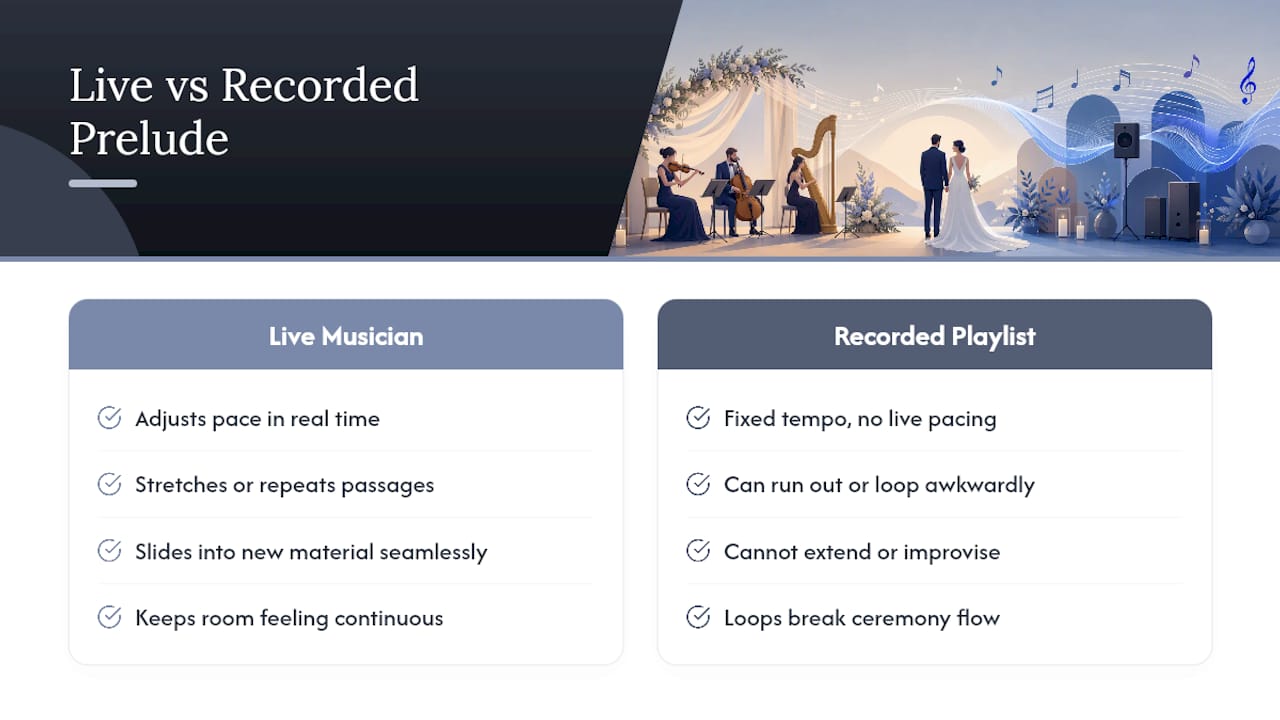
The moment this matters most is exactly when plans fall apart: the ceremony that starts 15 minutes late because a groomsman locked his keys in the car. A recorded playlist just runs out and loops awkwardly back to song one. A live musician stretches, repeats a passage, or slides into something new, and the room never feels the delay.
That's the real case for live music at a moment this important. A wedding day never runs exactly on time. Book accordingly.
— Alex
Bringing In Live Music for Your Ceremony Prelude
If you'd rather not manage fade timing and buffer tracks yourself, live wedding ensembles solve the prelude problem outright: a performer who adjusts pacing as guests arrive, no playlist gaps, no awkward loop if things run late. Music services for ceremonies often include solo piano for intimate or formal settings, jazz trios for added warmth and texture, string quartets for a classical ambiance, and DJ or hybrid setups that combine live instruments with backed-up playlists for flexibility.
A solo pianist tends to make sense for smaller or budget-conscious ceremonies; a string quartet or personalized jazz ensemble fits larger, more formal venues where the room can support a fuller sound. Bookings typically begin with a conversation about mood, key songs, and the ceremony timeline to ensure smooth planning and execution on the day itself. Check availability and get a quote through the Alexlevinmusic services page to start planning your prelude.
Where to Listen Before You Decide
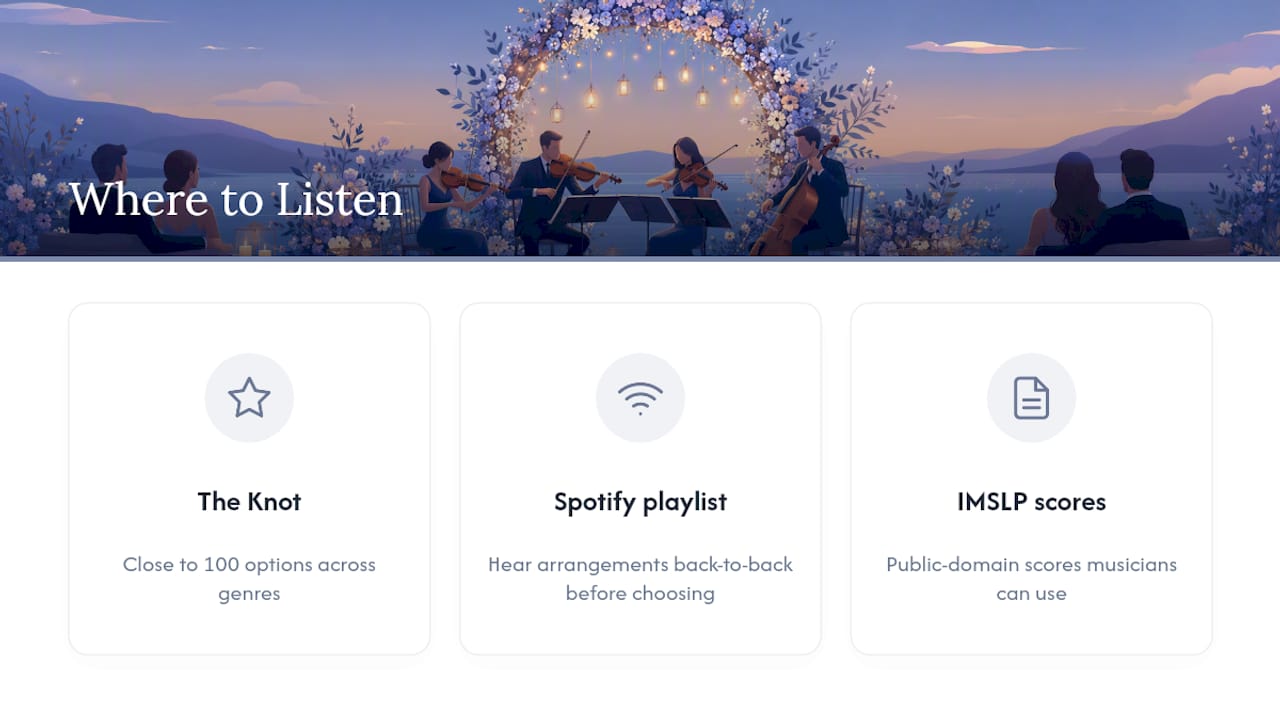
For a broader sample beyond this list, The Knot's curated prelude song roundup covers close to a hundred options across genres, and their Spotify prelude playlist lets you hear arrangements back to back before committing. If you're hiring a string quartet or pianist and want arrangement references beyond a pop recording, IMSLP's public domain score library is worth sending along so your musicians can work from a proper score rather than guessing at an arrangement.
Sources
- Wedding Prelude Songs: Best Music Before the Ceremony
- 93 Wedding Prelude Songs to Set the Stage for Your Ceremony
- Wedding music playlist checklist (Paperless Post)
- 70 Wedding Prelude Songs to Play While Guests Arrive