If you want a fast answer: pair "The Way You Look Tonight" (Sinatra) or a solo piano version of "At Last" (Etta James) for the processional, save "Come Away With Me" (Norah Jones) for the first dance, and close on Louis Armstrong's "What A Wonderful World" for the recessional. Below is a working shortlist you can hand straight to a band or DJ.
- "The Way You Look Tonight" (processional, instrumental) — warm, unhurried, built for a slow aisle walk.
- "At Last" (bridal entrance, vocal or instrumental) — the classic entrance swell, works beautifully on solo piano.
- "Misty" (processional, slow) — moody and romantic, best with sax or piano leading.
- "Fly Me To The Moon" (recessional, medium swing) — light enough to send guests out smiling.
- "Come Away With Me" (first dance) — modern, intimate, and easy to slow-dance to.
- "L.O.V.E." (recessional, upbeat) — Nat King Cole's charm at a celebratory tempo.
- "My Funny Valentine" (first dance, ballad) — tender, low-key, and lyrically direct.
- "What A Wonderful World" (recessional) — Armstrong's version reads as pure joy walking back up the aisle.
- "Cheek to Cheek" (cocktail transition) — playful swing that bridges ceremony and reception.
- "Someone To Watch Over Me" (processional, vocal) — Ella Fitzgerald's phrasing gives it a hush that quiets a room.
Choose instrumental versions for the aisle walk if you want lyrics out of the way; save vocal versions for moments guests are seated and listening. And always walk the aisle once at the actual tempo before the big day. Jazz rhythms bend more than a string quartet's, so what sounds right through headphones can feel oddly fast or slow underfoot.
Key Takeaways
The right jazz ceremony song comes down to matching tempo and instrumentation to the moment, then rehearsing the walk before the wedding day.
| Point | Details |
|---|---|
| Match song to moment | Processionals need steady, walkable tempo; recessionals can run upbeat and celebratory. |
| Choose instrumental for entrances | Skip distracting lyrics during the aisle walk by favoring sax, piano, or string arrangements. |
| Rehearse the actual walk | Time your aisle at the venue itself since jazz tempos vary more than traditional processional music. |
| Confirm booking logistics early | Lock in setup time, rehearsal slot, and a backup plan three to nine months ahead. |
| Personalize beyond the popular picks | Tie song choices to your own story rather than relying only on top-ranked lists. |
Table of Contents
- Jazz Wedding Ceremony Songs Organized by Moment
- 50+ Jazz Wedding Songs and Versions Worth Previewing
- How to Choose the Right Song for Your Ceremony Timing
- Choosing the Right Instruments for Each Ceremony Moment
- Booking a Live Jazz Ensemble: A Practical Checklist
- Weaving Jazz Into Cultural and Religious Ceremony Traditions
- Licensing and Permissions for Using Jazz Songs at Your Ceremony
- Making Your Jazz Playlist Feel Like Your Story
- Where to Preview Recordings and Build Your Playlist
- What Actually Matters When You're Picking Ceremony Music
- Sources
Jazz Wedding Ceremony Songs Organized by Moment
Picking the right song starts with knowing which moment it's for. A processional needs a different pace and mood than a recessional, and a first dance asks for something you can actually sway to without counting steps.
Processional and aisle walk. These need a steady, walkable pulse, usually slow to medium, and often work best without words competing for attention. Strong picks: "The Way You Look Tonight" (Sinatra), "Misty" (instrumental, sax or piano), "Someone To Watch Over Me" (Fitzgerald), "My One and Only Love" (Coltrane's ballad recording is a favorite for a hush), "In A Sentimental Mood" (Ellington/Coltrane, instrumental), "Autumn Leaves" (instrumental, waltz feel), "It Had To Be You" (medium, warm), "The Nearness of You" (slow, tender), "Embraceable You" (slow, romantic), "A Foggy Day" (medium swing, upbeat energy for a shorter aisle), "But Not For Me" (medium), "I Only Have Eyes For You" (slow, dreamy), and "Dream a Little Dream of Me" (medium, a WeddingWire favorite for processional playlists).
Bridal entrance or alternate entrance. If you want a moment of anticipation before your actual entrance song, a short instrumental intro or a brief piano cue works well here. Bands often vamp on the intro bars of a standard like "At Last" for eight or sixteen counts, then land on the full melody the second you appear. That timing trick is worth requesting specifically if you want a dramatic pause.
First dance. This is where romantic jazz wedding tracks get to breathe. Classic choices include "The Way You Look Tonight," "L.O.V.E.," and "Fly Me To The Moon" at a slower tempo, while contemporary interpretations like Norah Jones's "Come Away With Me" or Diana Krall's phrasing on "The Look of Love" bring a more modern, low-lit feel. Couples who want something less expected sometimes ask their band to arrange a favorite pop song as a jazz ballad, which brings genuine warmth to a song that started out upbeat.
Recessional. This is the one moment built for energy. "What A Wonderful World," "L.O.V.E.," "Cheek to Cheek," "Sing, Sing, Sing," and "I Got Rhythm" all send guests out at a celebratory clip.
Pro Tip: Ask your band to prepare two tempo versions of your top processional pick, one slightly slower, one at standard tempo. Aisle nerves change everyone's walking pace, and having the option on hand saves a scramble.
50+ Jazz Wedding Songs and Versions Worth Previewing
Because so many jazz standards have been recorded dozens of times, the artist you choose changes the entire mood. Frank Sinatra's take on a standard tends to feel polished and confident; an early Billie Holiday recording feels raw and intimate; a Michael Bublé cover often smooths things into something radio-friendly and modern. Here's a working catalog organized by feel, with version notes where they matter.
Slow ballads, ideal for processionals or quiet moments:
- "The Way You Look Tonight" — Frank Sinatra (classic) or a contemporary big-band cover
- "Misty" — Sarah Vaughan or an instrumental sax arrangement
- "My Funny Valentine" — Chet Baker (intimate) or Ella Fitzgerald (fuller)
- "The Nearness of You" — Norah Jones (modern) or Nat King Cole (vintage)
- "Someone To Watch Over Me" — Ella Fitzgerald
- "Embraceable You" — Billie Holiday
- "In A Sentimental Mood" — John Coltrane and Duke Ellington's duet recording
- "My One and Only Love" — John Coltrane
- "I Only Have Eyes For You" — The Flamingos' doo wop jazz crossover
- "When I Fall in Love" — Nat King Cole
- "Everything Happens To Me" — Chet Baker
- "You Go To My Head" — Billie Holiday
- "Body and Soul" — Coleman Hawkins' instrumental version
- "Skylark" — a favorite for solo piano arrangements
- "Prelude to a Kiss" — Duke Ellington, instrumental
Swing and upbeat, suited to recessionals and cocktail transitions: 16. "Fly Me To The Moon" — Frank Sinatra 17. "L.O.V.E." — Nat King Cole 18. "Cheek to Cheek" — Ella Fitzgerald and Louis Armstrong's duet 19. "I Got Rhythm" — instrumental big band arrangement 20. "Sing, Sing, Sing" — Benny Goodman, high energy instrumental 21. "Let's Fall in Love" — a WeddingWire processional favorite at a livelier clip 22. "All of Me" — a swing standard with dozens of covers 23. "It Don't Mean a Thing" — Duke Ellington, upbeat 24. "Ain't Misbehavin'" — Louis Armstrong 25. "On the Sunny Side of the Street" — Louis Armstrong 26. "A Foggy Day" — medium swing 27. "Route 66" — a fun, unexpected recessional pick 28. "Zing! Went the Strings of My Heart" — playful, upbeat 29. "Mack the Knife" — Bobby Darin's swing arrangement 30. "Jeepers Creepers" — Louis Armstrong, lighthearted
Mellow background, suited to cocktail hour or a low-key ceremony atmosphere: 31. "Georgia On My Mind" — Ray Charles 32. "Autumn Leaves" — instrumental piano trio 33. "Stardust" — Nat King Cole 34. "'Round Midnight" — Thelonious Monk, instrumental 35. "Blue in Green" — Miles Davis, instrumental 36. "Someday My Prince Will Come" — instrumental jazz trio 37. "How Deep Is the Ocean" — Billie Holiday 38. "What's New" — Linda Ronstadt's jazz crossover 39. "Waltz for Debby" — Bill Evans, instrumental 40. "Someone Like You" — Diana Krall's jazz reworking
Instrumental standouts and modern picks: 41. "Come Away With Me" — Norah Jones 42. "The Look of Love" — Diana Krall 43. "At Last" — Etta James (vocal) or a solo piano arrangement 44. "What A Wonderful World" — Louis Armstrong 45. "Feeling Good" — Michael Bublé's big-band version 46. "Everything" — Michael Bublé 47. "Cry Me a River" — instrumental sax version 48. "So Nice (Summer Samba)" — a bossa-jazz alternate for outdoor ceremonies 49. "Dream a Little Dream of Me" — instrumental guitar and piano duo 50. "Since I Fell For You" — Etta James
This list draws heavily from The Knot's collection of romantic jazz standards and repeat entries across The Bash's jazz wedding roundup, which both confirm how consistently the same handful of songs show up across different curated lists. Send your top ten to your band or DJ ahead of time so they can flag anything that needs a key change or a tempo adjustment for your venue.
How to Choose the Right Song for Your Ceremony Timing
Picking a beautiful song is the easy part. Making it work logistically takes a few extra steps most couples skip until the final week, which is exactly when problems show up.
- Match tempo to your walk. A processional lasting 60 to 90 seconds at roughly 60 to 80 beats per minute suits most 20 to 30 foot aisles. Longer aisles need either a slower tempo or a short instrumental intro before your walk begins.
- Decide instrumental or vocal. If the lyrics of your chosen song say something oddly specific (breakups, heartbreak, unrelated imagery), go instrumental for the entrance and save the vocal version for later.
- Build a logistics checklist. Confirm cue points, whether the song fades out or ends cleanly, mic needs for any officiant announcements, and a scheduled rehearsal slot with your musicians.
- Interview your band or DJ carefully. Ask directly whether they'll rehearse your cues in advance. WeddingWire's processional guide specifically flags that jazz tempos vary more than traditional processional music, so practicing your walk to the actual recording (or a live run through) matters more here than with a string quartet playing Pachelbel.
Pro Tip: Time your walk with a stopwatch at the actual venue, not your living room. Carpet, an incline, or a longer aisle than you estimated can throw off your timing by ten or fifteen seconds, which is enough to make a song feel like it's dragging or cutting off too soon.
For a deeper breakdown of pacing and cue timing, Alexlevinmusic's guide on processional music selection walks through the same decision points in more detail.
Choosing the Right Instruments for Each Ceremony Moment
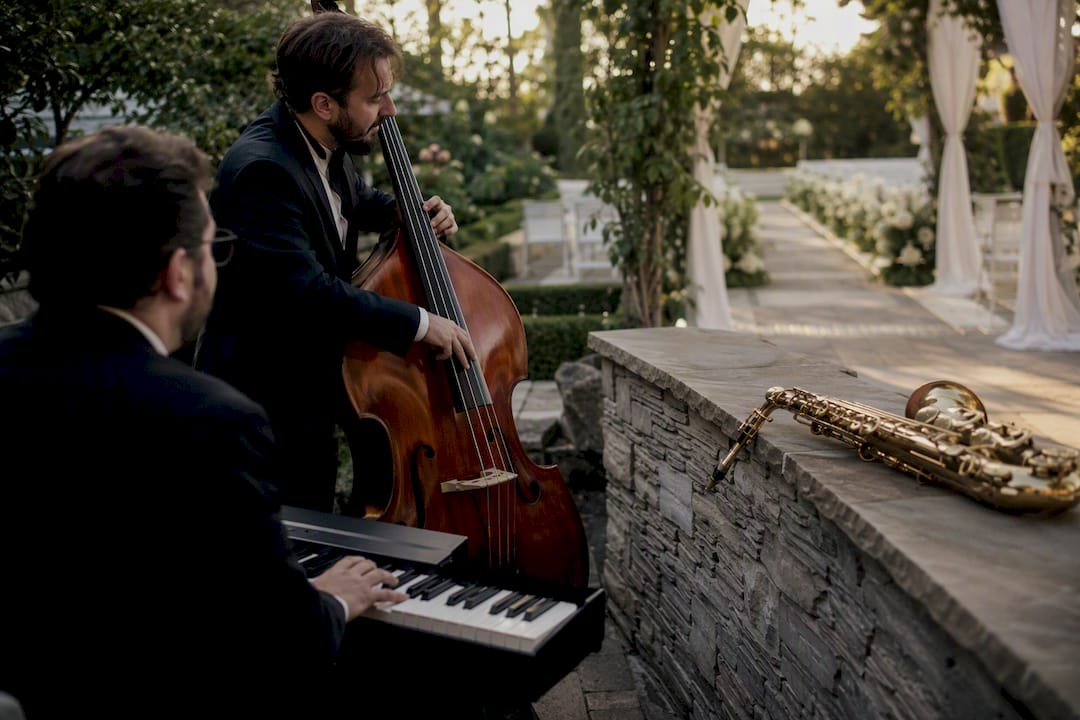
A solo piano gives you warmth and flexibility in a small chapel or intimate backyard setting. A saxophone leads beautifully on ballads and cuts through outdoor noise better than piano alone. Guitar adds a lighter, more contemporary texture, especially on bossa-inflected songs. Strings pair naturally with jazz standards when a couple wants something between classical elegance and swing.
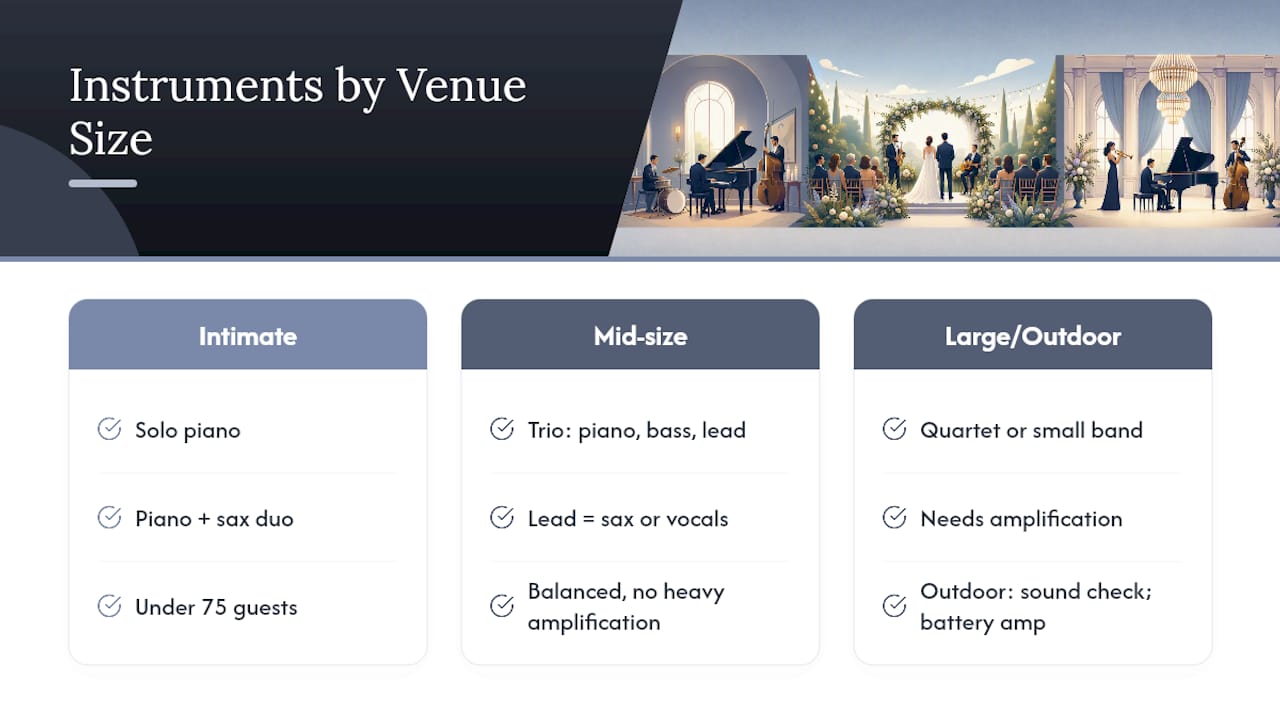
For intimate venues (under 75 guests), a solo pianist or a piano-and-sax duo covers most needs without overwhelming the room. Mid-size venues often do well with a trio, piano, bass, and a lead instrument like sax or vocals. Larger venues or outdoor spaces usually need a quartet or small band with amplification, since sound dissipates fast outside and a lone instrument can get lost.
Turning a pop song into a jazz arrangement is a skill, not a shortcut. It takes real musicians to reharmonize a melody and keep it recognizable. For outdoor ceremonies specifically, budget time for a sound check. Wind and open air change balance more than couples expect.
Pro Tip: If your ceremony is outdoors, ask your ensemble about battery-powered amplification. It solves the projection problem without cables running across grass.
Booking a Live Jazz Ensemble: A Practical Checklist
Most couples plan ahead several months before their wedding date to book musicians, especially for peak seasons A typical first conversation covers your ceremony timeline, venue acoustics (indoor versus outdoor), and whether you want a trio, quartet, or solo piano handling the ceremony before the group expands for cocktail hour or reception; for guidance on choosing drinks that fit your wedding vibe, check out the best tequila for weddings.
Customization is where a professional ensemble earns its fee. Alexlevinmusic regularly arranges couples' personal song requests into jazz versions and handles specific cue timing, like holding a vamp until the bride reaches the aisle's midpoint. Reviewing sample setlists and video clips before booking gives you a real sense of how a band executes those transitions live, not just how they sound on a studio recording.
Before signing anything, confirm these details in writing:
- Arrival and setup time relative to your ceremony start
- A scheduled rehearsal or sound check window
- A weather contingency plan for outdoor ceremonies
- A backup recorded-track option in case of equipment failure
- Cancellation and force-majeure terms
Request an itemized quote once you know your guest count and venue layout. It's the fastest way to compare what's actually included.
Weaving Jazz Into Cultural and Religious Ceremony Traditions
Jazz rarely has to replace tradition. It usually sits alongside it. Many couples keep a religious or cultural processional (a specific hymn, a traditional instrumental, a family song) for the formal entrance, then bring jazz in for the recessional, cocktail hour, or moments before the ceremony officially begins.
For interfaith or blended-tradition weddings, jazz often works as a neutral middle ground. It carries emotional warmth without the specific religious associations a hymn might have, which can matter when two families are bringing different traditions into the same ceremony. A jazz arrangement of a culturally significant melody, reworked by a skilled trio, can also bridge two worlds. A traditional song reimagined with a swung rhythm or a walking bass line still honors its origin while giving the ceremony a distinctly different texture at the moment it plays.
Some couples reserve jazz specifically for the exit, letting the formal parts of the ceremony stay traditional and using "What A Wonderful World" or "Sing, Sing, Sing" as the celebratory turn toward the reception. Others ask musicians to learn a specific cultural piece and arrange it in a jazz style entirely, though that takes advance notice. A skilled arranger typically needs several weeks to transcribe and rehearse an unfamiliar melody properly. If this matters to you, raise it in your first conversation with your band, not two weeks before the wedding.
Licensing and Permissions for Using Jazz Songs at Your Ceremony
Most couples never think about music licensing until someone asks, and the honest answer is that it rarely becomes an issue for a private wedding ceremony. Playing a recorded song at a private event, whether from a personal device or through a hired DJ, generally falls outside the commercial licensing requirements that apply to public performances, broadcasts, or venues charging admission.
Live performance is even simpler in most cases. When you hire a jazz ensemble to play a cover of a standard like "At Last" or "Fly Me To The Moon," many reception venues already carry a blanket performance license (commonly through ASCAP or BMI) that covers live cover performances on their premises. It's worth asking your venue directly whether they hold one, since some do and some don't, particularly smaller or non-traditional venues like private estates or family properties.
Where licensing becomes a real consideration is if you plan to record and publicly share your ceremony video, especially on a monetized platform, or if a vendor plans to use footage of your ceremony music commercially. In those cases, the safest move is a quick conversation with your venue and your videographer about what's already covered and what isn't. For the ceremony itself, though, hiring musicians to perform a jazz standard for your guests is standard practice and not something that typically requires you to secure a separate license.
Making Your Jazz Playlist Feel Like Your Story
The strongest ceremony playlists aren't just a list of popular titles. They carry a thread that connects to the couple actually getting married. If jazz was playing on your third date, or your grandmother used to sing along to Ella Fitzgerald in the kitchen, that detail belongs in your ceremony far more than a song chosen purely because it ranked well on someone else's list.
A few ways couples personalize their selections: choosing a song from the era or city where you met, requesting an arrangement of a song from your first dance as a couple long before the wedding, or asking your band to work in a brief instrumental quote of a meaningful melody during the processional's opening bars. Some couples split the difference by keeping classic standards for the formal moments and saving a more personal, less expected song for the recessional, when the mood has already shifted toward celebration.
If you and your partner don't share an obvious "our song," lean into mood instead of memory. Ask yourselves what kind of room you want to walk into: hushed and intimate, or warm and a little playful. That answer usually points you toward the right corner of the catalog faster than scrolling through fifty titles. Whatever you land on, tell your band or DJ the story behind it. A musician who understands why a song matters will play it differently than one just reading a title off a sheet.
Where to Preview Recordings and Build Your Playlist
- The Knot's jazz love songs list — nearly 49 standards with cover-version notes.
- WeddingWire's processional picks — aisle-specific songs and timing advice.
- The Bash's jazz wedding roundup — core standards across multiple vendor lists.
- A representative Spotify playlist for quick listening across moods.
What Actually Matters When You're Picking Ceremony Music
Most jazz wedding lists treat every song as interchangeable, ranked by how often it shows up elsewhere. That's backwards. The songs that repeat across every major list, Sinatra, Fitzgerald, Armstrong, Nat King Cole, earn their place because they're genuinely flexible across tempo and arrangement, not because they're the most original choice available.
Where conventional advice falls short is logistics. Plenty of lists hand you fifty song titles and stop there, leaving couples to discover the hard way that a song they loved on a streaming app doesn't sit right at their actual walking pace. The song matters less than whether someone rehearses it with you.
If you take one thing from this, prioritize the walk through over the wish list. A gorgeous song played at the wrong tempo, with no cue plan and no rehearsal, will feel off no matter how well it charted on someone else's roundup. A modest song, well timed and well played by musicians who took the time to rehearse with you, will feel exactly right.
— Alex
Sources
- 49 Romantic Jazz Love Songs to Play on Your Wedding Day — The Knot
- 25 Jazzy Wedding Processional Songs — WeddingWire
- 37 Best Jazz Wedding Songs — The Bash