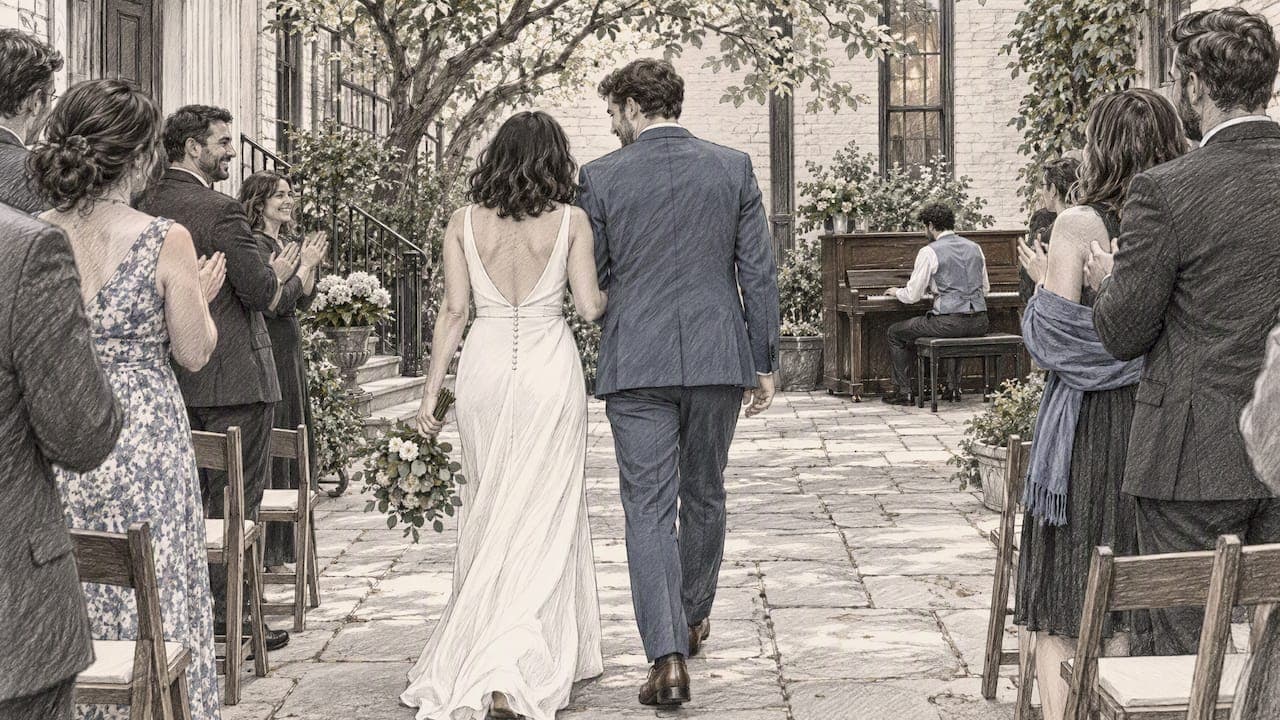
Choose songs by ceremony moment rather than by genre: prelude (8 to 12 tracks for roughly 15 to 30 minutes), processional (1 to 3 choices), ritual moments (a short instrumental), signing (3 to 8 minutes of quiet music), and recessional (one upbeat exit). Live or recorded both work, and Alex Levin Music builds these sets around that same structure for couples who want it played live.
TL;DR:
- Plan 8 to 12 prelude songs for 15 to 30 minutes; recorded tracks need queue management, and venues may require licensing coverage for commercial streams.
- Match processional music to the entrance order: staged walks may need separate songs, and performers need a cue and rehearsal at the planned walking pace.
- Keep readings and rituals focused with quiet instrumentals or silence; musicians should lower the volume beneath speech and follow the officiant’s cue to swell or fade.
- Signing usually lasts 3 to 8 minutes, so live players can continue until signaled; recorded music needs a long track or two queued songs.
- Set an upbeat recessional for a brisk exit, then agree whether it fades or hands off to cocktail music; musicians need that cue in advance.
Table of Contents
- Prelude and seating: playlist length, tone, and sample tracks
- Processional (walk-in) song options and staging by role
- Special moments and ritual music (readings, handfasting, unity rituals)
- Signing of the register: quieter choices and timing
- Recessional and exit songs: how to choose one that lands well
- Musician's notes from Alex: rehearsal, timing, and the musician checklist for couples
- What most couples get wrong about ceremony music
- Book live ceremony music that fits this exact plan
- FAQ
- Sources
Prelude and seating: playlist length, tone, and sample tracks
Prelude music plays while guests arrive and find seats, so it needs enough variety to cover 15 to 30 minutes without repeating a mood twice. Most couples land on 8 to 12 songs, timed to start when doors open and to wind down just before the processional begins.
The tone here sets expectations for the whole ceremony. A few directions that work well for a non-religious ceremony:
- Acoustic guitar or piano instrumentals for a relaxed, low-key arrival.
- Jazz standards for a classic, elegant feel, especially for an evening ceremony.
- Instrumental pop arrangements of songs guests will recognize without the lyrics pulling focus.
- Gentle R&B or soul instrumentals for warmth without heaviness.
Live musicians can stretch or trim the prelude in real time as guests trickle in, which recorded playlists cannot do. Musicians can read the room and add a song if seating runs long. Recorded music is more budget-friendly and gives total control over the exact tracks, but it needs a sound system and someone managing the queue. If you go recorded, check the venue's policy on public performance licensing for commercially streamed music, since some venues require coverage through a licensing service.
Processional (walk-in) song options and staging by role
How many people are walking, and in what order, changes what the music needs to do. A single entrance needs one song long enough to cover the walk at a measured pace. A staged entrance, with a wedding party, then parents, then the couple, often uses one song for the party and a second for the couple's own entrance, or one arrangement that shifts tempo partway through.
A few categorized starting points:
- Classical instrumental: Pachelbel's Canon in D remains a reliable choice and appears across most major ceremony song collections for its steady, unhurried pace.
- Modern ballad arrangements: a string quartet version of a favorite love song gives a familiar feel without religious language.
- Acoustic covers: a stripped-down guitar or piano version of a well-known song for a more intimate walk.
- Cinematic instrumentals: film score pieces work well for couples who want a bigger, more dramatic entrance.
Whoever plays live needs the exact tempo and measure count ahead of time, not just the song title. Give your musician or DJ a cue word or a nod from the officiant, and rehearse the walk at the actual pace you plan to use, not a quicker version. Our processional song guide broken down by role covers specific picks for the wedding party versus the couple's own entrance, and our piece on what processional music is and how to choose it goes deeper on selection logic.
Special moments and ritual music (readings, handfasting, unity rituals)
Readings and rituals, like a handfasting or a sand or unity ceremony, generally work better with instrumental music or no music at all rather than a song with lyrics competing for attention. A secular ceremony is built around flexibility, so the music during these segments should support the words being spoken, not pull focus from them.
For a short ritual, a single soft instrumental phrase, repeated or looped, is usually enough. For a longer reading or a multi-step ritual, a continuous instrumental piece in a similar key and tempo keeps the mood steady without drawing attention to a shift in music.
- Soft piano or solo strings for a short handfasting or ring warming.
- A continuous ambient instrumental for a longer, multi-part ritual.
- Near silence, with music only underscoring the very start and end, for a reading meant to stand alone.
Musicians should play at a low volume during spoken parts and watch the officiant for a cue to swell or fade, never playing at a volume that competes with a voice that is not amplified.
Pro Tip: Ask your musician to hold the final chord of a ritual song rather than cutting it off; it gives the moment a cleaner close than silence does.

Signing of the register: quieter choices and timing
Signing the register, or any paperwork segment, typically takes 3 to 8 minutes and calls for calm, unobtrusive music that lets guests relax without feeling like the ceremony has stalled. This is a good spot for a mellow jazz instrumental or a quiet reflective piece, something with enough length or repeatability to stretch if the signing runs long.
A few practical choices:
- A slow jazz standard played as an instrumental.
- A looped acoustic guitar or piano piece that can extend naturally.
- A soft classical piece in a similar register to what played during the ceremony itself.
Live musicians can simply keep playing until they get a signal that signing is finished, which is one of the clearest advantages over a fixed recorded track. If you are using recorded music, pick a song with a long runtime or queue up two tracks back to back so there is no awkward silence if signing takes longer than planned. Give musicians an agreed hand signal or a nod from the officiant so the transition out of this segment feels intentional rather than abrupt.
Recessional and exit songs: how to choose one that lands well
The recessional is the one moment in the ceremony built for energy. Couples generally want something upbeat, triumphant, or cinematic, with a tempo that matches a quicker, celebratory walk rather than the slower pace of the processional.
A few cross-genre options that tend to land well:
- An upbeat brass or swing arrangement for a classic, celebratory exit.
- A modern pop song reimagined by a live band for extra momentum.
- A cinematic instrumental build for a couple who wants a bigger, more dramatic finish.
Live arrangements tend to build more energy than recorded tracks because musicians can push the tempo and volume as guests start cheering. For the handoff into cocktail hour, decide ahead of time whether the recessional song fades out as guests exit or whether a new track starts immediately once the aisle clears. Either works, but your musicians or DJ need the cue in advance so the transition feels planned rather than accidental.
Musician's notes from Alex: rehearsal, timing, and the musician checklist for couples
I have played enough ceremonies to know the music rarely fails because of song choice. It fails because of timing gaps nobody planned for.
A short checklist worth giving any musician or DJ you hire:
- Share a two-column setlist: moment name and ideal duration for each one.
- Include a backup recorded playlist in case a live musician needs a short break.
- Give an on-the-day contact who can relay a timing change in real time.
- Note the venue's acoustics, since an outdoor ceremony needs different amplification than a small indoor chapel.
- Rehearse the processional and recessional at your actual walking pace, not a faster one.
Pro Tip: A good musician can shorten or extend a processional by repeating or trimming a musical phrase, so tell them your walk is longer or shorter than average rather than picking a song by length alone.
Our guide on how musicians customize wedding songs and our ceremony music timeline cover this in more detail.
What most couples get wrong about ceremony music
The common advice treats ceremony music like a playlist problem: pick songs you like, put them in order, done. The harder and more useful problem is pacing. A beautiful song played too long during signing feels like dead air. A gorgeous processional piece cut off mid-phrase because nobody counted measures undercuts the one walk you only do once.
What the research on this actually supports is specificity: naming a duration and a role for every moment, not just a vibe. Couples who hand their musician a mood board of favorite artists tend to get a serviceable ceremony. Couples who hand over a setlist with durations, cues, and a backup plan tend to get one that feels seamless from the first prelude note to the last recessional chord. Prioritize the timing document before the song list. The songs are replaceable; a ceremony that runs smoothly is not.
— Alex
Book live ceremony music that fits this exact plan
We build ceremony sets around this same moment-by-moment structure: a prelude set, processional arrangement, ritual underscoring, signing music, and a recessional, performed by different ensembles depending on what the ceremony calls for.
- Custom arrangements sized to your actual walk length and ritual timing, not a generic song cut.
- One point of contact on the day so cues happen on time without you managing it.
- Options from solo piano to full ensembles, all built around the same checklist outlined above.
Wedding Ceremony Music starts from $3,000, and we are glad to put together a consultation around your specific ceremony timeline.
FAQ
What is a non-traditional wedding song?
A non-traditional wedding song is any piece that is not a religious hymn or classic wedding standard, often a modern love song, film score, or jazz instrumental reimagined for the ceremony. Couples choosing non-religious ceremonies frequently pick music tied to their own story rather than convention.
What is a good song to walk out of church to after a wedding?
For a non-religious ceremony, a good exit song is upbeat, triumphant, or cinematic, matched to a brisk walking pace rather than the slower tempo used for the processional. Brass, swing, or a live band arrangement of a familiar pop song tends to create the most energy on the way out.
What are the top wedding songs?
There is no single official ranking, but The Knot's ceremony song collections consistently feature a mix of classical instrumentals, like Pachelbel's Canon in D, alongside modern ballads such as "A Thousand Years." The right choice depends more on the moment it's used for than on popularity alone.
What are some non-cliche wedding songs?
Non-cliche options usually come from outside the standard wedding playlist: a jazz standard reimagined as an instrumental, a film score piece, or an acoustic cover of a song that means something specific to the couple. Wandermoons' guidance on secular ceremonies supports choosing music tied to your own relationship rather than what is expected.
How many songs do I need for a non-religious ceremony?
Plan for roughly 8 to 12 songs for the prelude, 1 to 3 for the processional, one or two short pieces for rituals, a few minutes of music for signing, and one song for the recessional. A musician-built checklist covering each moment makes this far easier to execute than one long playlist.
Sources
- 162 Wedding ceremony songs for your ceremony music playlist — The Knot
- Non-Religious Wedding Ceremony: A Complete Guide to Meaningful Rituals and Ideas - WANDER MOONS