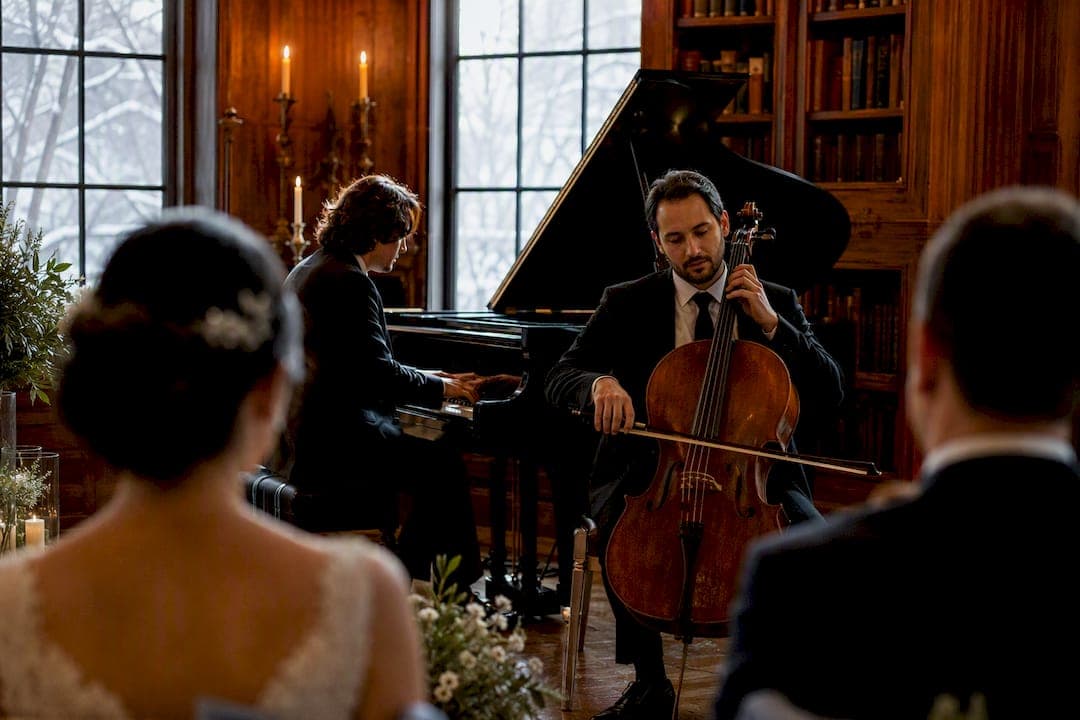
The best winter wedding music leans on warm instrumentals (strings, piano, cello), a handful of seasonal ballads placed with restraint, and a few upbeat reception songs to close out the night. Live musicians make this even better because they can read the room in ways a playlist cannot. Below, you'll find curated song sets for every moment of the day, straight from Alex, plus the practical steps to turn them into an actual timeline.
TL;DR:
- Live musicians can adapt dynamically to room acoustics, making their warmth and intimacy more effective in enclosed winter venues than recordings.
- Seasonal songs should be arranged subtly, with jazz and instrumental versions at cocktail hour and holiday tunes saved for special moments like the end of the reception.
- Transitioning smoothly between musical moods requires careful planning of tempo and key, with live performers holding chords and simplifying textures when needed.
- Classical and jazz standards work best for winter ceremonies and cocktail hours, while diverse genres like Motown and pop can energize the dance floor and accommodate guest tastes.
- Proper sound setup, understanding venue acoustics, and thoughtful playlist building are essential for creating a cohesive, warm winter wedding soundtrack.
Table of Contents
- Winter Wedding Music Picks for Every Key Moment
- Winter and Christmas Song Ideas That Actually Work
- Why Strings and Piano Suit Winter Ceremony Music
- Live Musicians or a Playlist: How to Decide
- Building Your Winter Wedding Reception Playlist Step by Step
- Making Transitions Feel Seamless, Not Jarring
- Blending Genres and Traditions Without Losing Cohesion
- Matching Music to Your Guest List's Age Range and Taste
- Adding Holiday Touches Without Turning It Into a Christmas Party
- Sound Setup and Acoustics for Winter Venues
- Do You Need a License to Play Recorded Music at Your Wedding?
- The Real Question Behind Winter Wedding Music
- Why Hire Alex Levin Music for Your Winter Wedding Soundtrack
- Where to Hear More Winter Wedding Music
- Sources
- FAQ
Winter Wedding Music Picks for Every Key Moment
Every wedding has five or six musical turning points, and each one calls for a different mood. Here's a working set for each, built around tempo, tone, and what actually plays well in a heated room full of people in coats they just took off.
Processional (6 to 8 songs, pick one or two):
- "Canon in D" — Pachelbel, string quartet arrangement
- "A Thousand Years" — Christina Perri, instrumental piano version
- "Clair de Lune" — Debussy
- "River Flows in You" — Yiruma
- "Winter" from The Four Seasons — Vivaldi
- "Ave Maria" — Schubert, cello and piano
- "All of Me" — John Legend, string arrangement
- "Songbird" — Fleetwood Mac, instrumental cover
Keep processional songs around one to two minutes long. Longer than that, and you're either looping the intro or rushing the bridal party.
Ceremony interludes (6 to 8 songs): these fill the unity candle, sand ceremony, or a reading, and they need to sit quietly behind spoken words without disappearing. "Meditation from Thaïs" (Massenet), "Nocturne in E-flat" (Chopin), "The Swan" (Saint-Saëns), and light jazz reharmonizations of "Fly Me to the Moon" all work because they hold a mood without pulling focus.
First dance (10 picks): "At Last" (Etta James), "La Vie en Rose," "Come Away With Me" (Norah Jones), "The Way You Look Tonight," "Unforgettable," "Can't Help Falling in Love," "Stand By Me," "Make You Feel My Love," "Fly Me to the Moon," and "Everything" by Michael Bublé. Notice the tempo range: most sit between 60 and 80 beats per minute, slow enough to sway without counting steps.
Cocktail hour (8 to 10 songs): this is where jazz standards earn their keep. Small-ensemble jazz and acoustic pop covers stay familiar without competing with conversation, which is exactly what cocktail hour needs. Think "Autumn Leaves," "Cheek to Cheek," acoustic versions of "Lover" by Taylor Swift, and light bossa nova covers of modern hits. Programming from long-running jazz radio shows like WICN's Sunday Jazz Brunch is a good model for how to layer standards with newer material.
Reception openers and dancefloor starters (8 to 12 songs): "Uptown Funk," "September" (Earth, Wind & Fire), "I Wanna Dance with Somebody," "Signed, Sealed, Delivered," "Superstition," and "Don't Stop Believin'" cover a wide age range and rarely miss.
Winter and Christmas Song Ideas That Actually Work
Not every couple wants Christmas wedding music at their reception, and that's fine. But for a December wedding, a few tasteful seasonal touches can make the day feel unmistakably yours.
Christmas classics that translate well to wedding moments:
- "Have Yourself a Merry Little Christmas" (slow tempo, works as a first-dance alternate)
- "The Christmas Song," instrumental piano version for cocktail hour
- "Let It Snow," jazz trio arrangement for reception background
- "White Christmas," string quartet version for processional or interludes
Modern winter love songs that feel romantic, not novelty:
- "Snow" by Sleeping at Last
- "Winter Song" by Sara Bareilles and Ingrid Michaelson
- "This Christmas Kiss" adapted with a slower, jazzier arrangement
Seasonal songs work best when the arrangement downplays the novelty factor. A slowed-down instrumental cover or a jazz reharmonization turns a song you'd hear in a mall into something that actually belongs at a wedding. Save the recognizable, upbeat Christmas songs (think "Jingle Bell Rock") for the very end of the reception, if at all, when guests expect a little fun and won't mind the shift in tone.
Pro Tip: Ask your musician or DJ to fade a Christmas classic under ambient conversation during cocktail hour rather than playing it as a featured track. Guests register the seasonal warmth without ever consciously noticing "hey, that's a Christmas song."
Why Strings and Piano Suit Winter Ceremony Music
Enclosed winter venues change how music behaves. Indoor rooms with low ceilings and heavy drapery absorb high frequencies and let lower-register instruments bloom, which is why cello, piano, and viola sound richer indoors in January than they ever do at an outdoor June ceremony. Live performers consistently note that winter weddings favor these warmer, more intimate arrangements precisely because the acoustics reward it.
Pieces that arrange beautifully for strings, piano, or cello:
- Vivaldi's "Winter" (obvious, but it earns its place)
- Handel selections and arrangements from Messiah
- Chopin nocturnes for quiet interludes
- Acoustic string arrangements of contemporary pop for the processional
Chamber ensembles that specialize in wedding repertoire often recommend seasonally themed classical works precisely because they translate cleanly into a two- or four-piece arrangement. For processional and recessional, keep pieces to 90 seconds; ask your musician to hold chords longer and thin out the texture during any verse-like section so the melody stays clear as you walk. If you have a specific pop song in mind, a live player can usually rework it. Musicians customize songs far more often than couples realize.
Live Musicians or a Playlist: How to Decide
Recorded playlists are cheaper and simpler to run. Live musicians cost more and need space, power, and load-in time. Here's how to weigh it.
- Cost and logistics. A string quartet or jazz trio runs higher than a curated Spotify playlist, and you'll need to budget power outlets, a load-in window, and sometimes a dedicated corner of the room.
- Acoustic adaptation. A live band adjusts instantly to a room's echo or a noisy HVAC system in ways a fixed recording can't.
- Emotional payoff. Processional, cocktail hour, and first dance are the three moments that reward live music most, since a musician can read the pace of the room and hold or shorten a phrase accordingly.
Pro Tip: If budget only allows live music for part of the day, put it toward the ceremony and cocktail hour. Reception dance sets do fine with a strong DJ or a well-built playlist, since guests are focused on each other, not the source of the sound.
Before booking, ask any band or venue about power access, sound ordinances (common at hotel and estate venues after certain hours), and whether they'll coordinate directly with your DJ for a clean handoff between live sets and recorded music.
Building Your Winter Wedding Reception Playlist Step by Step
- List every moment in your day (processional, seating, ceremony, recessional, cocktail, entrance, first dance, dinner, dancing, last song) and assign a mood to each.
- Pick one anchor song per moment first, then build outward with two or three backups in case timing shifts.
- Map durations. Processional songs run 90 seconds to two minutes; first dances usually run the full song, three to four minutes.
- Plan transitions so tempo and key don't lurch from a slow cello piece straight into a dance-floor anthem.
- Test it in context. Play the full sequence at home, at the volume you'll actually use, before locking anything in.
- Prepare offline copies. Venues with spotty Wi-Fi or streaming outages have ruined more than one reception opener.
- Hand off a cue sheet. Give your band or DJ start times relative to your schedule (for instance, processional 0:00 to 1:20) and note the fade type you want, whether that's a sudden stop, a fade under applause, or a continuous roll into the next song.
- Keep a printed backup of your final cue sheet in case a phone dies or a laptop won't cooperate.
- Share the sheet with your planner, not just your musicians, so everyone is working from the same timeline.
Making Transitions Feel Seamless, Not Jarring
Smooth transitions come down to two things: tempo and key. Jumping from a 60 BPM piano ballad straight into a 120 BPM dance track feels abrupt; a brief instrumental bridge or a DJ mixing up gradually softens the shift.
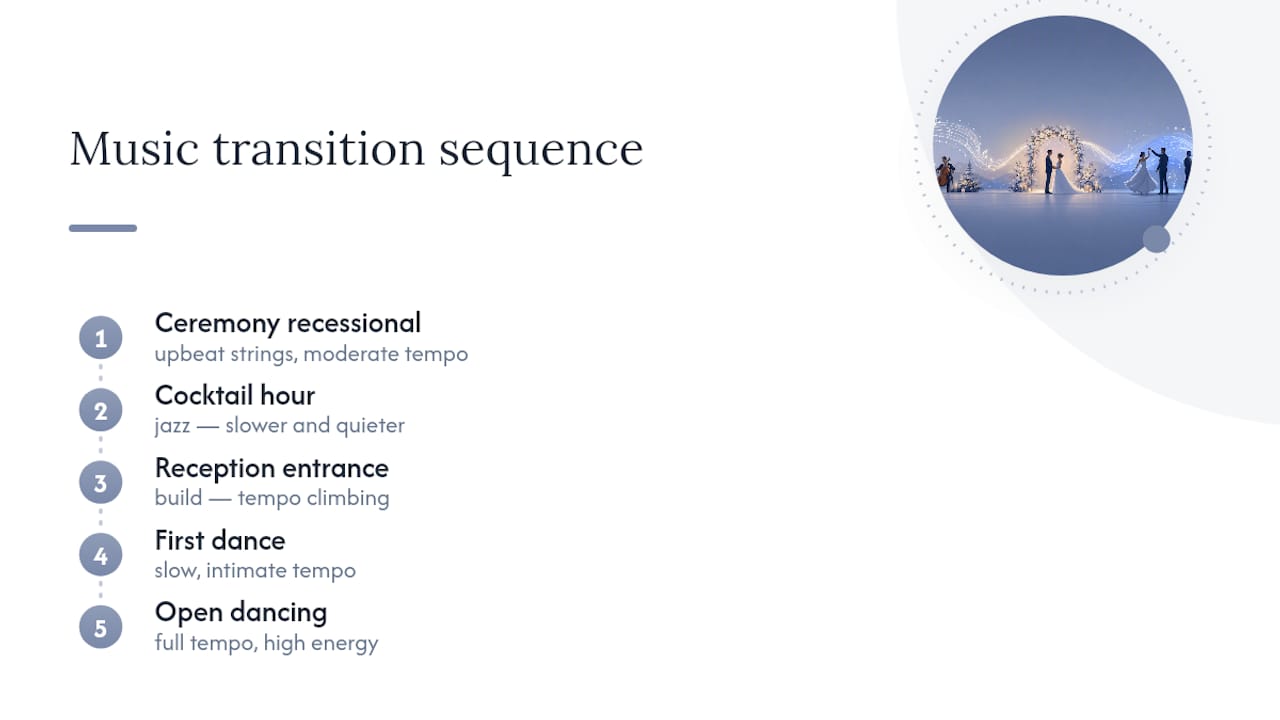
A workable sequence: ceremony recessional (upbeat strings, moderate tempo) into cocktail hour (jazz, slower and quieter) into reception entrance (a build, tempo climbing) into first dance (slow again) into open dancing (full tempo). Guests barely notice they've moved through five different moods if each step nudges the energy rather than slamming it.
Pro Tip: If your band handles both ceremony and reception, ask them to hold the same key signature between the recessional and the cocktail-hour opener. It's a small trick, but it makes the transition feel intentional instead of accidental.
Blending Genres and Traditions Without Losing Cohesion
Winter weddings often bring together guests from very different musical backgrounds, and the music should reflect that rather than flatten it. Couples with mixed cultural backgrounds frequently want a Bollywood processional number, a Klezmer tune during the reception, or a Motown set for the dance floor, alongside the classical pieces at the ceremony.
The trick isn't picking one lane. It's sequencing. Open the ceremony with tradition-specific music if it matters to your family, move into more neutral instrumental territory for the vows themselves, and save the full genre mix for the reception, where the format naturally invites variety. A live jazz trio or string quartet can often flex into these traditions with the right arrangement request, whether that's a tango-inflected first dance or a hora during the reception. If your families come from different backgrounds, loop your musician in early. A band that can sight-read or quickly learn a specific cultural piece saves you from having to choose between "everyone's music" and "just ours."
Genre variety also protects against the most common winter wedding music complaint: an entire night of slow, moody instrumentals that never lifts. Balance is the goal, not uniformity.
Matching Music to Your Guest List's Age Range and Taste
A wedding with grandparents, college friends, and coworkers in the same room needs a soundtrack that flexes across generations without feeling scattered.
The safest approach: use classical and jazz standards for the ceremony and cocktail hour, since those genres read as universally appropriate regardless of age, then let the reception dance set stretch wider. A strong reception mix moves through eras deliberately, Motown and soul for the older crowd, 2000s and current pop for the younger one, and a run of universally known songs (think "Uptown Funk" or "September") to pull everyone onto the floor at once.
If your guest list skews heavily toward one generation, lean into it rather than fighting it. A wedding full of 60somethings will fill the floor faster for Motown than for current pop, and the reverse is just as true. Ask your band or DJ for a "bridge" set list, roughly six songs that work regardless of who's in the room, to use whenever the floor starts thinning out.
Adding Holiday Touches Without Turning It Into a Christmas Party
The line between "festive winter wedding" and "wedding that feels like it happened at a company holiday party" is thinner than most couples think. The fix is placement, not avoidance.
Save recognizable holiday songs for moments where a little novelty is welcome, the very end of the reception, or a specific surprise moment like a coordinated last song. Keep the ceremony and dinner hour built on instrumental arrangements, even seasonal ones, so the mood stays elegant rather than tipping into party mode. A cello arrangement of "White Christmas" during the ceremony reads as thoughtful. The same song played with vocals and a full band during dinner reads as a Christmas special.
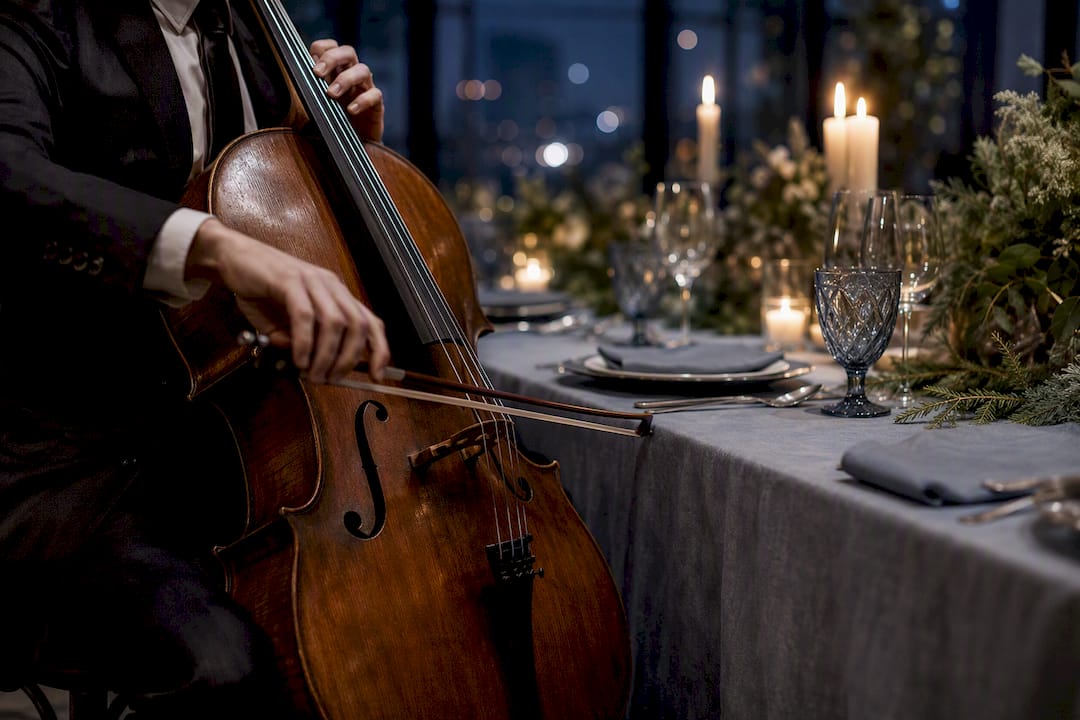
Decor helps set the boundary too. If your venue is already dressed in greenery, candles, and string lights, the music doesn't need to compete for seasonal atmosphere, it can stay understated and let the room do the work. Reserve one or two bigger, obviously festive musical moments (a surprise sing-along, a holiday-themed exit song) rather than sprinkling them throughout, so the choice feels intentional instead of default.
Sound Setup and Acoustics for Winter Venues
Winter weddings mean indoor ceremonies almost by default, and indoor rooms behave very differently from tents or gardens. Low ceilings, heavy curtains, and carpet all absorb high frequencies, which is why lower-register instruments (cello, piano, viola) tend to sound fuller than a bright violin or a full horn section in the same space.
Ask your venue about wall material and ceiling height before booking your musicians. A ballroom with hard surfaces and high ceilings creates echo that a soloist can get lost in, while a room full of soft furnishings and low ceilings can swallow sound if the ensemble is too small. A venue with tricky acoustics usually needs a sound check the same day, not just a walk-through weeks earlier.
Sound equipment matters just as much as room shape. A small acoustic ensemble might need nothing more than a couple of area mics for the ceremony, while a reception dance set generally needs a full PA system, monitors for the band, and a backup power source if you're at a venue prone to breaker issues in cold weather (space heaters draw more power than people expect). If any part of your celebration moves outdoors, even briefly for photos or a fire pit toast, check the specific logistics around cold-weather equipment and heating needs well ahead of time.
Do You Need a License to Play Recorded Music at Your Wedding?
Most private weddings don't require a special music license to play recorded songs during the ceremony or reception, since these are private, non-commercial events. Licensing becomes a real concern the moment you plan to record and publicly share the day, particularly if you're hiring a videographer who will post the ceremony video online or a photographer creating a highlight reel for social media.
If your wedding video will include copyrighted songs and get posted to YouTube, Instagram, or a public website, you may need sync and master rights clearance for those specific tracks. Music licensing for event video is worth understanding before your videographer starts editing, since platforms can flag or mute videos that use unlicensed commercial recordings. Streaming a DJ set or having a live band perform covers at a private event doesn't typically trigger the same requirements, but if you're unsure, ask your venue or planner directly, since some reception halls carry their own blanket licensing agreements (through ASCAP or BMI, for instance) that already cover recorded music played on-site.
The Real Question Behind Winter Wedding Music
Most couples ask the wrong question first. They ask "what songs sound like winter," when the better question is "what do I want this specific moment to feel like, and which arrangement gets me there." A Christmas classic played as a jazz trio instrumental and the same song played with a full vocal arrangement communicate completely different things to a room, even though the melody hasn't changed at all.
Winter venue acoustics get treated as a footnote in most planning guides, but the room shape does more to define your sound than the genre you pick. A string quartet in a stone chapel and the same quartet in a carpeted hotel ballroom need entirely different dynamics to land the same way. Alex commonly adjusts bowing intensity and instrument balance on the spot depending on how a room absorbs or reflects sound, something a fixed recording simply cannot do.
The other overlooked piece is arrangement flexibility. Couples fixate on song titles when the arrangement decision, instrumental versus vocal, slow versus tempo, sparse versus full, usually matters more to how a moment feels.
— Alex
Why Hire Alex Levin Music for Your Winter Wedding Soundtrack
Choosing live musicians can be an alternative to relying solely on playlist apps and hoping the acoustics cooperate. A string quartet, solo piano, or jazz trio arrives ready to adapt in real time, adjusting dynamics for your specific venue instead of relying on a static recording that sounds the same everywhere.
Every setlist gets customized around your ceremony, cocktail hour, and reception, whether that means reworking a modern pop song for strings during your processional or building a jazz-forward cocktail set that leans into the season without tipping into novelty. The musicians typically handle logistics such as coordinating with venues on power, sound checks, and timing to help ensure the cue sheet holds up on the day. If you're picturing warm instrumentals for your ceremony and a jazz trio for cocktail hour, explore what live music adds to a winter wedding, and check availability for your date, or browse reception band options to start building your booking.
Where to Hear More Winter Wedding Music
- Winter Wedding: instrumental piano album on Apple Music
- Winter Wedding Songs playlist on Spotify
- Chamber ensemble repertoire guide
Sources
- Winter Wedding –Instrumental Romantic Piano Music for the Perfect Wedding in Winter and Christmas Time - Apple Music
- Winter Weddings: How Live daytime Music enhances your wedding — JAM Duo
- The Art of Curating Music for Winter Weddings | Dennis Winge
- Winter Wedding Music Ideas | Great Lakes Chamber Players
FAQ
What songs give off winter wedding vibes?
Instrumental arrangements of Vivaldi's "Winter," piano covers of "Snow" by Sleeping at Last, and cello versions of "Clair de Lune" all create that warm, seasonal atmosphere without leaning on obvious holiday tunes.
What are the top wedding songs couples choose most often?
"At Last" by Etta James, "Perfect" by Ed Sheeran, and "Can't Help Falling in Love" consistently rank among the most requested first-dance songs, largely because their tempo and lyrics suit nearly any couple.
What winter wedding trends should couples expect in 2026?
Expect more couples blending classical instrumentals with personalized genre mixes, pairing seasonal decor with carefully placed holiday music, and showing a preference for live ensembles adaptable to smaller, more intimate indoor venues.
What are the best winter love songs for a first dance or playlist?
"Winter Song" by Sara Bareilles and Ingrid Michaelson, "Snow" by Sleeping at Last, and instrumental piano covers of "A Thousand Years" all capture a romantic winter mood without feeling like a holiday novelty track.