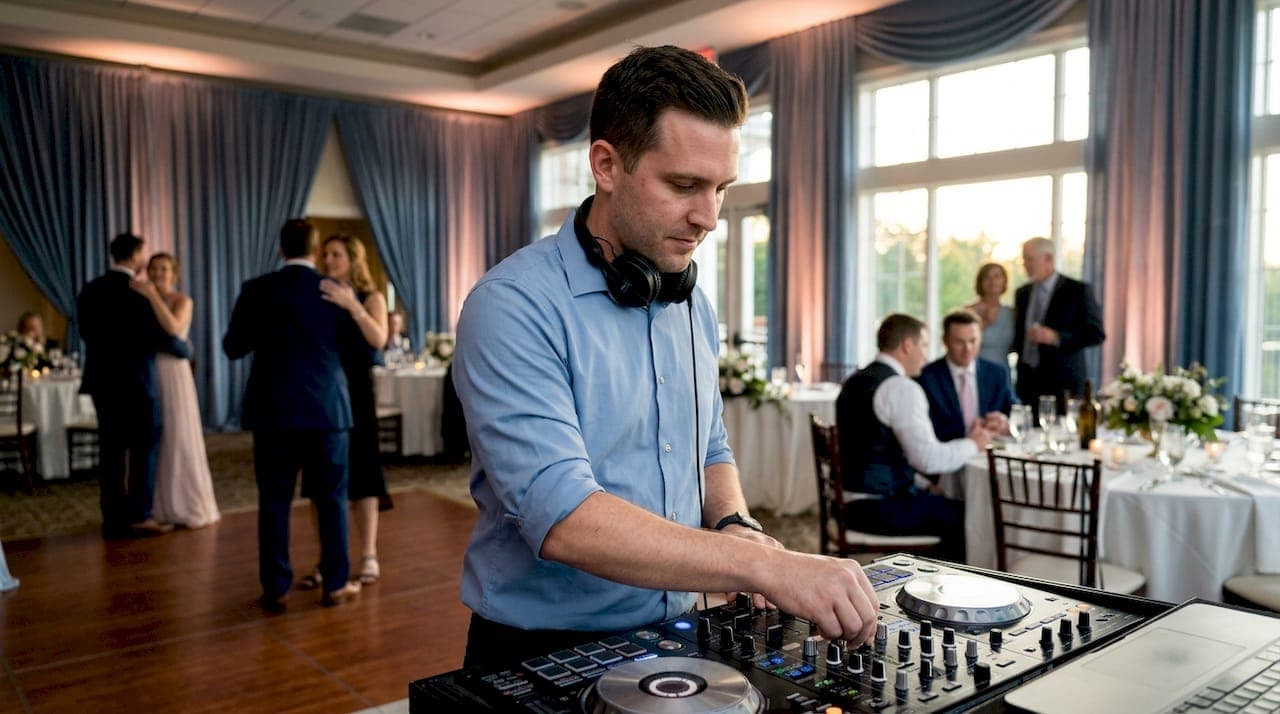
Transition music between wedding events is the curated flow of songs that connects distinct wedding moments, maintaining energy and ambiance so guests never feel the day lose momentum. Most couples spend weeks choosing their first dance song and almost no time thinking about what plays during the cocktail hour shift, the walk from ceremony to reception, or the quiet stretch before the dance floor opens. That gap in planning is where weddings lose their rhythm. This guide covers every major transition point, how to build playlists that hold the day together, and the professional techniques that separate a forgettable soundtrack from one guests talk about for years.
What are the key transition moments during a wedding?
Every wedding contains four or five moments where the energy must shift deliberately. Miss one, and guests feel it, even if they cannot name why.
The most significant shift is the move from ceremony to cocktail hour. Wedding entrance music typically moves from intimate, romantic ceremony songs to upbeat, party-ready reception tracks. That contrast creates excitement and signals to guests that the formal portion is over. A string quartet playing Pachelbel's Canon during the processional and then pivoting to a jazz trio covering Stevie Wonder during cocktail hour is a textbook example of this shift done well.
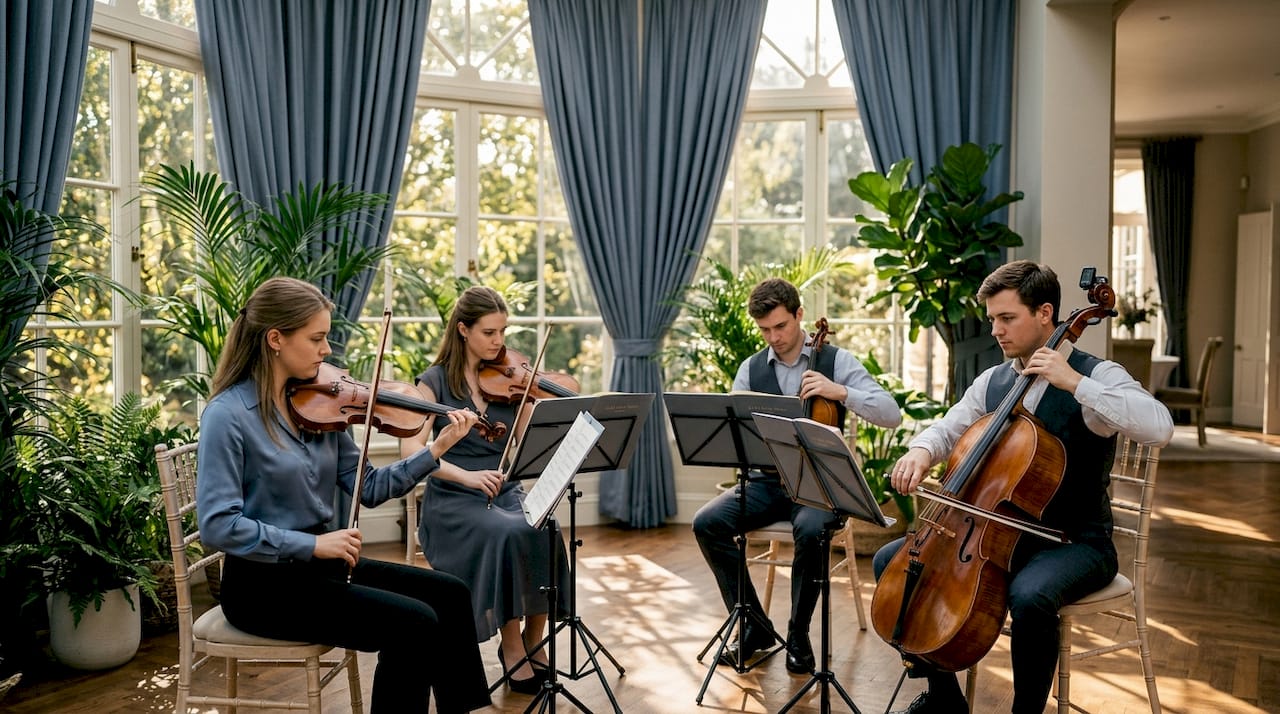
The second major transition is cocktail hour into dinner. The energy here should drop slightly, not crash. Guests move from standing and mingling to sitting and eating, so the music needs to follow that posture change. Upbeat lounge jazz, acoustic pop covers, or light bossa nova all work well here. The goal is background music for weddings that feels warm and conversational without demanding attention.
The third and most technically demanding transition is dinner to the dance floor. This is where most weddings stall. Guests are full, seated, and comfortable. Getting them to stand requires a gradual energy build, not a sudden jump from Frank Sinatra to Bruno Mars. Professional DJs use what the industry calls a "Bridge Song" for exactly this purpose.
The fourth transition is the reception exit or send-off. This moment needs a burst of joy, something anthemic and familiar that sends guests out on a high note. Think Queen's "Don't Stop Me Now" or a crowd-favorite sing-along that everyone knows by heart.
Here is a quick reference for each transition point and its musical goal:
- Ceremony end to cocktail hour: Shift from reverent to celebratory. Use live music or upbeat jazz to signal the mood change.
- Cocktail hour to dinner: Lower energy slightly. Choose lounge, acoustic, or instrumental tracks that feel warm but unobtrusive.
- Dinner to dance floor: Build gradually. A mid-tempo bridge song is non-negotiable here.
- Special moments (first dance, cake cutting, toasts): Use fill music during delays to prevent dead air.
- Reception exit: Go anthemic. Choose a song with universal recognition and high energy.
How do you select and prepare wedding music playlists?
Song selection for transitions comes down to three criteria: tempo, mood, and lyrical relevance. A song can be beautiful and still be wrong for a transition if its tempo clashes with the energy you are trying to create or its lyrics reference heartbreak during a joyful moment.
Organizing music into folders by wedding moment, such as Ceremony, Cocktail Hour, Dinner, Floor Fillers, and Safety Crates, is the standard professional approach. It allows quick access during live execution and prevents the panic of searching through a 500-song library mid-event. Couples working with a DJ should ask specifically how their music is organized before the wedding day.
The "Do-Not-Play" list is the most important control tool in wedding music planning. It prevents songs with negative associations or clashing tones from interrupting the flow, and it gives couples real authority over the soundtrack without micromanaging every song choice. A well-written Do-Not-Play list paired with a Must-Play list gives your DJ the creative room to read the room while staying inside your boundaries.
Pro Tip: Set a Music Lockdown date seven days before your wedding. This means all song choices are finalized, backed up, and confirmed with your DJ. Last-minute additions create confusion and increase the risk of something going wrong during the event.
Here is a comparison of playlist approaches to help you decide what works for your wedding:
| Approach | Best for | Trade-off |
|---|---|---|
| Fully curated by couple | Strong personal vision | Limits DJ flexibility to read the room |
| DJ-led with Must-Play and Do-Not-Play lists | Most weddings | Requires trust in your DJ's judgment |
| Live musician-led sets | Intimate or themed weddings | Less song variety, higher emotional impact |
| Hybrid (live music plus DJ) | Larger receptions | Requires tight coordination between performers |
For couples building their own playlists, tools like Spotify's collaborative playlist feature or dedicated wedding planning apps such as Zola and Joy allow you to share song ideas with your DJ and track selections by event segment. The key is to build your reception playlist with each segment in mind, not as one undifferentiated list.
How do you execute smooth transitions between wedding music segments?
Execution is where preparation either pays off or falls apart. The three core techniques professionals use are crossfading, bridge songs, and fill music.
Crossfading songs of similar tempo and key smooths transitions and maintains energy flow. Matching tempos on the beat while fading one track out and another in prevents the jarring silence or clash that signals an amateur setup. This is beatmatching, and it is the baseline skill that separates a professional DJ from someone running a playlist off a laptop.
Here is a step-by-step framework for executing the dinner-to-dance-floor transition, the most challenging shift of the night:
- Begin the last dinner song at a slightly higher tempo than the previous tracks.
- Introduce a mid-tempo bridge song that sits between the dinner vibe and the dance floor energy. Think Pharrell's "Happy" or Earth, Wind and Fire's "September."
- Watch the room. If guests are starting to move in their seats, the bridge is working.
- Follow the bridge with a high-energy crowd favorite that functions as a formal invitation to the dance floor.
- Sustain that energy for at least three songs before varying tempo.
Pro Tip: Fill music during speeches is not optional. If a toast-giver is late or a speech runs long, soft background music fading in instantly keeps the room from feeling awkward. Brief silences that stretch past 10 seconds shift guest attention from anticipation to discomfort.
Timing transitions around speeches and toasts requires coordination between the DJ, the MC, and the venue coordinator. A shared timeline document, updated the week before the wedding, is the most reliable way to keep everyone aligned. The DJ needs to know exactly when each speech ends so fill music or the next segment's playlist is ready to go without a gap.
| Transition moment | Recommended technique | Common error |
|---|---|---|
| Ceremony to cocktail hour | Live music or upbeat jazz set | Silence while guests move between spaces |
| Cocktail hour to dinner | Gradual tempo drop over 2 to 3 songs | Abrupt stop and restart |
| Dinner to dance floor | Bridge song plus energy build | Jumping straight to high-BPM tracks |
| During speeches | Soft fill music on standby | No backup plan for delays |
| Reception exit | Anthemic crowd favorite | Ending on a slow or unfamiliar song |
Common mistakes when managing transition music between wedding events
The most common error couples make is finalizing their music too late. Flawless wedding music takes 90% preparation. When song choices arrive the night before or the morning of the wedding, DJs cannot organize folders properly, confirm edits, or prepare backup options. The result is hesitation during live execution, and guests feel every second of it.
Dead air is the second most damaging mistake. A silence of even 15 to 20 seconds during a transition reads as a technical failure to most guests. Experienced wedding DJs emphasize reading the crowd and adjusting dynamically, but that skill only works when there is a library of prepared fill music to draw from. Without it, even experienced professionals are left scrambling.
Other mistakes worth knowing before you finalize your plan:
- Mismatching energy levels: Playing a slow ballad immediately before the first dance opener kills momentum. Every song in a transition sequence should move the energy in one direction.
- Overloading the Must-Play list: When couples request 40 or 50 must-play songs, the DJ loses the flexibility to read the crowd and adjust in real time. Fifteen to twenty must-play songs is a workable number for most receptions.
- Skipping vendor communication: The DJ, MC, caterer, and venue coordinator all affect timing. If the caterer is running 20 minutes late on dinner service, the DJ needs to know so cocktail hour music can extend without an awkward gap.
- No backup songs: Every transition point should have at least two or three safety songs ready. If a crowd is not responding to the planned bridge song, the DJ needs an immediate alternative.
- Avoiding these common music planning mistakes is as important as choosing the right songs in the first place.
Creative ideas for memorable wedding music transitions
The most memorable weddings use transitions as intentional moments rather than logistical necessities. A live acoustic guitarist playing a stripped-down version of the couple's favorite song during the walk from ceremony to cocktail hour creates a moment guests remember long after the reception ends.
Cultural and thematic motifs offer another layer of personalization. A wedding with a New Orleans theme might use a brass band to lead guests from the ceremony space to the reception hall. A South Asian wedding might incorporate classical sitar during the cocktail hour before shifting to Bollywood-influenced dance tracks. These choices feel cohesive because the music reflects the couple's identity rather than a generic wedding template.
Instrumental or lounge versions of popular songs work particularly well during dinner. A jazz arrangement of a current pop hit gives guests the familiarity of a song they recognize without the lyrical distraction that can interrupt conversation. Artists like the Vitamin String Quartet have built entire catalogs around this concept, covering everything from Taylor Swift to Radiohead in orchestral arrangements.
Guest participation elements, such as a brief sing-along during the reception entrance or a crowd shout-out during a high-energy transition, create shared moments that shift the energy faster than any technical DJ technique. The first dance song, according to professional guidance, should remain adaptable based on guest reaction during cocktail hour and dinner. If the room is already energized, a more upbeat first dance choice lands better than a slow ballad.
Key takeaways
Transition music between wedding events works best when preparation, organization, and real-time crowd reading combine into a single coordinated approach.
| Point | Details |
|---|---|
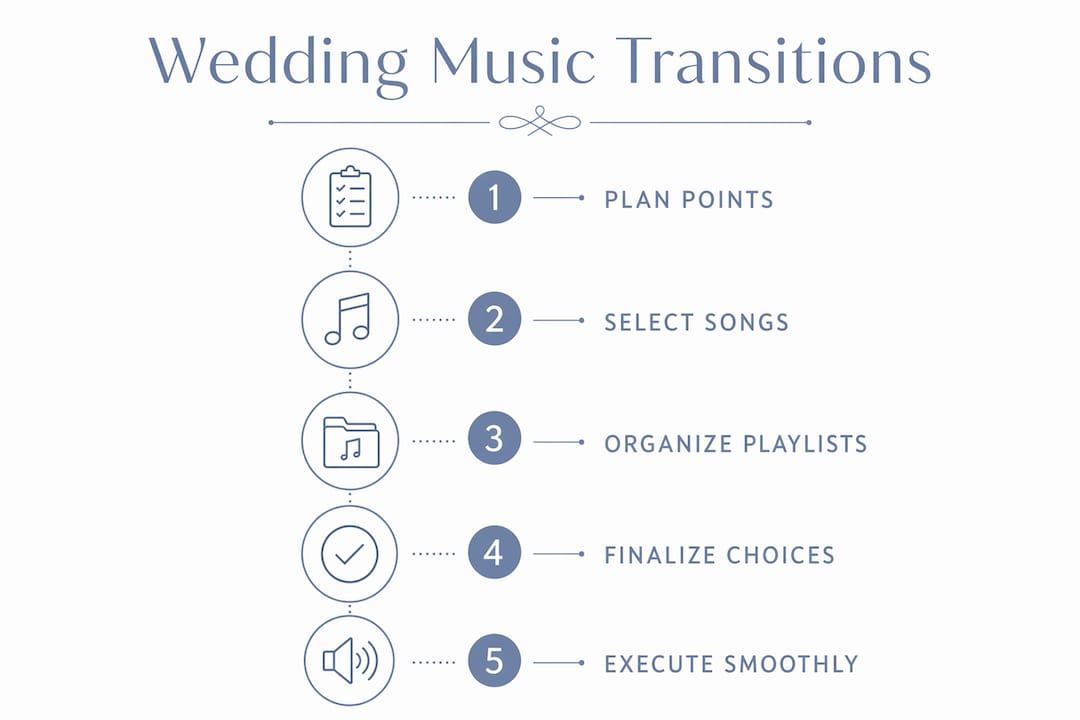
| Plan every transition point | Identify ceremony exit, cocktail hour, dinner, and dance floor shifts as distinct musical moments. |
| Use bridge songs deliberately | A mid-tempo bridge song between dinner and dancing prevents dead air and builds energy gradually. |
| Finalize music one week out | Set a Music Lockdown date seven days before the wedding to confirm all songs and backups with your DJ. |
| Build a Do-Not-Play list | This list gives couples real control over tone without limiting the DJ's ability to read the room. |
| Coordinate all vendors | Share a detailed timeline with your DJ, MC, and venue coordinator to prevent gaps during transitions. |
What I've learned from years of wedding music transitions
After working hundreds of weddings across Philadelphia, New York, and beyond, the pattern I see most often is this: couples spend enormous energy on the big moments and almost none on the spaces between them. The first dance is perfect. The entrance song is perfect. But the 12 minutes between the end of dinner and the opening of the dance floor? That stretch is where the night either catches fire or goes flat.
The couples who get this right are not necessarily the ones with the biggest music budgets. They are the ones who sat down with their musician or DJ and talked through the whole day as a sequence, not a list of highlights. They asked, "What plays while guests are finding their seats?" and "What happens if the speeches run long?" Those questions sound small. They are not.
I also think the industry undersells the value of live music specifically for transitions. A recorded track can crossfade. A live musician can read the room in real time, slow down, speed up, or hold a note longer because they feel the energy shift before it happens. That responsiveness is something no playlist can replicate, and it is most visible during the quiet, in-between moments that define how a wedding actually feels to the people in the room.
My honest advice: treat your transitions as seriously as your song selections. The guests who remember your wedding as one that "just flowed" are responding to exactly that.
— Alex
How Alexlevinmusic can perfect your wedding day sound
Planning the music between your wedding events is where most couples need the most help and get the least of it. Alexlevinmusic specializes in exactly this: curating live performances and DJ sets that manage every transition point with intention, from the ceremony exit through the final send-off.
Whether you want a jazz trio for cocktail hour, a string quartet for the ceremony, or a full DJ set that builds the dance floor from scratch, Alexlevinmusic brings the experience to handle every shift in energy without a gap or a misstep. The team coordinates directly with your venue and vendors, so the music always lands at the right moment. If you have been wondering whether live music outperforms a playlist for managing these transitions, that question has a clear answer. Reach out to Alexlevinmusic to discuss your wedding timeline and build a sound plan that holds the whole day together.
FAQ
What is transition music between wedding events?
Transition music between wedding events is the curated sequence of songs that connects distinct moments in the wedding timeline, such as the ceremony exit, cocktail hour, dinner, and dance floor opening, to maintain energy and prevent awkward silences.
How do you avoid dead air during wedding music transitions?
Fill music on standby is the standard professional solution. Soft background tracks fade in instantly during delays, such as a late toast-giver or a slow venue changeover, keeping guests comfortable and engaged.
How many must-play songs should you give your DJ?
Fifteen to twenty must-play songs is a practical limit for most receptions. More than that restricts the DJ's ability to read the crowd and adjust the energy in real time, which is where professional value is most visible.
What is a bridge song and why does it matter?
A bridge song is a mid-tempo track placed between a seated segment like dinner and a high-energy segment like the dance floor. It shifts guest mindset gradually from relaxed to ready to move, preventing the dead zone that kills dance floor momentum.
When should you finalize your wedding music choices?
Set a Music Lockdown date seven days before your wedding. This gives your DJ time to organize folders, prepare backups, and confirm edits without the pressure of last-minute changes affecting live performance quality.