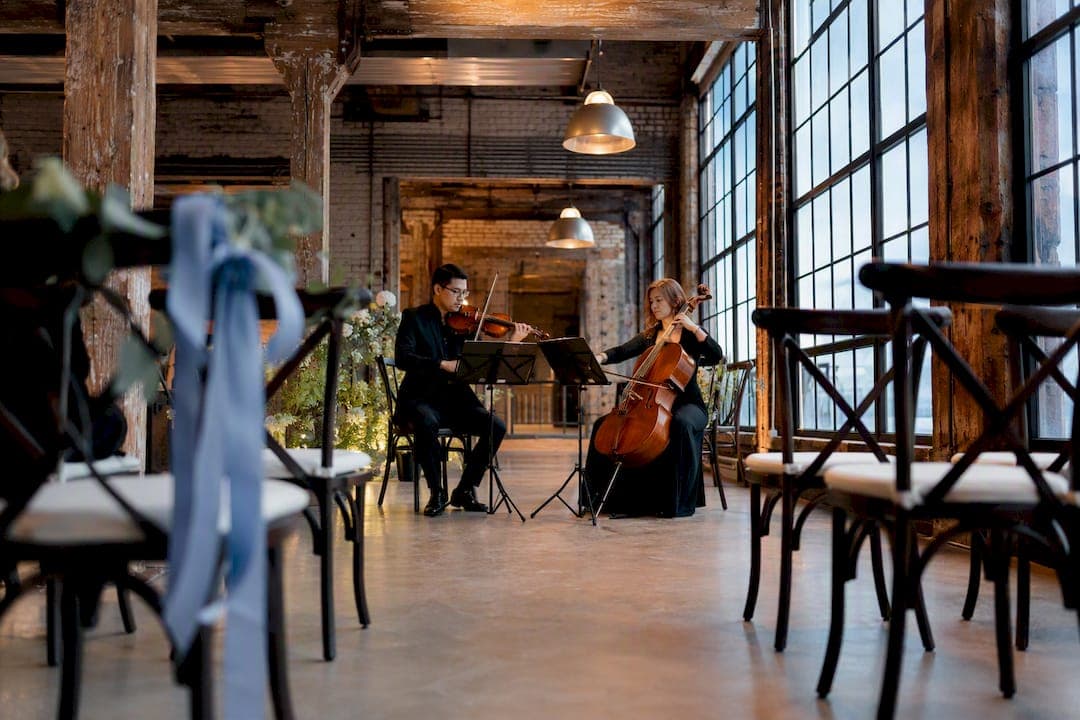
Loft weddings need flexible, controlled instrumentation, not just great musicians. Pair a string trio or solo piano for the ceremony and cocktail hour with a versatile band or a band-and-DJ hybrid for the reception, so energy can scale up without overwhelming a room full of brick and glass. Loft acoustics tend to be reverberant and unforgiving, so a sound plan matters as much as the setlist. Professional live music services offer ensembles designed for such settings, often including consultation to work out the details before contract signing.
TL;DR:
- Loft venues require acoustic treatments like fabric baffles and strategic speaker placement to limit echo and ensure clear sound for speeches and delicate instruments.
- Booking a single, versatile live band that covers multiple segments reduces scheduling issues and eliminates the need for additional vendors or sound checks.
- Ensure the venue’s load-in access, power supply, sound ordinances, and curfews are confirmed in writing to prevent technical or scheduling conflicts on the wedding day.
- Live music budgets range from $1,500 to $7,500, with booking well in advance especially for peak seasons; smaller ensembles cost less and require less space.
- Ask for unedited live footage, detailed contract terms, and perform a room walkthrough to verify acoustics, space, and sound system requirements before finalizing your musician selection.
Table of Contents
- Which Ensembles Work Best for Loft Wedding Music
- How Loft Acoustics and Décor Shape Your Music Choices
- What Logistics Checklist Should You Confirm With the Venue?
- What Should You Budget and When Should You Book?
- What Questions and Contract Terms Protect You?
- Sample Setlists and How to Transition Between Segments
- Coordinating Music Timing With Your Other Vendors
- Managing Noise Restrictions and Venue Sound Policies
- What I've Learned Performing in Loft Venues
- Ready to Book Live Music for Your Loft Wedding?
- Sources
Which Ensembles Work Best for Loft Wedding Music
Loft venues photograph beautifully and sound terribly if nobody plans for it. High ceilings, concrete floors, and floor-to-ceiling windows create long sightlines and long echoes at the same time, so the ensemble you pick has to earn its place both visually and acoustically.
For the ceremony, a string duo, string trio, or solo piano usually wins. These instruments carry naturally without heavy amplification, and their smaller footprint keeps the aisle photogenic instead of cluttered with speaker stands. Professional planners generally recommend matching the musical format to the moment rather than booking by genre alone, and nowhere is that truer than in an open industrial space where every instrument competes with the room itself.
Cocktail hour calls for something that fills space without dominating conversation. A jazz trio or acoustic duo tends to work better here than a full band. Live music at this stage is often described as creating a richer atmosphere than a playlist, and a trio can adjust volume and tempo on the fly as the room fills.
Reception is where loft weddings usually need the most flexibility:
- A versatile band that can shift from dinner music to dance sets in one contract avoids a second vendor and a second sound check.
- A band-and-DJ hybrid works well when you want live energy early and a DJ takeover once the floor gets crowded.
- If budget or floor space is tight, a scaled-down quartet performing as a trio, or a duo with a strong PA, can cover the room without sacrificing sound quality.
How Loft Acoustics and Décor Shape Your Music Choices
Exposed brick, concrete, glass, and steel beams reflect sound instead of absorbing it, which mean speech and delicate string tones can blur into a wash of echo. Optimal reverberation for speech and music generally falls around 0.8 to 1.2 seconds, and most untreated lofts run well past that.
The fix isn't more musicians. It's better production. Absorptive drapery along hard walls, hanging fabric baffles overhead, and thoughtful stage placement do more for clarity than adding a fourth violin. Angling speakers away from glass and toward guests, and using smaller line arrays instead of oversized PA stacks, keeps sound controlled rather than bouncing wall to wall.
- Ask the venue whether soft furnishings, rugs, or drapery are available or allowed.
- Request stage placement away from windows and hard corners.
- Confirm whether the musicians bring their own line array or expect house sound.
Pro Tip: If your loft has exposed ductwork or a mezzanine, ask your musicians to do a walkthrough or video call before the wedding. Ceiling height changes how sound travels more than most couples expect.
For anything larger than a trio, or a guest list over 100, it's worth booking a dedicated sound tech rather than leaving it to the band's built-in system.
What Logistics Checklist Should You Confirm With the Venue?
Loft venues were converted from warehouses, factories, and commercial buildings, which means load-in can be its own production. Confirm these before booking anyone:
- Access dimensions. Measure doorways, freight elevators, and stairwells. A grand piano or upright bass won't fit through every entrance.
- Setup time window. Ask how many hours before the ceremony the space is available for load-in and sound check.
- Power supply. Find out whether the venue provides dedicated circuits or whether musicians need to bring a generator or run extension cords across the floor.
- Stage footprint. Confirm the square footage allotted for the band versus dance floor and guest seating.
- Permits and curfews. Many converted loft buildings sit in mixed-use zones with strict noise curfews tied to residential neighbors.
- Who's responsible for what. Nail down in writing who provides sound equipment, lighting, and a sound tech, and who pays if something's missing. Our outdoor and non-traditional venue logistics guide walks through similar questions for spaces without built-in production.
What Should You Budget and When Should You Book?
Live music budgets vary by scope, but published ranges generally run from $1,500 to $7,500, with many planners treating around $3,500 as a reasonable target for meaningful live coverage across the day.
- Solo piano or a single string player sits at the lower end.
- Trios and quartets cost more per hour but cover ceremony and cocktail hour with one contract.
- Full bands with production and a sound tech land at the higher end, especially with travel fees or extra musicians.
It is generally recommended to book live music well in advance, especially for peak wedding season dates, while off-peak dates may have somewhat more flexibility. Most musicians and bands require a deposit to hold the date.
One band that covers ceremony through reception reduces coordination risk compared to hiring separate acts for each segment. Fewer vendors means fewer chances for a scheduling gap on the actual day.
What Questions and Contract Terms Protect You?
Before signing anything, ask to see live performance footage from real events, not a polished promo reel. Unedited clips reveal stage setup, crowd energy, and how the group actually sounds in a room, which matters more in a reverberant loft than almost any other venue type.
- Have they performed at a similar loft or industrial space before, and can they describe two specific features that affected their setup?
- What exactly is included in the fee: setup, breakdown, sound equipment, overtime rate?
- Is there a written contract covering date, time, set length, payment schedule, and cancellation policy?
- Is there a backup performer clause if someone gets sick?
Our own breakdown of questions to ask before booking a wedding band covers the contract language worth insisting on. A vendor who can't produce live footage, gives a vague cancellation policy, or has no backup plan is a red flag worth walking away from.
Sample Setlists and How to Transition Between Segments
A refined, jazz-leaning timeline might run: a prelude of standards on solo piano, a classical or jazz-adjacent processional and recessional, cocktail-hour jazz standards from a trio, ambient instrumental music during dinner, then an uptempo set (funk, motown, dance-floor classics) once the band takes the reception stage.
A modern, soul-leaning version keeps the same structure but swaps repertoire: acoustic pop arrangements for the ceremony, R&B and soul cuts for cocktail hour, and contemporary dance hits for the reception peak.
Two transition rules matter more in a loft than elsewhere:
- Keep music continuous during vendor changeovers. A silent room in a loft feels louder than one with soft background music, because every cough and chair scrape echoes.
- If you're switching from a live act to a DJ, overlap the last few songs rather than cutting hard. A DJ can mix in under the band's final number so the energy never dips.
Coordinating Music Timing With Your Other Vendors
Music doesn't operate in isolation. The band or DJ needs a shared timeline with your caterer, photographer, and planner, because loft spaces often have single-room layouts where every transition is visible to every guest.
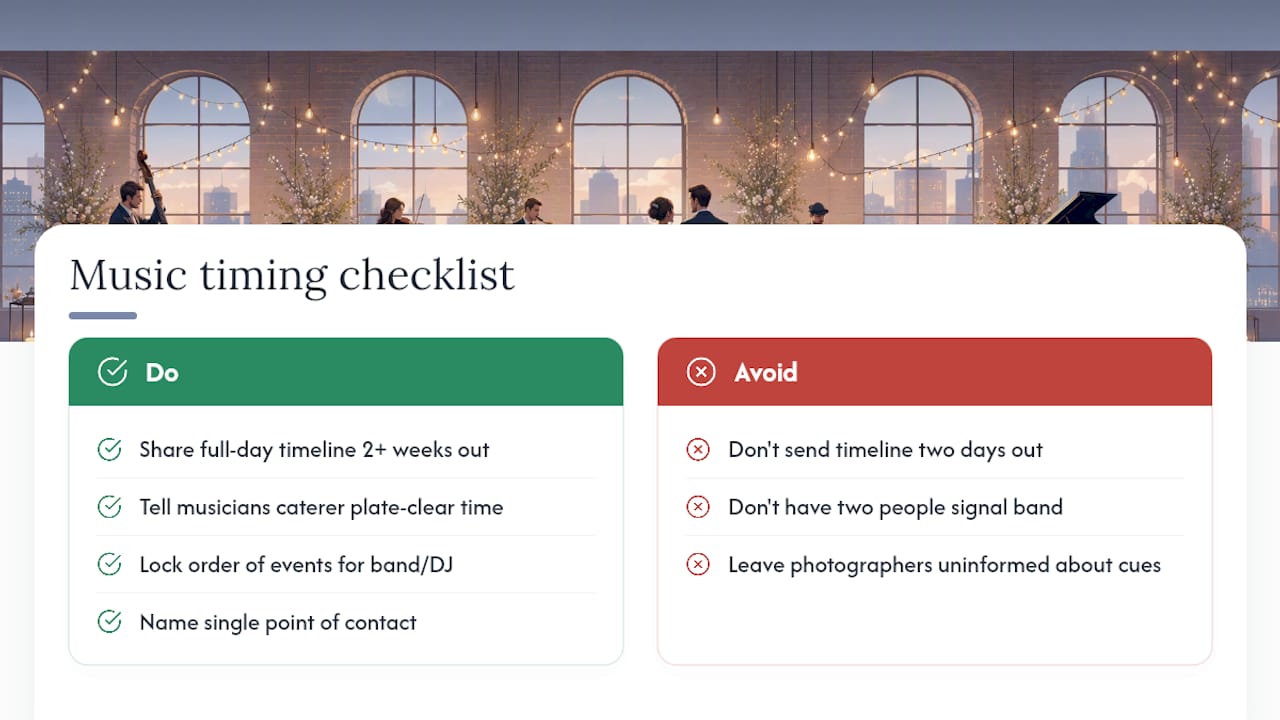
Share your full-day schedule with your musicians at least two weeks out, not two days out. Dinner service timing affects when ambient background music should shift into speeches, and speeches affect when the band can start building back toward dance energy. If your caterer needs 20 minutes for plate clearing before toasts, your musicians should know to stretch the dinner set rather than run out of material.
Photographers benefit from knowing exactly when the first dance and cake cutting happen, since those moments often require a slight music cue, like a song fading in as the couple takes the floor. Give your band or DJ a locked-in order of events, even if timing shifts by ten or fifteen minutes on the day.
Loft venues frequently combine ceremony and reception in the same room with a quick turnover, which means your florist, rental company, and musicians may all be working in the same footprint within minutes of each other. Loop your planner in on where the band sets up during the flip so nobody's tuning a cello while chairs are being stacked around them.
A single point of contact, usually your planner or the bandleader, should hold the master timeline and cue every transition. Two people trying to signal the band at once is how cues get missed.
Managing Noise Restrictions and Venue Sound Policies
Many loft venues sit inside converted commercial buildings with residential neighbors upstairs or next door, which means noise ordinances and venue-specific curfews are common. Ask the venue directly for their decibel limit and cutoff time in writing, not just verbally during the tour.
Some lofts install sound limiters that cut power automatically if levels spike past a set threshold. If yours has one, tell your musicians before the wedding, not during sound check. A band caught off guard by a limiter mid song can lose momentum on the dance floor at exactly the wrong moment.
If there's a hard curfew, plan your reception timeline backward from it. Push speeches and formalities earlier so the dance portion has room to breathe before the cutoff, rather than cramming everything into a rushed final hour.
Ask whether the venue requires music to move indoors after a certain hour if any part of your event uses an outdoor terrace or rooftop attached to the loft. Some buildings allow outdoor music until early evening and require everything to shift inside after that. Confirm this during your initial venue walkthrough, and pass the restriction along to your musicians so they can plan the setlist and volume curve around it instead of finding out mid reception.
What I've Learned Performing in Loft Venues
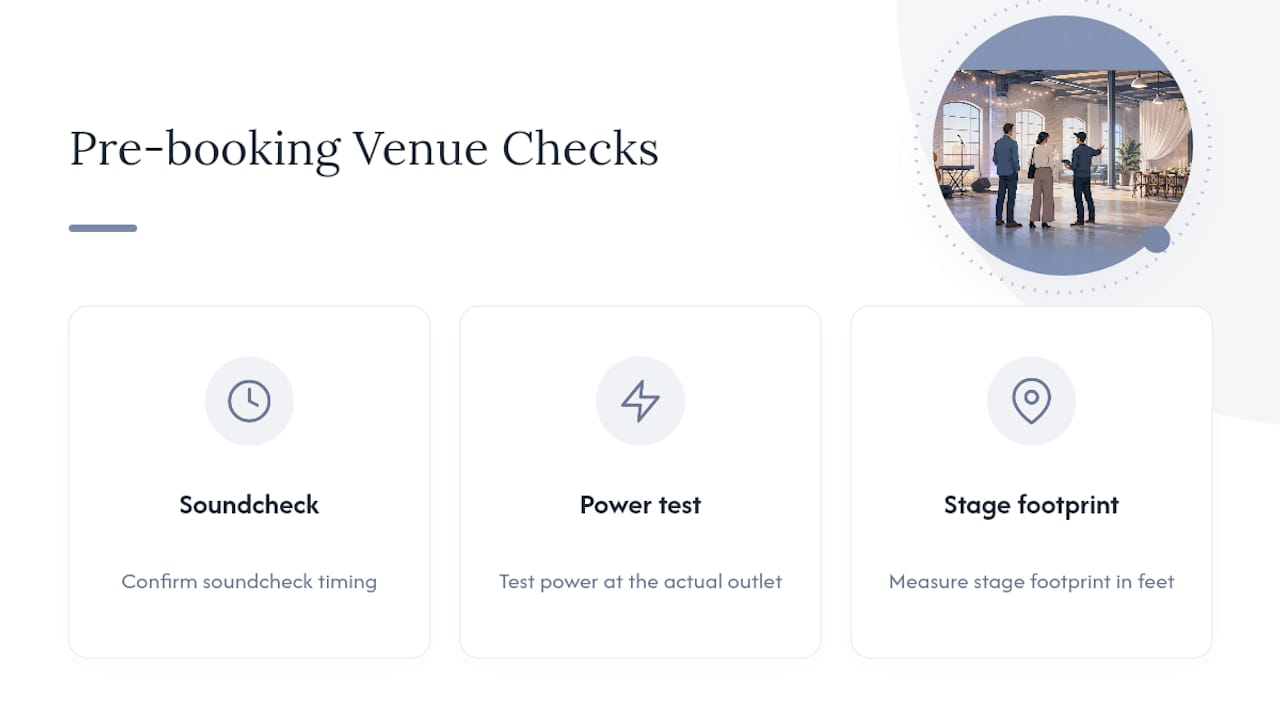
Before accepting a loft gig, I always confirm three things: soundcheck timing, a power test at the actual outlet the band will use, and the real stage footprint measured in feet, not guessed from a floor plan. Loft owners often underestimate how much space a six-piece band with a keyboard rig actually needs.
Small changes make the biggest difference. Swapping a full string quartet for a trio in a particularly echoey space cleaned up the sound more than any EQ adjustment could. Adding a few strategically placed fabric baffles behind the stage cut down harsh reflections in one venue enough that guests could hear the vows from the back row. Low-profile mic stands instead of tall boom stands kept sightlines clear for photographers without sacrificing sound quality.
The couples who have the smoothest day are almost always the ones who let their musicians see the room before the wedding, even just through photos or a video call.
— Alex
Ready to Book Live Music for Your Loft Wedding?
Some music service providers specialize in open, reverberant spaces where controlled, professional sound matters more than a larger band, offering options such as jazz trios, string quartets, solo piano, and DJ or hybrid live-DJ setups, each scalable to a venue's footprint, often providing video samples for clients to assess the sound in a real room before booking.

A consultation covers your venue's layout, your ceremony-to-reception timeline, and which ensemble configuration fits your space and guest count. From there you'll get a written proposal with clear pricing, so there's no guessing about what's included. Browse wedding reception band options or explore the full range of services to see ensemble sizes and sample clips, then request availability for your date to get a straight answer on pricing and logistics before you sign with anyone.
Sources
For deeper acoustic guidance, see Heyda's venue acoustics resource and Cap City Band's entertainment planning checklist. For vendor vetting, read common wedding music planning mistakes on the Alex Levin Music blog.