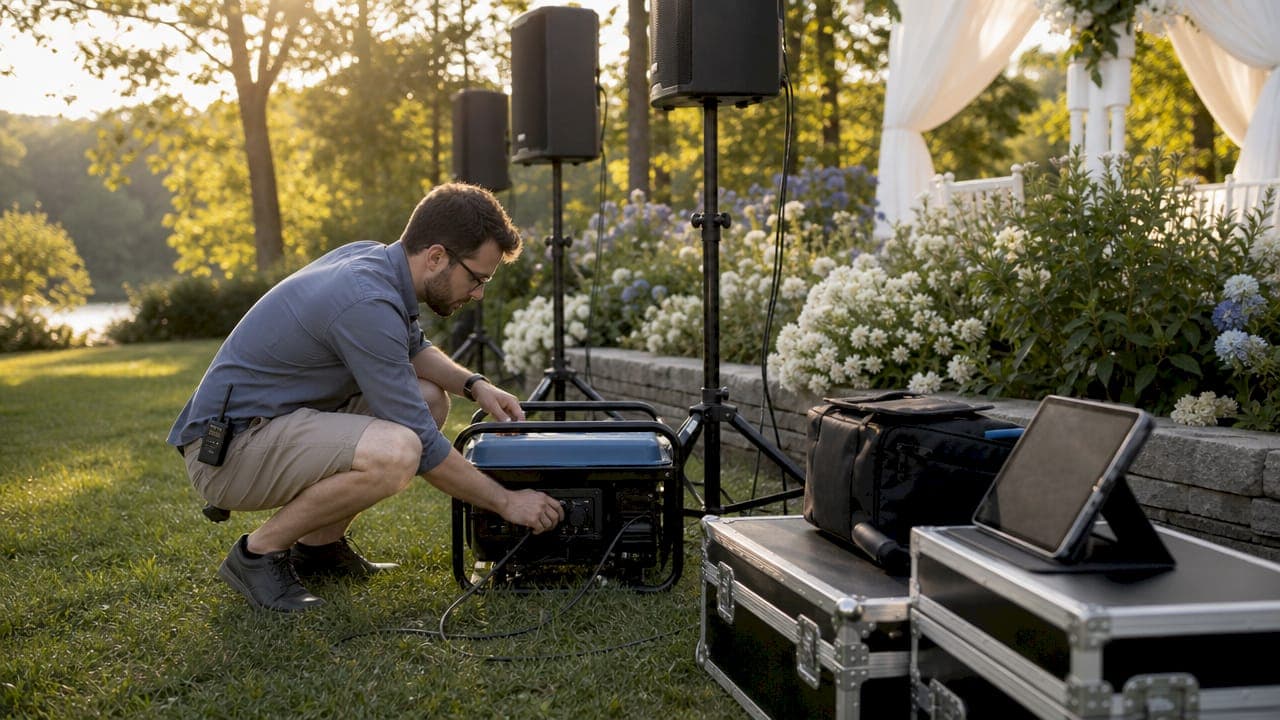
Outdoor wedding live music logistics is the full process of planning sound systems, power supply, weather readiness, and vendor coordination to deliver a flawless live performance at an open-air wedding. Unlike indoor events, outdoor venues strip away every acoustic advantage: no walls, no ceiling, and no natural sound reflection. That means every decision about speakers, power circuits, and timing carries real consequences. Get these details right, and live music becomes the emotional centerpiece of your wedding day. Miss them, and you risk audio dropouts, weather delays, and frustrated guests.
What are the essential equipment and power requirements for outdoor live music?
Sound behaves differently outside. Outdoor music has no acoustic reflections, so sound dissipates quickly without proper speaker placement. A single high-volume stack that works fine in a ballroom will leave half your guests straining to hear. The fix is a distributed speaker system: four to six medium-output speakers spread across the space, each covering a defined zone.
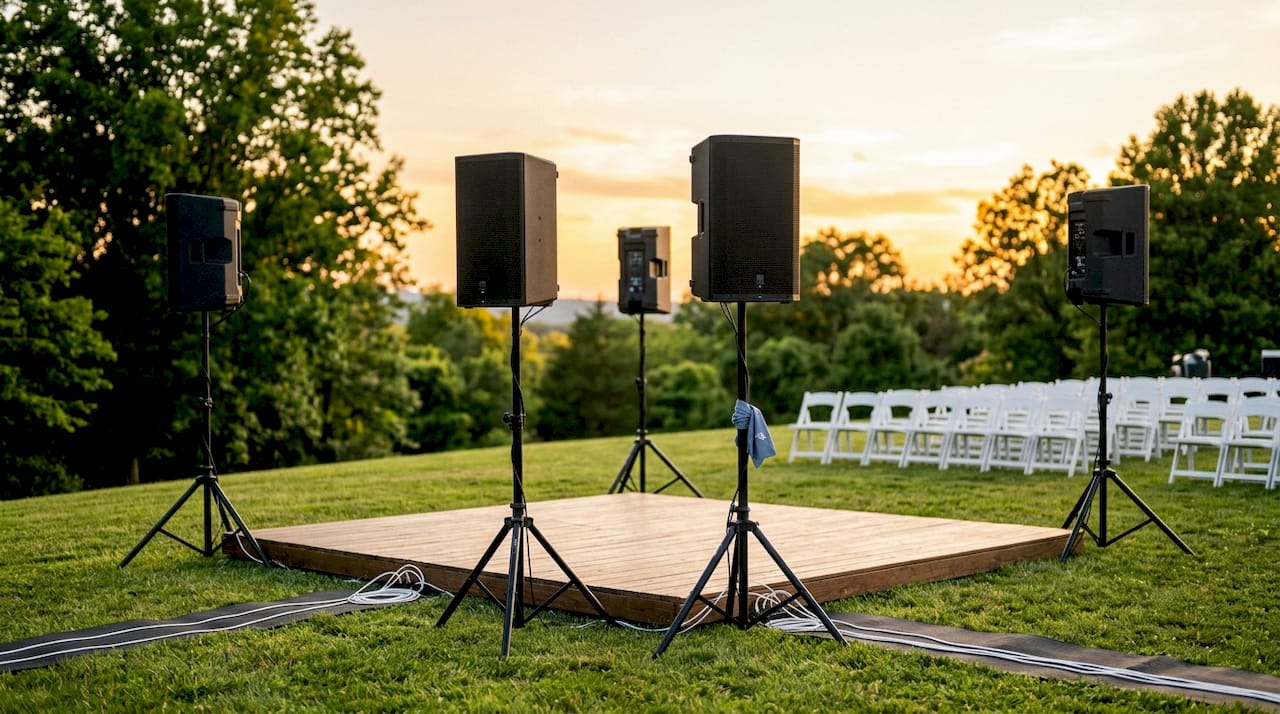
Power is the second critical variable. Mid-size outdoor productions require 3,500–5,000 watts, while larger setups with full bands and stage lighting can demand 7,500 watts or more. That scale means a standard residential outlet is never enough. You need a dedicated generator or confirmed venue power with enough capacity confirmed in writing before the event date.
Bands add another layer of complexity. Live bands need two separate dedicated circuits: one for sound gear and one for lighting. Mixing both on a single circuit creates an audible buzz in the speakers and risks equipment failure mid-performance. Confirm this requirement with your venue coordinator at least 60 days out.
Power protection matters just as much as power supply. An Uninterruptible Power Supply (UPS) connected to key audio equipment prevents brief power blinks from cutting the music during a first dance or ceremony processional. A UPS acts as a battery buffer, keeping gear running through momentary outages.
Equipment checklist for outdoor wedding music setup
- Distributed speaker system: Four to six medium speakers placed at audience level, not a single elevated stack
- Dedicated power circuits: Separate circuits for audio and lighting to eliminate interference
- Generator or venue power: Confirmed capacity of 3,500–7,500+ watts depending on production size
- Surge protectors and UPS devices: Protect audio gear from power fluctuations and brief outages
- Outdoor-rated extension cords: 12-gauge or heavier cords are required outdoors; residential-grade cords are a safety and insurance violation
- Heavy-duty cable ramps: Cover all floor cables crossing guest walkways to prevent trips and comply with venue safety rules
Pro Tip: Ask your venue for a written power diagram showing outlet locations, circuit ratings, and breaker access points. This single document prevents 90% of power disputes on the day of the event.
| Equipment | Outdoor requirement |
|---|---|
| Speaker system | Distributed array, 4–6 units |
| Power supply | 3,500–7,500+ watts, dedicated circuits |
| Extension cords | 12-gauge outdoor-rated minimum |
| Power protection | UPS for audio, surge protectors throughout |
| Cable management | Heavy-duty cable ramps over all walkways |
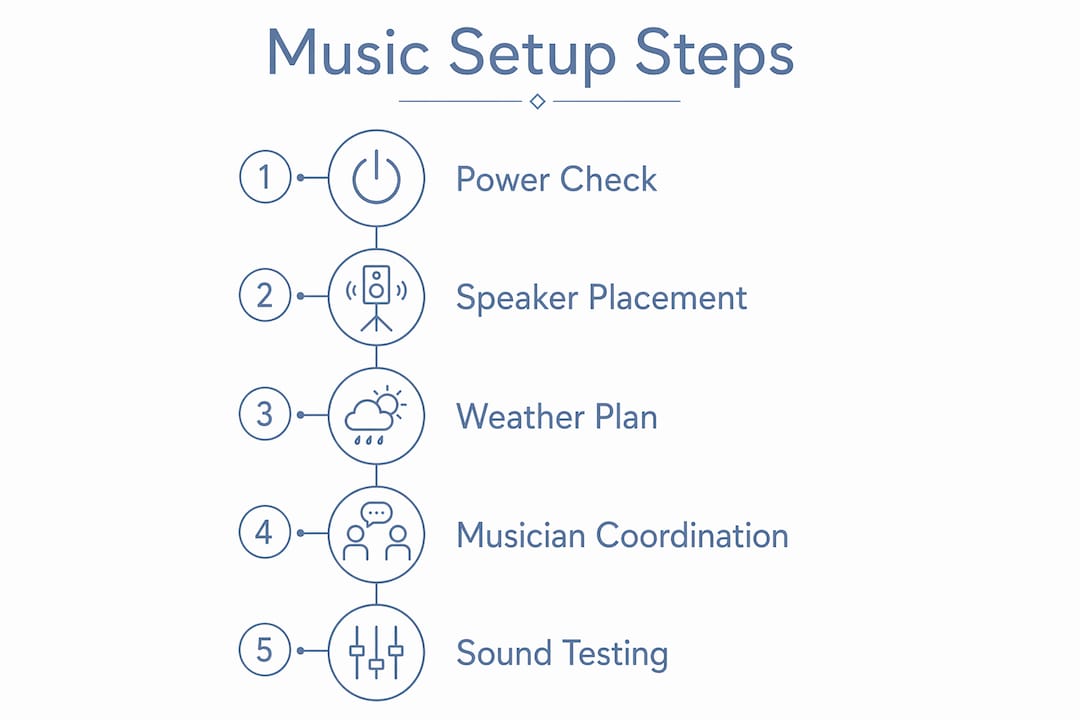
How to plan for weather contingencies and venue coordination?
Weather is the single biggest threat to outdoor wedding live music. A written weather contingency plan is non-negotiable. It should name the person who makes the go/no-go call, set a decision deadline (typically 48–72 hours before the event), and identify a backup indoor location with its own confirmed power access.
Even light winds of 10 mph degrade audio quality outdoors. Wind scatters sound, pushes it away from guests, and creates handling noise in microphones. A covered stage, canopy, or marquee solves two problems at once: it protects musicians and equipment from rain, and it provides a partial acoustic barrier that keeps sound directed toward the audience.
Musicians need level, stable performance surfaces, shade from direct sun, and shelter from rain. A grand piano left in direct sunlight for two hours before a ceremony will go out of tune. A string quartet performing on uneven grass risks injury and instrument damage. These are not preferences. They are safety requirements that belong in your vendor contract.
Venue coordination requires more lead time outdoors than indoors. Confirm sound policies, noise ordinances, and cutoff times in writing. Many outdoor venues in suburban and rural areas have local noise restrictions that cap amplified sound at a specific decibel level or require music to stop by 10 p.m. Discovering this on the wedding day is a planning failure, not bad luck.
Steps for weather and venue coordination
- Draft a written contingency plan at least 90 days before the wedding, naming decision makers and backup locations.
- Inspect the performance surface in person. Confirm it is level, firm, and shaded or coverable.
- Request a venue power diagram showing circuit locations, ratings, and breaker access.
- Confirm noise ordinances and amplified sound cutoff times in writing with the venue.
- Schedule load-in time generously. Outdoor setup takes longer than indoor due to equipment transport and uneven terrain. Build in at least 90 extra minutes for soundcheck.
- Assign a weather monitor to track forecasts in the 72 hours before the event and brief all vendors on the contingency protocol.
Pro Tip: Book a covered stage or canopy as a standard item in your budget, not as a weather-dependent add-on. Waiting until rain is forecast means paying premium rates or going without.
How to select and coordinate live musicians for an outdoor wedding?
Choosing the right ensemble starts with your venue size and power availability. A 10-piece band with a full horn section sounds incredible, but it requires substantial power, a large stage footprint, and extended setup time. A jazz trio or string quartet delivers elegance with a fraction of the logistical load. Match the ensemble size to what your venue can realistically support before you fall in love with a lineup. Alexlevinmusic offers wedding ensembles and soloists ranging from solo piano to full jazz bands, making it straightforward to find the right fit for your outdoor space.
Coordination is where most outdoor wedding music plans break down. A single point person should manage all live music logistics using a shared master document that tracks the timeline, song lists, arrival times, and vendor contacts. Without this, musicians arrive at the wrong entrance, soundcheck runs into cocktail hour, and the ceremony processional starts late.
Key coordination tasks for live music at outdoor weddings
- Confirm arrival and load-in times with musicians at least two weeks before the event, not just at booking
- Share a detailed run-of-show document covering ceremony start, cocktail hour, dinner, and reception transitions
- Assign a single on-site contact who can answer musician questions and relay real-time updates
- Plan music transitions between ceremony, cocktail hour, and reception so there are no silent gaps
- Brief musicians on the venue layout including parking, load-in access, and restroom locations
- Discuss briefing your band in detail before the event to align on set lists, timing cues, and dress code
Timing cues deserve special attention outdoors. Wind, ambient noise, and distance make it harder for musicians to hear verbal cues from a coordinator. Use visual signals or a dedicated earpiece for the bandleader so that processional starts, first dance cues, and toasts happen exactly on schedule.
What common pitfalls should you avoid with outdoor live music?
The most expensive mistakes in outdoor wedding music planning are predictable. Knowing them in advance is the difference between a smooth event and a crisis.
- Underestimating power needs. Couples assume a venue's standard outlets will handle a full band. They rarely do. Confirm wattage capacity before signing any music contract.
- Using residential extension cords. Thin, household-grade cords overheat outdoors and create fire and shock risks. Only 12-gauge or heavier outdoor-rated cords meet safety and insurance standards.
- Ignoring speaker placement. A single speaker stack pointed at the dance floor leaves ceremony guests unable to hear vows. Plan speaker zones for each phase of the event separately.
- Skipping the written contingency plan. Verbal agreements about rain backup plans dissolve under pressure. Every weather decision must be documented and shared with all vendors.
- Poor cable management. Unsecured cables crossing guest walkways are a trip hazard and a liability. Heavy-duty cable ramps are a required safety measure, not an optional upgrade.
"Couples often underestimate the complexity of outdoor live music logistics, assuming it will be similar to indoor setups." The gap between that assumption and reality is where most outdoor wedding music problems originate.
Avoid common wedding music planning mistakes by treating the technical side of live music with the same attention you give the song selection. Both matter equally to the guest experience.
Key Takeaways
Outdoor wedding live music logistics requires confirmed power capacity, distributed speaker placement, a written weather contingency plan, and a single coordinator managing all vendor communication.
| Point | Details |
|---|---|
| Power capacity first | Confirm 3,500–7,500+ watts of dedicated power before booking any ensemble. |
| Distributed speakers | Use four to six medium speakers across zones, not a single high-volume stack. |
| Written weather plan | Document the decision maker, timeline, and backup location at least 90 days out. |
| Single coordinator | One person with a shared master document prevents timeline failures and miscommunication. |
| Safety compliance | Use 12-gauge outdoor-rated cords and cable ramps on every walkway without exception. |
What I've learned from years of outdoor wedding performances
Couples spend months choosing the perfect song for their first dance and minutes thinking about where the power comes from. I understand why. The music feels personal. The logistics feel like someone else's job. But after performing at outdoor weddings across Philadelphia, New York, and beyond, I can tell you: the logistics are the music. A beautiful song played through a buzzing, underpowered speaker system is not beautiful anymore.
The detail that catches most couples off guard is the timeline. Outdoor setup genuinely takes longer than indoor. Uneven ground, longer cable runs, generator placement, and soundcheck on an open-air stage all add time. I have arrived at venues where the coordinator scheduled soundcheck for 30 minutes before guests arrived. That is not enough. Build 90 minutes of buffer into your setup window and protect it.
The other thing I have seen make or break outdoor events is the single-coordinator model. When the venue, the musicians, and the wedding planner are all answering to different contacts, information gets lost. One person with a shared document and the authority to make real-time calls changes everything. If you are planning music flow from ceremony through reception, that coordinator is the most important hire you make after the musicians themselves.
— Alex
Live outdoor wedding music, handled professionally by Alexlevinmusic
Planning live music for an outdoor wedding is genuinely complex. The right ensemble, the right power setup, and the right coordination all have to come together on the same day, in the same place, regardless of weather.

Alexlevinmusic specializes in exactly this. From jazz trios and string quartets to full bands and DJ services, every booking includes professional coordination of sound requirements, load-in logistics, and event timing. Couples and planners in Philadelphia, New York, and surrounding areas trust Alexlevinmusic to handle the technical details so the music speaks for itself. Live music at weddings creates moments a playlist simply cannot replicate. Reach out to discuss your outdoor wedding date and get a tailored recommendation for your venue and vision.
FAQ
What power supply does a live band need outdoors?
Most mid-size live band setups require 3,500–5,000 watts of dedicated power, with larger productions needing 7,500 watts or more. Bands also need two separate circuits: one for audio and one for lighting, to prevent interference.
How do you handle sound quality issues outdoors?
Outdoor venues have no acoustic reflection, so sound dissipates fast. A distributed system of four to six medium speakers placed at audience level delivers far better coverage than a single high-volume stack.
What should a weather contingency plan include?
A written weather contingency plan should name the decision maker, set a go/no-go deadline of 48–72 hours before the event, and confirm a backup indoor location with its own power supply.
How early should musicians arrive for an outdoor wedding?
Outdoor setup takes longer than indoor due to terrain, longer cable runs, and generator placement. Musicians and sound crews should arrive at least 90 minutes earlier than they would for a comparable indoor event.
Who should coordinate live music logistics on the wedding day?
One designated point person should manage all live music logistics using a shared master document covering the timeline, song lists, and vendor contacts. This prevents the communication breakdowns that cause delays and missed cues.