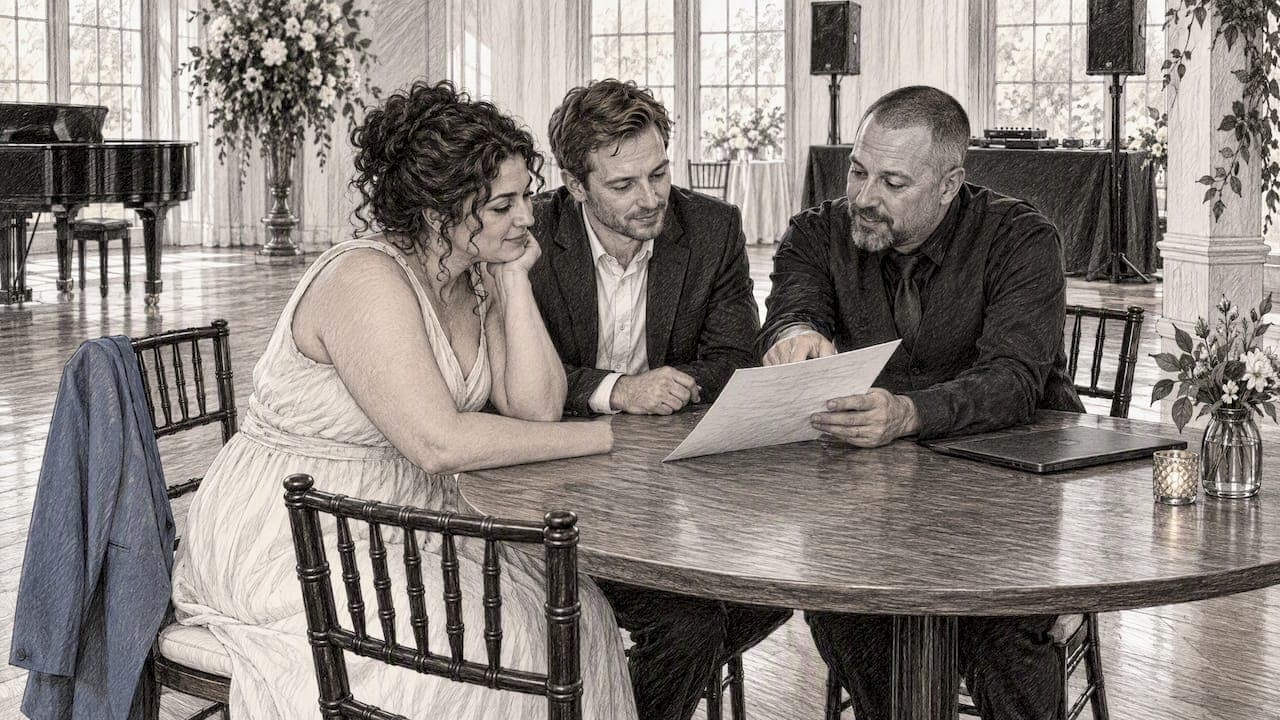
A wedding do-not-play list is a short, written record of songs you want kept off your reception playlist, handed directly to your DJ or band before the big day. It exists to protect your dance floor and the mood you're building all night. The single move that matters most: put this list in your vendor packet and walk through it with your DJ or band during your final planning call.
TL;DR:
- Common flags include choreographed line dances, overplayed hits, novelty songs, breakup anthems, explicit lyrics, and crowd splitters such as Sweet Caroline.
- Separate songs into absolute bans and tracks to avoid unless requested, giving your DJ room to handle guest requests without crossing firm boundaries.
- Send a single page list with the reasoning behind each ban in your final vendor packet well before the wedding, not on the morning.
- Build 30 minute buffers around major moments and 5 minute buffers around smaller transitions, allowing your DJ to adjust timing rather than chase exact cues.
- Ask your DJ about substitutes, edits, key changes, or mashups before banning a song guests may want, particularly when its chorus is recognizable.
Table of Contents
- 1. The songs couples flag most often
- 2. Why these particular songs cause problems
- 3. How to build and share your list with vendors
- 4. Smart replacements that keep the energy up
- 5. What musicians actually think of these lists
- Let us handle the playlist and the boundaries
- FAQ
- Sources
1. The songs couples flag most often
Most "do not play" requests fall into the same handful of buckets: line dances that split the room, pop hits everyone's heard a thousand times, novelty songs that feel out of place at a formal event, breakup anthems, and anything with lyrics that clash with the tone you want. The Knot's rundown of commonly skipped wedding songs gives a useful starting list of 26 tracks couples flag again and again, and the categories below echo that pattern.
Line dances and choreographed group songs
- The Chicken Dance
- Electric Slide
- Cupid Shuffle
- Cha-Cha Slide
- Macarena
- Cotton Eye Joe
These songs force a structured routine onto a crowd that may include guests who have no idea what the steps are, and they tend to clear the floor of anyone who isn't already a fan.
Overplayed pop and radio staples 7. Uptown Funk 8. Don't Stop Believin' 9. Wagon Wheel 10. September 11. I Gotta Feeling 12. Shut Up and Dance
These aren't bad songs. They're just the songs guests have heard at every wedding since 2015, and that familiarity can read as lazy rather than celebratory.
Novelty and children's songs 13. Baby Shark 14. The Macarena (again, for its novelty factor as much as its choreography) 15. Who Let the Dogs Out 16. Y.M.C.A.
Fun at a birthday party, awkward at a black-tie reception. These tend to shift the room's energy from elegant to chaotic fast.
Breakup and sad songs 17. Single Ladies (Put a Ring On It) 18. Someone Like You 19. Since U Been Gone 20. Before He Cheats 21. We Are Never Ever Getting Back Together
"Single Ladies" is a dance-floor favorite for some crowds, but its lyrics about being unattached and done with a relationship sit oddly at a wedding, which is why it shows up on nearly every do-not-play roundup.
Songs with explicit or off-tone lyrics 22. WAP 23. Blurred Lines 24. Any unedited rap or pop track with graphic language your grandparents will hear clearly
Genre traps and divisive crowd-pleasers 25. Sweet Caroline 26. Don't Stop the Music
Both are crowd-pleasers for some guests and eye-rollers for others, landing on the list less because they're bad songs and more because they split the room so cleanly.
Pro Tip: Mark each song as either an absolute ban or a "please avoid unless requested," so your DJ knows where there's real flexibility.

2. Why these particular songs cause problems
Tempo and phrasing matter more than most couples realize. Line dances like the Cupid Shuffle work because they're built around a repeated, predictable structure, but that same structure alienates anyone who hasn't memorized the steps, splitting your floor into dancers and spectators.
Lyrics matter too. A breakup anthem or an explicit verse can clash with the tone you're going for, especially with family members or older relatives within earshot. Novelty songs and forced singalongs create a similar social split: some guests love the shared moment, others feel put on the spot.
Overplay is its own category of damage. A song doesn't need bad lyrics or awkward choreography to wear out its welcome. Hearing the same hits at every wedding for a decade creates guest fatigue before the first chorus even ends, and DJs report that forced-participation songs often produce more eye-rolling than enthusiasm once the novelty wears off.

3. How to build and share your list with vendors
Keep the list workable. Aim for a reasonable number of absolute bans (songs that never play under any circumstance) and a larger number of "discouraged" tracks your DJ can use judgment on if a guest specifically requests one. A list longer than that starts to feel like a restriction on the vendor's expertise rather than guidance.
Timing matters as much as song choice. The 30-5 minute rule, a general wedding-planning guideline, suggests building a 30-minute buffer around major moments like the first dance or cake cutting, and a 5-minute buffer around smaller transitions like moving from cocktail hour to the reception. Apply that same buffer thinking to your music: give your DJ breathing room to adjust the set rather than hitting cues to the second.
Share the list as a one-page document, a simple Google Doc works fine, and include it in your final vendor packet alongside your ceremony timeline. Give your DJ or band reading copy well before the wedding, not the morning of. And leave room for their judgment: a good musician can swap a banned song for something in the same spirit without you having to spell out every alternative, which is often more useful than a line-by-line ban.
4. Smart replacements that keep the energy up
Swapping out a song doesn't mean losing the moment it was meant to create. For line dances, upbeat tracks with a strong beat but no required choreography (think classic Motown or funk) keep the floor moving without splitting the crowd. For overplayed pop hits, newer chart-toppers or genre-specific favorites your DJ knows well can hit the same energy without the deja vu.
For "Sweet Caroline" style singalong moments, ask your DJ about tracks with a strong, recognizable chorus but less wedding-circuit mileage. And before banning a song outright, consider asking your DJ for a shortened edit, a key change, or a mashup. Often that's a better fix than cutting a song your guests might genuinely want.
5. What musicians actually think of these lists
A clear, well-organized list makes our job easier, not harder. We translate your bans into a working set list almost instantly when the reasoning is included, and a short conversation about your priorities beats a long document every time.
— Alex
Let us handle the playlist and the boundaries
Handing a vendor a list is one thing. Having a musician who actually reads it, understands the reasoning, and builds a set around it in real time is another. We offer live music booking built around exactly this kind of collaboration, so your do-not-play list becomes part of a set plan instead of a sheet of paper nobody checks mid-reception.
Our services cover the moments where a do-not-play list matters most:
- Reception Music: live band performance that works your list into a full night of song choices, starting from $3,000.
- DJ & Hybrid Music: a DJ and live musician combination for couples who want both flexibility and a live-band feel, starting from $3,000.
- Ceremony Music and Cocktail Hour Music: coordinated playlist control from the moment guests arrive, both starting from $3,000.
If you're weighing a DJ against live musicians, a helpful outside resource on selecting a wedding DJ walks through what to ask before you book. When you're ready to talk through your own reception, reach out to discuss your date and playlist priorities.
FAQ
What are good do-not-play songs for a wedding?
Common picks include line dances like the Cupid Shuffle and Electric Slide, overplayed hits like Uptown Funk, and breakup songs like Single Ladies. These recur across wedding-music roundups, including The Knot's list of 26 songs couples frequently flag.
What are the top songs couples most often skip at weddings?
Among the most frequently mentioned are songs such as the Chicken Dance, Cotton Eye Joe, Macarena, Baby Shark, and Sweet Caroline, largely because they are either overplayed, divisive, or built around forced group participation. Reasons vary by couple, but overplay and awkward lyrics top the list.
What is the 30-5 minute rule for weddings?
The 30-5 minute rule is a timing guideline that builds a 30-minute buffer around major event moments and a 5-minute buffer around smaller transitions. Applying it to music means giving your DJ flexibility to adjust timing around key moments instead of locking every song to an exact minute.
Should I give my DJ a do-not-play list?
Yes. Coverage from The New York Times on wedding music notes that couples increasingly hand DJs do-not-play lists, and DJs report that context behind each ban helps them pick better replacements than a blanket "no."
Sources
- These 26 "Do Not Play" Wedding Songs Are a Hard Pass
- For Perfect Wedding Day Music, Couples Give D.J.s ‘Do Not Play’ Lists - The New York Times