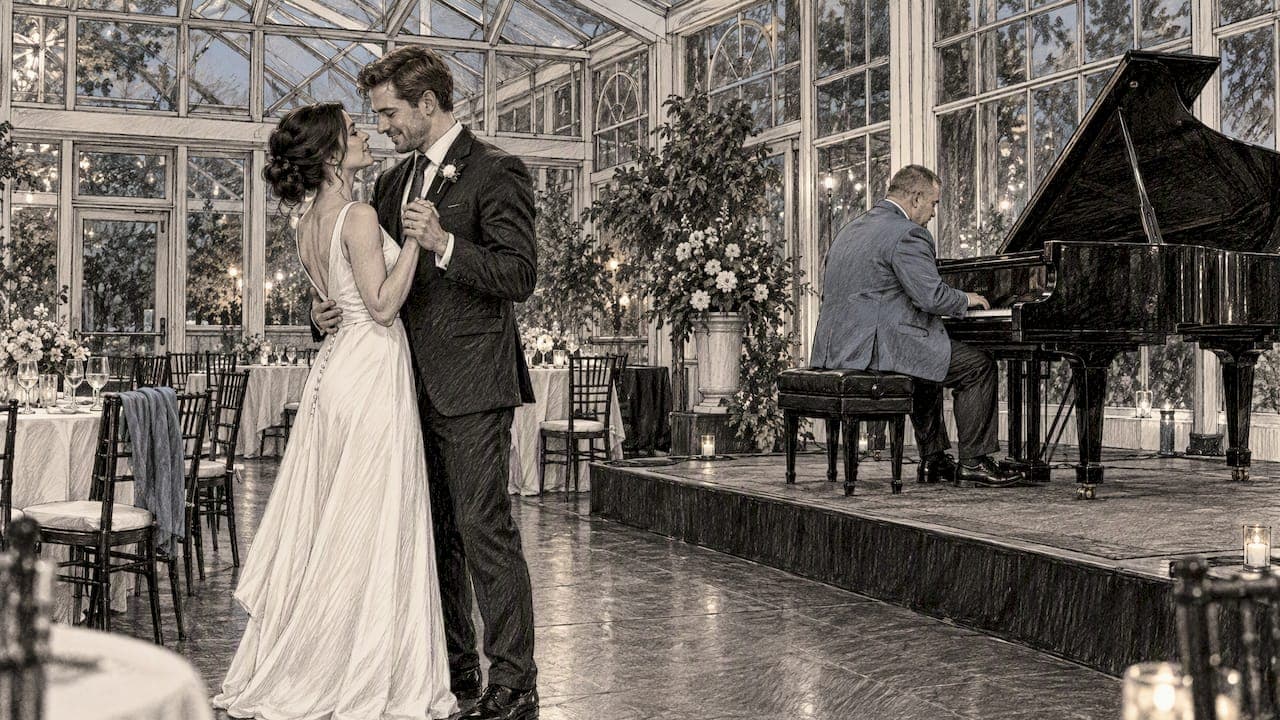
A must-play wedding song is one that reliably pulls guests of every age onto the dance floor or genuinely moves the room, not just a personal favorite. Songs like "Uptown Funk," "I Wanna Dance with Somebody," and "At Last" belong on almost every list for exactly that reason. Use the categorized picks and moment-by-moment map below as a starting point, then hand your final version straight to your DJ or band.
TL;DR:
- Choose 10 to 15 anchor songs across classics, dance tracks, romantic picks, and personal favorites, then assign each to a specific reception moment.
- Allow about 60 minutes for cocktail hour and 60 to 90 minutes for dinner; open dancing with three to five energetic songs.
- Give your DJ or band 15 to 20 priority songs, a do not play list of 10 to 20 songs, and three to five reserve tracks.
- Usually, professional vendors and most reception venues handle licensing; confirm coverage for a private, unlicensed space or your own playback system.
- Match arrangements to the room: reverberant chapels suit smaller ensembles, while open barns and tents need stronger amplification and simpler arrangements.
Table of Contents
- 1. Must-Play Songs by Category
- 2. Mapping Must-Play Songs to Every Wedding Moment
- 3. Steps to Build a Playlist That Actually Flows
- 4. How Live Musicians Adapt Must-Play Songs
- 5. Handling Guest Requests Without Losing Control of the Night
- 6. Licensing Rules for Playing Popular Songs at Your Wedding
- 7. Matching Song Choices to Your Venue's Acoustics
- 8. Customizing Must-Play Songs for Your Wedding's Style
- 9. What Years of Playing Receptions Teaches You About a Crowd
- Let Live Music Carry Your Must-Play List
- FAQ
- Sources
1. Must-Play Songs by Category
Every strong wedding playlist pulls from a few proven buckets: timeless classics, high-energy dance tracks, slow romantic songs, a few unexpected picks for personality, and party anthems from other genres. Mixing all five keeps the floor full and the room emotionally engaged.
Classic hits work any time after dinner and especially well as the night opens up:
- Stevie Wonder, "Signed, Sealed, Delivered I'm Yours"
- Marvin Gaye, "Ain't No Mountain High Enough"
- The Temptations, "My Girl"
- Etta James, "At Last"
- Frank Sinatra, "Fly Me to the Moon"
- Earth, Wind & Fire, "September"
- Whitney Houston, "I Wanna Dance with Somebody"
- ABBA, "Dancing Queen"
- Neil Diamond, "Sweet Caroline"
- Journey, "Don't Stop Believin'"
- The Jackson 5, "I Want You Back"
- Van Morrison, "Brown Eyed Girl"
- Al Green, "Let's Stay Together"
Upbeat and dance tracks are the backbone of the party once things get going:
- Bruno Mars, "Uptown Funk"
- Justin Timberlake, "Can't Stop the Feeling!"
- Beyoncé, "Crazy in Love"
- Mark Ronson ft. Bruno Mars, "Uptown Funk"
- Daft Punk, "One More Time"
- Lizzo, "About Damn Time"
- Dua Lipa, "Levitating"
- Usher, "Yeah!"
- Michael Jackson, "Don't Stop 'Til You Get Enough"
- Kool & The Gang, "Celebration"
Romantic and slow songs anchor first dances, parent dances, and quieter moments:
- Etta James, "At Last"
- Ed Sheeran, "Perfect"
- Elvis Presley, "Can't Help Falling in Love"
- John Legend, "All of Me"
- Norah Jones, "Come Away with Me"
- Frank Sinatra, "The Way You Look Tonight"
- Christina Perri, "A Thousand Years"
- Louis Armstrong, "La Vie en Rose"
Unique and alternative picks give the set personality without sacrificing energy:
- Harry Styles, "As It Was"
- Fleetwood Mac, "Dreams"
- Hall & Oates, "You Make My Dreams"
- Tame Impala, "The Less I Know the Better"
- Vampire Weekend, "A-Punk"
Cultural and genre party songs keep a mixed crowd engaged, especially during the open dance set:
- Marc Anthony, "Vivir Mi Vida"
- Los Del Rio, "Macarena"
- Daddy Yankee, "Gasolina"
- Whitney Houston or Bill Withers for soul lovers, "Lovely Day"
- Earth, Wind & Fire, "Boogie Wonderland" for a disco turn
Editorial roundups like The Knot's reception song list show how these categories repeat across hundreds of curated picks, which is a good sign that the songs above have staying power rather than being a passing trend.
2. Mapping Must-Play Songs to Every Wedding Moment
A must-play list only works when it is organized by moment, not just by vibe; coordinating music with video coverage ensures seamless reception flow as explained in Ten Questions to Ask a Wedding Videographer. Each part of the reception calls for a different tempo and purpose.
- Prelude (about 30 minutes): soft instrumental or acoustic songs as guests arrive and find seats, such as light jazz standards or acoustic covers.
- Processional and recessional: one or two songs each, chosen for pacing rather than lyrics; these work best performed live since tempo can be adjusted to match the walk. Our processional song guide breaks these down by wedding party role.
- Cocktail hour (about 60 minutes): 15 to 20 relaxed songs, often jazz or acoustic pop, that support conversation instead of competing with it.
- Dinner (60 to 90 minutes): mellow, familiar songs at low volume, mixing classics with a few romantic picks.
- First dance: one song, usually a recorded studio version or a custom live arrangement if you want something personal.
- Parent dances: one song per dance, typically slower and sentimental.
- Dance-floor openers: three to five high-energy songs to pull the whole room in at once, such as "Uptown Funk" or "Celebration."
- Grand exit: one short, celebratory song, often under three minutes, to close the night on a high note.
A detailed reception music checklist lays out timing for each of these segments if you want a printable version to share with your planner.
3. Steps to Build a Playlist That Actually Flows
- Decide your overall vibe (classic, modern, eclectic) before picking individual songs.
- Choose 10 to 15 anchor must-play songs that represent that vibe across categories.
- Map those songs to specific moments using the structure above.
- Plan a tempo curve: start mellow, build gradually, peak in the middle of the dance set, then ease into the exit song.
- Give your DJ or band two short lists: a "must-play" list of 15 to 20 songs and an "if possible" list for extras.
Transitions matter as much as song choice. A skilled DJ or band uses medleys and segues to avoid dead air between tempo shifts, which keeps guests on the floor instead of walking off between tracks.
Pro Tip: Keep 3 to 5 reserve songs in your back pocket for when the floor needs a jolt, and limit your Do-Not-Play list to 10 to 20 songs so your DJ or band still has room to read the room.
Our 10 tips for building a reception playlist go deeper on pacing if you want a fuller walkthrough.
4. How Live Musicians Adapt Must-Play Songs
A skilled trio or band does not just replay the studio version of a must-play song. We shorten intros so a familiar track keeps energy high without delaying the moment it is meant to support, and we often shift the groove toward a swing or Latin feel while keeping the melody recognizable. For a first dance, that might mean a stripped piano arrangement; for the dance floor, it might mean a tight horn-driven cover that hits harder live than the recording. A live ensemble shines during cocktail hour and ceremony moments, where tempo flexibility and real-time reading of the room matter most. Brief your musicians with your must-play list in advance so they can build arrangements around it rather than improvising cold.
5. Handling Guest Requests Without Losing Control of the Night
Guests will ask for songs, and a good DJ or band treats that as part of the job, not a disruption. The cleanest approach is to give your vendor a prioritized must-play list and a short Do-Not-Play list before the event, then trust them to filter requests against it in real time.
Most pros will slot a reasonable request into a natural gap rather than interrupting your planned flow, and they will quietly decline anything on your Do-Not-Play list without making a scene of it. It helps to tell your DJ or band ahead of time how much flexibility you want them to have: some couples want every request screened by the planner, while others are happy to let the floor's energy guide last-minute calls.
Live musicians have an added advantage here. A band can often improvise a short instrumental nod to a request between songs, or work a line of a requested melody into a transition, without fully derailing the set. That kind of on-the-fly adjustment is one reason couples hire a live band or hybrid DJ/band setup instead of a fully pre-programmed playlist: the room gets handled, not just played to.
6. Licensing Rules for Playing Popular Songs at Your Wedding
Most wedding venues and hired performers handle music licensing as part of doing business, which means you rarely need to think about it directly. Professional DJs and bands typically operate under performance licenses, and most reception venues already carry the blanket licensing needed to allow popular recorded or live music on site. If you are planning a private, unlicensed venue or building your own playback system without a hired vendor, it is worth confirming with the venue what licensing coverage already applies before finalizing your song list. The short version: hiring a professional DJ or band for your reception music removes the licensing question from your to-do list almost entirely.
7. Matching Song Choices to Your Venue's Acoustics
A song that sounds perfect on a studio recording can fall flat in a cavernous barn or an echo-heavy stone chapel. Hard surfaces like tile, stone, and glass tend to amplify reverb, which can muddy fast, dense arrangements, while outdoor spaces swallow sound and demand more amplification or a tighter, punchier arrangement to cut through open air.
A string quartet or solo piano often performs better than a full band in a small, reverberant chapel, since fewer instruments mean less competing sound. A large tent or barn with high ceilings, on the other hand, usually calls for stronger amplification and simpler arrangements that stay clear at volume. Walking the venue with your musicians or DJ before the day, or at minimum sharing photos and room dimensions, lets them plan instrumentation and sound setup around the actual space instead of guessing.

8. Customizing Must-Play Songs for Your Wedding's Style
A must-play song does not have to sound the same at every wedding. A jazz trio can turn a pop anthem into a cocktail-hour-appropriate swing number, trading the original drum machine for a walking bass line and brushed drums. A swing band can push a familiar dance-floor hit into a big-band arrangement with horn lines that make it feel like a vintage celebration rather than a direct cover. A string quartet can take a romantic ballad and strip it down to strings alone, which often suits a formal or outdoor ceremony better than a full vocal track.
The key is matching the arrangement to the moment and theme, not just the song. For more on how live ensembles shape mood during less obvious moments like cocktail hour, our piece on cocktail hour soundscapes covers how instrumentation choices change the feel of a room. It is also worth reviewing common wedding music planning mistakes before finalizing requests, since a mismatched arrangement request is one of the easier things to avoid with a little planning.

9. What Years of Playing Receptions Teaches You About a Crowd
The songs that never fail are the ones that let every generation sing along at the same time. Watching a grandmother and a twelve-year-old both know every word to the same chorus tells you more about a song's staying power than any chart ever will.
— Alex
Let Live Music Carry Your Must-Play List
We build our entire approach around taking the songs you care about and performing them to match the mood and style of your event, adapting arrangements to suit each moment.
Our Ceremony Music, Cocktail Hour Music, Reception Music, and DJ & Hybrid Music services each start at $3,000, and every booking is shaped around your must-play list, your venue, and your style. If live music is part of how you want your reception to feel, check availability and get a quote for your date.
FAQ
What song is played most at weddings?
There is no single universally agreed "most played" song, but tracks like "I Wanna Dance with Somebody," "Dancing Queen," and "Sweet Caroline" show up repeatedly across major editorial and DJ-curated playlists as consistent favorites.
What are the top 10 songs for a wedding?
A strong top 10 typically blends classics, dance anthems, and one or two romantic songs, drawing from lists like those compiled by The Knot. Mixing eras and tempos matters more than hitting an exact ranked order.
What are the top 10 most requested wedding reception songs?
Commonly requested songs include "Uptown Funk," "I Wanna Dance with Somebody," "Dancing Queen," "Don't Stop Believin'," and "Sweet Caroline," based on patterns seen across large DJ playlists. These songs recur because they work across a wide range of ages and tastes.
What are the top 20 wedding songs of all time?
There is no official ranked list, but a solid top 20 would pull evenly from classic hits, upbeat dance tracks, and romantic songs covered in our category breakdown above. Combining sources like The Knot's roundup with your own must-play priorities gives a more useful list than any single ranking.
How many songs should be on a wedding reception playlist?
A full reception playlist, covering cocktail hour through the dance floor, usually runs 60 to 100 songs, following the moment-by-moment structure outlined in planning checklists. Your actual must-play list should stay much shorter, around 15 to 20 songs, so your DJ or band has room to read the crowd.
Sources
- 200 Wedding Reception Songs That Should Be on Your Playlist — The Knot
- Top 200 Most Requested Wedding Reception Songs 2026 - playlist by C West Entertainment | Spotify
- Your Wedding Music Checklist | Paperless Post