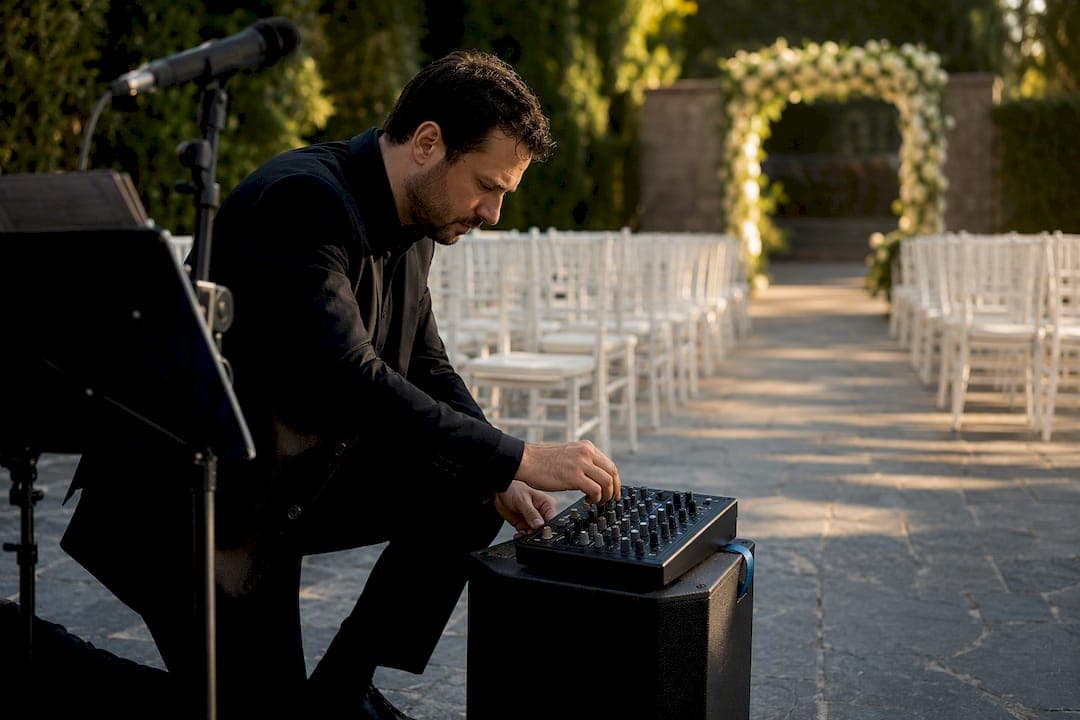
Every wedding ceremony sound setup comes down to five things: enough performance space, a confirmed power source, a weather or backup shelter plan, a clear amplification decision, and a scheduled arrival window with soundcheck time. Get those five written into the contract and run sheet, and the technical side of your ceremony music takes care of itself. Skip even one, and you're troubleshooting during the processional. Professional live music providers build all five into every ceremony booking as standard practice.
TL;DR:
- Most professional musicians arrive at least 60 to 90 minutes before the ceremony to set up and conduct soundchecks, ensuring smooth playback and mic levels.
- Detailed placement, power sources, and backup equipment are crucial, especially for outdoor sites or larger ensembles, to prevent technical issues during the event.
- Clear timing instructions, including exact start points and timestamps for songs, are essential to avoid delays and miscommunication during processional and recessional cues.
- Contracts should specify technical requirements, load-in details, weather contingencies, and explicit performance and equipment responsibilities to prevent disputes.
- Amplification should only be used for outdoor settings, large guest counts, or when the distance exceeds 30 to 40 feet, with smaller setups often projecting well without extra gear.
Table of Contents
- Building Your Ceremony Sound Setup Checklist
- How Do You Time Ceremony Music Cues Correctly?
- Does Your Ceremony Actually Need Amplification?
- What Belongs in Your Musician Contract?
- Ceremony Day: Arrival, Soundcheck, and Contingencies
- What Musicians Wish Every Couple Knew
- Booking Alex Levin Music for Your Ceremony
- Sources
- FAQ
Building Your Ceremony Sound Setup Checklist
The physical footprint musicians need changes with ensemble size, and most couples underestimate it. A solo pianist or guitarist needs a moderately sized pad near a power source. String quartets require a larger space and armless chairs to play comfortably. That last detail trips up more ceremonies than anything else. Cellists and violinists cannot play from chairs with arms, and a lot of ceremony sites default to folding chairs that block bowing.
Placement matters as much as square footage. Musicians should sit or stand where sound projects naturally toward guests, not off to a side where the first three rows hear everything and the back rows hear nothing. For outdoor sites, shade and a flat, dry surface protect both the players and the instruments, since direct sun warps wood and glare makes reading music difficult.
- Confirm exact footprint needed for your ensemble size and request armless chairs in writing if strings are involved
- Locate outlets near the performance area and ask whether extension cords are permitted
- Ask about battery or UPS backup for sites without reliable outdoor power
- Map the load-in path: nearest door, elevator access, and realistic walking distance from parking
- Clarify who supplies speakers, mics, and stands, and what backup equipment is expected on-site
Getting these venue details before you contact musicians lets them tell you exactly what to bring or request instead of guessing on the day.
Pro Tip: Ask the venue for photos of the actual ceremony spot at the time of day your ceremony starts. Afternoon sun that looks fine in a morning photo can blind a violinist an hour later.
How Do You Time Ceremony Music Cues Correctly?
A ceremony has five musical moments, and each one needs a different kind of instruction. The prelude plays as guests arrive, usually 20 to 30 minutes of background music with no strict cue. Seating music covers immediate family and wedding party entry. The processional (sometimes two, one for the wedding party and a separate one for the couple) needs a precise start point. Signing or ritual music fills quiet ceremonial moments like a unity ritual or program signing. The recessional closes things out as the couple exits.
Processional and recessional cues are where vague instructions cause problems. "Start when she starts walking" works fine when there's a live musician watching the door. But for a song with a slow intro, tell the musician exactly where the meaningful part begins, like "start at 0:48" or "skip the first verse, begin at the chorus." That precision matters more with recorded tracks than with live arrangements, since a musician can react to the room in real time.
- List every ceremony moment (prelude, seating, processional, signing, recessional) and assign one song to each
- Note timestamps for any song that needs to skip an intro or fade in mid-track
- Request custom arrangements early, since pop songs often need arrangement fees and extra rehearsal time
- Set a firm cutoff date for song changes, ideally two to three weeks before the wedding
- Hand a written cue sheet to your officiant, planner, or day-of coordinator, not just the musicians
Our guide to processional music selection covers song pacing in more detail if you're still choosing.
Does Your Ceremony Actually Need Amplification?
Amplification becomes necessary once you cross a few thresholds: an outdoor setting, more than 30 to 40 feet between the musicians and the back row, ambient noise from traffic or wind, or a guest count above roughly 75. Below those thresholds, a skilled solo pianist or a string quartet usually projects fine on their own, especially indoors with decent acoustics.
When amplification is needed, less is almost always better. A solo vocalist or acoustic guitarist typically needs one small speaker and a single mic. A string quartet rarely needs amplification at all unless the venue is large or outdoors with wind. A small jazz trio or band, if used for the ceremony itself, needs a modest PA, not a house system built for a reception dance floor.
- A compact, musician-managed PA with speakers angled toward guests and run at low volume often sounds clearer than a large house system, which can sound distant or boomy in an open-air setting
- Wireless lavalier mics work well for officiants who need both hands free for readings
- Handheld mics suit a single reader or vocalist who stays in one spot
- Confirm in advance whether your musicians supply their own sound system, since some do and some don't, and that gap causes last-minute scrambling more than any other single issue
Backup gear matters just as much as the primary setup. Spare batteries, a second playback source, and an extra mic should be standard, and battery-powered speakers are often the safer call for outdoor ceremonies with no reliable outlet nearby. If your venue has strict rules on amplified sound, check them against our breakdown of common venue restrictions before you finalize a plan.
What Belongs in Your Musician Contract?
A vague contract is where most ceremony sound problems start, months before the wedding even happens. Contracts should specify setup times, substitute musician policy, technical requirements like armless chairs and parking access, repertoire commitments, and who owns equipment responsibility. Vague language here is what turns a solvable logistics gap into a Saturday-afternoon argument.
Specific, enforceable phrasing beats general promises. A line like "venue will provide one armless chair per musician within 10 feet of the performance area" protects you far better than "seating will be provided." The same goes for load-in: name a parking distance and confirm freight elevator access if the ceremony is above ground level.
- Number and names of performers, plus what happens if one is unavailable
- Arrival and soundcheck time, stated as a specific window, not "before the ceremony"
- Equipment responsibility: who brings speakers, mics, stands, and extension cords
- Weather contingency clause naming an indoor backup location
- Repertoire list with a cutoff date for changes, payment terms, and cancellation policy
Before you sign anything, ask the venue directly whether amplification is permitted, how many outlets sit near the ceremony spot, and where load-in happens. Our list of vendor questions covers the exact wording to use with a booking agent.
Pro Tip: Attach your cue sheet and run sheet directly to the signed contract as exhibits. That way, "we agreed on that" is documented, not remembered.
Ceremony Day: Arrival, Soundcheck, and Contingencies
Musicians typically need 60 to 90 minutes before the first note to set up and balance sound, though a solo player with minimal gear can often work with less. That window covers instrument setup, sound leveling, and a run-through of the processional cue.
- Musicians arrive per the contracted window and begin setup immediately
- Soundcheck confirms playback works, mic levels are set, and someone walks to the back row to listen
- The officiant, planner, or a designated point person confirms cue timing directly with musicians
- If the processional runs late, musicians vamp or repeat sections rather than cutting the song short
- If weather forces a last-minute move indoors, the backup location and power source should already be confirmed, not improvised
A written run sheet with times and a named cue owner for each moment removes guesswork on the day itself. Our ceremony music timeline guide includes a template you can adapt directly.
What Musicians Wish Every Couple Knew
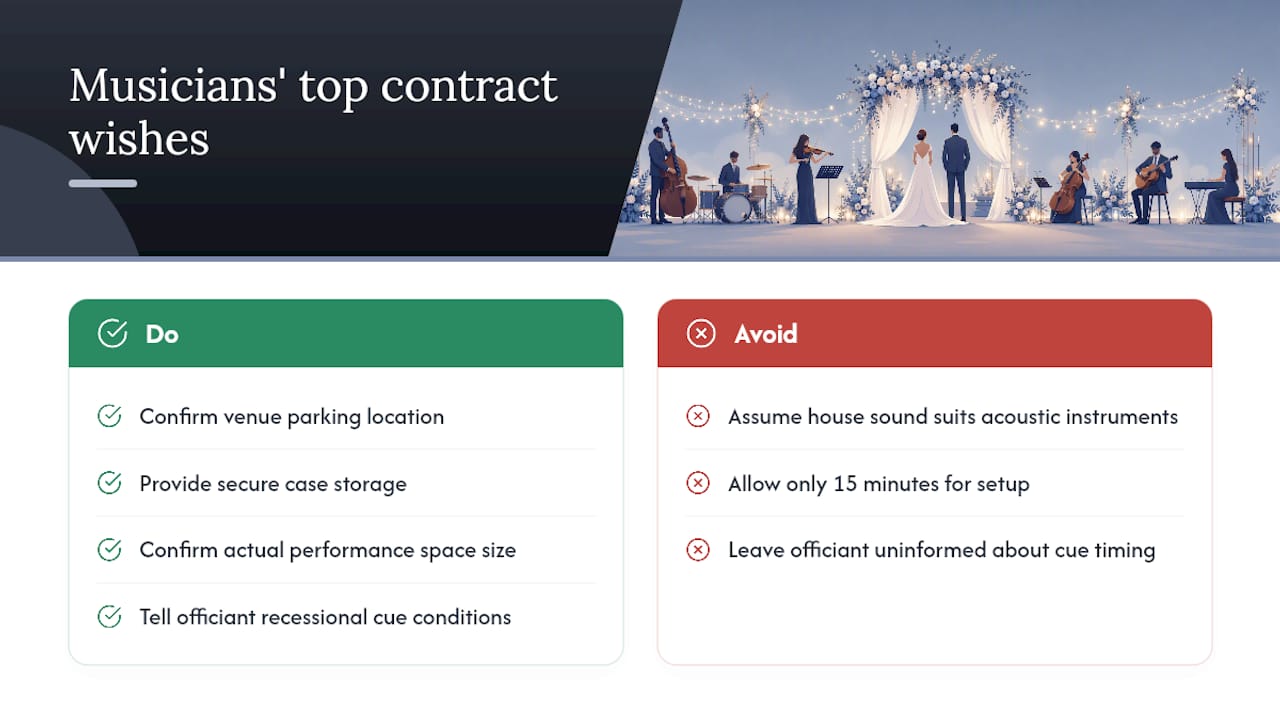
Three mistakes come up again and again. Couples assume the venue's house sound system will work, then discover it's tuned for a DJ and sounds harsh on acoustic instruments. Planners schedule fifteen minutes for setup when a quartet needs forty. And nobody tells the officiant that the recessional cue depends on the couple actually reaching the aisle, not on a fixed clock time.
What actually fixes these problems isn't more gear. It's communication. Musicians want clear logistics: where to park, where to stow cases, how much space they'll actually get. Give us that, and a good ensemble stays invisible in the best way, present enough to elevate the moment, quiet enough that nobody remembers thinking about the sound at all.
— Alex
Booking Alex Levin Music for Your Ceremony
Experienced live music providers handle the technical planning most couples don't know they need to ask for. Every ceremony booking typically comes with a consultation, a written checklist, a cue sheet, and on-day coordination so nobody is improvising sound decisions an hour before the processional.

After you inquire, the process is straightforward: a consultation to match ensemble to venue, a repertoire and cue session to lock in your processional and recessional timing, and a final contract that covers setup windows, equipment responsibility, and weather contingencies before you ever sign. If you're also planning cocktail hour or reception entertainment, the same team can coordinate cocktail hour music and reception music under one booking.
Start with the ceremony music page to see ensemble options and check date availability, or review the ceremony band service details if you want a closer look at logistics before reaching out.
Sources
- Questions to ask your wedding musicians — GigSalad
- Wedding Ceremony Music Setup Checklist — DJs In Maine
FAQ
Do all wedding ceremonies need amplification?
No. Amplification becomes necessary mainly for outdoor settings, guest counts above roughly 75, or when the distance between musicians and the back row exceeds 30 to 40 feet. A string quartet or solo pianist indoors with a smaller group often needs none.
How early should ceremony musicians arrive?
Most professional ensembles arrive 60 to 90 minutes before the first note to allow for setup and a sound check. Soloists with minimal equipment may need less time, but building in a buffer avoids a rushed start.
What should be included in a ceremony musician contract?
A solid contract names the performers, substitute policy, arrival and setup times, equipment responsibility, weather contingency, and repertoire commitments. These details are what prevent disputes over who provides what on the day.
Can I request a custom arrangement of a specific song?
Yes, most ensembles can arrange pop or contemporary songs for ceremony instrumentation, but it typically requires extra arrangement time and a firm request deadline. Set that cutoff a few weeks out so there's time to rehearse the new arrangement properly.
What is Alex Levin Music's ceremony music pricing?
Wedding Ceremony Music with Alex Levin Music starts from $3,000 as a one-off booking fee. That includes ensemble performance along with the consultation and logistics support outlined in the contract.
What backup equipment should musicians bring?
Reliable setups include spare batteries, a second playback source, and an extra microphone in case of failure. For outdoor sites, battery-powered speakers are often more dependable than relying on a single power outlet.