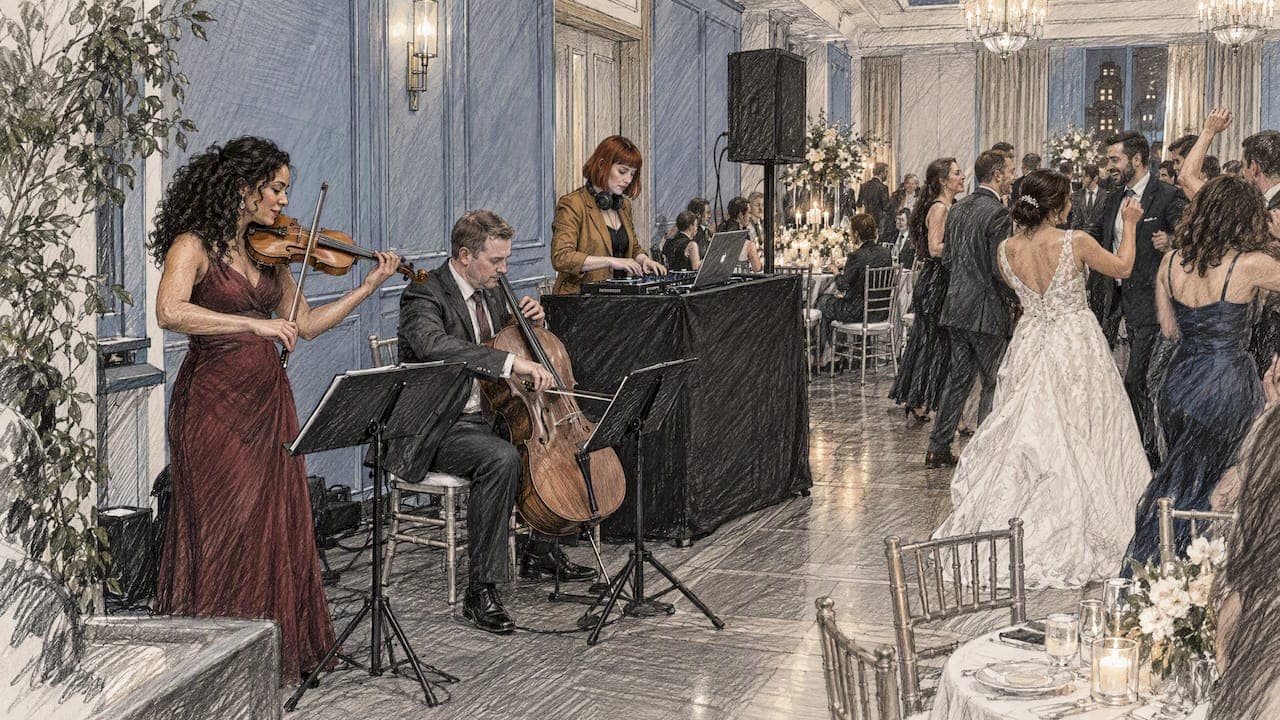
Yes, you can have both, and for many couples it is the best-sounding way to run a wedding day. Live strings suit the ceremony and cocktail hour, when guests are listening and talking. A DJ suits the reception, when you want a packed dance floor and every song you love. The work is in the handoffs: who plays when, how the sound gets from one act to the other, and who is in charge of it all.
This guide covers how to divide the day, how to plan transitions, what to confirm with your venue, what the combination costs and how a hybrid setup differs from hiring two separate vendors.
TL;DR
- Put strings on the ceremony and cocktail hour, and the DJ on dinner, dancing and the last song of the night.
- Plan every handoff in writing, with start times, end times and the exact song that ends one act and starts the next.
- Ask both acts to share one sound plan with the venue, or hire a single team that does both.
- Budget separately: a DJ's national average is around $1,800, while our live music packages start at $3,000.
- Send both vendors the same must-play and do-not-play lists so the night sounds like one story.
Table of Contents
- Why strings and a DJ work well together
- How to divide the day between strings and DJ
- The handoff: planning the transition between acts
- Coordinating songs, sound and space
- What strings and a DJ cost in the United States
- One team or two? Hybrid options
- Perspective: how we plan a strings-and-DJ wedding
- Work with us on both parts of the day
- A sample timeline you can adapt
- FAQ
- Sources
Why strings and a DJ work well together
A ceremony and a dance party ask for opposite things from music. During the ceremony, music supports the moment: the processional, the signing, the recessional. Guests are seated, quiet and watching. Vogue's wedding entertainment guide says ceremony entertainment should be subtle, with a string quartet as a common choice, while the reception can shift into a dance party.
A DJ cannot easily replicate the warmth of a live quartet playing a favorite song as you walk in, and a quartet cannot easily run a three-hour dance floor with 400 songs on call. Together, you get each at its strongest.
There is a practical side too. Strings do not need a lot of setup space or amplification, so they fit a garden, a church balcony or a hotel foyer. A DJ needs power, a table and speakers that can fill a ballroom. Splitting the job lets each act work in the space it suits.
If you are still deciding between the two, our comparison of a live band versus a DJ for your wedding walks through the tradeoffs. If you already know you want both, read on.
How to divide the day between strings and DJ
The simplest split follows the natural energy of the day. Wedding professionals quoted by Brides suggest treating the wedding as distinct musical moments: a live ensemble for the ceremony and cocktail hour, and the DJ taking over for the reception.
Here is how that looks in a typical timeline.
| Part of the day | Best fit | What the music is doing |
|---|---|---|
| Guest arrival and prelude | Strings | Sets a calm, elegant tone while guests find seats |
| Processional and recessional | Strings | Marks the big moments with live, personal arrangements |
| Cocktail hour | Strings, or a jazz trio | Background that lets conversation flow |
| Grand entrance and first dance | DJ (or strings for the first dance) | Needs cues, announcements and a microphone |
| Dinner | DJ, or live piano | Low volume, steady mood |
| Dancing | DJ | Full-range sound, requests, seamless mixing |
Ceremony
This is where strings earn their fee. A quartet or trio can play the prelude as guests arrive, a different piece for the bridal party, and a favorite for your entrance. Many couples ask for pop songs arranged for strings, such as a song that is meaningful to them, in place of traditional classical pieces. If you are building the order of service, our ceremony music timeline lists each moment that needs a cue.
Some couples ask whether a DJ can handle the ceremony instead. It can work if the venue has good sound and you are specific about the song selections and cues. But you lose the live element, and someone has to press play at exactly the right moment. Strings remove that risk.
Cocktail hour
Cocktail hour is the easiest place to keep live music going. Guests are mingling, the room is usually smaller and the music should sit under the conversation. Strings can play lighter repertoire here, such as jazz standards or instrumental versions of pop songs. See how we think about it in our piece on cocktail hour soundscapes.
Reception
The DJ's job begins in earnest at the reception: introductions, toasts, cake cutting and dancing. A good DJ reads the room and moves between genres, which is hard for a four-piece ensemble to do for hours. If you want some live energy in the room too, a hybrid setup, where a DJ plays alongside live musicians, is an option we cover below.
The handoff: planning the transition between acts
The most common problem with two acts is dead air. Guests walk from the ceremony to cocktail hour to the ballroom, and silence in any of those spaces feels like something went wrong.
The Brides professionals view transition music as part of the mood, not filler: music should continue as guests move between spaces. During a room change, the live act should keep playing until guests have cleared the area, and the DJ should already have music running in the next room.
In practice:
- Overlap on purpose. Have strings play the last 10 to 15 minutes of cocktail hour while the DJ is already set up and playing quietly in the reception room.
- Name the exit song. Agree on the final song the strings will play, and tell the DJ so the first track fits.
- Assign one point person. Ask your planner, venue coordinator or a trusted friend to cue both acts. Do not let each vendor guess when the other has finished.
- Put it in writing. A one-page timeline with start times, end times and cues should go to every vendor at least a week before the wedding.
We go deeper on this in our guide to transition music between wedding events, and our post on seamless planning from dinner to dancing covers the shift into the party.
Coordinating songs, sound and space
Two vendors who have never met can still sound like one team if you give them the same information.
Song lists
Give both acts the same must-play list and the same do-not-play list. It prevents the DJ from playing a song the strings already played, and it stops either one from touching a track you dislike. Our lists of wedding songs you must play and a do-not-play list couples can share are a good starting point.
A useful trick: choose one or two songs that appear in both worlds. If strings play an instrumental version of a song during the ceremony, the DJ can play the original at the reception. Guests notice the callback, and it ties the day together.
Sound equipment
Live music industry guidance on combining a band and a DJ keeps returning to the same checklist: compatible sound equipment, balanced levels, enough space to set up, and a sound technician. That applies to strings and a DJ too. Ask each vendor:
- What do you bring, and what do you need from the venue?
- Do you need power at a specific location, and how much?
- Will you share a mixer or run separate systems?
- How much setup and soundcheck time do you need?
Production teams who work on hybrid events say the cleanest changeover happens when the console accommodates both systems, with the live channels already patched and the DJ's input pre-routed, so a technician can crossfade without a visible re-patch or a gap. That level of planning is more than most small weddings need, but it explains why it helps to design the audio for both acts from the start, not improvise it on the day.
Venue questions
Before you sign anything, ask your venue:
- Are there sound limits or a curfew?
- Is there a house sound system, and can both acts use it?
- Where will the strings play if it rains, and is there power there?
- When does each vendor get access to the room, and in what order?
- Can vendors load in at the same time without blocking each other?
Book your vendors early so the schedule can be shaped around the day, not the other way around. Hidden Door Travel's vendor booking timeline is written for destination weddings but the point about locking in vendors early holds for any date.
A few other items worth confirming with each act: how long they play and when they take breaks, what attire they wear, whether they need a meal, and whether the contract covers overtime. Common planning slips show up in our list of wedding music mistakes couples should avoid.
What strings and a DJ cost in the United States
Prices vary by city, season, day of the week and hours. Use these as orientation, not quotes.
DJ. A guide summarizing The Knot's Real Weddings Study puts the national average wedding DJ cost at about $1,800, with most couples paying between $1,000 and $2,500 for reception coverage. Adding ceremony sound, uplighting or overtime pushes the quote up.
Strings. Quartet pricing depends on ensemble size, hours played, travel and how many custom arrangements you request. Two quotes with the same total can include very different things, so compare the number of musicians, the playing time (including prelude), setup and breakdown, and whether a ceremony rehearsal or sound equipment is included.
Our packages. Our ceremony, cocktail hour, reception and DJ and hybrid packages each start from $3,000 per event. Pricing beyond the starting point depends on the ensemble, the length of the event and the location, so we quote it after we hear about your plans.
What changes the price
- Ensemble size. A duo costs less than a quartet.
- Hours of music. Prelude plus ceremony plus cocktail hour adds up.
- Travel. Out-of-town venues add time and cost.
- Custom arrangements. Special song requests take rehearsal time.
- Date. Saturdays in peak season are priced higher than weekdays or off-season dates.
- Sound and setup. A quartet that brings its own amplification costs more than one using the house system.
There is a common budgeting question about splitting costs; the idea that a wedding budget should follow set percentages gets repeated a lot, but your music spend is better set by how much of your day depends on it. If dancing is your priority, put more into the DJ or hybrid. If the ceremony is the emotional center, put more into strings.
One team or two? Hybrid options
Booking separate vendors is common and works well with a planner. Its downside is that you become the coordinator. The two acts may use different equipment, communicate with you separately and not know each other's schedule.
A single provider that offers both live music and DJ services removes those gaps. One contract, one timeline, one sound plan. You also get a more natural handoff, since the person cueing the music at the end of cocktail hour is working with the same people who will start the dance set.
A hybrid format goes a step further. A DJ plays through the evening with live musicians adding a violinist, saxophonist or pianist on top of the tracks. It keeps the DJ's range and gives guests something to watch. It is a strong fit when you want an elegant feel for dinner and a high-energy late night in the same room.
Our DJ and hybrid music offering is built for this: we pair live ensembles with DJ sets so a single team can carry your day from the first note of the prelude to the last dance. See also how we handle reception music if you want a live band for part of the night.

Perspective: how we plan a strings-and-DJ wedding
Most couples who ask us about combining the two are worried that it will feel like two different weddings. It does not have to. When we plan a day with live strings and a DJ, we start with the timeline, not the instruments. We ask how the day moves, where guests will be at each hour, and how you want each moment to feel.
Then we choose music that connects the segments. A song that opens as a string arrangement during the ceremony can come back as a dance remix. A jazz-leaning cocktail hour can ease guests into the swing and pop of the reception. Customization matters more than the instrument list: the best sound for your wedding is the one built around your songs, your venue and your guests.
Our advice is simple. Decide who owns the timeline, put every cue in writing and never leave a gap between acts. If you do those three things, the combination feels effortless to your guests, even though it took a lot of planning behind the scenes.
— Alex
Work with us on both parts of the day
If you want live music that carries from the ceremony into the dance floor, we can plan the whole sequence with you. We offer wedding ceremony music, cocktail hour music and DJ and hybrid sets, each starting from $3,000 per event. Tell us your date, venue and the feel you want, and we will build a plan around it through our main site.
A sample timeline you can adapt
This is a model for a ceremony at 4:00 p.m. with a reception after. Adjust it to your venue.
| Time | Moment | Music |
|---|---|---|
| 3:30 | Guests arrive | Strings play the prelude |
| 4:00 | Processional | Strings, with a song picked for the bridal party and another for you |
| 4:25 | Recessional | Strings, upbeat arrangement |
| 4:30 | Cocktail hour | Strings play lighter repertoire |
| 5:15 | Guests move to the reception room | Strings play last piece; DJ already playing quietly in the ballroom |
| 5:30 | Grand entrance | DJ |
| 6:00 | Dinner | DJ at a low volume, or live piano |
| 7:30 | Dancing | DJ, full volume |
| 10:30 | Last dance | DJ |
The reception checklist on our blog, wedding reception music checklist, helps you fill in the middle of the evening.
FAQ
Can you have a string quartet and a DJ at the same wedding?
Yes. The usual approach is strings for the ceremony and cocktail hour and a DJ for the reception. Each act plays during the part of the day it suits best, and a written timeline keeps the handoff smooth.
Is a DJ fine for the ceremony instead of strings?
A DJ can handle a ceremony if the sound system is good and you give clear cues for each song. Strings add a live, personal feel and do not depend on someone pressing play at the right second. If your budget is tight, a solo violinist or a trio can be a smaller step than a full quartet.
How do I avoid silence between the ceremony and the reception?
Let the live act keep playing until guests have left the space, and have the DJ already playing in the next room. Name the last song the strings will play and the first the DJ will play. Assign one person to cue both acts.
How much should I budget for both?
The national average for a wedding DJ is around $1,800, according to a guide summarizing The Knot's study. Live strings are priced by ensemble size and hours, and our packages start from $3,000 per event. Ask each vendor what is included before comparing totals.
Should the strings and DJ use the same sound system?
It depends on the venue and the setup. Sharing a system can make the handoff smoother, but only if both acts agree on levels and a technician is available. If they use separate systems, confirm power, space and setup times in advance.
Sources
- How to Hire Musicians for Every Part of Your Wedding, Brides
- Everything You Need to Know About Wedding Entertainment, Vogue
- How Much Does a Wedding DJ Cost? (2026 Guide), Paperlust
- Lock Vendors Early: Destination Wedding Timeline, Hidden Door Travel