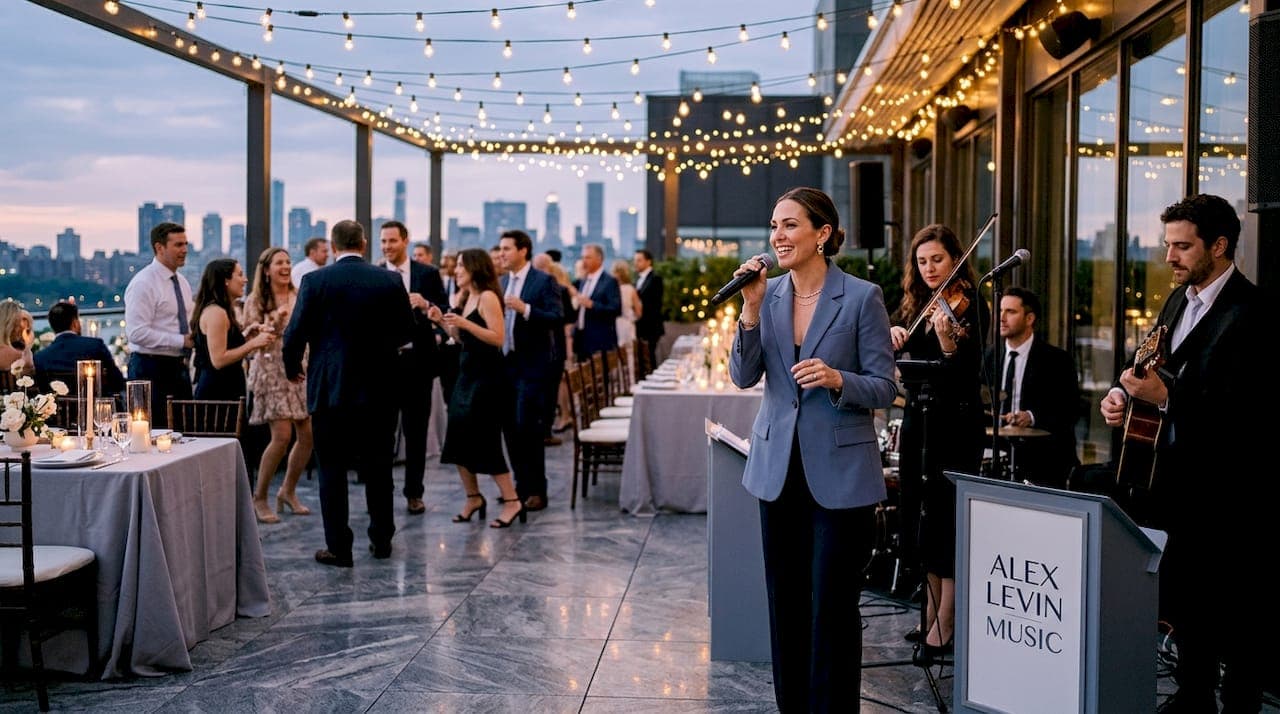
Choosing between a live band and a DJ for your wedding determines the entire mood, energy, and flow of your celebration. The live band vs DJ wedding decision is not simply about music. It shapes how your guests feel, how your timeline runs, and how much of your budget gets allocated to entertainment. According to The Knot's 2026 Real Weddings Study, the average couple spends around $34,000 on their wedding and hires approximately 13 professionals. Entertainment is one of the highest-impact decisions in that mix. This guide breaks down every major factor so you can choose with confidence.
What are the main differences in atmosphere and guest experience?
Live bands and DJs create fundamentally different atmospheres, and the distinction goes far beyond sound quality. A live band delivers a visual and emotional performance. Guests watch musicians play, react to the room, and feed off the crowd's energy in real time. That kind of spontaneous interaction is something no playlist can replicate. For couples who want their reception to feel like a concert or a sophisticated jazz evening, live music at weddings creates an atmosphere that guests remember for years.
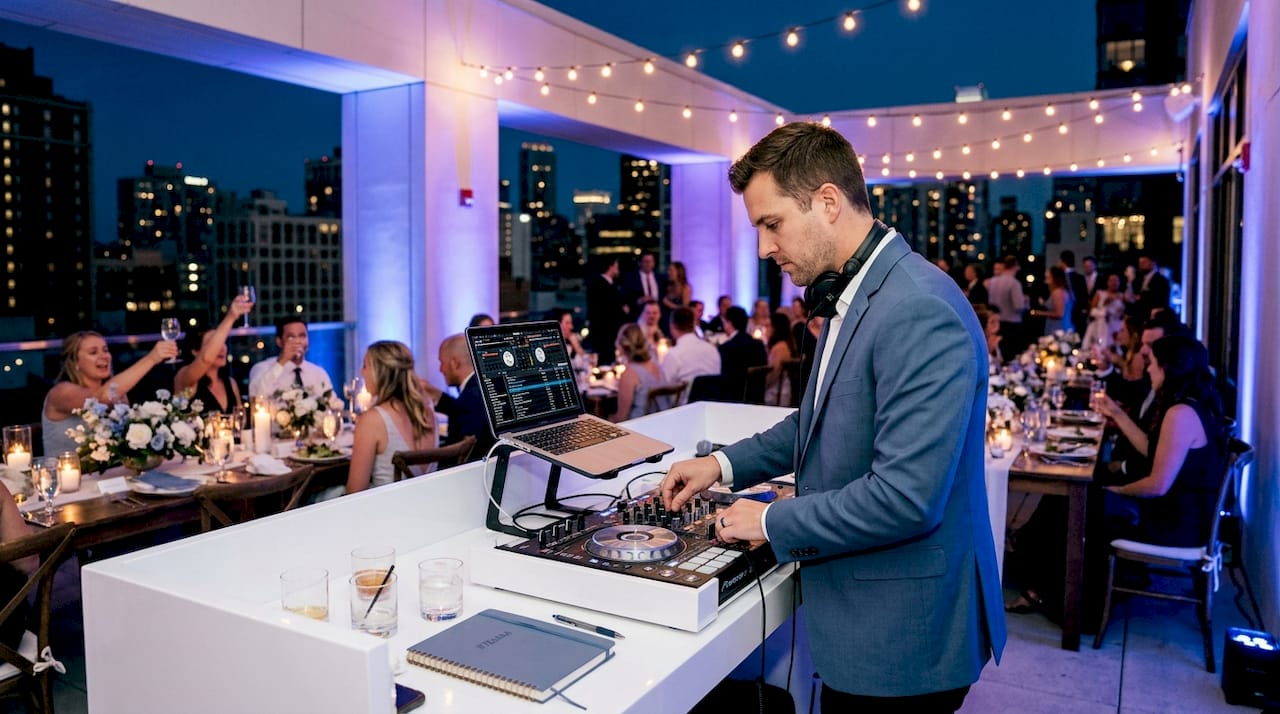
DJs, on the other hand, offer something equally powerful: total musical range and uninterrupted energy. A skilled DJ can move from Frank Sinatra to Bruno Mars to a Latin salsa set without losing a single dancer. That flexibility makes DJs especially effective for receptions with mixed-age guest lists or couples who want a specific genre-hopping party vibe. The advantages of hiring a DJ extend to MC duties as well, since most DJs handle announcements, introductions, and crowd management as part of their service.
Here is how each option shapes the guest experience across key moments:
- Ceremony and cocktail hour: Live ensembles, whether a string quartet, jazz trio, or solo pianist, add elegance and warmth that recorded music rarely matches.
- First dance and dinner: A live band performing your first dance song creates an emotional peak that guests talk about. A DJ can match the exact recorded version you love.
- Late-night dancing: DJs typically excel here, with the ability to read the room and shift tempo without any interruption.
- Mixed-age crowds: Live bands tend to engage older guests who grew up with live music as the standard for celebrations. DJs often energize younger crowds more effectively.
The honest truth is that neither format is universally superior. The right choice depends on your vision, your guests, and your venue.
How do cost and logistics compare for a live band vs a DJ?
Budget is where the live band vs DJ wedding reception decision gets concrete fast. Wedding bands average $4,500 while wedding DJs average $1,800, making bands roughly 150% more expensive. That gap reflects real cost drivers: multiple musicians, individual equipment, longer load-in times, and often a dedicated sound engineer.
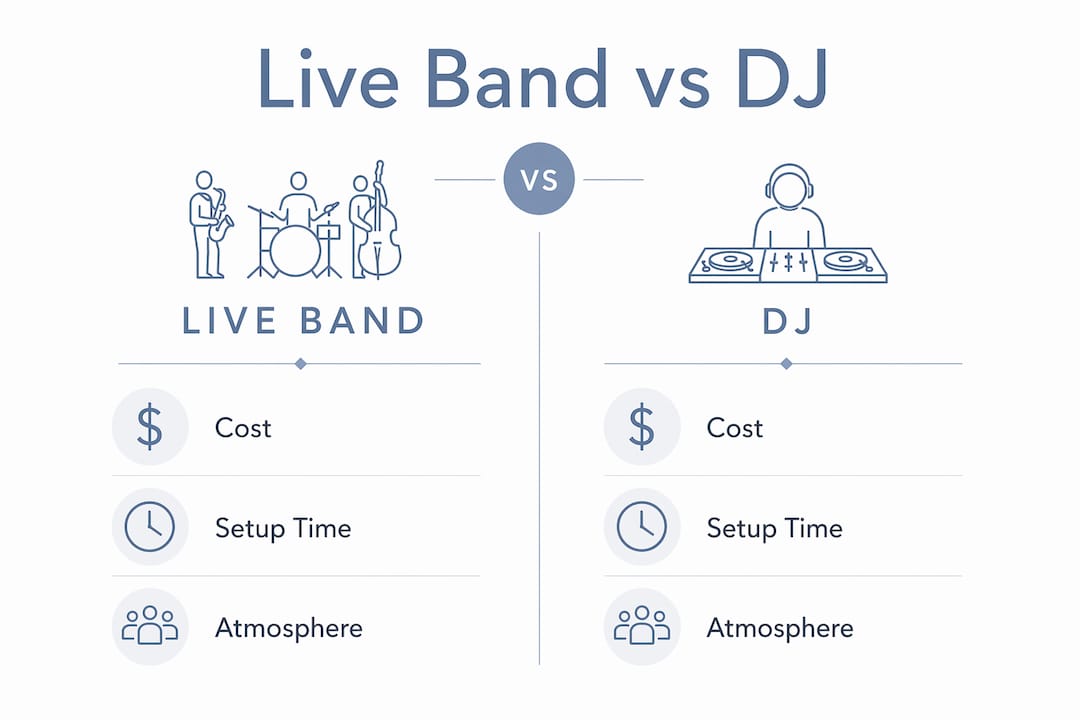
The table below shows the primary cost and logistics differences at a glance:
| Factor | Live band | DJ |
|---|---|---|
| Average cost | ~$4,500 | ~$1,800 |
| Setup time | 2 to 3 hours | 30 to 60 minutes |
| Stage space needed | 9 to 12 m² | 4 to 5 m² |
| MC duties included | Rarely | Usually yes |
| Musical range | Limited to repertoire | Virtually unlimited |
| Break coverage needed | Yes | No |
Beyond the headline fees, hidden costs in band contracts often include travel fees, custom song rehearsal charges, PA system rentals, and sound engineer fees. These extras can push a $4,500 band quote to $6,000 or more before the day arrives. DJs typically bundle PA, lighting, and MC services into one fee, which simplifies both budgeting and vendor coordination.
Pro Tip: Ask every band and DJ candidate for a fully itemized quote that includes equipment, travel, overtime rates, and any rehearsal fees before signing a contract. Comparing total costs rather than headline rates prevents budget surprises.
When budgeting for a band or DJ for your wedding, also factor in gratuity, which typically runs 10 to 15 percent of the total fee for exceptional service. Knowing how to find your wedding band or DJ within your budget range saves significant time during the vendor search process.
What are the timing and performance flow differences at a reception?
Pacing control is the single biggest operational difference between live bands and DJs, and most couples do not realize this until they are mid-reception. Bands perform in sets with 20 to 30 minute breaks between them, typically covering a total window of 90 to 120 minutes of live performance. DJs provide continuous music throughout the entire reception without any planned downtime.
Here is what a typical reception timeline looks like with each option:
- Cocktail hour (6:00 to 7:00 pm): A live ensemble or DJ sets the tone as guests arrive and mingle.
- Dinner and first dances (7:00 to 8:30 pm): The band or DJ handles formal moments including the first dance, parent dances, and toasts.
- First band set (8:30 to 9:30 pm): The band opens the dance floor with a high-energy set.
- Band break (9:30 to 10:00 pm): Without planned coverage, the dance floor empties. This is the most common energy drop at band-led receptions.
- Second band set (10:00 to 11:00 pm): The band returns for a closing set.
- Late night (11:00 pm onward): A DJ or curated playlist keeps the party going.
Without planned coverage during band breaks, the dance floor often empties and energy drops sharply. Many professional bands now include a DJ playlist service between sets as a standard feature or at modest additional cost. Confirm this detail before booking.
Pro Tip: Build a curated playlist specifically for band break periods and assign a point person, your DJ, your band's sound tech, or your planner, to manage it. A well-chosen 20-minute playlist keeps guests dancing and prevents the post-set exodus.
How do venue size and sound restrictions affect your choice?
Your venue may make the decision for you before you even compare costs. DJs require roughly 4 to 5 m² of space while a four-piece band needs 9 to 12 m² of dedicated stage area. Smaller ballrooms, historic estates, and rooftop venues often cannot physically accommodate a full band setup without sacrificing guest seating or a dance floor.
Key venue factors to evaluate before booking:
- Sound limiters: Many urban venues and hotel ballrooms use electronic sound limiters that cut power to the PA system if volume exceeds a set threshold. These limiters frequently affect live bands more than DJs, since live drums and amplified guitars push volume levels higher.
- Load-in access: Bands require multiple trips with heavy equipment and typically need 2 to 3 hours for setup and soundcheck. Venues with limited loading dock access or strict setup windows may not accommodate this.
- Power supply: A full band setup draws significantly more power than a DJ rig. Confirm available circuits with your venue coordinator before finalizing your entertainment contract.
- Acoustic alternatives: If your venue restricts volume but you want live music, smaller ensembles like a jazz trio, string quartet, or solo piano are viable solutions. These formats work beautifully for ceremonies and cocktail hours without triggering sound limiters.
Outdoor venues present their own challenges. Wind, ambient noise, and lack of natural acoustics can diminish the impact of a live band while a DJ's controlled PA system adapts more easily to open-air conditions.
What are the advantages of a hybrid band and DJ model?
The hybrid entertainment model is the fastest-growing format in wedding planning, and for good reason. It combines a live band for the emotional peaks of the evening with a DJ for continuous late-night energy. The hybrid approach uses live band sets for early reception and cocktail hours, then transitions to a DJ for late-night dancing, capturing the strengths of both formats.
Planning a hybrid setup requires more coordination than booking either option alone. Consider these factors:
- Shared sound systems: Confirm whether the band and DJ will share a PA system or bring separate rigs. Shared systems reduce setup complexity but require technical coordination between vendors.
- Transition timing: Plan the exact handoff moment between the band's final set and the DJ's first track. A clean transition keeps the dance floor full. A fumbled one loses momentum.
- Contracts and communication: Both vendors need to know each other's set times, equipment requirements, and contact details well in advance. Miscommunication between vendors is the most common cause of hybrid event problems.
- Budget reality: A hybrid setup costs more than booking either option alone. Expect to budget for both a band fee and a DJ fee, though some entertainment companies offer combined packages that reduce total cost.
- Integrated providers: Booking a single company that offers both live band and DJ hybrid services simplifies contracts, coordination, and technical setup considerably.
The hybrid model works best when your reception runs four hours or longer. Shorter receptions rarely have enough time to justify the complexity of managing two entertainment formats.
Key takeaways
The live band vs DJ wedding decision comes down to three factors: your budget, your venue's physical and acoustic constraints, and the specific atmosphere you want to create for your guests.
| Point | Details |
|---|---|
| Cost gap is significant | Bands average $4,500 versus $1,800 for DJs, with bands often adding hidden fees. |
| Venue constraints matter | Bands need 9 to 12 m² of stage space and 2 to 3 hours of setup time. |
| Pacing requires planning | Band breaks without coverage cause energy drops; always plan between-set music. |
| Hybrid model is viable | Combining a live band with a DJ captures emotional peaks and continuous late-night energy. |
| Personality drives satisfaction | 53% of couples cite DJ personality as a deciding factor, and the same principle applies to bands. |
What I've learned from years of playing both sides of this decision
After performing at hundreds of weddings across Philadelphia, New York, and beyond, I have watched couples agonize over this choice and I have seen both options succeed and fail. Here is what the planning guides do not tell you.
The couples who regret their entertainment choice almost always made it based on price alone or on what they thought they were supposed to do. The couples who rave about their reception made the choice that matched their actual personality, not their Pinterest board. A jazz trio at a 50-person intimate dinner is a completely different experience than a six-piece band at a 200-person ballroom reception, and neither is wrong.
What I find consistently underestimated is the importance of the vendor's communication style before the wedding. Personality ranks as a deciding factor for 53% of couples choosing a DJ, and I believe the same standard applies to bands. A musician or DJ who responds slowly, hedges on details, or cannot clearly explain their set structure is a risk regardless of how impressive their demo sounds.
My honest recommendation: if your guest list skews older and your venue has the space, a live band creates moments that no recording can match. If you want maximum musical range, uninterrupted energy, and a lower total cost, a skilled DJ delivers. And if your budget allows and your reception runs four-plus hours, the hybrid model is genuinely the best of both worlds. Just make sure whoever you hire can tell you exactly what happens during every minute of your reception, not just the highlights.
— Alex
Let Alexlevinmusic handle your wedding entertainment
Planning your wedding entertainment does not have to be a guessing game. Alexlevinmusic offers wedding reception bands ranging from jazz trios and string quartets to full party bands, plus professional DJ services and hybrid packages that combine live performance with seamless DJ coverage. Every package is customized to your venue, timeline, and musical vision, whether you want sophisticated jazz for a cocktail hour or a high-energy dance floor for the entire night.
Serving Philadelphia, New York, and surrounding areas, Alexlevinmusic brings together live musicians and DJ expertise under one roof, which means one point of contact, one contract, and zero coordination headaches. Browse the full range of ensembles and soloists or reach out directly to discuss your wedding date and vision.
FAQ
How much does a wedding band cost compared to a DJ?
Wedding bands average $4,500 while wedding DJs average $1,800, making bands roughly 150% more expensive. Total costs often run higher once travel, equipment, and sound engineer fees are added.
Do live bands take breaks during a wedding reception?
Yes. Bands typically perform in sets with 20 to 30 minute breaks between them. Without planned music coverage during those breaks, the dance floor empties and energy drops significantly.
What is a hybrid wedding entertainment setup?
A hybrid setup uses a live band for early reception sets and a DJ for late-night dancing, combining the emotional impact of live performance with the continuous energy of a DJ. It requires careful coordination between vendors and a shared or compatible sound system.
Which is better for small or restricted venues?
DJs are the practical choice for smaller venues. They require only 4 to 5 m² of space and shorter setup time, while bands need 9 to 12 m² and are more likely to trigger venue sound limiters. Smaller live ensembles like a jazz trio are a strong middle-ground option.
Does personality matter when choosing a wedding DJ or band?
Personality is a primary selection factor. 53% of couples cite DJ personality as a deciding factor in their hiring decision, and responsiveness before the wedding is a reliable indicator of how well the vendor will perform on the day itself.