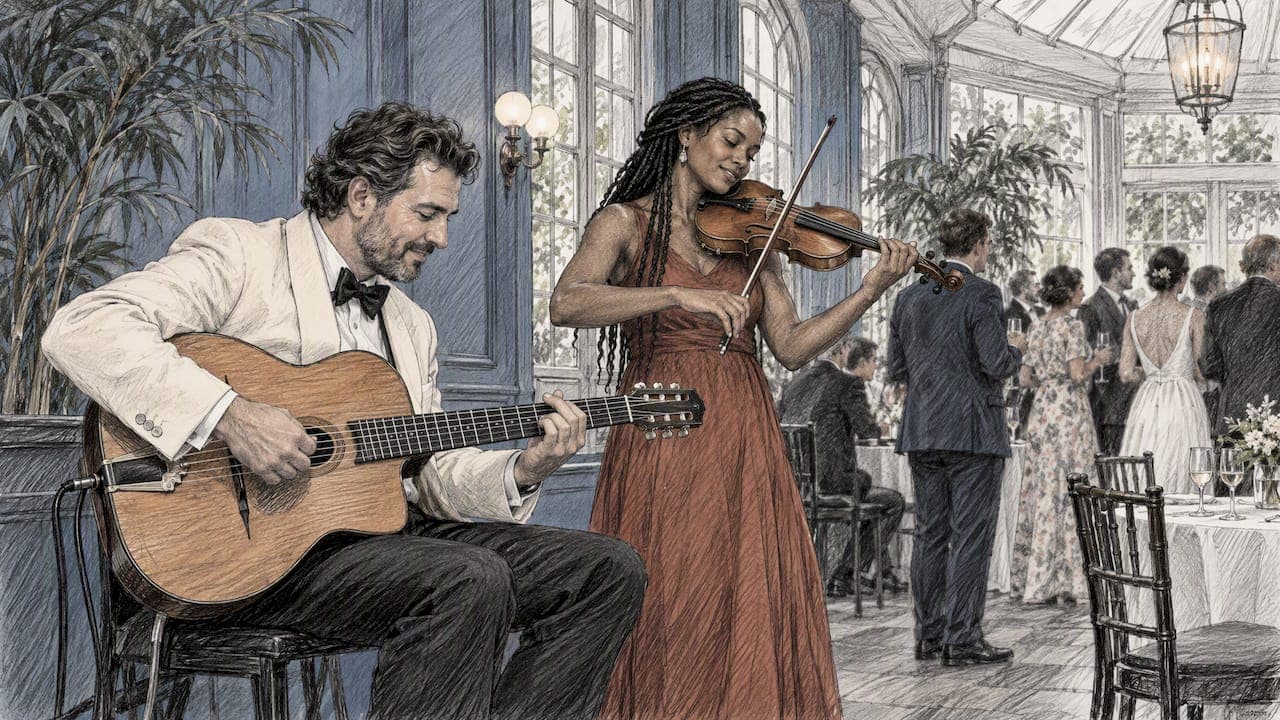
A gypsy jazz wedding means hiring a small acoustic group, usually guitars, violin and upright bass, to play Django Reinhardt-style swing. The music covers the whole day. It is quiet enough for a ceremony and dinner, and fast enough to get a dance floor moving. Below you'll find how to match the lineup to each part of the day, what live music costs, which venue and contract details to settle early, and how we approach this style.
TL;DR
- Gypsy jazz is acoustic and works at every stage of a wedding: a duo or trio for the ceremony and cocktails, a larger group for dancing.
- Live wedding bands in the U.S. average roughly $4,500 according to The Knot, and Mid-Atlantic couples often pay more. Our ceremony, cocktail hour, reception and DJ/hybrid music start at $3,000.
- Check the venue's noise limiter, power access and load-in rules before you sign anyone.
- Put the exact lineup, set lengths, breaks, deposit and cancellation terms in writing.
- We build custom ensembles, so if you love the swing-guitar sound, ask us to shape a lineup around it.
Table of Contents
- What gypsy jazz actually is, and why couples choose it
- Matching the lineup to each part of the day
- Building your set list
- What a gypsy jazz wedding costs
- Venue questions to settle before you sign
- Questions to ask any band, and what the answers should tell you
- The contract: what must be in writing
- Our perspective
- Plan your wedding music with us
- A simple planning timeline
- FAQ
- Sources
What gypsy jazz actually is, and why couples choose it
Gypsy jazz is also called jazz manouche. It is named for and popularized by the guitarist Django Reinhardt, but it is not simply preserved Romani folk music. Scholars writing in Current Musicology describe the modern genre as an invented tradition that coalesced in the late 1980s, a sophisticated synthesis of style. That matters for a wedding: you are hiring a repertoire and a sound, not a fixed ritual, so you can shape it.
The sound is what couples are after. Rhythm guitars drive a steady, percussive pulse, a lead guitar or violin plays fast improvised lines, and a bass anchors it. Nothing needs a drum kit or a wall of speakers. The result feels vintage and elegant, a little Parisian, and lively. Guests who don't know the genre still recognize it as a happy sound.
Three reasons it suits weddings:
- It flexes with the moment. Played softly, it is conversation-friendly background for dinner. Played hard, it is dance music.
- It is acoustic. Small groups rarely need heavy amplification for a modest crowd, which helps in barns, gardens, restaurants and historic rooms.
- It is personal. Familiar songs, from pop to wedding classics, can be arranged in the swing-guitar style, so the set sounds like you and not like a generic playlist.
Matching the lineup to each part of the day
The best way to use this style is to scale the group to the moment instead of booking one big band for everything.
| Moment | Typical lineup | What the music should do |
|---|---|---|
| Ceremony | Duo (guitar and violin) or solo guitar | Frame the processional and recessional without competing with vows |
| Cocktail hour | Trio (add bass) | Set a social, conversational mood |
| Dinner | Trio or quartet, played softly | Stay under the conversation |
| Dancing | Quartet or larger, with up-tempo swing | Keep energy high and the floor full |
This scaling approach is what many working bandleaders recommend, and it also helps with volume complaints. If your guest count is under about 100, an acoustic group can often carry a room unamplified.
Ceremony
Keep it simple. Two musicians playing a slow, lyrical arrangement for the processional is plenty. Pick one piece for the walk down the aisle and another for the exit; the exit is where an up-tempo swing tune lands best. If you want to compare formats for the ceremony, see our wedding ceremony music page.
Cocktail hour
This is where gypsy jazz does its best work. Guests are mingling, the photographer has the couple, and the music sets the tone for the evening. A trio can play standards, French songs and swing arrangements of pop tunes at a level that invites conversation. We wrote about the difference between real atmosphere and background noise in our piece on cocktail hour soundscapes.

Reception and dancing
Be honest about what this genre does on a dance floor. Fast gypsy swing is thrilling for 30 to 45 minutes and delivers a true showpiece moment. A full night of nothing but 280-beats-per-minute guitar can tire a mixed-age crowd. Many couples solve this in one of three ways:
- Book two or three sets of gypsy swing mixed with slower standards and recognizable covers.
- Add a vocalist or a horn for variety.
- Pair the live set with a DJ for the late-night party. Our DJ and hybrid music option exists for exactly this, and our comparison live band vs DJ walks through the trade-offs.
Building your set list
Start with the genre's core: songs from the Hot Club era, such as "Minor Swing", "Nuages" and "Dark Eyes", plus standards from the American songbook. Then add three to five personal requests. Ask the band whether they will arrange them in the swing-guitar style, and ask how much lead time they need. A good group will happily arrange a song you love, but a new arrangement takes rehearsal, so request it months ahead, not the week before.
A few practical tips:
- Name your must-play list and your do-not-play list separately.
- Give a specific song for each key moment: processional, bride or partner entrance, first dance, cake cutting, last dance.
- If your first dance is a slow song, ask for a tempo you can actually dance to. Fast swing arrangements of ballads can be charming, but not always for a first dance.
- For more ideas on modern repertoire, our guide to modern jazz wedding songs lists songs by part of the day, and lounge jazz wedding music covers standards and pop covers.
What a gypsy jazz wedding costs
Price depends on the number of musicians, hours played, travel and the market. Some numbers to anchor your budget:
- The Knot reports that the average cost of a live wedding band in the U.S. is around $4,500, and that the median spend is lower because many couples book small groups.
- The same guide puts standalone ceremony musicians at a much lower average, around $500, since that is often a single player for under an hour. WeddingWire's cost guide gives a similar U.S. average of $500 for ceremony musicians.
- Costs run higher in expensive regions. In the Mid-Atlantic, spending above $7,000 for a band is common, based on The Knot's regional figures.
Our own pricing: wedding ceremony music, cocktail hour music, reception music and DJ and hybrid music each start from $3,000 per event. That is the starting point for professional, experienced musicians with customization and planning communication included. Your final quote depends on the lineup and hours, so we give it after a conversation about your day. We serve Philadelphia, New York and beyond.
Ways to keep the cost sensible
- Use a smaller group for the ceremony and cocktails, and scale up only for dancing.
- Choose a trio instead of a quintet. Gypsy jazz is built for small groups, so you lose less than you would with a pop band.
- Book a weekday or off-peak date where the band has availability.
- Read our budget live music wedding tips for more ways to save without cutting the live element.
Venue questions to settle before you sign
Acoustic gypsy jazz is friendlier to tight venues than a brass-driven party band, but you should still check the room.
Sound limiters
Many venues install a device that cuts power when the noise passes a set level. A UK venue guide from Function Central notes that most acts will accept a limiter set around 92 dB or higher, though they prefer it off during the performance. That guide is British, but limiters and noise ordinances exist across U.S. venues and towns too. Ask the venue for the exact decibel level, whether it applies outdoors, and the cutoff time. Our article on wedding venue music restrictions goes deeper, and if you are marrying in Manhattan or Brooklyn, use our NYC venue sound checklist on your walk-through.
Space, power and weather
- Outdoor setup: musicians need a flat, stable surface and shade. Direct sun detunes instruments and wears out players.
- Power: even an acoustic group may want one outlet for a small amplifier, a pickup or a microphone.
- Load-in: confirm where musicians can park, which door they use and when the room opens.
- Backstage space: a quiet place for cases and coats, plus a meal for the band, is standard for professional groups. Ask your caterer to include them.
- Rain plan: decide in advance where the music moves if weather turns.
Our setup timeline and venue checklist is a copy-ready list you can send to your venue coordinator.
Questions to ask any band, and what the answers should tell you
When you speak with a group, listen for specifics.
- Who exactly will play? You want named musicians, not a substitute chosen later.
- Can I see full-length video from a real wedding? Short highlight reels hide how a set flows.
- How do you handle requests? Look for a clear process and deadline.
- What happens if a musician is ill? A professional bandleader has a plan and a bench of replacements.
- What do you need from the venue? A prepared band answers quickly and in detail.
We expand each of these in questions to ask before booking your wedding band.
The contract: what must be in writing
A live music agreement protects both sides. The Musicians' Union in the UK publishes guidance on hiring musicians for an event; its rules are British, but the practical list of items applies anywhere. Make sure yours covers:
- The exact lineup and any right to substitute.
- Start time, set lengths and break lengths.
- Load-in time, sound check time and venue access.
- Power and space requirements.
- Deposit amount, due dates and how it is credited to the balance.
- Cancellation and illness terms, ideally by mutual written agreement.
- Meals and any travel or overtime fees.
Venue terms matter just as much as band terms. If you rent a private property for the weekend, signed rules about amplified sound, guest counts and hours can override whatever you assume. This explainer on vacation rental wedding rules shows why an addendum should be signed before you pay the band a deposit.
Our perspective
We have played enough weddings to know that the style on the flyer is rarely what makes a night work. What works is the fit between the music and the moment, and the communication around it.
We love the gypsy jazz sound for cocktail hours and dinner. It is elegant, acoustic and conversational. Where we would push back is on using only one flavor for a whole reception. Mix swing with standards and with songs your guests know, and the dance floor stays full longer.
That is why we build custom ensembles. Our work centers on jazz, swing and sophisticated styles, with trios, quartets, string quartets and solo piano, and we shape the lineup and repertoire around your event, not the other way around. If a swing-guitar flavor is what you want, tell us, and we will talk through how to reach it with the musicians and arrangements that suit your venue and guest list.
One more thing. Ask hard questions about sound and logistics early. In our experience, that conversation is what separates a smooth wedding from a stressful one.
— Alex
Plan your wedding music with us
We play weddings across Philadelphia, New York and beyond, with music for the ceremony, the cocktail hour and the reception, plus DJ and hybrid sets when you want live music and a late-night party. Ceremony, cocktail hour, reception and hybrid music each start from $3,000. Tell us your date, venue and the sound you love, and we will propose a lineup. Start on our reception music page or contact us through the main site.
A simple planning timeline
- 9 to 12 months out: shortlist venues and check their sound rules. Start booking music for popular dates.
- 6 to 9 months out: sign the contract and pay the deposit.
- 3 months out: send your song requests and key moments.
- 1 month out: confirm timeline, load-in, power and meals with the venue and caterer.
- 1 week out: send the final schedule and a day-of contact.
FAQ
Is gypsy jazz good for a wedding ceremony?
Yes, particularly in a duo format with guitar and violin. The sound is gentle and acoustic, and it carries well in small outdoor and indoor spaces. Pick a slow, lyrical arrangement for the processional and save the livelier tune for the recessional.
How many musicians do I need?
For a ceremony, two is usually enough. A trio suits cocktails and dinner, and a quartet or larger group gives a stronger sound for dancing. Choose by guest count and room size, and ask the band what they recommend for your venue.
Can a gypsy jazz band play songs that aren't jazz?
Usually, yes. Many groups arrange pop songs and wedding favorites in the swing-guitar style. Send your requests early so the musicians have time to prepare, and ask whether the arrangement will be new or already in their repertoire.
How much should I budget?
The Knot reports a U.S. average of about $4,500 for a live wedding band, with ceremony-only musicians costing far less. Our wedding music packages start from $3,000 per event, and the final price depends on lineup, hours and location.
Sources
- The Average Cost of Hiring a Band or DJ for Your Wedding, The Knot
- Wedding Ceremony Music Cost Guide, WeddingWire
- "Django's Tiger": From Jazz to Jazz Manouche, Current Musicology
- Live Music & Your Venue: 13 Things You Need to Check, Function Central
- Hiring Live Musicians for an Event, The Musicians' Union