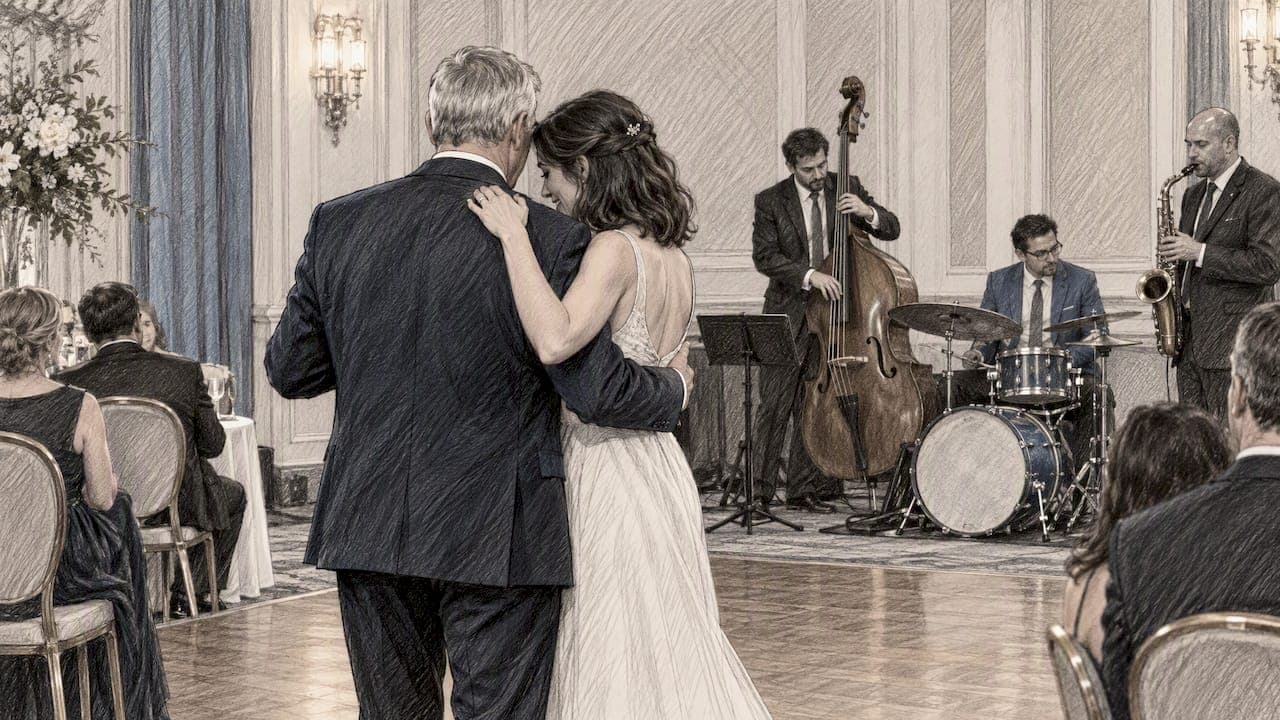
For a first dance, "The Way You Look Tonight" or "It Had to Be You" set a romantic, unhurried tone. For a father-daughter or mother-son dance, "I Wish You Love" brings warmth without overreaching. Processionals favor instrumental readings of Sinatra standards, while "Fly Me to the Moon" lifts a cocktail hour. We cover how to adapt each for live performance below.
TL;DR:
- The Way You Look Tonight suits a slow first dance, while It Had to Be You fits midtempo steps and a relaxed reception.
- When a first dance needs trimming, cut the intro, a repeated verse, or an instrumental solo, but preserve the chorus and emotional peak.
- I Wish You Love keeps parent dance lyrics affectionate without sounding romantic, while instrumental Sinatra excerpts suit processionals better than full vocal tracks.
- Read the full lyric sheet before committing, since references to heartbreak, past relationships, or irony can feel wrong during vows or a parent dance.
- Choose recorded music for tight budgets, limited space, or a specific vintage recording; confirm venue licensing, while live players can adjust pacing to the room.
Table of Contents
- 1. Top Sinatra songs for wedding moments
- 2. Tempo, lyrics, and timing: adapting Sinatra for your choreography
- 3. Quick checklist: picking the right Sinatra song for your couple and venue
- 4. Live performance vs recorded tracks: when to hire a Sinatra-style ensemble
- 5. Why Sinatra's songs work at weddings: musical and cultural notes
- 6. Musician's note: arranging Sinatra for real weddings
- How Alex Levin Music helps bring Sinatra to your wedding
- FAQ
- Sources
1. Top Sinatra songs for wedding moments
Sinatra's catalog spans tempos and moods wide enough to cover a whole wedding timeline, and the trick is matching the right track to the right moment rather than picking favorites at random.
For a first dance, three songs come up again and again, each for a different reason:
- "The Way You Look Tonight": a classic slow waltz feel, gentle and unhurried, built for a couple who wants a traditional sway rather than choreography.
- "It Had to Be You": romantic mid-tempo swing with a conversational lyric that suits couples who met later in life or after a long search.
- "I've Got a Crush on You": a gentle, almost whispered ballad that works well for an intimate, smaller-scale wedding where the room is close and quiet.
Parent dances call for songs with more sentimental weight, and lyrics matter more here than tempo. "I Wish You Love" works for either a father-daughter or mother-son dance because its lyric is affectionate without being romantic in a way that feels odd between parent and child. "I'll Dance at Your Wedding" leans directly into the occasion itself, with a lyric that names the moment, which makes it a strong pick for couples who want the song to say exactly what is happening. Both songs also leave natural pauses where a brief toast or a few words from a parent can slot in without cutting the music awkwardly.
Ceremony moments ask for restraint. A full vocal Sinatra track rarely suits a processional, since the room's attention is on the entrance, not the lyric. Short instrumental excerpts of Sinatra standards, played by a soloist or small ensemble, let the melody carry the moment without competing with vows or readings. For a recessional, "Love and Marriage" works well as an upbeat, celebratory exit song, and its longstanding association with marriage themes makes it an easy, recognizable choice for guests. Our guide on jazz wedding ceremony songs goes deeper on arranging standards for processional and recessional use.
Cocktail hour and reception are where tempo can finally open up. "Fly Me to the Moon" and "Cheek to Cheek" both carry the kind of light swing energy that keeps a room moving without demanding anyone dance yet. These songs also transition well into a broader reception set, which our must-play wedding songs list covers in more detail for other moments in the night.
2. Tempo, lyrics, and timing: adapting Sinatra for your choreography
A first dance can work well with a concise edit, which means some Sinatra recordings may need a trim. The usual approach is to cut the opening instrumental intro, shorten a repeated verse, or drop an instrumental solo in the middle, all without touching the chorus or the emotional peak of the lyric.
Tempo matters as much as length:
- Slow: "The Way You Look Tonight" and "I've Got a Crush on You" fall here, ideal for a traditional sway.
- Mid-tempo: "It Had to Be You" and "I Wish You Love" sit in the mid-tempo category, good for a dance with a few simple steps.
- Upbeat: "Fly Me to the Moon" and "Cheek to Cheek" belong here, built for cocktail hour energy rather than a slow dance.
Lyrics deserve a close read before locking in a song. A line that references heartbreak, a past relationship, or an ironic twist can land oddly during vows or a parent dance, so it helps to scan the full lyric sheet, not just the chorus most people remember.
Pro Tip: Give your band or DJ a timecode and bar count for every cut, such as "start at 0:18, skip to bar 17 for the final chorus," so the edit stays consistent across rehearsal and the live performance.
3. Quick checklist: picking the right Sinatra song for your couple and venue
Running through a short checklist before committing to a song saves time during band or DJ meetings.
- Moment: confirm whether the song is for first dance, parent dance, ceremony, or reception.
- Dance experience: a couple with little dance practice may want a slower, steadier tempo.
- Desired mood: romantic, sentimental, playful, or celebratory changes which song fits.
- Venue acoustics: a small indoor room handles a quiet ballad differently than an open outdoor space.
- Live vs recorded: decide early, since arrangement choices differ between the two.
- Lyric suitability: read the full lyric, not just the hook, for any line that feels off for the moment.
A few listening tests can help confirm a choice: play the full original track together, then listen to the intended edit alone, then hear a live arrangement sample if one is available. A couple choosing between "The Way You Look Tonight" and "It Had to Be You" for a first dance might pick the former for a formal ballroom and the latter for a smaller, relaxed backyard reception.
4. Live performance vs recorded tracks: when to hire a Sinatra-style ensemble
Live musicians bring dynamic pacing, which means a soloist or trio can slow down, hold a note, or build toward a climax in ways a fixed recording cannot. Acoustic instruments also fill a room differently than speakers, especially for an outdoor ceremony or a venue with high ceilings.
Recorded tracks still make sense in some cases:
- A tight budget that cannot cover a live ensemble.
- A small venue with no practical space for musicians.
- A specific vintage Sinatra recording the couple wants note for note.
Licensing is worth a quick check when using recorded music at a public venue, and most venues already carry the necessary performance licenses, so it is worth confirming with the venue directly. A live band benefits from a short soundcheck and a few notes on phrasing, since Sinatra's style relies on relaxed timing just behind the beat rather than a strict metronome feel.
Pro Tip: For a tailored Sinatra feel, a solo vocalist, jazz trio, or hybrid DJ-and-live-soloist setup each offer a different balance of intimacy and flexibility, worth comparing against your venue size.
5. Why Sinatra's songs work at weddings: musical and cultural notes

Sinatra's phrasing, relaxed, conversational, and never rushed, is part of why his standards translate so naturally to wedding moments that call for warmth rather than spectacle. Many of his signature songs came from the same era's great songwriters, including Cole Porter and Rodgers and Hart, whose lyrics were built around romantic storytelling rather than simple hooks.
Not every Sinatra classic is a love song in the traditional sense. "My Way" grew into something larger than a personal statement.
"My Way" became an anthem of self-determination in American culture, even though Sinatra himself had mixed feelings about the song.
This matters for couples choosing music: a song's fame does not always mean it fits the moment, and "Love and Marriage," by contrast, has carried a direct association with marriage themes since its original release, which the archival record of Sinatra's recorded work helps place in context.
6. Musician's note: arranging Sinatra for real weddings
A shortened arrangement of "The Way You Look Tonight" can help the final chorus land as a couple finishes their dance. The instrumental solo was moved earlier and cut straight to the last verse. My one tip: tell your band exactly where you want the emotional peak to hit, and let the arrangement build toward that point.
— Alex
How Alex Levin Music helps bring Sinatra to your wedding
We build custom Sinatra-style sets for every part of your wedding day, from ceremony music and cocktail hour to reception and DJ and hybrid setups that blend live instruments with recorded tracks. Whether you want a soloist for your processional or a full swing band for dancing, we arrange each song to fit your timing and venue, the same way we would trim or reorder a classic for a first dance. For a more intimate setting, Dan Piano Studio shares useful live piano perspectives for small weddings. Reach out to request a sample set, talk through your song choices, and schedule a consultation and soundcheck for your date.
FAQ
What was Sinatra's favorite song to sing?
Sinatra's personal favorites varied over his career, and he spoke about several songs with pride at different points. His own feelings toward "My Way" were notably mixed, even as the song became one of his most culturally significant recordings.
Who picks the song for the mother-son dance at a wedding?
The groom and his mother typically choose the mother-son dance song together, often with input from the couple. Sinatra tracks like "I Wish You Love" work well because the lyric stays warm without being overly romantic.
What's the most famous wedding song?
There is no single universally agreed "most famous" wedding song, since trends vary by generation and region. Among Sinatra standards, "The Way You Look Tonight" and "Love and Marriage" remain two of the most recognizable choices for weddings.
What is the best wedding entrance song?
The best entrance song depends on the mood a couple wants, from a quiet instrumental to a bright, upbeat number. A short instrumental excerpt of a Sinatra standard often works well for a processional, while an upbeat track like "Love and Marriage" suits a celebratory recessional.