Aim for around one to two minutes for most first dances. That's the range wedding professionals consistently recommend for couples who want the moment to feel intimate and memorable without testing anyone's patience, including their own. Guests stay locked in, photographers get the shots they need, and you're not standing there wondering when it ends.
A few reasons the short-and-sweet approach works:
- Guest attention peaks in the first 60–90 seconds of any performance, then drifts
- Nerves are real; a shorter window means less time for anxiety to show
- Photo and video teams capture the key moments in the first two passes around the floor
- A clean ending lands harder than a slow fade nobody saw coming
That said, 60–90 seconds isn't the only right answer. Couples who want a fuller experience, or who've put real rehearsal time into choreography, can push to 2.5–3 minutes without losing the room. The rest of this guide walks through every range, how to pick your song section, what to tell your DJ or band, and how to time the whole thing so your reception flows.
Key Takeaways
Most couples get the best results from a first dance of 60–120 seconds, with a clear edit point communicated to their DJ or band at least two weeks before the wedding.
| Point | Details |
|---|---|
| Sweet spot for most couples | 60–90 seconds covers the emotional peak without testing guest attention. |
| Medium range option | 2.5–3 minutes works well when you've rehearsed and want a fuller arc. |
| Choreography ceiling | Cap complex routines at 3 minutes (3.5 max) to reduce stress and error risk. |
| Vendor briefing matters | Give your DJ or band exact start/end timestamps and MC cue language in advance. |
| Alexlevinmusic live option | Jazz trios, solo piano, and DJ-hybrid ensembles can be arranged to your exact target length. |
Table of Contents
- What first dance length actually works for you?
- When in your reception should the first dance happen?
- How to pick the right section of your song and edit it
- What to tell your band or DJ before the wedding
- How rehearsal time and comfort level should shape your decision
- When to invite guests onto the floor and how to cue it
- Three sample plans you can copy
- Mistakes that make a first dance feel awkward
- What live wedding music has taught me about first dance timing
- Live music that fits your first dance, exactly as planned
- Sources
What first dance length actually works for you?
Not every couple is the same, and the right duration depends on three things: how comfortable you are on the floor, how much you've rehearsed, and what kind of moment you want to create. Here's how the ranges break down.
Short (45–90 seconds)
This is the go-to for couples who haven't taken lessons, feel self-conscious about dancing in front of a crowd, or simply want to keep the evening moving. You pick the chorus or the most emotionally loaded 60 seconds of your song, dance through it, and invite guests to join. Clean, confident, done.
The tradeoff: less time for photos to capture variety, and some guests may feel it ended before they could settle in. But most couples who go short report zero regret.
Medium (90 seconds–3 minutes)
Monumental Ballroom's guidance puts 2.5–3 minutes as a practical sweet spot for couples who want a fuller experience while keeping guests engaged. This range gives you room for a verse, a chorus, and a natural emotional arc without overstaying. It's also where most popular songs land before editing, which makes coordination with your DJ straightforward.
Long (3+ minutes, up to 3.5 max)
Wedding Dance Coach recommends capping choreographed routines at roughly 3 minutes, with 3.5 as an absolute ceiling, and for good reason. Beyond that point, even a polished routine starts to feel like a recital. If you're going long, you need the rehearsal hours to back it up, and your DJ or band needs a clear fade or cut point.
Plan A Wedding's guide echoes this: songs longer than about 4 minutes should almost always be edited, regardless of how much you love the full version.
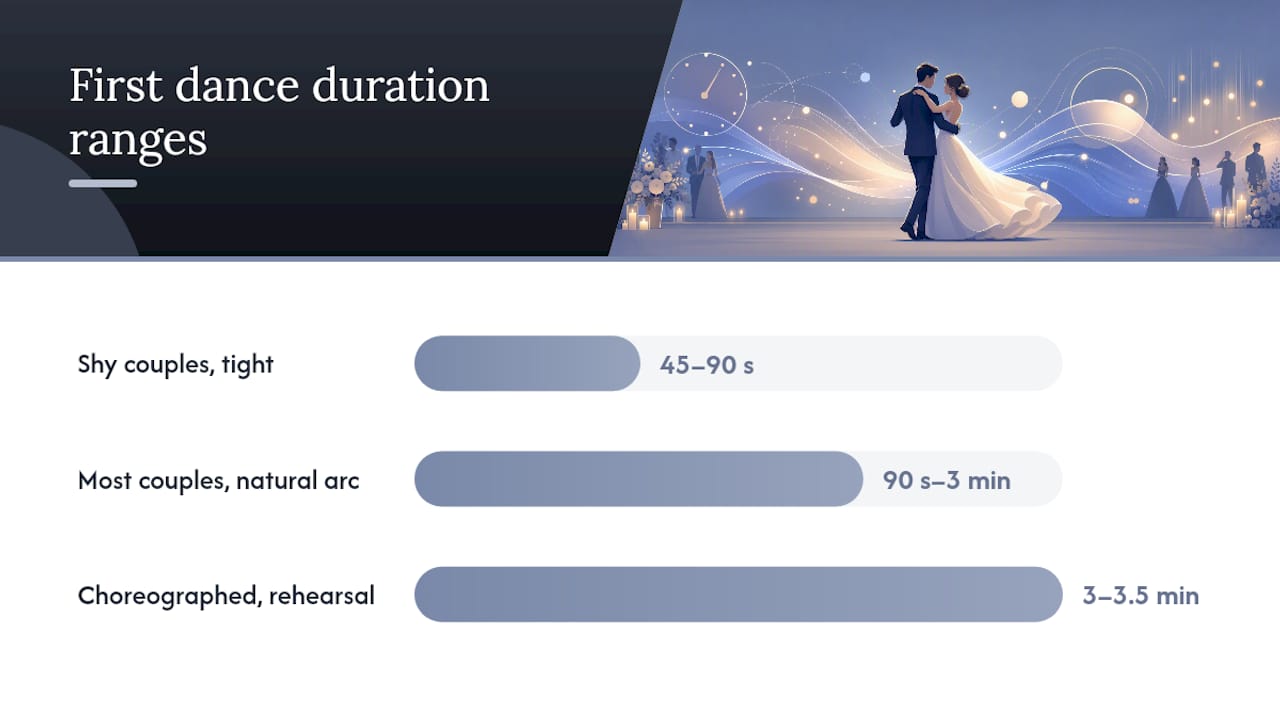
| Range | Best for | Pros | Watch out for |
|---|---|---|---|
| 45–90 seconds | Shy couples, minimal rehearsal | Tight, emotional, no lull | Less photo variety |
| 90s–3 minutes | Most couples, some prep | Natural arc, easy DJ coordination | Needs a clear edit point |
| 3–3.5 minutes | Choreographed routines | Showcases work, full song feel | Requires significant rehearsal |
Pro Tip: If you love a song but it runs 4+ minutes, you don't have to cut your favorite part. Ask your DJ to start at the second verse or chorus, where the emotional payoff already exists, and fade after the next chorus. You get the best 90 seconds of the track.
When in your reception should the first dance happen?
Placement matters as much as duration. The three most common spots are:
- Right after introductions, before dinner — The energy is high, guests are standing, and the transition from "couple walks in" to "couple dances" feels natural. Most planners favor this.
- After dinner, before open dancing — Works well if you want guests settled and fed before the spotlight hits you. The risk is a post-dinner energy dip.
- As part of a formal introductions block — Some couples stack introductions, first dance, and parent dances back-to-back before dinner. Efficient, but it can feel like a ceremony extension rather than a reception moment.
One number worth knowing: each dance typically consumes about five minutes of reception time once you factor in the walk to the floor, the MC announcement, the dance itself, and the transition back to guests. If you have a first dance, a father-daughter dance, and a mother-son dance, that's roughly 15 minutes of structured time before open dancing begins. Plan accordingly.
A simple flow that works for most receptions:
- Couple introduced by MC
- Walk to floor (30 seconds)
- MC announces first dance and song title
- Music starts, couple dances (60–180 seconds depending on your plan)
- MC invites guests to join or transitions to dinner
- Band or DJ shifts to background music or dinner set
How to pick the right section of your song and edit it
Most couples make the mistake of thinking they have to dance to the whole song. They don't. The goal is to find the 60–180 seconds that carry the most emotional weight, then build the dance around that window.
Here's how to do it:
- Listen to the song three times with a timer. Note where the energy peaks, where the lyrics hit hardest, and where a natural pause or key change occurs.
- Identify your start point. For most pop and jazz songs, the second verse or the first chorus is where the song opens up. Starting at 0:30–0:45 often drops you right into the emotional core.
- Mark your end point. Pick a moment immediately after a chorus or a lyrical resolution. That's where a fade sounds intentional rather than abrupt.
- Give your DJ exact timestamps. "Start at 0:34, fade beginning at 1:58 after the second chorus" is the kind of brief that gets executed correctly.
- Rehearse your final move to land on the fade. A dip, a spin, or a held embrace timed to the last note turns an edit into a cinematic moment.
Wedding Dance Coach advises fading at a musically logical moment immediately after the chorus, and communicating the exact bar or timecode to your DJ so nothing is left to guesswork on the day.
Pro Tip: Hard cuts feel jarring on a dance floor. Always ask for a fade of 3–5 seconds rather than a sudden stop, unless you're landing a choreographed ending on a specific beat.
For first dance jazz songs, the structure is often more fluid: a 16-bar intro, a melody statement, then improvisation. Ask your musician or DJ to play the melody statement and one chorus, then fade. That typically lands at 90–120 seconds and sounds complete.
What to tell your band or DJ before the wedding
This is where most couples lose time and create stress. Vague instructions ("just play the song") leave room for a live band to extend a solo by 45 seconds or a DJ to play the full 4-minute album version. Specificity is the fix.
Checklist for your vendor briefing:
- Exact song title and artist, plus the specific recording or version you want
- Start timestamp (e.g., "begin at 0:34, not the intro")
- End timestamp or target duration (e.g., "fade at 2:00")
- Whether you want a fade or a hard stop
- MC cue language (the exact words you want announced)
- Signal for when guests should be invited to join
Sample cue lines you can copy:
- "Ladies and gentlemen, please direct your attention to the dance floor as [Name] and [Name] share their first dance as husband and wife."
- "Start at 0:34, fade beginning at 1:58 after the second chorus ends."
- "After the fade, please invite all guests to join the couple on the dance floor."
Live bands behave differently from DJs here. As noted in Alexlevinmusic's booking guidance, bands can adapt arrangements to deliver a tighter 90–120 second version by shortening intros and solos, but you have to ask for that explicitly. A jazz trio playing "At Last" without direction will naturally extend the melody and add a solo, which can push the arrangement past 3 minutes. Tell them your target duration at the rehearsal or in your pre-event brief.
For more on how to find and brief your wedding band or DJ, including what questions to ask before you sign a contract, that resource covers the full process.
How rehearsal time and comfort level should shape your decision
The single biggest mistake couples make is choosing a dance length based on the song they love rather than the time they've put in. Those two things need to match.
Rough rehearsal estimates by complexity:
- Simple sway with slow turns: 1–2 practice sessions, comfortable at 60–90 seconds
- Basic choreography (dip, spin, box step): 4–6 sessions, comfortable at 90–150 seconds
- Full routine with lifts or multiple transitions: 10+ sessions, comfortable at 2.5–3.5 minutes
Choreography coaches cap complex routines at about 3 minutes because learning and executing longer sequences under wedding-day pressure significantly raises the risk of errors. Muscle memory built in a studio doesn't always survive the adrenaline of 150 people watching.
Pro Tip: If you're anxious about dancing, pick a song section that ends naturally at 90 seconds, then plan to invite guests to join at that exact moment. You get the intimacy of a solo dance without the exposure of a long performance.
The emotional resonance of the song matters more than its full length. Plan A Wedding's guidance makes this point clearly: prioritize emotional fit over playing the entire track. A 75-second version of a song that means everything to you will land harder than a 3-minute version of something you chose because it "felt right for a wedding."
When to invite guests onto the floor and how to cue it
Bringing guests in at the right moment can actually strengthen your first dance rather than cut it short. Here are the main approaches:
- Solo for the full song, then open floor — Works best for choreographed dances or couples who want the full spotlight. The DJ or band transitions directly to the first open-dancing song.
- Solo for 60–90 seconds, then invite guests — The most common structure. The couple gets their intimate moment; guests join before anyone gets restless. The MC or DJ makes the call.
- Designed handoff — The couple's dance transitions into a parent dance or a group song (like a family circle dance). Requires coordination with the MC and band/DJ in advance.
Sample DJ/MC announcements for inviting guests:
- "And now, we'd like to invite all of you to join [Name] and [Name] on the dance floor."
- "If you have someone you love nearby, this is your moment — please join the couple."
- "Let's open the floor — everyone's welcome."
Inviting guests early is also a legitimate comfort strategy. If you're nervous, knowing the solo portion ends at 90 seconds gives you a defined finish line. You're not performing indefinitely; you're sharing 90 seconds, then the room fills in around you.
Three sample plans you can copy
Plan A: Short and sweet (60–90 seconds)
| Step | Timing |
|---|---|
| MC introduction and walk to floor | 0:00–0:30 |
| MC announces song | 0:30–0:45 |
| Music starts (begin at chorus) | 0:45 |
| Dance (chorus + second chorus) | 0:45–2:15 |
| Fade, final dip or embrace | 2:15–2:30 |
| MC invites guests to join | 2:30 |
Song structure: start at the first chorus (~0:30 in a typical pop song), dance through two choruses, fade.
Plan B: Medium (2–3 minutes)
| Step | Timing |
|---|---|
| MC introduction and walk to floor | 0:00–0:30 |
| MC announces song | 0:30–0:45 |
| Music starts (begin at verse 2) | 0:45 |
| Dance (verse + two choruses) | 0:45–3:15 |
| Fade after second chorus | 3:15–3:30 |
| Transition to dinner or open floor | 3:30 |
Song structure: start at verse 2 (~0:45 in), move through the bridge and second chorus, fade at a natural resolution.
Plan C: Choreographed (3–3.5 minutes)
| Step | Timing |
|---|---|
| MC introduction and walk to floor | 0:00–0:30 |
| MC announces song | 0:30–0:45 |
| Music starts (from intro) | 0:45 |
| Full choreographed routine | 0:45–4:15 |
| Planned ending move on final note | 4:15 |
| Applause, transition | 4:15–4:45 |
Song structure: full song from intro, with DJ or band instructed to hold the final note for a beat. Requires 10+ rehearsal sessions and a pre-set edit or arrangement.
Mistakes that make a first dance feel awkward
Red flags to watch for:
- Playing the full 4+ minute album version with no edit or cue
- No briefing given to the DJ or band on start/end points
- Choreography that exceeds the couple's rehearsal hours
- Poor audio mix (music too loud for the MC to be heard during announcement)
- No planned signal for when guests should join
Quick fixes:
- Send your DJ a timestamped edit brief at least two weeks before the wedding
- Agree on a physical cue (a nod, a look at the DJ booth) if you want to end early
- Keep one simple fallback move (a slow sway) you can default to if nerves hit mid-routine
- Ask the MC to script the announcement word-for-word so nothing gets improvised
The most important thing: let the moment be real. A 75-second dance where you're actually present with each other will outlast any memory of a 3-minute routine where you were counting beats. Wedding pros consistently note that shorter, authentic dances tend to feel more memorable than longer rehearsed performances, precisely because the couple is connecting rather than performing.
What live wedding music has taught me about first dance timing
After playing hundreds of weddings, the pattern is consistent: the couples who stress the least about their first dance are the ones who made a decision early, communicated it clearly to their musicians, and let go of the idea that longer means more meaningful.
The anxiety usually comes from the same place. Couples worry they'll look awkward, that guests will be bored, or that the song will end at the wrong moment. What actually happens when the music starts is that the room goes quiet, everyone smiles, and the couple has about 30 seconds before the emotional weight of the moment takes over entirely. By the time most couples find their footing, the dance is nearly over anyway.
One moment that stays with me: a couple who had planned a 3-minute choreographed routine, then called two weeks before the wedding to cut it to 90 seconds. They'd realized they wanted to actually look at each other instead of counting steps. The result was one of the most genuinely moving first dances I've witnessed. No one in the room knew what they'd cut.
Live music that fits your first dance, exactly as planned
Alexlevinmusic brings something a playlist can't: a live ensemble that reads the room and adjusts in real time. Whether you want a jazz trio playing a 90-second arrangement of a Sinatra standard, a solo piano version of your favorite song cut to your exact timestamp, or a DJ-and-live-hybrid that handles both the first dance and the open floor, the setup is built around your timeline.
When you reach out, share your target length, the song and version you have in mind, and whether you want a live arrangement or a DJ edit. Alexlevinmusic handles the coordination with your MC, sets the fade or ending point, and walks you through the full booking process so nothing is left to chance on the day. Serving Philadelphia, New York, and beyond, the team is available for consultations now. Check availability and start planning your first dance.
Sources
These are the primary references used throughout this guide. Share them with your DJ, band, or choreographer when briefing them on your plans.
- How Long Does the First Dance Take? When to Have It
- 9 Mistakes You're Making With the Timing and Order of Your Wedding Dances
- How Long Should Your First Dance Be? Perfect Wedding Dance Duration Guide — Monumental Ballroom
- Wedding First Dance: Song Selection, Lessons, and Choreography Tips | Plan A Wedding
- How Long Should Your First Dance Song Be? — Wedding Dance Coach