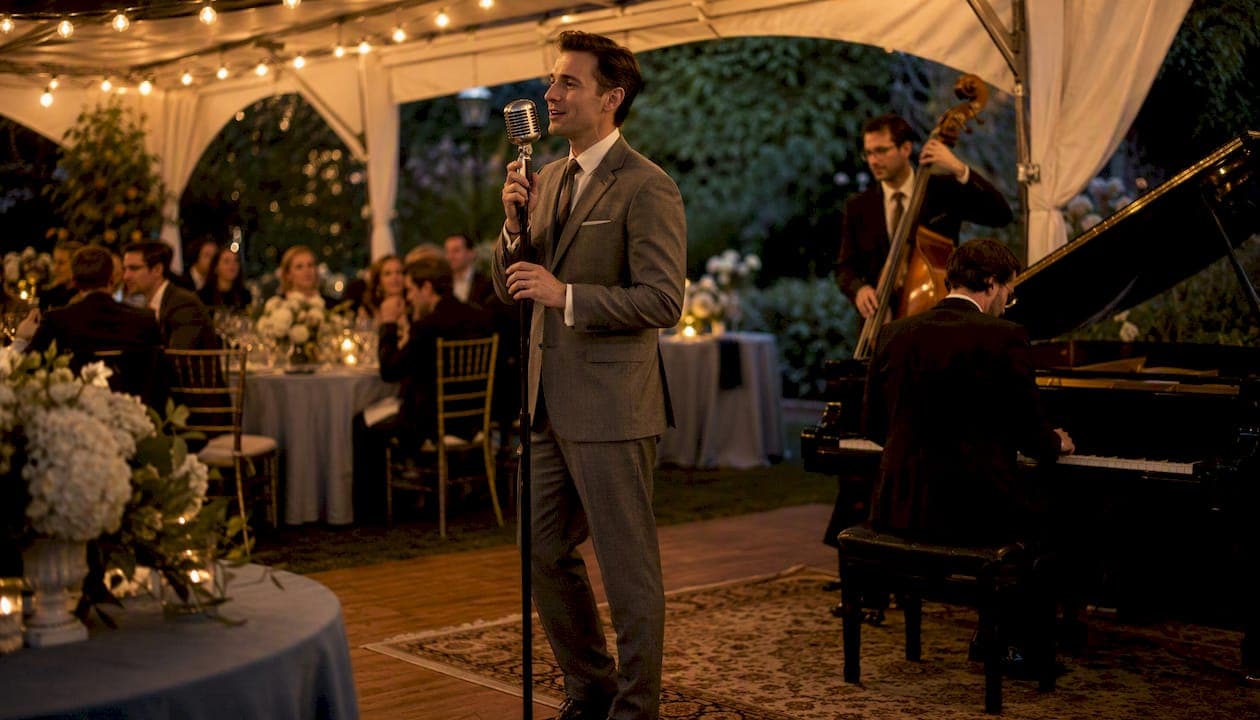
For ceremony-to-reception continuity, hire a Sinatra-style crooner paired with a jazz trio or quartet. That single combination covers intimate processionals, conversation-friendly cocktail sets, and a full dance floor by the time the reception hits its stride. Your immediate next step: request raw live clips (phone footage, not produced reels), confirm the date, and ask for a one-page contract summary. Alex Levin Music offers exactly this range of configurations, and The Knot is a reliable starting point for sourcing vetted local musicians in your market.
Key Takeaways
Hiring a Sinatra-style crooner with a jazz trio or quartet covers every wedding moment from ceremony to last dance, and booking 8–14 months out for peak dates protects your preferred lineup.
| Point | Details |
|---|---|
| Recommended hire | A crooner paired with a jazz trio or quartet covers ceremony through reception in one booking. |
| Book early | Popular ensembles fill 8–14 months out for peak spring and fall dates; start outreach once the venue is confirmed. |
| Vet with raw footage | Request unedited phone clips from a recent wedding to judge live performance and crowd interaction. |
| Confirm logistics early | Stage size, dedicated power, and load-in time must be verified with the venue before signing any contract. |
| Alexlevinmusic option | Alexlevinmusic offers solo-through-swing-band configurations with video samples, clear riders, and straightforward contracts. |
Table of Contents
- Why Sinatra-style live music elevates every part of a wedding
- Which ensemble format suits each part of your wedding?
- What to ask a Sinatra-style musician before you book
- What does Sinatra-style live music cost, and how far ahead should you book?
- Venue and technical logistics to confirm before you sign
- How to personalize your Sinatra-style setlist
- How Alexlevinmusic delivers Sinatra-style performances
- What performers know that planners often miss
- Alexlevinmusic: packages and how to get a quote
- Sources
Why Sinatra-style live music elevates every part of a wedding
Live Sinatra-style jazz brings three things a playlist never can: dynamic volume control, real-time crowd reading, and the kind of warmth that makes guests linger. A skilled crooner can pull back to near-conversational volume during dinner and push into a full swing groove the moment the dance floor opens. That range is the practical case for booking this style.
Where each moment fits:
- Ceremony: Slow, lyrical standards work beautifully for processionals. A solo voice or piano/voice duo keeps the focus on the couple without overwhelming a small chapel or outdoor garden.
- Cocktail hour: This is where a jazz trio earns its keep. Swing jazz at moderate tempo fills the room without shutting down conversation, which is exactly what guests need while they find their seats and catch up.
- Dinner: Cool jazz and ballad-tempo standards create a sophisticated backdrop. The music is present but not demanding.
- Reception/dancing: Uptempo swing standards pull guests onto the floor. A quartet or small swing band can build energy in a way a trio simply cannot match at full volume.
Swing jazz for dancing and cool jazz for cocktail hours represent two distinct subgenres worth distinguishing when you brief a band. Knowing which you want for which moment saves a lot of back-and-forth during planning.
Which ensemble format suits each part of your wedding?
Matching ensemble size to the moment is where most couples either nail the budget or blow it. Here is a practical breakdown:
| Ensemble | Best moment | Stage footprint | Notes |
|---|---|---|---|
| Solo crooner (voice only) | Ceremony, intimate dinner | Minimal | Needs PA; lowest cost |
| Piano/voice duo | Ceremony, cocktail | Small | Warm, self-contained |
| Jazz trio (piano, bass, drums or guitar) | Cocktail, dinner | Medium | Versatile; fits most venues |
| Quartet (trio + horn or vocalist) | Cocktail through dancing | Medium-large | Best all-day option |
| Small swing band | Reception dancing | Large | High energy; needs dedicated stage |
| Full swing ensemble (8–12 pieces) | Grand reception | Very large | Premium cost; requires advance planning |
The most cost-efficient approach for a full wedding day is to combine formats across the timeline: solo or duo for the ceremony, trio for cocktail hour, then quartet or small swing band for the reception. Ensemble swaps go smoothest when they coincide with vendor transitions (dinner service starting, cake cutting) so guests barely notice the changeover.
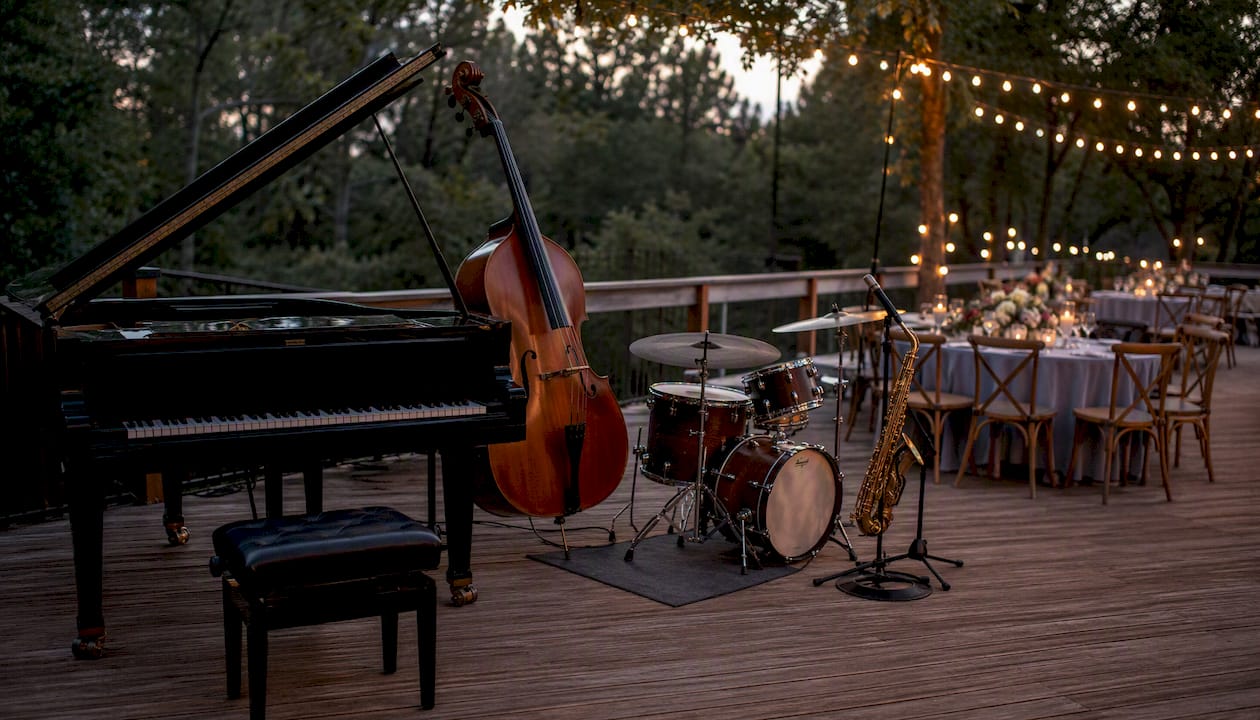
Pro Tip: Schedule a single extended soundcheck of 60–90 minutes before guests arrive and plan any ensemble swap to land during a natural break in the event timeline. This keeps load-in invisible to your guests.
What to ask a Sinatra-style musician before you book
The fastest way to validate fit is to ask for raw live footage and a sample wedding setlist before any contract conversation. Produced promo videos tell you almost nothing about how a performer handles a live room.
Questions to cover on your first call:
- Can you send unedited phone footage from a recent wedding, ideally during cocktail hour and dancing?
- What is your core Sinatra and classic jazz repertoire? Can you handle Ella Fitzgerald standards alongside the Sinatra catalog?
- Who exactly will perform? Is this a fixed lineup or a rotating collective?
- Can you arrange a specific first-dance song in a crooner style, and what is the lead time and fee?
- What is your technical rider (stage size, power, PA needs)?
- Do you carry liability insurance?
- What is your cancellation and backup policy if a musician is ill?
- What is the payment schedule and deposit amount?
Confirming availability, the band's typical event load, and whether their style genuinely matches your vision eliminates most day-of surprises. Also verify whether the lineup is fixed or rotates — a rotating collective means the performers you auditioned may not be the ones who show up.
Pro Tip: Ask specifically for a clip showing the performer interacting with guests between songs. Stage presence and crowd warmth are as important as technical skill for a wedding.
What does Sinatra-style live music cost, and how far ahead should you book?
Pricing varies widely based on ensemble size, travel distance, custom arrangements, and market demand. Here are realistic ranges for the U.S. market:
| Ensemble | Typical range | Key cost drivers |
|---|---|---|
| Solo crooner | $800–$2,000 | Travel, PA rental, custom arrangements |
| Piano/voice duo | $1,200–$3,000 | Duo travel, equipment |
| Jazz trio | $2,500–$4,500 | Three musicians, gear, city demand |
| Quartet | $4,000–$7,000 | Four musicians, larger PA, travel |
| Small swing band | $6,000–$10,000 | Full band logistics, city premium |
In high-demand cities, premium live groups can command prices above typical ranges per event — and that figure climbs further when custom arrangements, extended sets, or significant travel are involved.
Booking timeline guidance:
- Solo/duo: 4–6 months out for most markets; 6–8 months for peak spring/fall dates.
- Jazz trio or quartet: 6–10 months out; popular ensembles fill quickly in major metro areas.
- Small swing band or full ensemble: Popular and niche ensembles often book 8–14 months out for peak dates. Start outreach as soon as the venue is confirmed.
Venue and technical logistics to confirm before you sign
Confirm stage footprint, dedicated power circuits, and load-in schedule before the contract is signed. A venue that cannot accommodate a quartet's technical rider will cost you money in last-minute changes.
Checklist to run through with both the venue and the band:
- Stage size: Minimum 8×8 ft for a trio; 12×16 ft or larger for a quartet or swing band.
- Dedicated power: Live ensembles need at least two dedicated 20-amp circuits. Shared circuits with catering equipment cause audio failures.
- Noise limits/decibel restrictors: Many hotel ballrooms and outdoor venues have hard decibel caps. Confirm the limit and share it with the band before booking.
- Load-in time: Professional bands need 60–90 minutes for load-in and soundcheck. Build this into the venue timeline.
- Vendor meals: Most contracts require a hot meal for each musician. Confirm with catering.
- Liability insurance: Verify the band carries PLI and that the venue accepts it.
- Outdoor backup plan: Weather contingency for outdoor ceremonies or receptions must be agreed in writing.
Venue aesthetics and music choices interact more than most couples expect — a grand ballroom rewards a larger ensemble, while an intimate garden ceremony calls for restraint.
How to personalize your Sinatra-style setlist
Small personalization choices, like a custom crooner-style arrangement of a meaningful song, consistently make key wedding moments more memorable. The good news is that most of these changes are low-cost additions, not full custom productions.
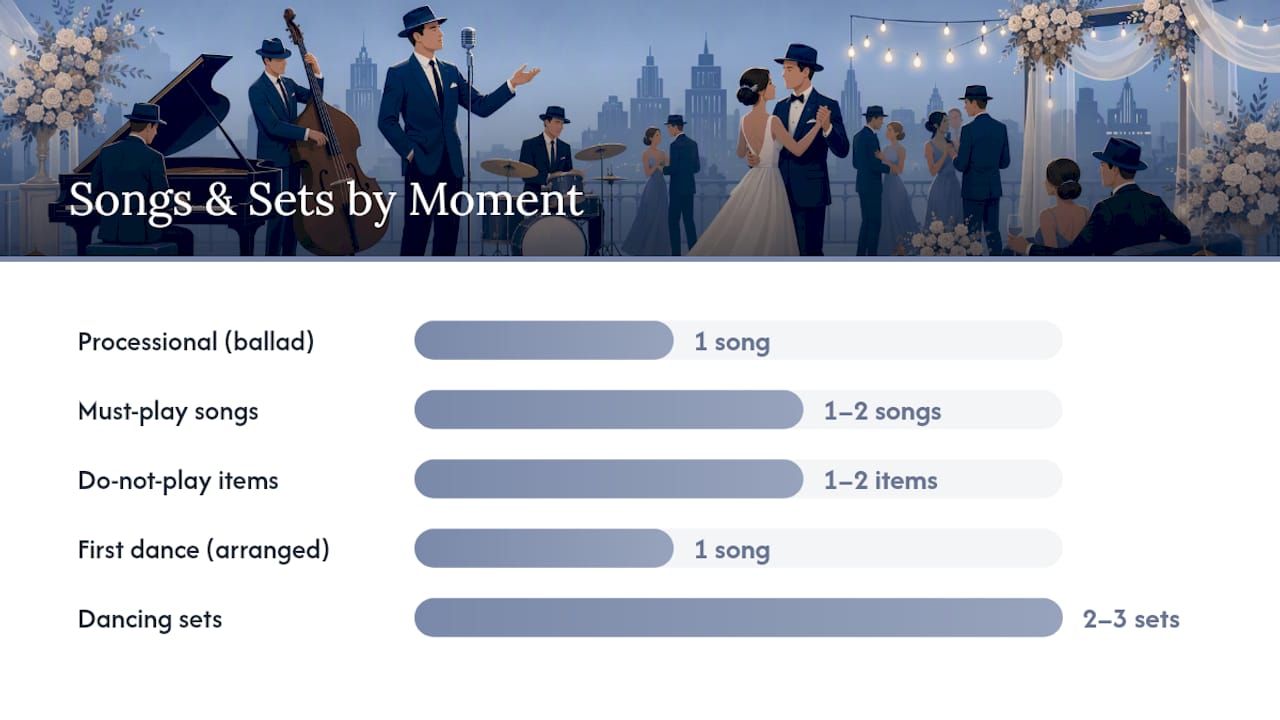
A sample setlist structure by moment:
- Processional: One slow, lyrical standard at ballad tempo (think the feel of a classic love song, not an uptempo swing number).
- Cocktail hour: A 45–60 minute medley rotating between swing standards, bossa nova-inflected jazz, and classic crooner ballads. Moderate tempo throughout.
- Dinner: Quieter, brushed-snare grooves and walking-bass intros on familiar standards. The band plays under conversation, not over it.
- First dance: One arranged standard, ideally with a key change or extended outro tailored to the couple.
- Dancing: Uptempo swing standards, building energy across 2–3 sets.
How to personalize without micromanaging:
- Give the band 1–2 "must-play" songs and 1–2 "do-not-play" items. That is enough direction without scripting the entire night.
- Request a condensed arrangement of a personal song in the crooner style. Most experienced performers need 2–4 weeks and may charge a small arrangement fee.
- Switching to a brushed-snares groove or adding a walking-bass intro can shift a song from background to feature without large additional cost.
Pro Tip: For the first dance, send the band a reference recording of the version you love most. It removes ambiguity about tempo, key, and feel far better than a song title alone.
How Alexlevinmusic delivers Sinatra-style performances
Alexlevinmusic offers curated configurations from solo crooner through quartet and small swing band, each with a clear technical rider, video samples, and a straightforward contract. The booking process follows a logical sequence: request clips and confirm the date, lock in the lineup and technical rider, review and sign the contract, coordinate load-in and soundcheck, then the performance itself with a follow-up to confirm everything landed as planned.
Video samples on the site show real wedding and event footage, not studio recordings. The blog covers personalization strategies and booking logistics in detail, so you can arrive at the first call already knowing the right questions. To check availability and request a quote, visit the services and booking page.
What performers know that planners often miss
Most couples spend hours choosing songs and almost no time thinking about volume. That is the real variable in a live Sinatra-style set. A crooner who can drop to near-whisper for a processional and build to a full swing shout for the last dance is doing something technically demanding, and it is the thing that separates a memorable performance from a competent one.
The other thing worth saying plainly: authenticity in this style is not about copying Sinatra note-for-note. The best performers bring their own phrasing to the material. What you are hiring is someone who understands the idiom deeply enough to make it feel alive in the room, not a tribute act running through a setlist on autopilot. Ask for that in the audition clip. If the performer sounds like they are reciting the song rather than inhabiting it, keep looking.
Alexlevinmusic: packages and how to get a quote
Alexlevinmusic covers solo crooner through small swing band configurations, serving weddings across Philadelphia, New York, and beyond. Every package includes a technical rider, video samples for review, and a clear contract with defined cancellation terms.
To move forward, have these details ready: your event date, venue name and city, which moments you want covered (ceremony, cocktail, reception, or all three), and a rough budget range. Then request availability and a quote directly through the site. Dates for peak spring and fall seasons fill months in advance, so the earlier you reach out, the more configuration options remain open.
Sources
- Everything You Need to Ask a Wedding Band Before You Book: 2025-2026 Guide | OurVows
- Music style questions and interview guidance for wedding bands | The Knot
- 50 Questions to Ask Your Wedding DJ or Band | Brides