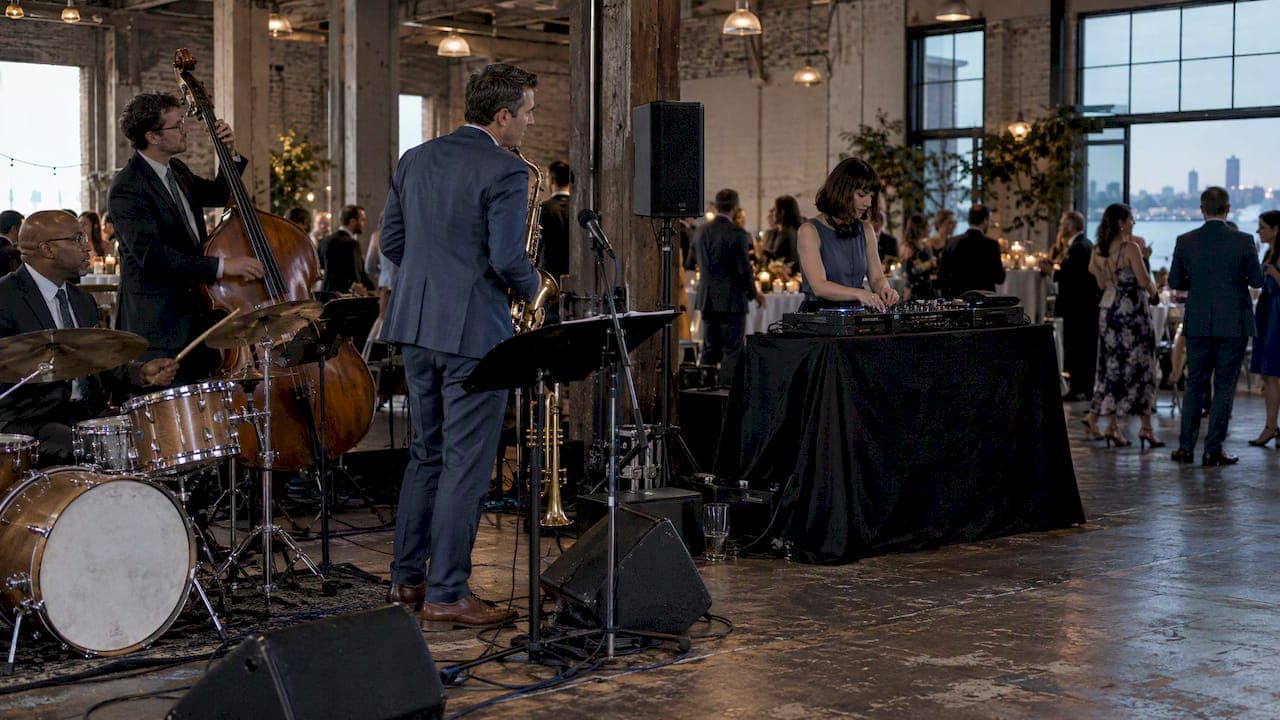
The best band-to-DJ transitions are planned, not improvised. A rehearsed, overlapped handoff, built on musical layering, a beat-matched fade, and a clear MC cue, keeps the dance floor full instead of letting energy drain during the swap. The checklist and booking guidance below show how to set this up with any vendor you hire.
TL;DR:
- Effective band-to-DJ transitions require a planned overlap with tempo matching and a crossover song in key and tempo for a seamless switch.
- A live instrument layered over the DJ’s first track for 30 to 60 seconds maintains energy and avoids dead air during the handoff.
- Using lighting cues and an MC announcement helps guests recognize the transition, reducing confusion and maintaining dance floor momentum.
- Planning, rehearsing, and a shared cue sheet are essential to prevent technical issues and execute a smooth handoff, especially in complex wedding setups.
- Budgeting for a coordinated hybrid setup typically costs $1,200 to $2,000, with early booking (9-18 months ahead) and detailed planning crucial for success.
Table of Contents
- What a successful band-to-DJ handoff sounds like
- Practical planning checklist: production, logistics, and communication
- Choosing songs and sequencing the set for a smooth handoff
- Using lighting and the MC to cue the switch
- Budget and booking timeline for a band plus DJ setup
- How Alex Levin Music builds the handoff into every booking
- Treat the transition like a performance moment, not a gap
- Book a hybrid DJ and live band handoff with Alex Levin Music
- FAQ
- Sources
What a successful band-to-DJ handoff sounds like
A clean handoff rarely happens by accident. It works because someone planned the overlap between the live set and the DJ's first track, so the dance floor never goes quiet.
The most reliable technique is layering: a saxophonist or percussionist plays live over the DJ's opening track for 30 to 60 seconds before the band fully steps out. It keeps a human element on stage while the DJ's sound system takes over the room. Crossover songs work the same way in reverse. The band plays the outro of a familiar tune while the DJ fades in a version of it, or a track in the same key and tempo, so the audience barely registers the switch.
None of this works without tempo planning. If the band's last song runs at 100 beats per minute and the DJ's opener is 128, the handoff will feel like a record skip. Matching BPM, or choosing a DJ track with a slow build, smooths the gap.
- Live instrument layered over the DJ's first track for a 30 to 60 second overlap.
- A shared crossover song, or two songs in a compatible key and tempo.
- One sound system and one front-of-house plan, so levels do not jump when the DJ takes the board.
Practical planning checklist: production, logistics, and communication
Most awkward handoffs trace back to production gaps, not musicianship. Stage-plot guidance built for working bar bands applies directly to wedding gigs, which almost always require two distinct setups: an acoustic or ceremony plot and a full reception plot. Saving both in advance, and tracing the signal flow from each microphone or input to the final output, catches missing cables and channel conflicts before load-in.
- Confirm load-in times, stage dimensions, power access, and who supplies microphones and playback equipment.
- Decide who owns the handoff cue, the bandleader or the DJ, and agree on a visual or in-ear signal.
- Run a soundcheck that names every input by channel, then save a compact fallback stage plot in case the footprint shrinks.
- Write the exact handoff minute into the run-of-show, and rehearse that specific bridge, not just the songs around it.
A single front-of-house plan, rather than two separate rigs, removes the volume mismatches and delays that cause dead air during the swap, according to the same wedding gig production guide.
Pro Tip: Have one person, not the couple, explain the entire handoff plan out loud in under two minutes. If they stumble, the plan has a gap.
Choosing songs and sequencing the set for a smooth handoff

Not every song makes a good bridge. The best handoff songs have long instrumental intros or outros, grooves that sustain for 30 seconds without a vocal hook, or tempos close enough to the next track that a DJ can beat-match without a jarring key or pace change.
DJs commonly plan sets using what is known as the rule of 32: most dance tracks are structured in 32-beat phrases, and mixing on phrase boundaries, rather than mid-phrase, keeps transitions sounding intentional. Applying that same logic to the band-to-DJ handoff means ending the live set on a phrase boundary, not mid-verse, so the DJ's first beat lands where the audience expects it.
- Ask the band for a sax-led groove or an extended outro that gives the DJ room to fade in.
- Request a drum fill or cymbal swell that resolves exactly on the DJ's first downbeat.
- Share a cue sheet between band and DJ ahead of time so no song gets played twice.
- Preface handoff songs with arrangement notes (tempo, key, length) rather than leaving them to guesswork.
A shared setlist and rehearsed crossover song, rather than a last-minute verbal agreement, is the detail that most often separates a smooth handoff from an awkward one. For more on choosing bridge songs, this guide on planning musical transitions covers cue sheets in more depth, and DRVVYN Sound's breakdown of transition rules is a useful reference for the DJ side of phrase-matching.
Using lighting and the MC to cue the switch
The handoff is not only musical. Lighting and an MC announcement tell the room, instantly, that the entertainment style is changing.
Dimming house lights while bringing up dance-floor lighting signals a shift before the first DJ beat even plays. A short MC line, something like "the band is handing things over to the DJ, keep that energy up," removes any confusion about whether the music stopped by accident. On stage, a simple visual cue, a drum roll or a held sax note, tells the DJ exactly when to drop the first beat.
- Bring dance lighting up as house lights come down, timed to the last bars of the band's set.
- Have the MC announce the switch by name, not just fade to silence.
- Use a drum fill or sustained note as the DJ's cue to start the track.
Pre-planned transitions with lighting cues and MC announcements are among the most reliable low-cost ways to smooth a band-to-DJ handoff and keep guests oriented to the change.
The most common failure modes are competing sound systems running simultaneously and lighting swaps that happen late, after the music has already changed. Both are production issues, not performance issues, and both are preventable with the planning above.
Budget and booking timeline for a band plus DJ setup
Combining a live band with a DJ adds a production layer, and that shows up in both price and lead time. A standard DJ reception package in most markets runs roughly $1,200 to $2,000, with the same range confirmed across state-level pricing guides. A separate national benchmark puts the median base DJ price near $1,440 before regional adjustments, with event duration and production needs as the main drivers of cost above that base.
- Add-ons like uplighting, a second DJ, or ceremony audio push packages toward the higher end of the range.
- A unified front-of-house setup, extra sound techs, or stagehands add cost but reduce handoff risk.
- Book DJs and musicians 9 to 18 months ahead during peak season, which also buys time for a rehearsed transition.
- Ask any vendor directly whether a coordinated rehearsal is included in the package before signing.
How Alex Levin Music builds the handoff into every booking
Events can be structured around the handoff rather than treating it as an afterthought: a ceremony trio or soloist, a reception band, and a DJ or hybrid set can be planned as one continuous arc, with rehearsal cues set in advance rather than improvised on the night.
- Ensemble templates move from ceremony trio to full reception band to DJ without a format the room has not already heard.
- A shared cue sheet and stage plot are built before load-in, following the same two-setup logic used across the planning checklist above.
- Live Band vs DJ Wedding: Which One Is Right for You? walks through layering live soloists, like sax or piano, over DJ tracks.
- An advance checklist covering inputs, cues, and fallback stage plots is available on request when you book.
Treat the transition like a performance moment, not a gap
A band-to-DJ handoff is a performance in its own right, and it deserves the same rehearsal as any other song on the set list. My one practical tip: assign a single owner for the cue, with a simple fallback (a drum fill, a sax note) if the signal gets missed, and bring that plan to your vendors early.
— Alex
Book a hybrid DJ and live band handoff with Alex Levin Music
If you want this handled rather than pieced together, DJ & Hybrid Music pairs a live ensemble with a DJ set as one coordinated booking, built for weddings and private events where the room needs to move from dinner to dancing without a flat spot. Current prices are available on the pricing page.
In your first consult, ask for three things: a written stage plot covering both the acoustic and full-band setups, dedicated rehearsal time for the exact handoff bridge, and a named owner for the cue, whether that is the bandleader or the DJ.
- Confirm which ensemble fits your reception, from a trio to a full swing band, before adding the DJ layer.
- Request the advance checklist so your venue and sound vendor see the stage plot ahead of load-in.
- Ask whether your package includes a rehearsed crossover song, not just a shared playlist.
Reach out through the DJ & hybrid service page to start a booking conversation and lock in a date with enough lead time for a rehearsed handoff.
FAQ
What are some good transition songs for DJing?
The strongest transition songs have long instrumental intros or outros, a sustained groove with no vocal hook, and a tempo close to the next track so a DJ can beat-match cleanly. Songs with a clear drum fill or cymbal swell near the end also give the DJ an obvious point to bring in the first beat.
What is the rule of 32 in DJing?
The rule of 32 refers to the common structure of dance tracks in 32-beat phrases, and DJs typically mix on those phrase boundaries rather than mid-phrase to keep the transition feeling intentional. Applying the same idea to a band-to-DJ handoff means ending the live set on a phrase boundary so the DJ's first beat lands where listeners expect it.
How much should I pay a DJ for a wedding reception?
A standard DJ package for a wedding reception typically runs between $1,200 and $2,000, with state-level guides confirming a similar range. Add-ons like uplighting, ceremony audio, or a second DJ raise the price above that base, and hybrid DJ and live band packages start at published minimums.
How do I create good DJ transitions after a live band?
Good transitions come from overlap, not a clean cut: have a live musician layer over the DJ's opening track for 30 to 60 seconds, and match tempo and key between the band's last song and the DJ's first. Pair that with an MC announcement and a lighting shift so guests register the change in style right away.
Sources
- The Wedding Gig Survival Guide for Working Bar Bands
- 2026 Wedding DJ Rates: Complete Pricing Guide and How to Budget for Your Perfect Reception | Wedding Rate
- How Much Does a Wedding DJ Cost in 2026? Price Guide by State | WeddingDJFinder