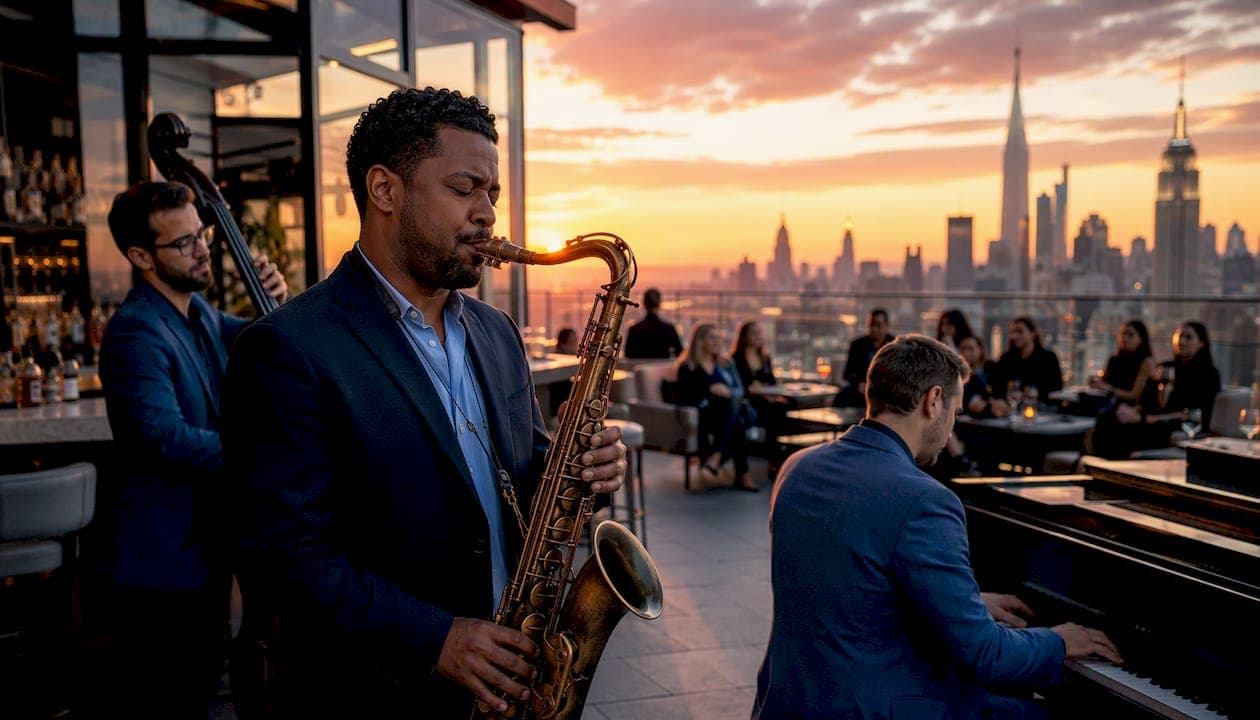
A cohesive live ensemble comes down to three things: reliable auditory coupling between musicians, a designated leader who controls timing and interpretation, and shared goals built through rehearsal before the event. Get all three right and the music flows. Miss one and you will hear it.
- Designate a lead role in every ensemble and name that person in your rider or briefing.
- Prioritize audio paths first. Research shows that removing audio causes large timing misalignment; visual cues alone cannot compensate.
- Require rehearsed groups. Musicians who have played together build shared internal models that let them anticipate each other in real time.
- Brief musicians on event-specific cues — entrance timing, tempo targets, and recessional signals — before the ceremony begins.
Alexlevinmusic applies these principles on every booking, from jazz trios at cocktail hours to string quartets at wedding ceremonies.
Table of Contents
- 1. How musicians actually communicate during a live performance
- 2. Why leadership and musical texture shape who follows whom
- 3. The practical checklist you can hand directly to your musicians
- 4. How ensemble format changes what you need to manage
- 5. Quick fixes for the most common on-site problems
- 6. Realistic timeline and budget factors to plan for
- 7. How Alexlevinmusic builds cohesion from booking to encore
- Key Takeaways
- What actually works at live events, and what people get wrong
- Alexlevinmusic delivers polished, cohesive live ensembles for your event
1. How musicians actually communicate during a live performance
Sound is the primary channel. A Frontiers in Psychology study found that eliminating audio between ensemble members causes substantial timing misalignment, while blocking visual contact produces a comparatively smaller effect. That single finding should reshape how you think about stage layout and monitoring.
"Ensemble musicians encode and decode subtle sensorimotor messages — head nods, breathing, bow movements — and use predictive internal models to anticipate each other's next phrase. Auditory information anchors the timing; visual cues fill the gaps at moments of uncertainty." — Royal Society B
Visual cues do matter, but selectively. Musicians use deliberate gestures — hand lifts, breath cues, head nods — at entrances, tempo changes, and structurally ambiguous moments. The practical implication: stage layout must let musicians hear each other first, see each other second. A string quartet arranged in a tight arc with foldback monitors satisfies both. A band spread across a wide stage with no monitors satisfies neither.
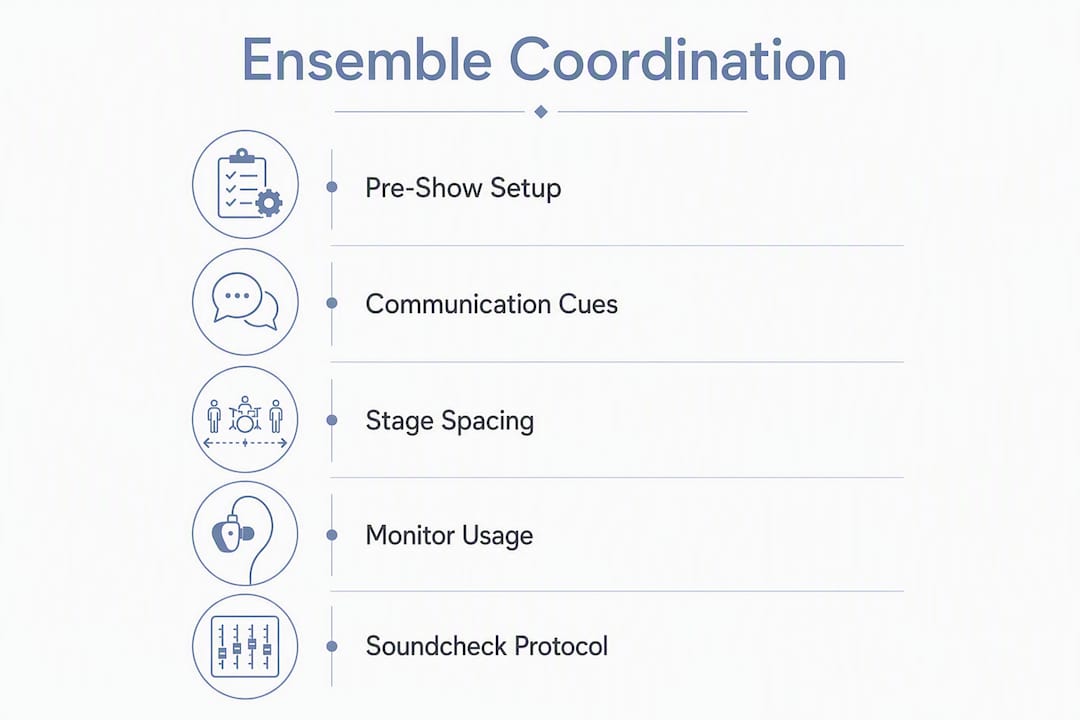
For your rider: require individual foldback or in-ear monitors for each musician, minimum stage spacing of four feet between players, and a quiet zone behind the performance area to reduce ambient bleed.
2. Why leadership and musical texture shape who follows whom
Clear leadership stabilizes timing and interpretive choices, especially during transitions. Royal Society B research shows that conductors and designated leads do more than mark tempo: they select expressive detail and drive synchronization, with measurable increases in leader-to-musician causal influence correlating with judged performance quality.
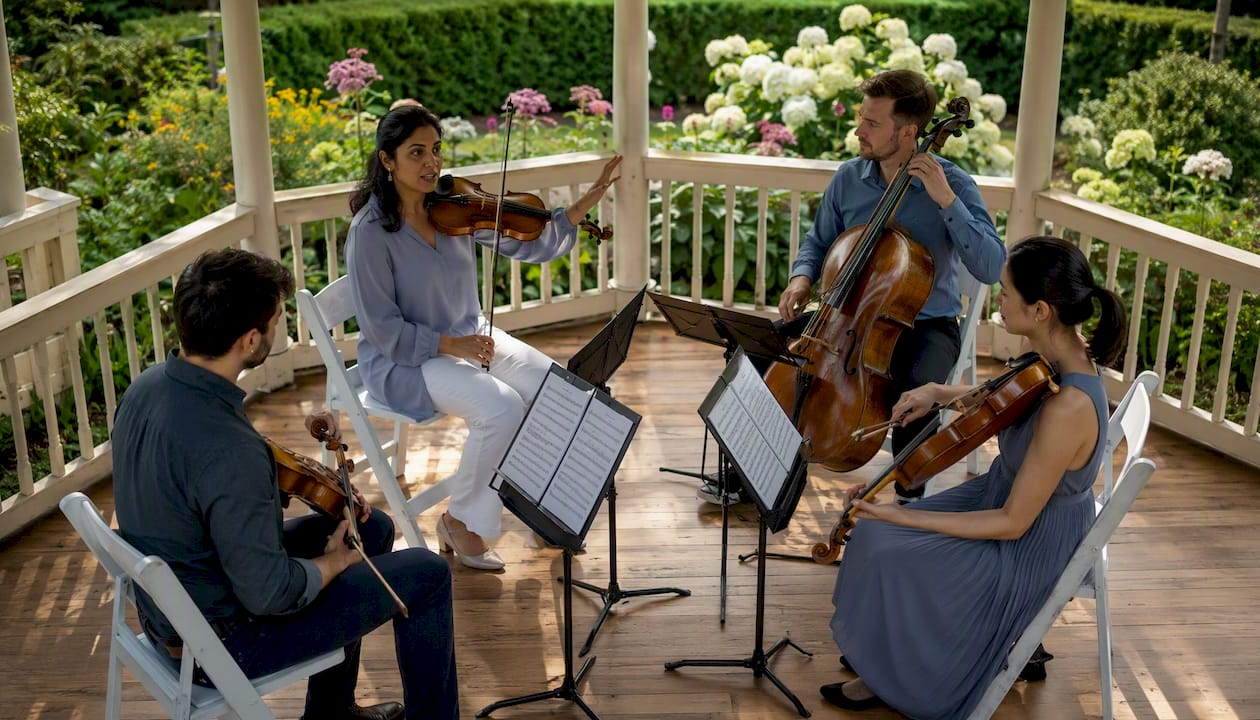
Musical texture amplifies this effect. A PLOS ONE study using video-based pose estimation found that homophonic textures — one clear melody over accompaniment, typical of a processional or ballad — produce stronger directional influence from the melody voice to the rest of the group. Polyphonic textures, where multiple independent lines share equal weight, distribute influence more evenly.
In planner terms:
- Ceremony processionals and recessionals are almost always homophonic. Name the melody lead explicitly in your briefing.
- Cocktail hour jazz often shifts between homophonic and polyphonic. The lead instrument (usually piano or saxophone) should be understood by all players as the tempo anchor.
- Reception dance sets benefit from a rhythm-section leader (drummer or bassist) who holds tempo while the melody instruments improvise.
Pro Tip: When your setlist includes pieces with a clear melody/accompaniment contrast, write the melody lead's name next to that piece in the printed setlist. A brief note removes ambiguity at the moment it matters most.
3. The practical checklist you can hand directly to your musicians
Follow this checklist and you cut timing drift, balance problems, and interpretive mismatch before they reach the event floor.
At booking:
- Ask whether the ensemble has played together before and how recently.
- Confirm who holds the lead role and how tempo decisions are made.
- Request a rider that specifies monitor needs, stage dimensions, and power requirements.
- Ask for video samples of live performances, not studio recordings.
In the rider: 5. Specify individual foldback monitors or in-ear monitors for each player. 6. Set minimum stage spacing (four feet between players as a baseline). 7. Require a dedicated quiet zone behind the stage for pre-show warm-up. 8. Include a substitution clause: if a member changes within 72 hours of the event, the band leader must notify you and confirm the replacement has rehearsed the setlist.
Setlist brief: 9. List every entrance and exit cue with a target tempo or feel description ("processional: slow, 60–70 BPM, no rubato"). 10. Mark the recessional as a hard stop or a fade, not "to be decided on the day."
Rehearsal and soundcheck timeline:
- Small ensembles (duo, trio): arrive 90 minutes before guests; 30 minutes load-in, 30 minutes soundcheck, 30 minutes private run-through.
- Quartets and string quartets: arrive 120 minutes before guests; add 30 minutes for tuning and ensemble balance check.
- Hybrid DJ + live setups: arrive 150 minutes before guests; routing and click-track sync require extra time.
Pro Tip: Pin a one-sentence cue protocol to the band leader's music stand: "Ceremony start = two taps on the stand. Hold = open palm. End = closed fist." Simple signals prevent the most common on-site confusion.
4. How ensemble format changes what you need to manage
Ensemble format shapes the dominant coordination needs. Here is how the most common formats compare:
| Format | Typical lead role | Monitor need | Rehearsal time | Bleed risk | Best event moment |
|---|---|---|---|---|---|
| Solo piano | Self-led | Low | 30 min | Low | Cocktail hour, dinner |
| Duo | Melody instrument | Low–medium | 45 min | Low | Ceremony, cocktail |
| Jazz trio | Piano or bass | Medium | 60 min | Medium | Cocktail, reception |
| Jazz quartet | Lead horn or piano | Medium–high | 90 min | Medium | Reception, corporate |
| String quartet | First violin | Low–medium | 90 min | Low | Ceremony, cocktail |
| DJ + live hybrid | DJ (click/tempo) | High | 120+ min | High | Reception, corporate |
For hybrid setups, the DJ's click track or backing track is the tempo spine. Every live musician must receive that click in their monitor. Without it, even a rehearsed group will drift within two or three songs. Ask directly: "Do you use a click or in-ear monitors for hybrid sets?" If the answer is no, that is a red flag.
Cocktail hour formats deserve special attention: a jazz trio in a reverberant room needs tighter spacing and lower stage volume than the same trio in a dry ballroom. Brief musicians on the room's acoustics in advance.
5. Quick fixes for the most common on-site problems
Most on-site problems have fast, repeatable solutions. Identify the symptom, then apply the corresponding action.
- Timing drift: Check monitor levels first. If musicians cannot hear the rhythm reference, tempo wanders. Ask the sound engineer to raise the bass or drum in the foldback mix. If no engineer is present, move musicians closer together so they can hear each other acoustically.
- Volume imbalance: One instrument is too loud or too soft. Adjust mic placement before touching the board — angling a microphone 15 degrees away from a loud source cuts bleed significantly. For acoustic instruments, physical repositioning is faster than EQ.
- Crowd noise overwhelming the ensemble: Raise the foldback level for the rhythm reference rather than the overall PA volume. Musicians need to hear themselves more than the audience needs more volume.
- Last-minute member substitution: Simplify the arrangement immediately. Drop any section that requires specific rehearsed cues and keep the lead role with the most experienced player present. Research on collective improvisation shows that shared collective goals produce tighter coordination than individual performance strategies — brief the substitute on the group's goal for each piece, not just the notes.
- Distraction or missed entrance cue: Establish eye contact with the band leader and use the pre-agreed hand signal. Do not call out across the room.
Pro Tip: Give the venue coordinator a printed copy of the cue protocol. If you need to signal the band during the ceremony, the coordinator can relay it without disrupting the room.
6. Realistic timeline and budget factors to plan for
Plan for at least 60–120 minutes of pre-show coordination for small ensembles, and up to 150 minutes for larger or hybrid setups. Insufficient pre-show coordination time is a common reason ensemble cohesion breaks down at live events.
Timeline minimums by phase:
- Arrival and load-in: 30–45 minutes
- Stage setup and cable routing: 20–30 minutes
- Soundcheck (per musician): 10–15 minutes
- Full ensemble soundcheck: 20–30 minutes
- Private run-through of ceremony or event-specific cues: 20–30 minutes
- Pre-show quiet period: 15 minutes minimum
Cost factors to build into your budget:
- Base fee per musician (varies by market, ensemble size, and experience level)
- Travel and parking, especially for Philadelphia and New York metro events
- Sound engineer or PA rental if the venue does not provide one
- Extra rehearsal time billed at an hourly rate
- Overtime risk: specify a hard end time in the contract and a per-30-minute overtime rate
Professional musicians at live events bring their own rehearsed coordination systems. That experience has real dollar value: it reduces the risk of a costly on-site problem that no amount of last-minute fixing can fully repair.
Include a buffer of at least 30 minutes between the end of soundcheck and the first guest arrival. That window is where the ensemble runs ceremony cues, confirms hand signals, and settles into the room acoustically.
7. How Alexlevinmusic builds cohesion from booking to encore
Alexlevinmusic follows a repeatable process designed to eliminate the most common ensemble cohesion failures before they reach your event.
- Pre-booking consultation: review of event timeline, venue acoustics, and ensemble format options.
- Rider and stage plan: a written technical rider specifying monitor needs, stage dimensions, and power requirements, sent to the venue in advance.
- Arrangement review: setlist confirmed with entrance and exit cues, tempo targets, and lead role assignments noted for each piece.
- On-site rehearsal and soundcheck: a structured pre-show run-through that includes ceremony cues and a full ensemble balance check.
- Stage manager coordination: a designated point person on the Alexlevinmusic side who communicates directly with the venue coordinator during the event.
- Video samples: recorded live performance examples available for review before booking, so you can assess ensemble balance and leadership in action.
To request a quote, include your event date, venue name, expected guest count, and preferred ensemble format. That information allows Alexlevinmusic to confirm availability and match the right musicians to your event's specific acoustic and timing requirements. See the full booking-to-encore process for a detailed walkthrough.
Key Takeaways
Cohesive live ensemble performance requires auditory coupling, designated leadership, and rehearsed shared goals — all three must be in place before the first guest arrives.
| Point | Details |
|---|---|
| Audio paths come first | Foldback monitors are the single highest-impact rider item; visual cues cannot substitute for hearing. |
| Name the lead role | Designate a melody or tempo lead for each piece, especially homophonic sections like processionals. |
| Rehearsed groups outperform ad-hoc lineups | Shared internal models built during rehearsal produce smoother real-time coordination. |
| Budget 60–150 minutes pre-show | Small ensembles need at least 60 minutes; hybrid setups need 150 minutes for routing and click sync. |
| Alexlevinmusic | Provides a structured pre-booking consultation, written rider, on-site rehearsal, and stage manager coordination for every event. |
What actually works at live events, and what people get wrong
The conventional wisdom is that more rehearsal time always equals better performance. That is mostly true, but the mechanism matters more than the hours. What rehearsal actually builds is a shared mental model — each musician internalizing not just their own part but a predictive simulation of everyone else's. Research on shared representations makes this explicit: groups that rehearse together recruit predictive internal models that let them adapt to each other in real time. An ad-hoc group with individually talented players does not have that, no matter how skilled each person is.
The counterintuitive lesson: simpler arrangements recover faster from disruption. When a last-minute substitution happens, the instinct is to keep the original arrangement and brief the new player quickly. The better move is to strip the arrangement down to its structural core — melody, rhythm, basic harmony — and let the group's shared leadership hold it together. Less complexity means fewer coordination points to fail.
The other thing planners consistently underestimate is the value of a pre-show quiet period. Fifteen minutes where the ensemble plays softly through the room, adjusting to the acoustics, is worth more than an extra 30 minutes of rehearsal in a practice space. The room changes everything: reverb, ambient noise, monitor reflections. Musicians who have played the actual space before the first guest walks in perform measurably better than those who have not.
Alexlevinmusic delivers polished, cohesive live ensembles for your event
Every event has one shot at a first impression, and the music sets it. Alexlevinmusic brings jazz trios, string quartets, solo piano, and hybrid DJ + live ensembles to weddings, corporate receptions, and private parties across Philadelphia, New York, and beyond — with a structured process that handles the technical details so you do not have to.
Every booking includes a pre-event consultation, a written technical rider, on-site soundcheck coordination, and a designated band leader who manages real-time cues during your ceremony and reception. You get live music that actually holds together, not just talented musicians sharing a stage.
To check availability, reach out with your event date, venue, guest count, and ensemble preference. Alexlevinmusic will confirm availability and recommend the right format for your event's specific moments. Visit the services page to see the full range of ensemble options and start the conversation.