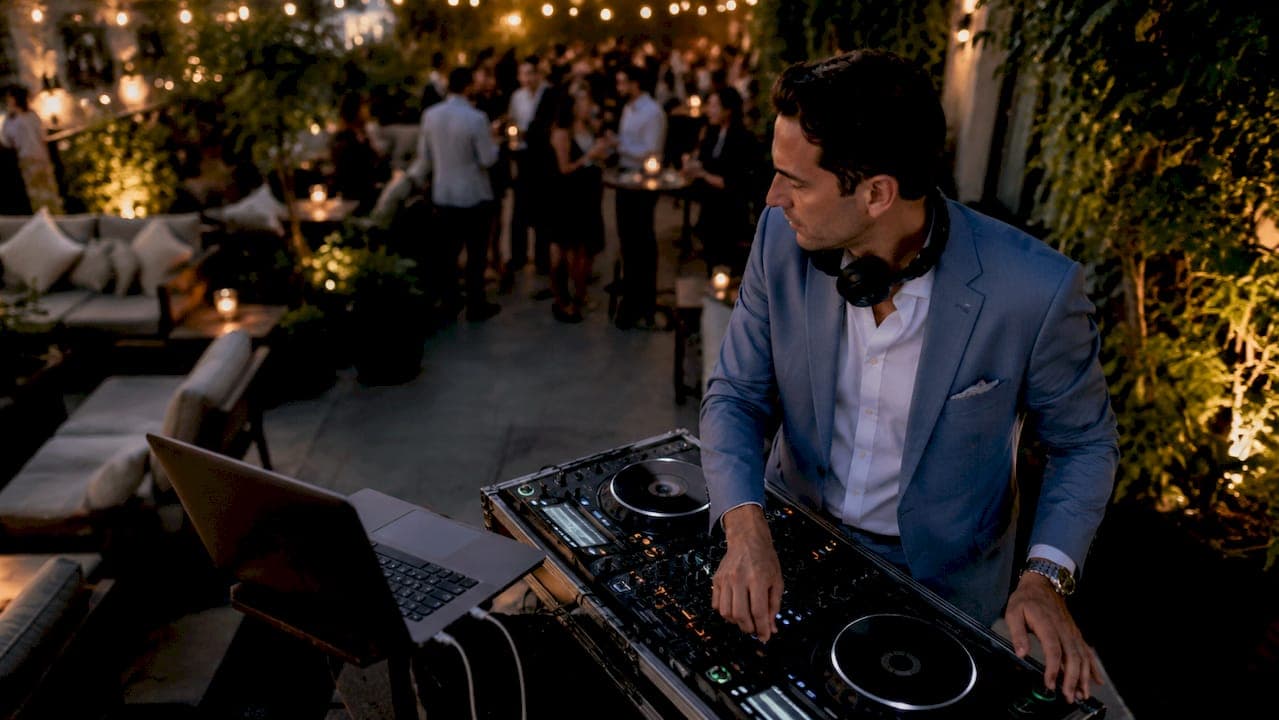
A DJ plays pre-recorded tracks mixed live in real time, while a live band performs music with instruments and vocals in front of your guests. That single difference in delivery creates two completely different event experiences. Understanding what is a DJ versus live band means going beyond the music itself. It means weighing atmosphere, logistics, cost, and the kind of memory you want your guests to walk away with. This guide breaks down every factor that matters, so you can make the right call for your specific event.
What is a DJ versus live band in terms of performance?
A DJ mixes pre-recorded tracks live, selecting songs and blending them with transitions, effects, and timing adjustments. A live band performs every note in real time, with musicians reading the room and adjusting energy on the fly. These are fundamentally different skill sets, and they produce fundamentally different results for your audience.
Live bands bring visual energy that recordings simply cannot replicate. Watching a saxophonist lean into a solo or a vocalist lock eyes with the crowd creates a moment. Research confirms this is not just perception. A pilot study of 130 participants found higher heart rates and emotional engagement among live concert attendees compared to those watching livestreamed pre-recorded music. That physiological response is the difference between guests who dance and guests who sit.
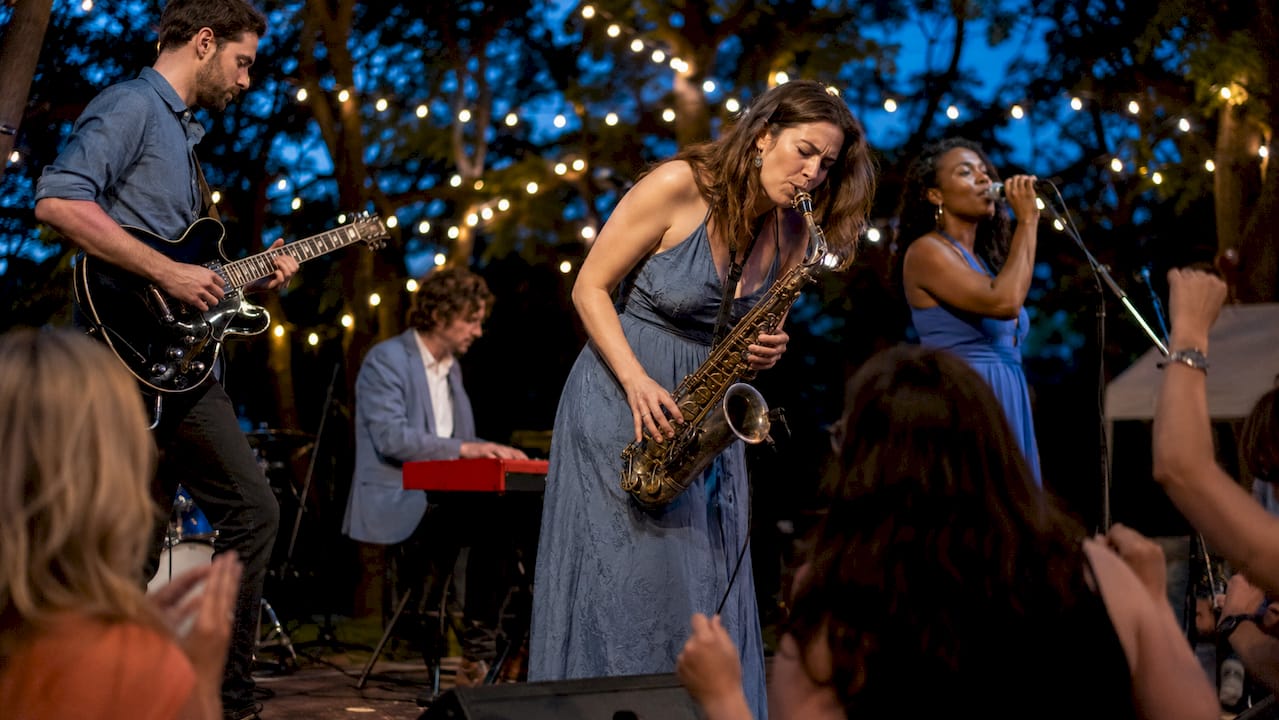
The science goes deeper. An EEG study showed that brainwaves synchronize more strongly with live music, particularly at faster rhythms, which explains why live performances consistently score higher for pleasure and engagement than recorded playback. Your guests are not just hearing the music. Their brains are literally locking in with it.
DJs offer something different but equally powerful: precision and range. A skilled DJ can move from Frank Sinatra to Beyoncé to a current Billboard hit without a single awkward pause. That genre-spanning continuity is nearly impossible for a live band to match. For events with mixed-age guest lists or unpredictable crowd energy, that flexibility is a real advantage.
"A live band's energy and concert-like atmosphere often justify a higher budget and space requirements, making them ideal for events where visual impact is the priority." — BandCalendar
How do music variety and song requests compare?
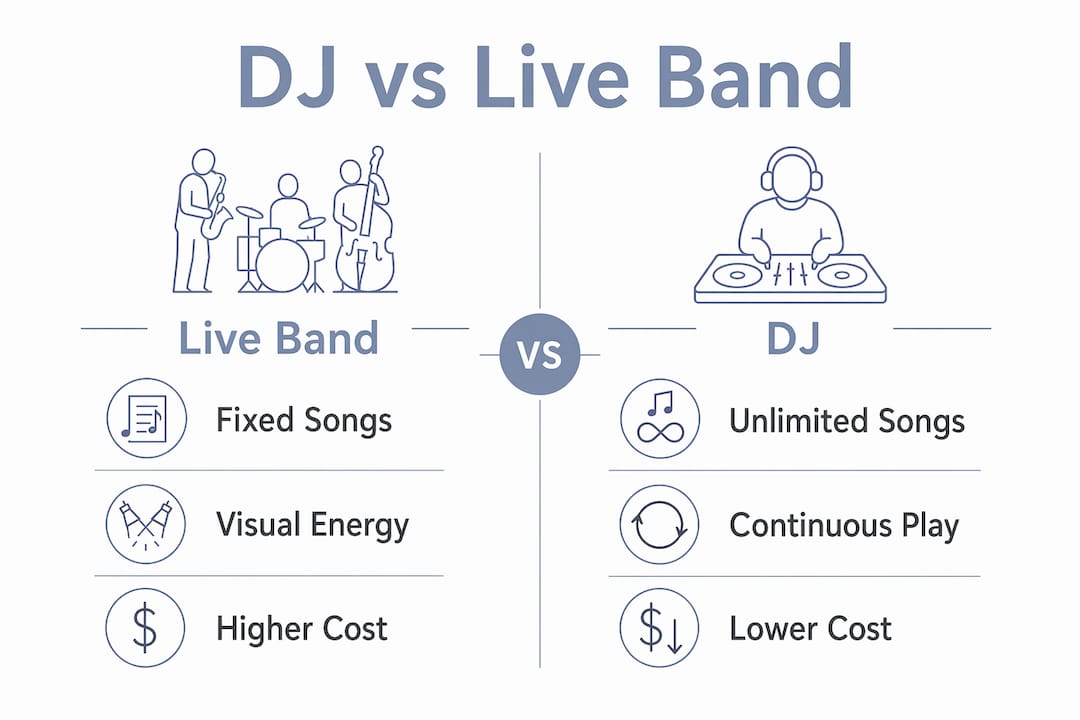
Music variety is where DJs hold a clear structural advantage. A DJ carries access to virtually unlimited songs and can fulfill a last-minute request in seconds at no extra cost. A typical wedding band's set list contains 40–60 songs. Learning a new song requires weeks of rehearsal and often comes with an additional fee.
That constraint matters more than most couples realize until the night of the event. If your grandmother's favorite song is not in the band's repertoire, you either pay extra, plan ahead by weeks, or accept that it will not be played. With a DJ, you add it to the playlist that afternoon.
| Factor | Live Band | DJ |
|---|---|---|
| Song library | 40–60 songs (fixed repertoire) | Virtually unlimited, instant access |
| Last-minute requests | Requires rehearsal, may cost extra | Available immediately, no added fee |
| Genre range per set | Limited by band's style and training | Spans any genre or era |
| Music continuity | Gaps during breaks | Continuous play throughout event |
Live bands also perform in two sets of roughly 45–60 minutes each, with 20–30 minute breaks between sets. Those breaks require a plan. Without one, your dance floor empties and the energy you spent the first set building disappears. Most professional bands manage a DJ playlist during breaks, but this needs to be confirmed and coordinated in advance.
Pro Tip: Ask any band you consider whether they provide music during their breaks and who controls that playlist. If they do not, budget for a separate DJ or playlist manager to cover those gaps.
What are the logistical differences between a DJ and a live band?
Logistics are the part of this decision that most event guides skip. They should not. The physical and time demands of a live band versus a DJ are dramatically different, and they affect your venue, your timeline, and your vendor relationships.
- Setup time: DJs typically arrive 1–1.5 hours before the event and spend 3–5 hours total on site. Live bands arrive 2–3 hours early and require 6–10 hours total, including setup, performance, and teardown.
- Stage space: A DJ needs a table, two speakers, and a controller. A five-piece band needs a full stage, monitor speakers, multiple microphone stands, and instrument amplifiers.
- Sound restrictions: Many venues, particularly historic buildings or outdoor spaces with noise ordinances, have strict decibel limits. An acoustic jazz trio or a DJ with controlled output can work within those limits. A full rock band often cannot.
- Coordination complexity: Bands involve more moving parts. You are coordinating load-in times, parking for multiple vehicles, catering for multiple performers, and sound checks that can run long.
None of these factors disqualify a live band. They simply require more planning. If your venue has a small stage or a hard cutoff time, a DJ or a smaller ensemble is the more practical choice. If you have a large ballroom and a generous timeline, a full band becomes much more manageable.
How do costs compare for DJs versus live bands?
Cost is the most direct factor in this decision for most event planners. Typical wedding DJs cost between $1,500 and $5,000. Live bands are generally more expensive because you are paying multiple performers, not one. A four-piece wedding band in a major market like Philadelphia or New York can run $5,000 to $15,000 or more depending on reputation, set length, and travel.
The price gap reflects real differences in overhead. A DJ has one performer, one setup, and one fee. A band has musicians, a sound engineer, equipment for each instrument, and often a manager or booking agent. Every additional person on stage adds cost.
What you get for that extra cost is a specific kind of experience. Live music's emotional impact on guests is measurable and documented. For a wedding or milestone celebration, that impact can be worth the premium. For a corporate cocktail hour or a casual birthday party, a skilled DJ often delivers equal or better results at a fraction of the price.
Pro Tip: When comparing quotes, ask both DJs and bands what is included in their fee. Travel, overtime, sound equipment rental, and MC services are often separate line items that change the final number significantly.
Additional costs to watch for include custom song arrangements from bands, overtime fees if your event runs long, and separate charges for ceremony versus reception coverage. A DJ who covers both ceremony and reception at a flat rate often represents strong value compared to a band that charges per set.
What are hybrid DJ and live band setups, and when do they work?
Hybrid setups are the fastest-growing format in professional event entertainment. The most common version: a live band performs for the first two sets of the evening, then a DJ takes over for late-night dancing. This gives you the visual energy and emotional impact of live music during dinner and the first hours of the reception, then the genre flexibility and continuous play of a DJ when guests want to dance until midnight.
A second hybrid approach adds live instrumentalists to a DJ set. A DJ plays the foundation while a saxophonist, percussionist, or vocalist performs over the tracks. This creates live energy without the full footprint of a band. It works particularly well in venues with limited stage space or events where the budget does not stretch to a full ensemble.
Hybrid setups also solve the break problem directly. When the band takes its 20–30 minute break, the DJ keeps the floor moving. Guests never notice the transition, and the energy stays consistent throughout the night.
Hybrid formats work best when:
- Your guest list spans multiple generations with different music preferences
- Your venue has a stage but also a separate dance floor area
- Your budget allows for both but not a full night of live band performance
- You want the ceremony and cocktail hour covered by live music and the reception by a DJ
The main trade-off is coordination. Two acts require two contracts, two sound setups, and clear communication about who does what and when. Work with a booking service that manages both to reduce that complexity.
Key takeaways
A DJ delivers versatility and continuous music at a lower cost, while a live band delivers measurable emotional impact and visual energy that recorded music cannot replicate.
| Point | Details |
|---|---|
| Performance type | DJs mix pre-recorded tracks live; bands perform every note in real time with instruments and vocals. |
| Music variety | DJs access unlimited songs instantly; bands work from a fixed repertoire of 40–60 songs. |
| Logistics and space | Bands need 6–10 hours on site and a full stage; DJs need 3–5 hours and minimal space. |
| Cost range | DJs typically cost $1,500–$5,000; live bands generally run higher due to multiple performers. |
| Hybrid option | Combining a live band with a DJ covers both emotional impact and continuous late-night music. |
Why the break problem is the one nobody talks about
I have worked events on both sides of this decision, and the single most overlooked issue is what happens during a band's break. Guests do not know the band needs to rest. They just know the music stopped. If there is no plan for those 20–30 minutes, the energy you spent the entire first set building simply evaporates.
The fix is simple but requires intention. Confirm with your band that they will manage a curated playlist during breaks, or hire a DJ to cover those windows. Do not leave it to chance or assume the venue will handle it.
My other honest observation: the DJ versus live band decision is often made on budget alone, and that leads to regret in both directions. Couples who stretch their budget for a band they cannot really afford end up stressed. Couples who default to a DJ because it is cheaper sometimes wish they had the live energy. The right answer is the one that fits your event style, your guest list, and your actual budget without compromise.
If your event is a formal wedding reception or a milestone corporate gala, choosing the right musician matters as much as the music itself. If it is a casual party where people want to dance all night, a great DJ is often the smarter call. Trust your read of the room before the room even fills up.
— Alex
Bring your event to life with Alexlevinmusic
Alexlevinmusic offers both live band ensembles and DJ services for weddings, corporate events, and private celebrations in Philadelphia, New York, and beyond. Whether you want a jazz trio for cocktail hour, a full reception band, or a DJ who keeps the floor moving all night, every performance is tailored to your event's style and guest list. Explore what makes live music special and see why clients across the region trust Alexlevinmusic for their most important occasions. Ready to find the right fit? Visit the services page or reach out directly to start building your event's sound.
FAQ
What is the main difference between a DJ and a live band?
A DJ mixes pre-recorded tracks live using equipment like controllers and mixers, while a live band performs music in real time with instruments and vocals. The core difference is recorded versus performed sound.
Is a live band better than a DJ for weddings?
Live bands create stronger emotional engagement and visual energy, which research links to higher physiological arousal among guests. Whether that justifies the higher cost depends on your budget, venue size, and the atmosphere you want to create.
How much does a wedding DJ cost compared to a live band?
Wedding DJs typically cost between $1,500 and $5,000. Live bands generally run higher because you are paying multiple performers, and costs vary based on set length, travel, and market.
Can a live band take requests on the night?
Most live bands work from a fixed set list of 40–60 songs and cannot learn new material on short notice. Last-minute requests typically require additional rehearsal time and fees, unlike a DJ who can pull up any song instantly.
What is a hybrid DJ and live band setup?
A hybrid setup combines a live band for the main performance sets with a DJ covering breaks or late-night dancing. This format maintains continuous music flow while delivering the live energy of a band and the genre flexibility of a DJ.