
Treat the brief like a production plan, not a setlist request

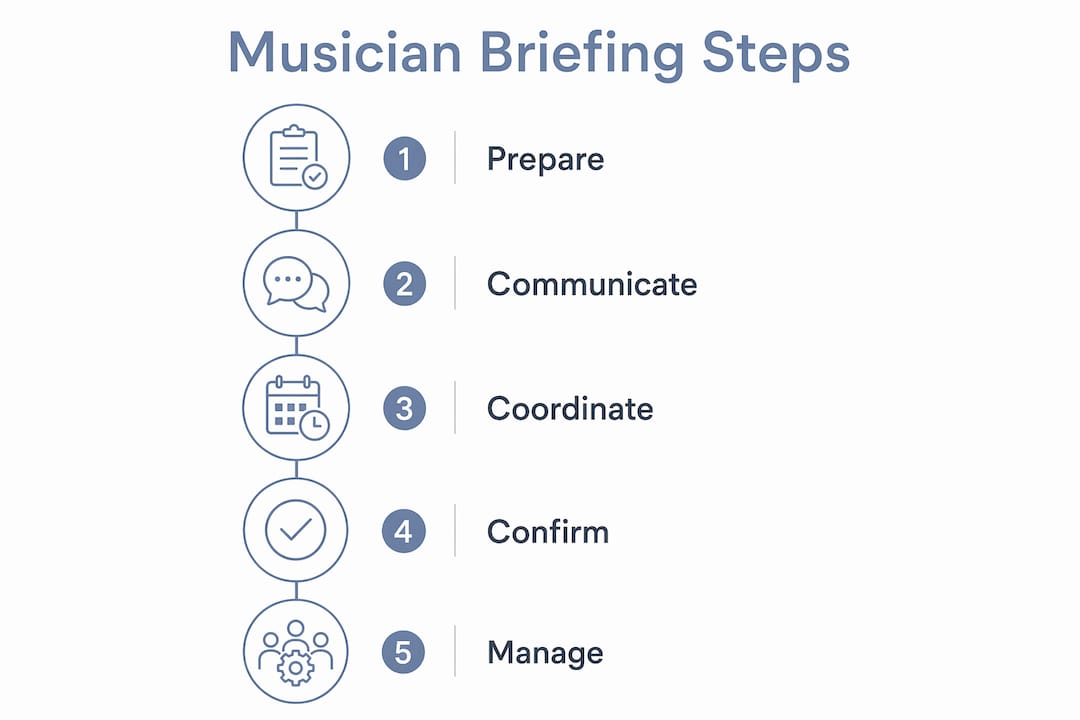
The most effective way to brief a corporate musician is to hand them something closer to a production document than a playlist. That means event goals, timing, audience demographics, technical specs, and contingency notes, all in one place before the first rehearsal.
Here is what a solid brief covers:
- Event goals and atmosphere: State whether the event is a networking reception, an awards ceremony, a product launch, or a celebration. Each calls for a different musical posture.
- Audience profile: Share the age range, industry, and cultural mix of attendees. A room of finance executives in their 50s and a tech company's all-hands for a 30-something team need very different energy.
- Performance slots and timing: List each slot with start time, duration, and the transition that follows, planning carefully with guidance from dynamic ticket pricing strategies to optimize event flow and attendance. Reception music into dinner into awards into dancing is a common arc, and musicians need to know exactly where they sit in it.
- Volume expectations: Specify whether each slot is background (conversation-friendly) or foreground (dance floor). Do not leave this to guesswork.
- Setlist preferences and restrictions: Name any songs you want included, any that are off-limits due to brand guidelines or current news, and any genre guardrails.
- Technical requirements: Confirm stage dimensions, power access, load-in time, and AV coordination contacts.
- Contingency planning: Note what happens if a speaker runs long, a segment is cut, or the schedule shifts by 30 minutes. Musicians who treat the brief as a production plan can flex in real time. Those who only have a setlist cannot.
Table of Contents
- How event goals and atmosphere shape what musicians actually play
- Volume and energy management: the skill most planners underestimate
- Key questions to ask when briefing a corporate musician
- How to identify a trustworthy corporate musician
- What you should expect from a corporate musician on the day
- Alexlevinmusic brings this level of preparation to every corporate event
- Key Takeaways
How event goals and atmosphere shape what musicians actually play
Musicians cannot tailor their performance to an event they do not understand. The official event name tells them almost nothing. What they need is context: why this event exists, what the company wants attendees to feel, and what success looks like from the client's perspective.
A product launch wants energy and excitement from the first note. An executive dinner wants sophistication and restraint. A year-end celebration might start with elegant background jazz and finish with a full dance set. Sharing that arc upfront lets musicians align music with your event's tone rather than guessing at it mid-performance.
- Company culture matters: A startup that prides itself on being unconventional will respond differently to a strict standards set than a law firm's annual gala.
- Industry context shapes song choices: A healthcare company may want nothing that reads as frivolous; a media company may actively want something unexpected.
- Brand guidelines apply to music too: If a competitor's song is on the charts or a particular artist is associated with a controversy, flag it early. Communicating artist restrictions upfront prevents last-minute setlist rewrites at the worst possible moment.
- Energy transitions need a plan: Background music that gradually builds into a high-energy set does not happen by accident. Brief the musician on where those transitions occur and what triggers them.
Volume and energy management: the skill most planners underestimate
Volume management is one of the most overlooked skills in corporate event planning. Get it wrong and you either kill the networking or drown the speeches.
Professional musicians read social cues and adjust dynamically, but they need a baseline to work from. Tell them what "background" means for your specific room. A 200-person cocktail hour in a hard-walled ballroom is acoustically very different from a 50-person dinner in a carpeted private dining room.
- Networking phases need conversation-level volume: If guests cannot hear each other, they stop mingling. The music becomes noise.
- Award ceremonies need precision: Volume drops for speeches, swells for walk-up cues, and returns to background between segments. This requires a briefed musician, not just a good one.
- Dance sets need permission: Some corporate crowds need a clear signal that it is time to move. Brief the musician on whether to build gradually or open with something that pulls people to the floor immediately.
- Energy arcs follow event phases: A well-structured music arc from dinner to dancing mirrors the emotional journey of the event. Musicians who understand that arc perform it; those who do not just play songs.
Pro Tip: Give musicians a simple three-level volume guide for each slot: "low" for networking, "medium" for dinner, "high" for dancing. It takes two minutes to write and eliminates the most common on-the-night friction.
Key questions to ask when briefing a corporate musician
A brief is also a vetting conversation. What you ask reveals as much about the musician's professionalism as what they answer.
- Ask about corporate experience specifically: General event experience is not the same as handling a complex running order with multiple cue points. Experience with corporate events and live cue management is a distinct skill set.
- Clarify stings and walk-up cues separately: If your event includes award presentations, provide the cue list as a standalone sequential document. Embedding stings inside a multi-page script increases the risk of errors under pressure.
- Confirm background music coverage: Most professional musicians include background music service between live sets, often using mixing software rather than static playlists. Confirm this is included and ask what it sounds like.
- Discuss the technical rider: Stage plot, power requirements, load-in window, and AV team contacts should all be exchanged before the contract is signed, not the week of the event.
- Verify insurance and certifications: Public liability insurance and PAT certificates are standard for professional corporate bookings. Ask for them. A musician who hesitates is a red flag.
- Ask about contingency protocols: What happens if the keynote runs 20 minutes over? How do they handle a sudden schedule change? The answer tells you whether you are working with a professional or a performer.
How to identify a trustworthy corporate musician
The difference between a professional corporate musician and a talented one who is not ready for corporate work shows up before the event, in how they communicate and what they bring to the table.
An Electronic Press Kit with live performance videos, a concise bio, and clear booking contacts is the baseline. If a musician cannot point you to one, that is a signal. Video samples from actual corporate events, not just studio recordings or wedding receptions, are the most useful proof of fit.
- Responsiveness matters: A musician who takes five days to reply to a briefing email will not be easier to work with on the day of the event.
- Look for production-minded communication: Do they ask about the running order, the AV setup, and the room layout? Or do they only ask about the setlist? The former is a corporate professional. The latter is a performer.
- Verify documentation proactively: Public liability insurance and PAT certificates should be offered without prompting. If you have to chase them, factor that into your decision.
- Check for contractual clarity: A proper booking agreement that covers cancellation, schedule changes, and liability protects both sides. A musician who resists putting terms in writing is not ready for corporate work.
- Watch how they handle the brief itself: A musician who reads it carefully, asks smart follow-up questions, and confirms details in writing is already doing the job well before they play a note.
What you should expect from a corporate musician on the day
Professionalism at a corporate event goes beyond playing well. Here is what a properly briefed musician should deliver without being asked:
- Arrive during the agreed load-in window and complete setup before guests arrive.
- Coordinate directly with the AV team on sound check timing and signal routing.
- Follow the running order and respond to cues from the event producer or stage manager.
- Manage volume independently across each phase without requiring constant direction.
- Handle schedule changes calmly and communicate any issues to the event contact immediately.
- Dress to the event's standard, whether that is black tie, business formal, or smart casual.
- Stay available for the full contracted period, including any agreed overtime terms.
A musician who needs to be managed during the event is a liability. The brief exists precisely so that does not happen.
Alexlevinmusic brings this level of preparation to every corporate event
When you have done the work of building a proper brief, you need a musician who actually uses it. Alexlevinmusic specializes in corporate event music for clients in Philadelphia, New York, and beyond, with ensembles ranging from jazz trios and solo piano to string quartets and DJ services.
Every booking starts with a detailed briefing process. Alexlevinmusic reviews your running order, coordinates with your AV team, and confirms setlist preferences, volume expectations, and contingency plans before the contract is signed. Performance videos and client resources are publicly available so you can assess fit before the first conversation. If you want live music that works as hard as the rest of your event production, reach out to Alexlevinmusic to check availability for your date.
Key Takeaways
A well-structured musician brief functions as a production document, and the planners who treat it that way consistently get better performances.
| Point | Details |
|---|---|
| Brief as production plan | Share event goals, timing, volume expectations, and contingency notes, not just a setlist. |
| Communicate atmosphere early | Tell musicians whether the event is a networking reception, awards ceremony, or celebration so they can calibrate energy and style. |
| Manage volume by phase | Specify conversation-level, dinner, and dance-floor volume for each slot to avoid on-the-night guesswork. |
| Vet with the right questions | Ask about corporate event experience, cue management, insurance, and contingency protocols before booking. |
| Alexlevinmusic for corporate events | Alexlevinmusic covers Philadelphia and New York with jazz, string, and DJ ensembles built for corporate briefs. |