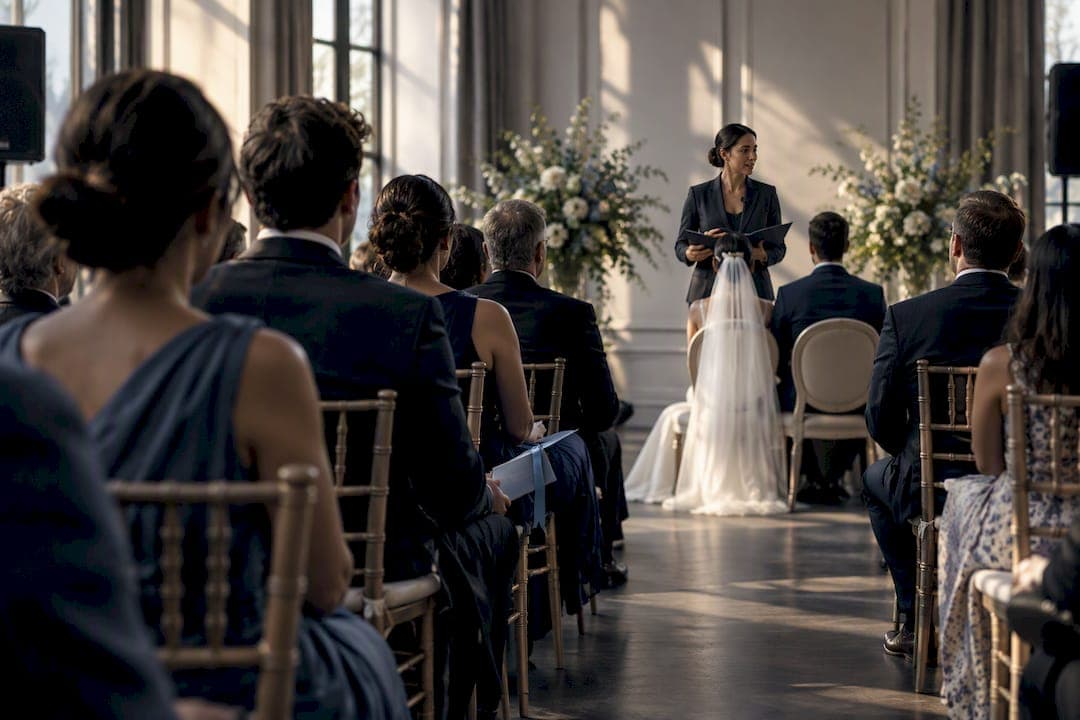
If your guest list is moderately large, you're outdoors, or grandparents will be seated beyond the first few rows, amplify the ceremony. The minimal setup: a discreet lavalier mic on the officiant (and a second on the couple if they're exchanging vows aloud), run into a small mixer feeding a pair of coverage speakers aimed at the seating, not the aisle. Skip the checklist and soundcheck steps below at your own risk, since a system that isn't tested at real volume fails more often than one that's never set up at all.
TL;DR:
- Amplification is essential for outdoor ceremonies or larger guest lists, especially beyond 30 guests or if ambient noise like wind or traffic is present.
- Lavalier and headset microphones are the most discreet options, with wind protection necessary outdoors, while handheld mics suit readings and toasts.
- Proper speaker placement focusing on even coverage is key to intelligibility, with system size scaling to ceremony size and outdoor conditions.
- Conduct thorough soundchecks at full volume, covering the entire seating area, and confirm wireless channels and batteries hours before guests arrive.
- Early planning with vendors and clear diagrams prevent cable, power, and timing conflicts, ensuring vows are heard clearly and the setup runs smoothly.
Table of Contents
- Do You Really Need a Ceremony Amplification Guide? When to Skip It, When to Commit
- Microphone Types for a Ceremony PA System, and When Each One Wins
- Speaker Placement: Why Even Coverage Beats Raw Volume
- Wireless Mics, Power, and Weather: What Trips Up Outdoor Ceremonies
- Mic Technique That Actually Prevents Feedback
- Your Soundcheck Timeline: Test Loud, Test Early, Test Everything
- Working With Vendors So the Audio Plan Actually Holds Together
- How a Ceremony Music Provider Actually Thinks About Amplification
- How Alex Levin Music Handles Ceremony Sound So You Don't Have To
- Sources
- FAQ
Do You Really Need a Ceremony Amplification Guide? When to Skip It, When to Commit
Not every ceremony needs a PA system, but fewer skip it safely than couples assume. Three factors decide it: venue type, guest count, and ambient noise.
Indoor ceremonies under 30 guests, in a room with decent acoustics and no HVAC hum, can often get away with unamplified vows. Everything else tips toward amplification. Outdoor settings lose sound to open air, wind, traffic, and birds quickly beyond the front few rows. A ceremony audio guide from production specialists notes that wind and ambient noise are the two most common reasons outdoor vows get lost. No amount of projecting will fix it.
Guest age matters more than most planners admit. Older guests lose high-frequency hearing first, which is exactly the range consonants live in. That's why "I do" sounds fine to the wedding party but garbled to grandma in row eight.
A few moments demand clarity above everything else:
- The processional cue, so the right people move at the right time
- Vows and ring exchanges, the emotional core guests came to hear
- Any legally required statements from the officiant
- Readings, especially from anyone unaccustomed to projecting their voice
Microphone Types for a Ceremony PA System, and When Each One Wins
Every microphone choice is a trade between invisibility and control. For ceremonies, invisibility usually wins, but not always.
Lavalier mics clip to a lapel or dress and stay out of every photo. They're the default choice for officiants and speaking couples because they free up the hands entirely. The catch is wind noise outdoors. A foam windscreen helps, but for exposed sites, a furry "deadcat" cover cuts far more low-frequency rumble.

Headset mics sit closer to the mouth than a lavalier, which gives more consistent volume as someone turns their head. They're a better pick for anyone who moves a lot while speaking, like an officiant who paces. The trade-off is visibility. They're harder to hide than a lavalier, though modern beige and skin-tone models are far less noticeable than the old boom-arm headsets.
Handheld mics work for readings and toasts because there's no clip-on setup time. They pick up handling noise if gripped tightly or tapped nervously, so they're a poor match for anyone unfamiliar with public speaking.
Boundary mics, placed flat on a table or altar surface, work well for stationary moments like a unity ceremony but struggle the moment someone leans away from them.
Essential accessories that prevent an on-the-day failure:
- Fresh batteries in every wireless pack, plus one full spare set
- A backup wired mic as a fallback if wireless drops
- Windscreens for every outdoor mic
- Gaffer tape to secure cable runs
Pro Tip: Pack a second lavalier already clipped to a spare battery pack, charged and ready. Swapping a dead unit takes ten seconds if it's pre-rigged; it takes ten stressful minutes if you're building one from scratch while guests wait.
Speaker Placement: Why Even Coverage Beats Raw Volume
The instinct to crank the volume is almost always the wrong move. What actually solves intelligibility problems is coverage, meaning every seat gets a roughly even amount of sound rather than the front row getting blasted while the back row strains. Coverage-focused placement also preserves the room's natural ambience instead of turning a garden ceremony into an outdoor concert.
Sizing the system to the seating geometry:
- Small ceremonies (under 50 guests): A single pair of compact powered speakers on stands, positioned at the front corners and angled slightly inward, covers most rooms and lawns without any additional gear.
- Medium ceremonies (50 to 150 guests): Add a second pair as side fills roughly two thirds of the way back, or raise the front pair on taller stands to throw sound further over heads instead of into the first three rows.
- Large ceremonies (150 plus, or long narrow aisles): Delay speakers timed a few milliseconds behind the mains keep the back rows in sync with what the front rows hear, avoiding the slap-back echo that comes from sound arriving twice.
Speaker height matters as much as placement. Mounting speakers on stands at roughly seven to eight feet, angled down slightly toward the seated crowd, keeps sound off the microphones up front and reduces feedback risk. Outdoors, take advantage of having no walls or ceiling to bounce sound around; the tradeoff is that nothing reinforces the sound either, so speakers need clean line-of-sight to every seat, not just the aisle.
Wireless Mics, Power, and Weather: What Trips Up Outdoor Ceremonies
Battery-powered speakers are convenient, but check the runtime against your actual ceremony length plus soundcheck plus buffer time. A speaker rated for six hours of playback may run closer to three or four at the volume a ceremony actually needs. For anything longer than a quick ceremony, or when the reception runs off the same gear later, mains power or a generator is the safer call.
Wireless mic frequencies can collide with other devices on-site, especially at venues hosting multiple events or near cell towers. Scanning for a clear channel before guests arrive, and having a backup frequency ready, prevents the static drop-outs that ruin recordings.
Weather deserves its own plan. Wind protection on lavaliers is non-negotiable outdoors, and speaker cabinets left in direct sun or possible rain need weatherproof covers or a tent. Power distribution should run on dedicated circuits where possible. For larger outdoor setups, wedding bands and audio crews often plan around two 20 amp circuits and a 6,000 watt generator as a baseline, with the generator as backup rather than the primary source.
- Confirm wireless channels are clear during the actual time slot, not the night before
- Weatherproof every speaker and mixer left outdoors overnight
- Keep a fully charged backup battery bank on-site regardless of the power source
Pro Tip: Ask the venue directly whether other events are booked nearby that same day. A neighboring reception running its own wireless system is the single most common cause of surprise interference.
Mic Technique That Actually Prevents Feedback
Feedback happens when a mic picks up its own amplified sound from a speaker and loops it back through the system. The fix starts with physics, not luck. Shure's own microphone guidance recommends placing mics close to the speaker, using unidirectional cardioid patterns, and keeping speakers behind the mic's pickup zone rather than in front of it.
Cardioid mics reject sound from behind while favoring what's directly in front, which is exactly why they're standard for ceremonies. Placement affects gain-before-feedback more than any single EQ adjustment, and directional mics also produce a proximity effect, a bass boost that happens the closer a voice gets to the capsule.
When running two or more mics at once, the 3:1 rule keeps things clean: any second microphone should sit at least three times farther from the first mic than that mic is from its intended source. Skip this and you introduce phase cancellation, where sound arrives at slightly different times and partially cancels itself out.
Gain structure matters just as much as placement. Start with the mixer's channel gain low, bring it up gradually, and stop as soon as you hear the earliest hint of ringing.
- Point mics away from speakers, never toward them
- Use the fewest mics necessary; every added mic lowers the system's total gain-before-feedback
- Test for phase issues by holding two mics close together and listening for a drop when moving between them
- If feedback starts, cut gain first, then reposition, then reach for EQ as a last resort
Shure's phase-testing guidance confirms that a dead spot appearing when switching between two nearby mics is a reliable sign of a polarity problem, not a placement problem, and it's fixed by flipping one mic's polarity switch rather than moving equipment around.
Your Soundcheck Timeline: Test Loud, Test Early, Test Everything
A soundcheck run at conversation volume tells you almost nothing about how the system behaves at ceremony volume, since feedback and dead spots often only appear once the gain comes up. Walk the entire seating area during the check, not just the front row, to catch spots where sound drops out or echoes off a nearby wall.
- Two to three hours before guests arrive: Run the full system at performance volume, confirm wireless channels are clear, and check every battery level.
- One hour before: Do a walk-through of the actual seating rows while someone speaks into each live mic, listening for coverage gaps.
- Thirty minutes before: Final levels check with the officiant and anyone reading, plus a spare-battery swap if any unit reads below half charge.
Whoever runs sound, the officiant, and the performer providing ceremony music should all be present for at least part of that check, since each catches different problems. Photograph the final setup and label every cable and channel; a walk-through checklist that records frequencies, battery levels, and labeled photos makes it possible to rebuild the exact same setup fast if the ceremony location shifts at the last minute due to weather.
Pro Tip: Write final gain settings on a sticky note attached to the mixer. If a last-minute helper has to make an adjustment during the ceremony, they'll know exactly where the levels should sit.
Working With Vendors So the Audio Plan Actually Holds Together
Sound doesn't operate in isolation from everything else happening that day. A clear run-of-show, shared with the ceremony musician, officiant, and photographer, prevents the classic mistake of a mic cable running straight through the aisle shot.
Talk to your photographer and videographer early about mic placement, since a lavalier clipped in the wrong spot creates a visible bulge or a boom shadow across the couple's faces in every close-up. A production checklist for event capture is worth reviewing with your video team so audio and camera plans don't collide on the day.
Ask the venue directly about available power outlets, any noise curfews, and whether they own house sound gear you're expected to use. Share a one-page diagram showing speaker positions, mic locations, and cable runs with every vendor involved, so nobody discovers a tripping hazard mid-ceremony.
- Confirm processional and vow cues with the officiant and musician in advance
- Route cables away from the aisle and any camera sightlines
- Ask the venue about curfews, outlet locations, and existing sound equipment
- Send a labeled setup diagram to every vendor a week out, not the morning of
How a Ceremony Music Provider Actually Thinks About Amplification
Musicians who play ceremonies for a living treat sound as inseparable from the music itself. A technician running a soundcheck isn't an add-on, it's what keeps a live cello or a string quartet from getting drowned out the moment vows start and guests shift in their seats. A ceremony music package built around this reality typically bundles the performance with a lavalier or handheld mic, coverage speakers, and someone present to manage levels quietly through the transition from processional to vows to recessional, so the couple never has to think about it.
— Alex
How Alex Levin Music Handles Ceremony Sound So You Don't Have To
Most couples researching a ceremony amplification guide are really trying to solve one problem: making sure vows are heard without a tangle of visible gear or a stressed-out relative running cables an hour before the processional. Alex Levin Music builds that solution directly into its wedding ceremony music packages, pairing live musicians with discreet lavalier mics and properly sized coverage speakers, run by someone who has already done the soundcheck before your guests take their seats.

Packages include the performance and amplification planning together, rather than leaving you to book a musician and a separate sound company and hope their timelines line up. If you'd like to see how a setup would look for your specific venue, request a quote and a sample setup photo and get a straight answer on what your space actually needs.
Sources
- Microphone techniques (Shure guidance hosted via UCI site)
- Shure PE56D user guide (how to control feedback; microphone technique)
- Three reasons why mic placement matters - Shure
- Audio sound system setup for live events - GeoEvent
FAQ
What Audio Equipment Do You Need for a Wedding Ceremony?
At minimum, a lavalier or headset mic for the officiant, a small mixer, and a pair of powered coverage speakers on stands. Larger or outdoor ceremonies add a second mic for vows, wireless backup channels, and possibly delay speakers for long seating areas.
What Is the 30-5 Minute Rule for Weddings?
It's a planning rule suggesting couples spend a substantial amount of time on ceremony logistics relative to the ceremony's duration, covering everything from processional timing to sound cues. Applied to audio, it means the soundcheck and setup time should far exceed the ceremony's actual runtime.
Who Walks Mom Down the Aisle?
There's no fixed rule; some ceremonies have a parent walk the couple down together, others skip it entirely depending on family structure and preference. Whatever the choice, whoever walks the aisle should be accounted for in the mic and cue timing during the soundcheck.
What Is the Most Common First Song at a Wedding Ceremony?
Processional song choice varies widely by taste and ceremony style, from classical pieces to contemporary arrangements, and there's no single dominant answer. What matters more for a ceremony amplification guide is making sure whatever source plays that song, whether live musicians or a playback device, is patched into the same sound system as the microphones so there's no volume mismatch when the mics come up.
Do I Really Need Amplification for a Small Indoor Ceremony?
Small indoor ceremonies with under 30 guests and reasonable acoustics can sometimes skip amplification safely. Add older guests, a large room, or more than a few dozen people, and even indoor spaces benefit from at least a basic lavalier and speaker setup for the officiant.