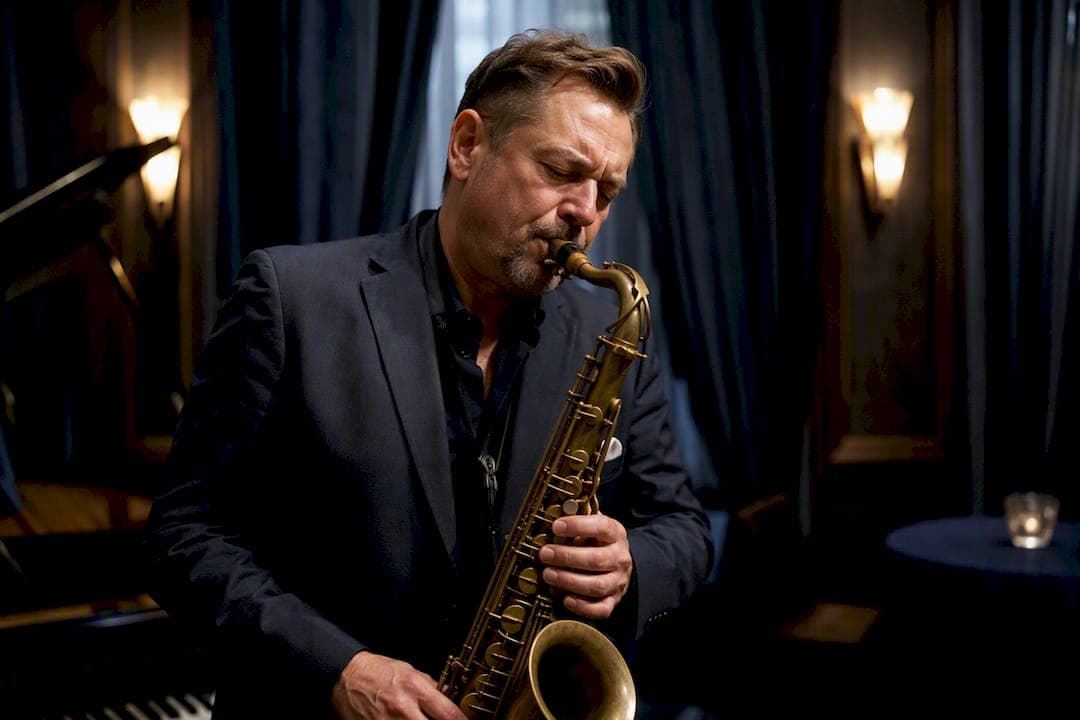
Jazz is a musical tradition built on improvisation, a rhythmic feel called swing, and the individual voice of the performer. No two performances of the same song ever sound quite alike, because the musicians are composing in real time, not just replaying notes on a page. The core ingredients that make jazz recognizable are improvised solos, swing rhythm, blue notes (pitches bent or flattened for emotional effect), and rich, complex harmony often built through call-and-response between musicians.
If you're brand new to this, hold onto three things:
- Jazz is created live, in the moment, more than it's written down and repeated exactly.
- The "feel" matters as much as the notes. Swing rhythm gives jazz its forward lean, almost like a walk with a little bounce in it.
- No single style defines jazz. It's a family of related approaches, from New Orleans brass bands to modern fusion.
Pro Tip: When you play a jazz recording for the first time, ignore the melody for the first 30 seconds and just listen to the drummer's cymbal. That steady, uneven "ding ding-a-ding" pattern is the swing feel. Once your ear locks onto it, everything else starts making sense.
Key Takeaways
Jazz is defined by improvisation, swing rhythm, and individual expression, built from a fusion of African rhythmic traditions and European harmony that emerged in New Orleans and evolved into dozens of distinct styles over more than a century.
| Point | Details |
|---|---|
| Improvisation is central | Musicians act as composer and performer simultaneously, so no two performances of a standard sound identical. |
| Swing feel drives the rhythm | Notes fall slightly around the beat rather than exactly on it, creating jazz's forward, rolling momentum. |
| Styles layer, not replace | Dixieland, swing, bebop, modal, fusion, and contemporary jazz all still get performed and recorded today. |
| Forms give solos structure | The 12-bar blues and 32-bar AABA form provide the harmonic map improvisers build solos around. |
| Listening trains the ear fastest | Sampling recordings across eras, from Louis Armstrong to modern releases, builds recognition faster than theory alone. |
For anyone planning an event where the sophistication and warmth of live jazz would set the right tone, whether that's a wedding ceremony, a corporate reception, or an intimate private celebration, Alexlevinmusic's jazz ensemble booking page walks through how to select the right combo size and instrumentation for your space and guest list. A live trio bringing genuine improvisation into the room delivers something a playlist simply can't replicate.
Table of Contents
- What Is Jazz Music, Explained in Plain Terms?
- What Musical Features Actually Define Jazz?
- How Did Jazz Originate and Develop?
- What Are the Major Styles of Jazz?
- What Instruments Make Up a Jazz Group?
- How Is Jazz Actually Created in Performance?
- Where Should a Beginner Start Listening?
- Why Does Jazz Matter Culturally?
- What Common Myths About Jazz Should You Ignore?
- Why Musicians Love Jazz, and Why You Should Give It a Chance
- Where Can You Learn More About Jazz?
- Frequently Asked Questions
- Sources
What Is Jazz Music, Explained in Plain Terms?
Jazz is a genre where the performer often functions as composer, not just as an interpreter. That single fact separates it from most Western classical music, where a violinist plays Beethoven's notes largely as written, night after night. A jazz saxophonist playing the same standard on Tuesday and Thursday might deliver two entirely different solos, built from the same chords but shaped by mood, audience energy, or what the bass player just did.
Britannica describes jazz as a harmonically sophisticated genre that originated in African American communities in New Orleans, blending African rhythmic traditions with European harmonic language borrowed from ragtime and blues. That fusion is what gives jazz its dual character: rhythmically loose and grounded at once, harmonically adventurous yet emotionally direct.
The Smithsonian's National Museum of American History frames this distinction well:
Jazz performers often act as both composer and interpreter in the moment, which keeps standards fresh and performance-dependent. The music depends on individual creative expression as much as on shared musical structure.
That's worth sitting with. In classical music, the composer and the performer are usually two different people, separated by decades or centuries. In jazz, they're frequently the same person, working simultaneously.
Trumpeter and bandleader Wynton Marsalis has pointed to jazz's rhythmic energy and improvisational surprise as what gives the music its sense of personal expression, distinct from genres built on fixed arrangements. That surprise factor is precisely why jazz resists a tidy, narrow definition. Ask ten musicians "what is jazz" and you'll get ten different answers, all partly right, because the genre spans everything from a solo pianist playing standards quietly in a hotel lobby to a nine-piece avant-garde ensemble improvising with no chord chart at all.
Here's what stays constant across nearly every jazz style:
- The performer shapes the music live, rather than only reproducing a fixed score.
- Rhythm carries as much emotional weight as melody or harmony.
- The "sound" of an individual musician (tone, phrasing, timing) matters as much as the notes they choose.
What Musical Features Actually Define Jazz?
Jazz has a recognizable DNA, even across wildly different eras and styles. Here's what to actually listen for.
Improvisation. This is jazz's engine. A musician builds a solo in real time, using the song's chords as a map rather than a script. The Smithsonian identifies improvisation, alongside swing and individual expression, as the trait that most distinguishes jazz from other genres.
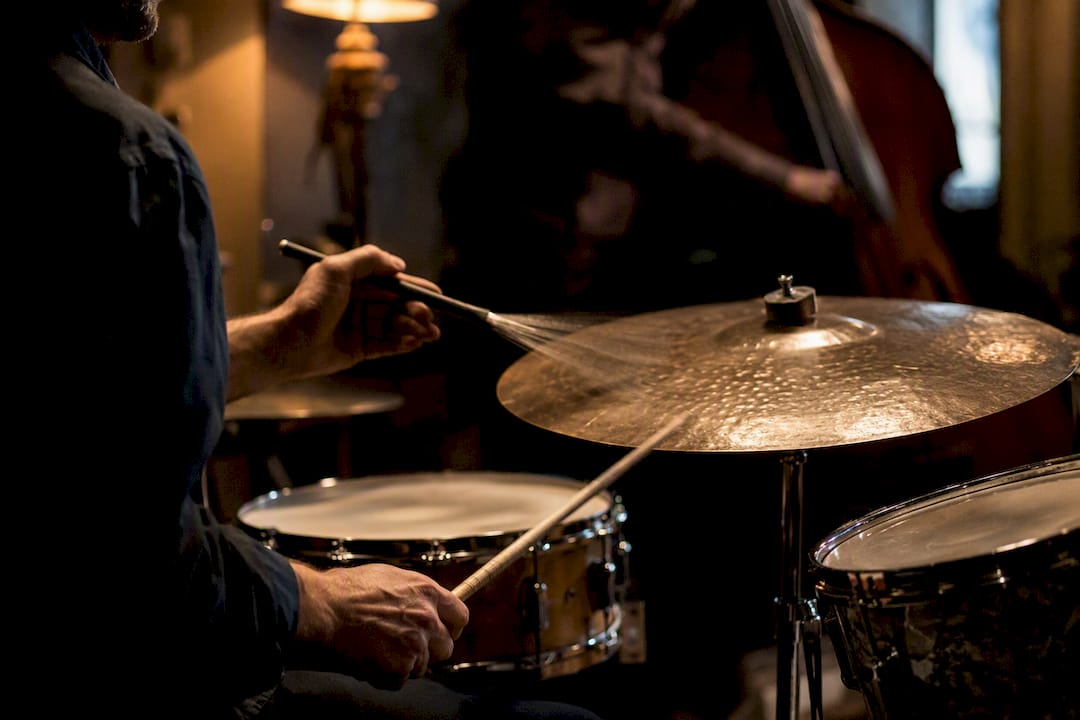
Swing feel. Swing is a rhythmic pattern where notes fall slightly ahead of or behind the beat rather than landing exactly on it, creating a rolling, propulsive momentum. It's easiest to hear in the ride cymbal pattern of a drummer or in how a bass player "walks" through a chord progression, one note per beat, gently pushing the tempo forward.
Syncopation. This means accenting beats you wouldn't normally expect, like the "and" between beats two and three. Jazz inherited heavy syncopation from ragtime, and it's part of why the music feels rhythmically restless in a good way.
Blue notes. These are pitches bent, slid into, or flattened slightly off their "correct" classical position, usually the third, fifth, or seventh note of a scale. They're borrowed directly from the blues and give jazz its expressive, vocal quality, even on instruments.
Call-and-response. One musician (or section) plays a phrase, and another answers it, echoing a tradition rooted in African musical practice and American gospel and blues. Listen for a horn line that seems to "ask a question" answered by the piano or another horn.
Polyrhythm. Multiple rhythmic patterns running simultaneously, often layered between drums, bass, and piano. This is subtler and takes more listening experience to catch, but it's part of what makes jazz rhythm section playing so dense.
Harmonic complexity. Jazz frequently uses extended chords (ninths, elevenths, thirteenths) and chromatic movement beyond basic major and minor triads, giving improvisers more colors to draw from.
Most jazz improvisation happens over one of two structural skeletons. The 12-bar blues is a repeating 12-measure chord pattern, the backbone of countless blues and early jazz tunes. The 32-bar AABA form, common in Broadway-era "standards," breaks into four 8-bar sections where the first, second, and fourth sections share a melody (A) and the third offers contrast (B, often called the "bridge").
To train your ear quickly, try this order:
- Listen for the steady swing pattern in the drums first, before anything else.
- Find the "walking" bass line and count how it moves, usually one note per beat.
- Notice when a soloist bends a note instead of hitting it cleanly. That's a blue note.
- Listen for a phrase that gets "answered" by another instrument. That's call-and-response.
- See if you can hear the song's form repeat (the same 12 or 32 bars looping under a new solo).
How Did Jazz Originate and Develop?
Jazz was born in New Orleans in the final years of the 19th century, in a city uniquely positioned to blend musical traditions that rarely mixed anywhere else in America. West African rhythmic practices, brought over through generations of enslaved communities, mixed with European harmonic structures, Caribbean dance rhythms, and the brass-band marching tradition that filled New Orleans streets for parades, funerals, and celebrations. Add the blues (with its expressive bent notes) and ragtime (with its syncopated piano patterns), and you get the raw ingredients of an entirely new sound.
The National Museum of American History traces this synthesis directly: jazz developed in New Orleans from a mix of African, European, Caribbean, and American influences, and it spread rapidly once recordings became widely available in the 1920s, an era now called the Jazz Age.
A rough timeline looks like this:
- 1890s to early 1900s: Cornetist Buddy Bolden, often cited as an early jazz pioneer, leads bands in New Orleans blending ragtime, blues, and brass-band traditions. No recordings of Bolden survive, but musicians who heard him described a louder, looser, more improvisational sound than the polite dance bands of the day.
- 1917: The Original Dixieland Jass Band records what's often cited as the first jazz recording, helping introduce the sound to a national audience outside New Orleans.
- 1920s: Pianist and composer Jelly Roll Morton, who claimed (with some exaggeration) to have invented jazz, records with his Red Hot Peppers, capturing early New Orleans jazz's structured, arranged side. Meanwhile, a young cornetist named Louis Armstrong leaves New Orleans for Chicago and begins recording with King Oliver's band before launching his own Hot Five and Hot Seven sessions, which push improvised solo playing to the center of jazz for the first time.
- Late 1920s onward: Jazz migrates north along with millions of Black Americans during the Great Migration, taking root in Chicago, New York, and Kansas City, each city developing its own regional flavor.
Recording technology and human migration worked together to turn a regional New Orleans practice into a national, then global, phenomenon. The National Park Service notes that recordings combined with traveling musicians accelerated jazz's spread far faster than live performance alone could have managed. Riverboats running up the Mississippi carried musicians and the music itself to river towns along the way. Prohibition-era speakeasies in Chicago and New York gave jazz a home in the 1920s underground nightlife scene, ironically helping a once-regional sound become the dominant popular music of the decade.
By the time Louis Armstrong's solos on records like "West End Blues" reached listeners across the country, jazz had already shifted from a collective, ensemble-driven New Orleans style toward something built around the individual soloist, a shift that would define the genre for the next century.
What Are the Major Styles of Jazz?
Jazz didn't replace one style with another the way fashion trends cycle out. Each era added a new branch to a tree that kept most of its older branches alive and still growing today.
- Early New Orleans/Dixieland: Collective, polyphonic improvisation where multiple horns weave melodic lines simultaneously rather than trading solos one at a time. Listen to Louis Armstrong's Hot Five recordings from the mid-1920s for the shift from collective playing toward the featured soloist.
- Swing/big band: Larger ensembles (often 12 to 17 pieces) playing tightly arranged charts with room carved out for soloists, built for dancing. Duke Ellington's orchestra, active from the 1920s through the 1970s, remains the genre's most sophisticated example, with compositions like "Take the 'A' Train" showing how arranged sections and improvised solos can coexist seamlessly.
- Bebop: Fast tempos, intricate melodic lines, and harmonically dense improvisation meant for listening rather than dancing. Charlie Parker's recordings from the mid to late 1940s, especially with trumpeter Dizzy Gillespie, defined this shift toward virtuosic, small-group playing.
- Cool jazz and hard bop: Cool jazz softened bebop's intensity into something more relaxed and arranged; hard bop pushed back with a bluesier, harder-driving groove. Miles Davis moved through both, and his 1959 album Kind of Blue remains the best-selling jazz record of all time.
- Modal jazz: Built solos around scales (modes) rather than rapidly shifting chords, opening up more spacious, exploratory improvisation. Kind of Blue again applies here, since Davis pioneered the modal approach on that same record.
- Free jazz/avant-garde: Loosens or abandons fixed chord structures and steady tempo altogether, prioritizing raw expression over conventional form. Ornette Coleman's late 1950s and 1960s recordings pushed this furthest.
- Fusion: Combines jazz improvisation with rock, funk, or electronic instrumentation, emerging in the late 1960s and 1970s. Miles Davis's Bitches Brew is the genre's landmark fusion statement.
- Contemporary jazz: Draws on all of the above simultaneously, often blending hip hop rhythms, electronic textures, or global influences with straight-ahead improvisation.
The Jazz notes that this evolution spans more than a century, and every one of these styles typically keeps a rhythm section paired with melodic lead instruments, even as the surface sound changes dramatically from Dixieland to fusion.
What Instruments Make Up a Jazz Group?
Every jazz ensemble, from a three-piece trio to a seventeen-piece big band, splits its work between two functional groups.
The rhythm section carries the harmonic and rhythmic foundation. A bassist plays a "walking" line, one note per beat, outlining the chords while pushing tempo forward. Drums provide the swing feel through the ride cymbal and keep time with the snare and bass drum. Piano or guitar fills in chords, called "comping," reacting to and supporting whoever is soloing rather than playing a fixed part.
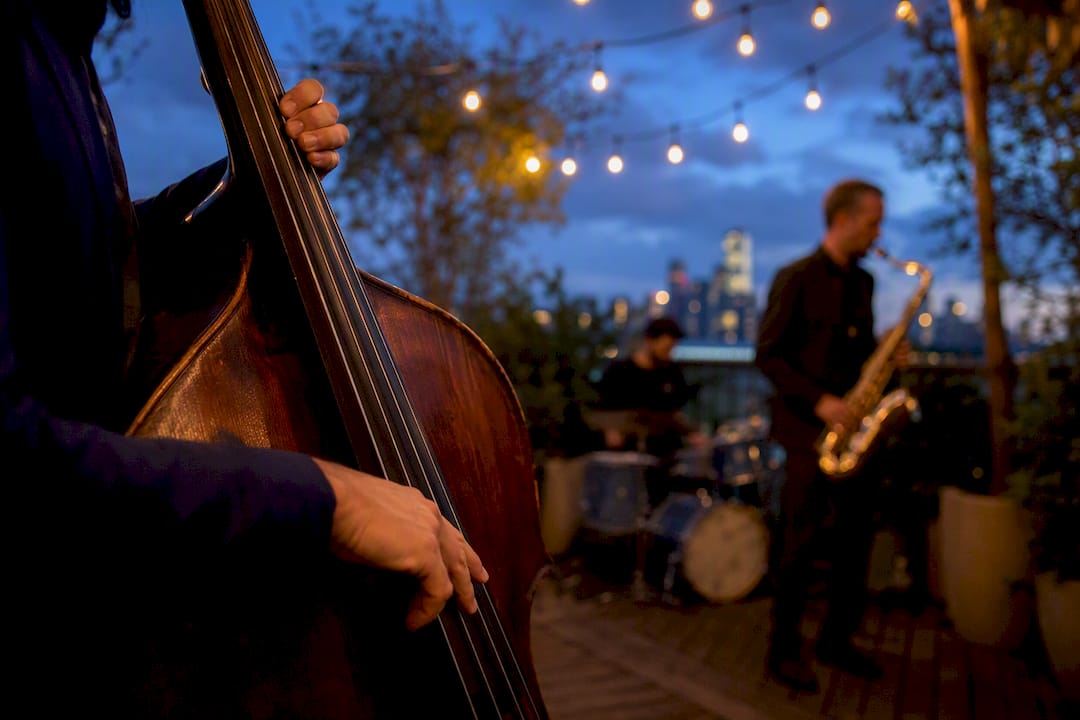
The front line carries melody and improvised solos. Trumpet often takes the lead voice, bright and cutting. Saxophone (alto, tenor, or baritone) brings a warmer, more vocal-like tone well suited to blue notes and bent pitches. Trombone adds a lower, sliding voice that can either blend with or answer the other horns. Vocalists function as another lead voice entirely, sometimes improvising wordlessly through scat singing, a technique Louis Armstrong helped pioneer and Ella Fitzgerald later mastered with breathtaking speed and precision.
Small combos (trios, quartets, quintets) give each musician more improvising space and rely heavily on listening and reacting to one another in real time. Big bands trade some of that spontaneity for arranged sections, section harmonies (multiple saxophones or trumpets playing tight harmony together), and dynamic contrast between full ensemble passages and individual solos. Some modern jazz groups also bring in nontraditional instrumentation, like electric keyboards, synthesizers, or even strings, particularly in fusion and contemporary styles.
How Is Jazz Actually Created in Performance?
Most jazz performances follow a structure musicians call "head, solos, head." The band plays the song's melody (the "head") once or twice through, then each musician takes turns improvising over the same chord progression for one or more repetitions of the form (called "choruses"), and the group returns to the head to close the tune. It sounds simple written out, but it requires real trust: everyone has to track where they are in the form without sheet music guiding every note.
That trust depends on a shared vocabulary. Jazz "standards", well-known songs from the Great American Songbook or written by jazz composers themselves, get passed between musicians through lead sheets: simplified scores showing only melody and chord symbols, leaving the actual arrangement and improvisation up to whoever's playing. Two musicians who've never performed together can often sit down and play the same standard convincingly because they both know the tune's chords and form.
- The rhythm section supports the soloist dynamically, responding to their energy rather than playing a fixed accompaniment.
- Soloists build phrases around the song's chord changes, not just its melody.
- The ii–V–I chord progression shows up constantly and functions as a kind of harmonic punctuation mark, resolving tension back to the home key.
Pro Tip: Next time you listen to a jazz solo, try to catch the moment right before a phrase resolves, usually where the chords are moving through something like a ii–V–I. That's the harmonic "landmark" most improvisers are aiming toward, and once you can hear it, entire solos start to make structural sense instead of sounding like a stream of random notes.
Where Should a Beginner Start Listening?
Immersive, cross-era listening is genuinely the fastest way to train your ear for jazz's rhythmic and harmonic vocabulary, according to guidance from Learn Jazz Standards. Rather than sticking to one era, jump around and let your ear absorb the range.
Ten recordings to start with, roughly chronological:
- Louis Armstrong, "West End Blues" (1928): Listen for his opening unaccompanied trumpet cadenza, one of the most influential improvised passages ever recorded.
- Duke Ellington, "Take the 'A' Train" (1941): Notice how tightly the big band's sections lock together while still leaving room for soloists.
- Ella Fitzgerald, "How High the Moon" (live scat versions): Focus on her scat singing; she's improvising melody with syllables, the same way a horn player improvises with notes.
- Charlie Parker, "Ko-Ko" (1945): A blistering tempo that shows off bebop's harmonic density and speed.
- Miles Davis, "So What" (1959): A textbook example of modal jazz, built on just two scales rather than rapid chord changes.
- John Coltrane, "Giant Steps" (1960): Listen for relentless, cascading chord changes played at breakneck speed.
- Ornette Coleman, "Lonely Woman" (1959): An early free jazz statement that abandons a fixed steady tempo.
- Herbie Hancock, "Watermelon Man" (1962 or the 1973 funk remake): Hear how jazz absorbs blues and, later, funk rhythm.
- Weather Report, "Birdland" (1977): A fusion landmark blending electric instruments with jazz improvisation.
- Any contemporary jazz artist working today: Seek out a current release to hear how the tradition keeps absorbing hip hop, electronic, and global influences.
Try listening to one recording a day, focused entirely on a single feature (swing, a blue note, a call-and-response moment) rather than trying to absorb everything at once.
Why Does Jazz Matter Culturally?
Jazz became one of the loudest voices for personal freedom in American culture during the 20th century, and that role didn't fade after the Jazz Age ended. The Smithsonian connects jazz's emphasis on individual improvisation directly to its historical role as a vehicle for freedom and personal expression, tying the music to broader social movements rather than treating it as pure entertainment.
During the 1920s Jazz Age, the music became shorthand for a loosening of social norms and a burst of Black American cultural expression that reshaped mainstream American entertainment. Decades later, jazz musicians including John Coltrane and Nina Simone wrote and performed music directly engaging with the civil rights movement, using the genre's improvisational freedom as a musical parallel to demands for social change.
Jazz's influence didn't stay contained to jazz clubs:
- Rock and roll borrowed jazz's blues foundations and rhythmic swing.
- Film composers, from golden-age Hollywood scores to modern soundtracks, regularly use jazz harmony and instrumentation for tension and sophistication.
- Classical composers including Aaron Copland and George Gershwin folded jazz harmony and rhythm directly into concert-hall works.
- Modern hip hop and R&B production frequently sample or interpolate jazz recordings, keeping the genre circulating in mainstream pop culture decades after its "golden era."
Jazz festivals now run on every continent, and the genre's core techniques, improvisation, swing, and individual expression, remain foundational to how musicians across nearly every popular style approach performance and live music. That cultural weight is part of why live jazz still carries a particular sense of occasion at weddings, galas, and corporate events today.
What Common Myths About Jazz Should You Ignore?
A handful of persistent myths keep new listeners away from jazz before they've even given it a real chance.
- Myth: Jazz is just noise with no structure. Almost every jazz performance runs on a defined form, like the 12-bar blues or 32-bar AABA structure, that musicians track carefully even while improvising freely within it.
- Myth: Jazz means old, dusty recordings. While the genre's foundational recordings date back a century, contemporary jazz artists release new material constantly, blending the tradition with hip hop, electronic production, and global rhythms.
- Myth: You need formal music training to enjoy jazz. Understanding chord theory deepens appreciation, but plenty of lifelong jazz fans never learned to read music. Following the rhythm and the emotional arc of a solo is enough to start.
- Myth: Jazz is only for solemn, serious listening. Jazz grew out of dance halls, parades, and rowdy New Orleans street celebrations. It has always had a playful, social side alongside its more contemplative moments.
Wynton Marsalis has pushed back directly against the idea that jazz lacks discipline, arguing that its rhythmic energy and improvisational surprise come from mastery of structure, not the absence of it. Accessibility isn't a myth. It's the whole point of starting with a handful of well-chosen recordings rather than trying to absorb a century of music at once.
Why Musicians Love Jazz, and Why You Should Give It a Chance
What draws musicians to jazz, again and again, is the collaborative listening it demands. You're not just playing your part; you're reacting to what the bassist just implied, what the drummer just accented, what the last soloist left unresolved. That constant, split-second conversation is unlike almost anything else in music, and it's why so many jazz musicians describe performing as closer to a dialogue than a recital.
If you're curious about learning to play rather than just listen, start smaller than you think you need to. Pick one blues progression, learn it in one key, and try improvising over it with just a few notes before worrying about theory.
Pro Tip: Don't wait until you "understand jazz theory" to start listening seriously. Pick three recordings from different decades, play them back to back, and just notice what feels different between them. Your ear will start doing the analytical work before your brain catches up.
Where Can You Learn More About Jazz?
- The Smithsonian's National Museum of American History offers a clear, education-focused breakdown of jazz's defining traits.
- Britannica's jazz entry gives a concise encyclopedic overview of the genre's origins and harmonic character.
- Music traces jazz's historical development from New Orleans through the Jazz Age.
- Jazz maps the genre's major stylistic eras for students and new listeners.
- For a listening-focused deep dive into how live jazz shapes a room's atmosphere, see Alexlevinmusic's guide to intimate live jazz settings.
Frequently Asked Questions
What is jazz music, explained simply? Jazz is a music tradition built around improvisation, a rhythmic swing feel, and individual creative expression, where musicians build solos in real time over established chord structures rather than reading a fixed score.
What makes jazz different from other music genres? Jazz treats the performer as composer in the moment. Classical musicians typically interpret a fixed score; jazz musicians create new melodic content live, which means the same song can sound completely different from one performance to the next.
Who are the most important jazz musicians to know? Louis Armstrong pioneered the improvised solo as jazz's centerpiece, Duke Ellington elevated big band composition and arrangement, Charlie Parker defined bebop's harmonic complexity, Miles Davis pushed jazz through cool, modal, and fusion styles, and Ella Fitzgerald set the standard for vocal improvisation and scat singing.
Do you need to understand music theory to enjoy jazz? No. Following rhythm, tone, and the emotional shape of a solo is enough to start. Theory deepens appreciation over time, but plenty of lifelong listeners never formally studied music.
What's the best way to start listening to jazz as a beginner? Sample recordings across different decades and styles rather than sticking to one era. Listening actively for one specific feature at a time, like swing feel or a blue note, trains your ear faster than passive listening ever will.
Sources
- Jazz | Britannica
- What is Jazz? - National Museum of American History
- Music
- Jazz
- Understanding Jazz (MUS205 lecture)