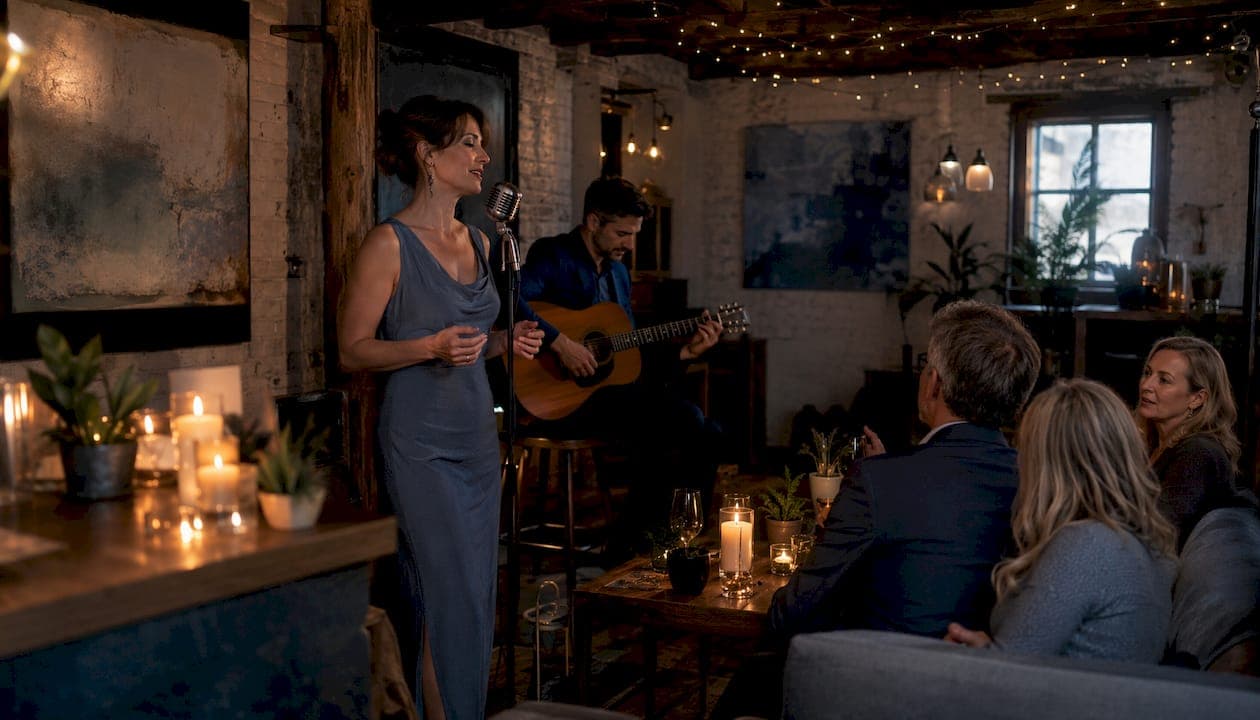
Live jazz is the single most effective music choice for intimate gatherings because it actively shapes conversation flow, reduces guest anxiety, and creates an atmosphere that recorded music simply cannot replicate. The evidence runs from peer-reviewed pilot trials to practical booking experience, and the practical guidance below covers everything from ensemble size to setlist timing. Alexlevinmusic has built its reputation on exactly this kind of tailored, small-event performance, making it a natural starting point for hosts ready to book.
Table of Contents
- The core social, emotional, and ambiance benefits of live jazz at intimate gatherings
- What the research and music experts say about jazz's cognitive and health effects
- Why live jazz usually beats a playlist for small private events
- How to choose the right ensemble and sound for a small space
- Practical checklist: questions to ask when booking live jazz for an intimate event
- Sample setlists and timing for cocktail hour, dinner, and after-dinner moments
- Key Takeaways
- What actually works in a private room: a performer's perspective
- Alexlevinmusic brings live jazz to your next intimate gathering
- Useful sources and further reading
The core social, emotional, and ambiance benefits of live jazz at intimate gatherings
Live jazz delivers three distinct layers of value at small private events: social, emotional, and atmospheric. Each one shows up differently depending on the moment in your evening.
Social benefits
- Conversation-friendly dynamics: A jazz trio playing at moderate volume gives guests a shared sensory anchor without forcing them to shout. The music fills silence without demanding attention, so introductions and side conversations happen more naturally.
- Natural attention cues: A musician leaning into a solo signals "listen for a moment," then pulls back. Guests instinctively follow that cue, creating brief shared moments that bring a room together without a host having to orchestrate anything.
- Guest-to-guest connection: Live music gives strangers an immediate, low-stakes conversation topic. "Do you know this song?" opens more doors than a name tag ever will.
Emotional and wellbeing benefits
- Reduced anxiety: Brief sessions of jazz listening have been linked to stress reduction and immune benefits, making it a genuinely calming presence for guests who arrive tense from a long workday.
- Uplifted mood: The rhythmic complexity of jazz triggers a mild cognitive engagement that keeps guests alert and positive rather than passive.
- Connection-building: Shared emotional responses to music, a collective smile at a well-timed phrase, create micro-bonds between people who may not know each other well.
Ambiance benefits
- Dynamic texture: Improvisation means the music never flatlines. A pianist shifting from a ballad to a bossa nova groove changes the room's energy without anyone touching a volume knob.
- Adaptive instrumentation: A skilled duo can drop to near-whisper levels during a toast and swell back up during dessert, something no playlist can do in real time.
At a cocktail dinner, for instance, a jazz duo playing standards keeps the room warm during arrivals. By the time guests sit down, the mood is already set. That's the kind of ambient work professional jazz musicians handle without you having to think about it.
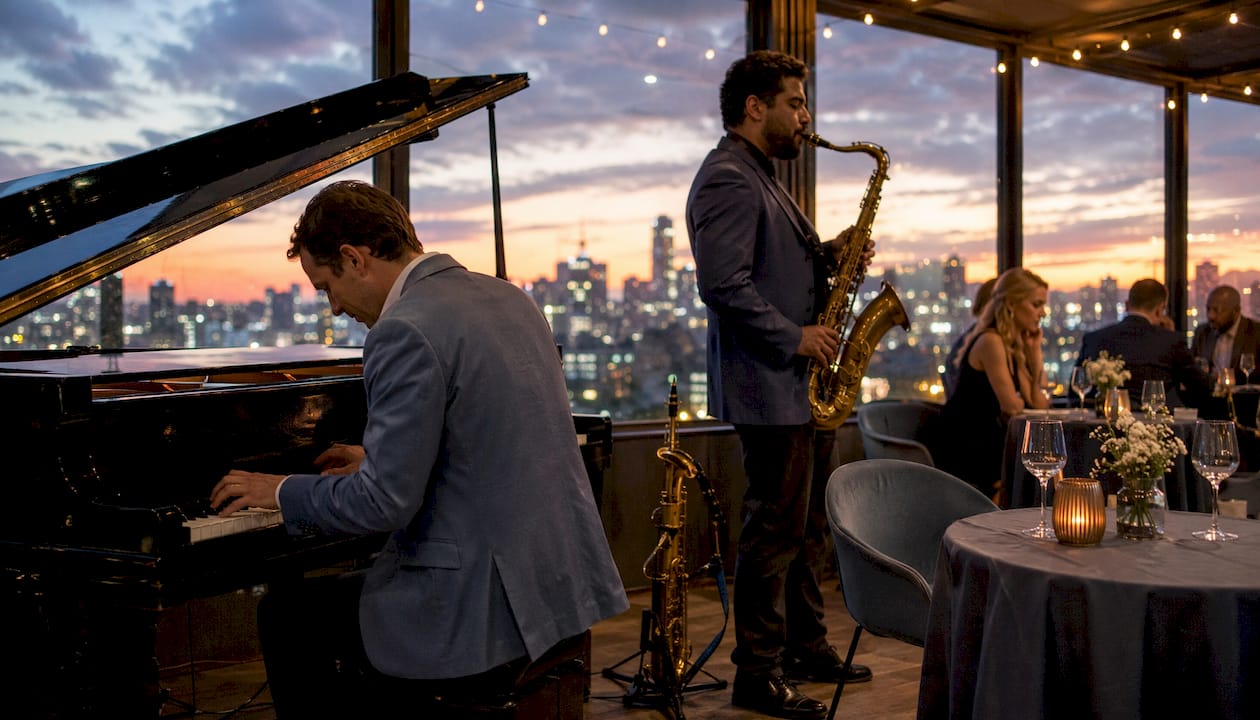
What the research and music experts say about jazz's cognitive and health effects
The wellbeing case for live jazz at intimate events is not just anecdotal. Controlled research backs it up.
"A 20-minute mindful jazz listening session produced immediate reductions in chronic pain intensity of about 23% and pain unpleasantness of about 35%, with effects that persisted across a four-week follow-up period." — UC Irvine School of Medicine
The MDPI pilot randomized controlled trial behind that finding compared mindful jazz listening against regular jazz listening in chronic pain patients. The mindful condition produced significantly greater immediate reductions in both pain and anxiety, and those lower scores held at the four-week check-in. For event hosts, the takeaway is practical: guests who arrive stressed or physically uncomfortable tend to relax faster in a room with live jazz than in silence or with generic background music.
Psychology Today adds a cognitive dimension. Jazz's improvisation and call-and-response structure requires performers to actively listen and respond to each other in real time, and listeners pick up on that exchange. The music stays mentally engaging without becoming intrusive, which is exactly what you want at a dinner where conversation is the point.
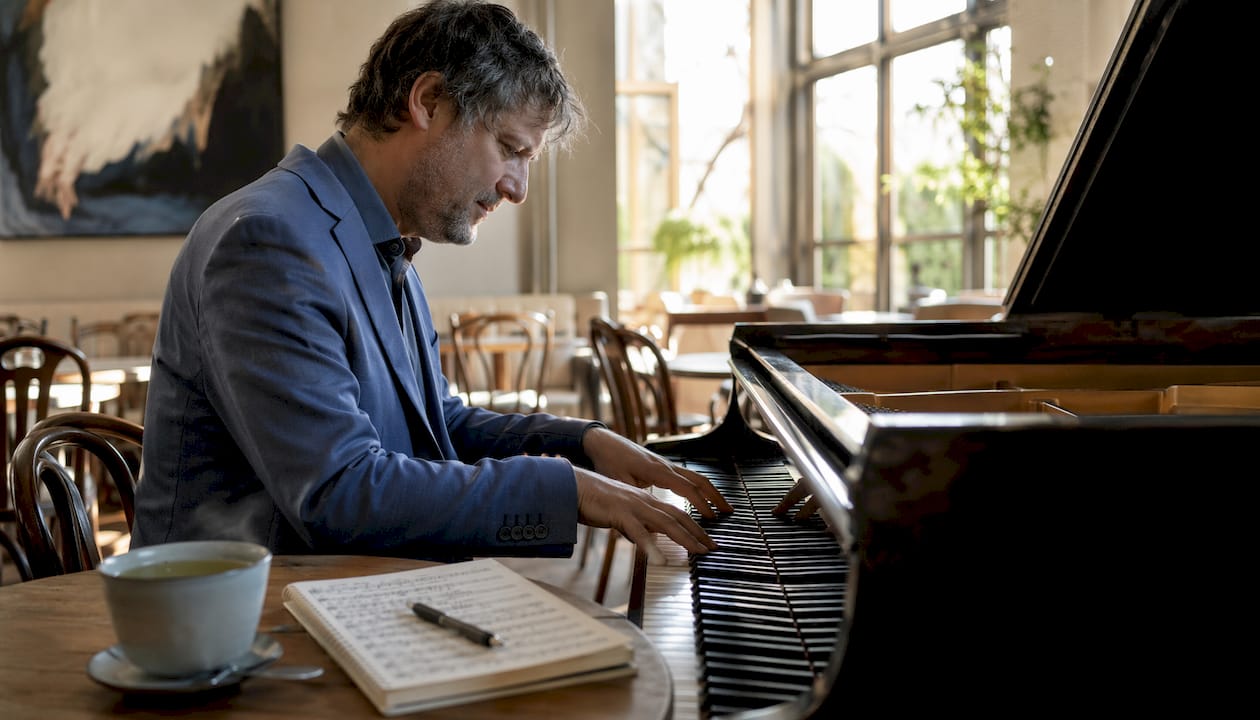
Pro Tip: Before a toast or a key speech, ask your musician to play one quiet, slow piece for two to three minutes. The room settles, guests stop side-conversations, and the speaker gets a genuinely attentive audience. This is a direct adaptation of the mindful listening protocol from the UC Irvine research.
Why live jazz usually beats a playlist for small private events
Playlists are convenient. They are also static, and static is a liability at an intimate event where the room's energy shifts every twenty minutes.
What live jazz does that a playlist cannot:
- Reads the room in real time and adjusts tempo, volume, and energy accordingly.
- Responds to a host's signal: a nod toward the musicians before a toast, and the volume drops immediately.
- Fills unexpected pauses (a late course, a delayed speech) without creating an awkward silence or an ill-timed upbeat track.
- Creates genuine shared moments when a musician takes a memorable solo or acknowledges a guest's request.
Where playlists fall short at intimate events:
- Curation gaps: even a carefully built playlist eventually lands on a track that kills the mood.
- Volume spikes between tracks from different recordings or eras.
- No responsiveness to the room. A playlist does not know that the host just stood up to speak.
- Transitions between songs can feel abrupt in a quiet room where every audio shift is audible.
The live music advantage is most pronounced in rooms under 40 guests, where every sound decision is felt by everyone simultaneously.
Pro Tip: Recorded music does have one legitimate role: brief interludes during setup, before guests arrive, or during a 15-minute break between sets. Use a curated playlist at low volume for those gaps, then let the musicians take over for every social moment that matters.
How to choose the right ensemble and sound for a small space
Matching ensemble size to your venue and guest count is the single most practical decision you will make when selecting a jazz ensemble.
Size guidelines:
- Solo piano or solo vocalist: Best for ultra-intimate settings, 8–20 guests, a living room, a private dining room, or a garden terrace. The sound stays conversational and never crowds the space.
- Duo (piano + bass, or guitar + vocals): The sweet spot for cocktail hours and seated dinners up to 30 guests. Enough harmonic richness to fill a room, quiet enough for easy conversation.
- Trio (piano, bass, drums): Works well for 25–50 guests in a mid-sized private room or loft. Drums should be brushes-only in low-ceilinged spaces.
- Quartet: Reserve for slightly larger private events, 40–70 guests, or outdoor settings where sound disperses quickly.
Volume and room considerations:
Hard floors and low ceilings amplify everything. In a living room or a restaurant private dining room, a trio with a drummer on brushes and an acoustic bass (or upright) will sit at a comfortable conversational level without a PA. Outdoor patios and backyards absorb sound, so a small PA or a slightly larger ensemble may be necessary.
Repertoire fit:
- Background cocktail/dinner: standards played at medium tempo, bossa nova, light swing, instrumental arrangements of pop classics.
- Feature moments (after-dinner, birthday toast): more melodic solos, a vocal number, or a guest-request slot.
Pro Tip: When you book, ask the musicians explicitly: "Can you play without amplification if the room is small?" and "How do you handle volume requests mid-set?" A professional ensemble will have clear answers and will welcome the conversation.
Practical checklist: questions to ask when booking live jazz for an intimate event
Use this list during your first call with a musician or ensemble. It covers the logistics that most hosts forget until the day of the event.
- Arrival and setup: What time do you need to arrive for load-in and soundcheck? (Budget at least 45–60 minutes before guests arrive.)
- Space requirements: How much floor space does the ensemble need? (A trio typically needs a 10×10-foot area minimum.)
- Power: How many standard outlets do you need, and where? Does the setup require a PA or a direct line?
- Set length and breaks: How many sets do you play, and how long are the breaks? (Standard format: two or three sets of 40–45 minutes with 15-minute breaks.)
- Volume control: Can you adjust volume on request during the event? Who is the point of contact for that?
- Noise curfew: Are you aware of the venue's or neighborhood's noise ordinance? Can you wrap by a specific time?
- Repertoire: Do you take requests? Can I send a short list of preferred songs or styles in advance?
- Contract basics: What is the deposit amount, cancellation policy, and overtime rate if the event runs long?
- Backup plan: If a musician is ill, what is your contingency?
- Placement: Will you need a specific spot in the room for sightlines or acoustics? Can we walk the space together before the event?
Sending this list in a single email when you confirm the booking saves three follow-up calls and prevents the most common day-of surprises.
Sample setlists and timing for cocktail hour, dinner, and after-dinner moments
Timing is where most hosts underplan. Here is a practical template you can adapt.
Cocktail hour (60–90 minutes)
- Set 1 (40 minutes): Light swing and bossa nova instrumentals. Think medium-tempo standards, Brazilian-influenced pieces, and a few recognizable melodies played softly. Volume: conversational, roughly the level of a quiet restaurant.
- Break (10–15 minutes): Recorded playlist at low volume.
- Set 2 (40 minutes): Similar repertoire, slightly warmer. A vocal number or two if you have a vocalist. End the set as guests move to the dinner table.
Dinner (75–90 minutes)
- Set 1 (25–30 minutes): Quieter ballads and slow bossa during the first course. This is when conversation is most active; keep the music genuinely in the background.
- Set 2 (25–30 minutes): Slightly more rhythmic pieces during the main course. A few standards guests will recognize without stopping to identify.
- Set 3 (25–30 minutes): Warmer, slightly upbeat selections during dessert and coffee. A good moment for a guest-request slot or a brief vocal feature.
After-dinner / feature moment (30–45 minutes)
- One focused set with more prominent solos, a vocal showcase, or a short "concert" moment where guests can listen rather than talk. This works especially well for birthday celebrations or milestone anniversaries where the music is part of the tribute.
Sample song categories that fit each moment: Great American Songbook standards, Brazilian jazz classics, instrumental arrangements of Motown or soul, and original compositions in a jazz style. A personalized setlist built around the guest of honor's favorite era or artist adds a layer of meaning no generic playlist can match.
Key Takeaways
Live jazz at an intimate gathering reduces guest anxiety, sustains conversation, and creates a shared emotional experience that recorded music cannot replicate.
| Point | Details |
|---|---|
| Research-backed wellbeing effects | UC Irvine research found mindful jazz listening reduced pain intensity by about 23% and pain unpleasantness by about 35%, with effects lasting four weeks. |
| Live beats recorded for small events | Live musicians read the room, adjust volume in real time, and respond to host cues, none of which a playlist can do. |
| Match ensemble size to guest count | Solo or duo for under 30 guests; trio for 25–50; quartet for larger or outdoor settings. |
| Plan timing in sets, not hours | Structure cocktail, dinner, and after-dinner moments as distinct sets with breaks; this pacing keeps energy consistent across the whole event. |
| Alexlevinmusic for intimate gatherings | Alexlevinmusic offers tailored solo piano, jazz duo, and jazz trio packages for private dinners, cocktail parties, and celebrations in Philadelphia, New York, and beyond. |
What actually works in a private room: a performer's perspective
The conventional wisdom says "hire a jazz trio and let them play." That advice is fine as far as it goes, but it misses the part that actually determines whether the music helps or hurts your event.
The most important thing a musician does at a private gathering is listen before playing. Room acoustics, ceiling height, the number of people talking, whether the floors are hardwood or carpeted: all of it changes the approach within the first five minutes. A good musician arrives early, walks the space, and makes decisions about instrumentation and volume before the first guest walks in. That preparation is what separates a performance that feels effortless from one that feels like it is fighting the room.
Small adjustments matter more than big ones. Moving from sticks to brushes on the drums drops the volume by a noticeable margin without changing the feel of the music. Simplifying a piano arrangement, fewer notes, more space, opens up the sonic room for conversation. Dropping the bass slightly in the mix during a plated course and bringing it back during transitions keeps the music present without ever becoming intrusive. These are micro-decisions that happen in real time, and they are the reason live musicians outperform even the most carefully curated playlist.
The moment I find most rewarding at a private event is the quiet piece before a toast. The room settles, people put down their glasses, and for thirty seconds everyone is listening to the same thing. That shared attention is what live music creates and nothing else does.
Alexlevinmusic brings live jazz to your next intimate gathering
The benefits covered in this article, calmer guests, better conversation, a room that feels alive rather than staged, are exactly what Alexlevinmusic delivers at private dinners, cocktail parties, and intimate celebrations across Philadelphia, New York, and beyond.
Alexlevinmusic offers solo piano, jazz duo, and jazz trio packages sized for small private rooms, with fully customizable setlists, flexible set lengths, and musicians who know how to work a room without overpowering it. Every booking includes a pre-event consultation to match instrumentation, repertoire, and timing to your specific space and guest list. The live music difference is real, and the booking process is straightforward: submit an inquiry with your date and guest count, receive a proposal within 48 hours, confirm with a deposit, and handle final logistics on a brief call before the event. Check availability and get a custom quote at alexlevinmusic.com.
Useful sources and further reading
- UC Irvine School of Medicine: Jazz and musculoskeletal pain relief — The primary summary of the UC Irvine pilot study on mindful jazz listening and pain/anxiety reduction.
- MDPI pilot RCT: 20-minute mindful jazz intervention — Full peer-reviewed trial with methodology, results, and four-week follow-up data.
- Psychology Today: What jazz music can do for the brain — Accessible explanation of improvisation, call-and-response, and cognitive engagement.
- The Joint Chiropractic: Health benefits of listening to jazz — Summary of stress reduction and immune system findings from jazz listening research.
- Alexlevinmusic: Overcoming event planning stress with professional jazz musicians — Practical guide on how professional musicians reduce host workload at private events.