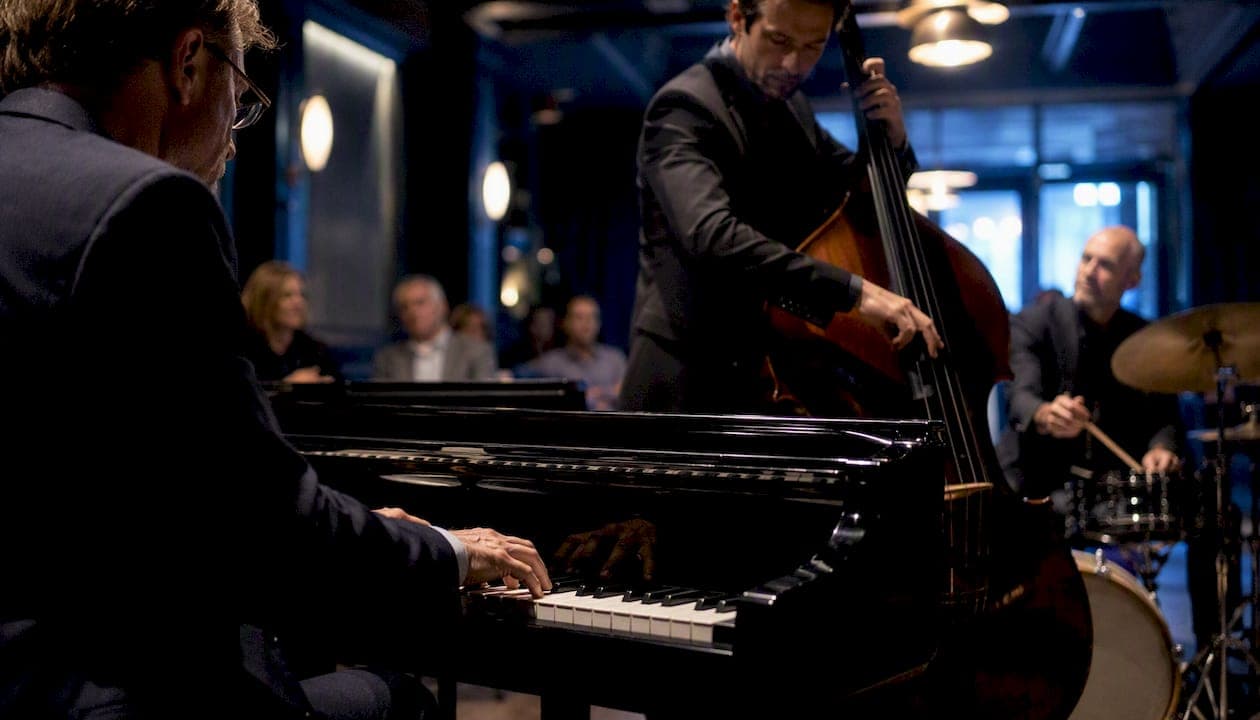
A venue entertainment program is the timeline and lineup of live music and related entertainment a client books for a private event, covering every segment from ceremony through reception. Think of it as the master document that tells your jazz trio when to start the prelude, cues the DJ for the first dance, and tells the venue coordinator exactly when the band takes a break. According to Joy's complete wedding music guide, a full-day wedding typically spans six distinct musical moments and calls for a broad selection of songs across the day. Alexlevinmusic works with planners, couples, corporate organizers, and private hosts to build exactly this kind of program.
Three problems that a well-built entertainment program solves:
- Guest flow and mood: Music cues guests to move, sit, dance, or quiet down without a single announcement.
- Vendor coordination: Every performer, AV tech, and venue manager works from the same timeline, eliminating conflicting instructions.
- Contingency and contract clarity: Written cues and overtime terms prevent surprises when a toast runs long or a set needs to extend.
Key Takeaways
A well-structured entertainment program, built around musical cues and confirmed in writing, is the single most reliable way to control guest experience and vendor coordination on event day.
| Point | Details |
|---|---|
| Define every segment | Map prelude through wind-down with durations; a full-day wedding covers six distinct musical windows. |
| Match format to goal | Live music leads on elegance and ceremony; a DJ leads on song variety and a long dance set. |
| Brief vendors in writing | Send the full brief two weeks out; confirm a one-page run-of-show 48–72 hours before the event. |
| Lock venue logistics early | Confirm curfew, decibel limits, stage footprint, and power in writing before finalizing any booking. |
| Alexlevinmusic | Offers ceremony, cocktail, reception, and hybrid packages with run-of-show consulting and single-contact coordination. |
Table of Contents
- What every event entertainment program should include
- Who you can hire: ensembles, DJs, and hybrid setups
- Sample program templates you can copy
- What does live music actually cost?
- How to build and deliver your entertainment brief
- Venue logistics every planner must confirm
- What your entertainment contract and rider must cover
- Live music or DJ: how to decide
- Real program examples from live bookings
- What I've learned building entertainment programs for live events
- Alexlevinmusic: live music and planning support for your event
- Sources
What every event entertainment program should include
Planning entertainment as a sequence of guest-experience windows — arrival, ceremony, cocktail, dinner, dancing — is the most reliable framework. Each window has its own energy goal, and the music should match.
Standard moments with typical durations:
- Prelude: 30–45 minutes of background music as guests arrive and find seats.
- Processional: 3–5 songs, typically 8–15 minutes depending on wedding party size.
- Ceremony: Interludes between readings, unity rituals, and a recessional; allow 20–30 minutes total for music cues.
- Cocktail hour: 60–90 minutes of ambient or light jazz, the longest single window for a live ensemble.
- Dinner: 90–120 minutes of background music, usually lower energy than cocktail.
- Dancing and wind-down: 2–3 hours, with a deliberate energy arc from peak to close.
Plan at least 20% more songs than you expect to use. For a 5-hour reception, a curated backup playlist should contain 90–110 songs in case the DJ needs to hand off or a set runs short.
Pro Tip: If you have a live musician for the ceremony, extend their booking to cover cocktail hour too. The same source note from Joy's guide confirms it creates a cohesive experience and costs less than two separate bookings.
Who you can hire: ensembles, DJs, and hybrid setups
Matching the right personnel to each segment is where most planners save money or accidentally overspend. Here is a quick comparison of common formats:
| Format | Best for | Space needed | Cost range (approximate figures) | Flexibility |
|---|---|---|---|---|
| Solo pianist or acoustic | Ceremony, intimate dinner | Minimal | moderate budget | Moderate |
| String quartet | Ceremony, cocktail hour | Small stage | budget depends on ensemble size and region | Moderate |
| Jazz trio | Cocktail, dinner, reception | Small stage | moderate to higher cost | High |
| Cover band (5–8 piece) | Reception dancing | Full stage | higher cost | High |
| DJ | Reception, any segment | DJ booth | $1,000–$3,000 | Very high |
| DJ + live hybrid | Full-day coverage | Medium stage | moderate to higher cost | Very high |
Pricing ranges for ceremony ensembles vary by region and tier, so treat these as planning benchmarks rather than quotes. A string quartet in a major metro will sit at the top of that range; a solo acoustic in a smaller market will sit near the bottom.
Pro Tip: Hire one versatile act to cover multiple segments when your venue and budget allow. A jazz trio that plays ceremony, cocktail, and dinner eliminates a second load-in, keeps the musical tone consistent, and often costs less than two separate bookings.
For a deeper look at the trade-offs, this DJ vs. live band comparison walks through the decision in detail.
Sample program templates you can copy
Use these as starting points. Paste them into your vendor brief and adjust times to match your venue's schedule.
Wedding full-day template
| Time | Segment | Performer | Song count | Notes |
|---|---|---|---|---|
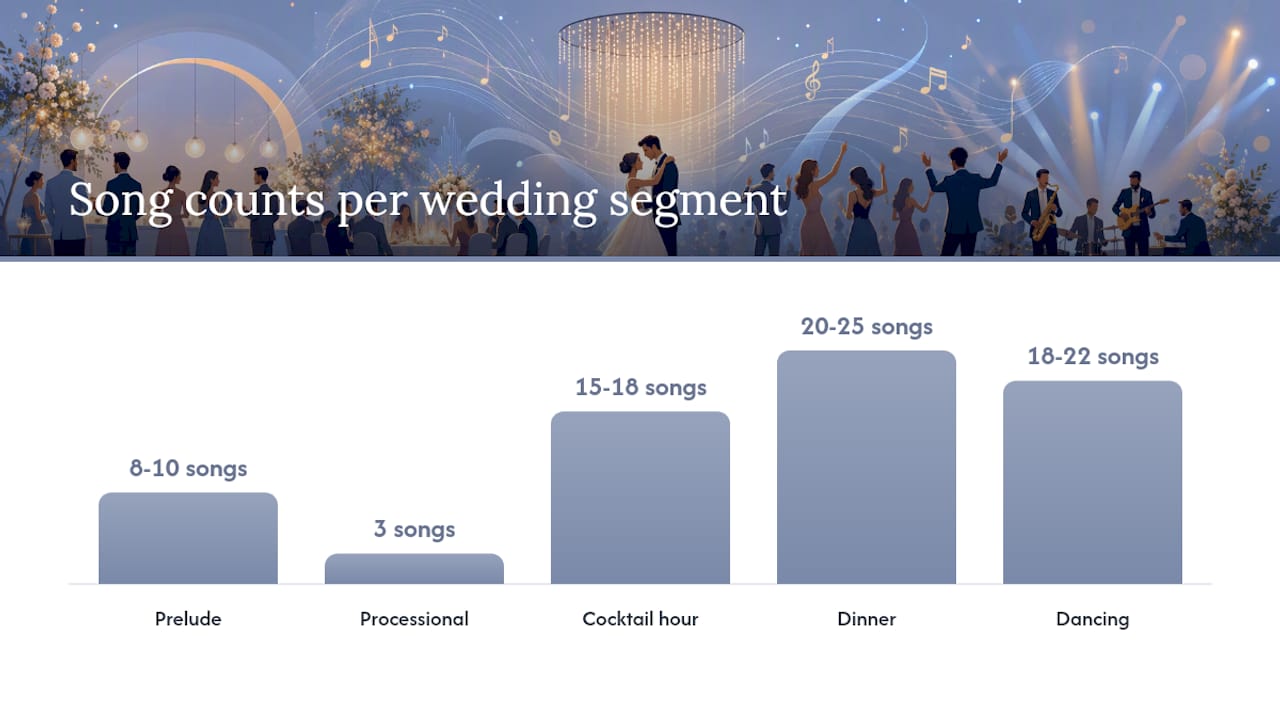
| 3:30 PM | Prelude | String quartet | 8–10 songs | Guests arrive; soft classical |
| — | Processional | String quartet | 3 songs | Cue on coordinator signal |
| 4:30 PM | Ceremony interludes | String quartet | 2 songs | Unity ritual, reading |
| 4:45 PM | Recessional | String quartet | 1 song | Upbeat; cue on officiant |
| — | Cocktail hour | Jazz trio | 15–18 songs | Ambient; no announcements |
| 6:30 PM | Grand entrance | DJ | 1 song | MC announces wedding party |
| 6:45 PM | First dance | DJ or live | 1 song | Cue from couple |
| — | Dinner | Jazz trio or DJ | 20–25 songs | Background level |
| 8:30 PM | Dancing | DJ | 18–22 songs | Energy arc to peak |
| 10:45 PM | Last dance / wind-down | DJ | 3 songs | Soft close |
Corporate cocktail hour (90 minutes): Solo pianist or jazz duo, 18–22 songs, no MC, volume kept conversational.
Seated private dinner (2 hours): Jazz trio or solo acoustic, 22–26 songs, no dancing set, music fades during toasts.
Pro Tip: For the grand entrance and first dance, write the exact song title, artist, and a one-line cue ("start when the doors open, fade at 1:45") directly into the contract. Verbal instructions get forgotten.
What does live music actually cost?
A DJ typically runs $1,000–$3,000, while a live band can reach well above that depending on size and market. The gap is real, but the variables below explain most of the spread within each category.
Main cost drivers:
- Number of performers: Each additional musician adds to the quote.
- Travel and parking: Anything beyond a local radius usually triggers a per-mile or flat travel fee.
- Overtime rates: Most contracts bill in 30-minute increments after the contracted end time.
- Equipment and PA: Some ensembles bring their own; others require a house system or rental.
- Custom arrangements: A bespoke arrangement of your first-dance song costs extra and needs lead time.
- Sound technician: Larger bands often require a dedicated tech, billed separately.
Overtime, parking, and last-minute song requests are the three most common unplanned costs at live events.*
How to build and deliver your entertainment brief
Send the full brief two weeks before the event, then a condensed run-of-show 48–72 hours prior. Planners who provide must-play and do-not-play lists, pronunciation notes, and key moment cues see significantly fewer day-of mistakes.
Your brief should include:
- Event details: Date, venue name, address, load-in time, and parking instructions.
- Timeline with cues: Every segment, start time, and the signal that triggers it.
- Must-play list: Song title, artist, and the moment it belongs to.
- Do-not-play list: Specific songs or genres to avoid.
- Pronunciation guide: Names for the MC to announce (wedding party, honorees).
- Emergency contacts: Venue coordinator, planner, and a backup phone number.
- Technical notes: PA availability, stage dimensions, power access.
For help avoiding the most common briefing mistakes, this wedding music planning guide covers the pitfalls planners hit most often.
Pro Tip: Send a one-page run-of-show to every vendor on the morning of the event. One shared document beats six separate text threads.
Venue logistics every planner must confirm
Check these before you finalize any entertainment booking. A multi-use venue checklist is a useful reference for the full operational picture.
- Load-in window: When can performers access the space, and is there a freight elevator or loading dock?
- Stage footprint: Minimum dimensions for each ensemble format (a string quartet needs roughly 10×10 feet; a full band needs 16×20 or more).
- Power and amperage: Confirm dedicated circuits for PA, lighting, and backline.
- PA and backline: Does the venue supply a house system, or does the performer bring their own?
- Sound limits: Ask for the decibel policy in writing. Many urban venues cap outdoor or rooftop sound.
- Curfew: Hard stop time for amplified music, not just the event end time.
- Noise ordinances: City or county rules that apply even inside the venue.
- Vendor insurance: Some venues require a certificate of insurance from every performer.
Pro Tip: Get the curfew and decibel limit in writing and add both as a clause in your entertainment contract. A verbal "we're flexible" from a venue coordinator does not protect you at 10:58 PM.
What your entertainment contract and rider must cover
Essential contract terms:
- Deposit and payment schedule: Typical deposits run 25–50% at signing, with the balance due before or on the event date.
- Cancellation and refund policy: Specify the refund timeline and any force majeure language.
- Overtime rate and rounding: State the per-30-minute rate and whether it rounds up automatically.
- Travel and parking reimbursement: Cap or flat fee, documented in writing.
- Insurance: Require a certificate of liability insurance from the performer.
- Day-of contact: One named person with authority to approve changes.
Rider checklist items:
- Stage dimensions and floor protection requirements.
- Dressing room or warm-up space.
- Meals or refreshments for performers (standard for bookings over four hours).
- Load-in location and access instructions.
- Onsite technical contact name and cell number.
Pro Tip: Ask every performer to initial the run-of-show page specifically, not just the main contract. It confirms they have read the cues, not just the payment terms.
Live music or DJ: how to decide
Both formats work. The right choice depends on four variables.
Live music advantages:
- Visual presence and energy that a speaker stack cannot replicate.
- Spontaneous interaction with the crowd.
- Strong fit for ceremony and cocktail segments where ambiance matters most.
DJ advantages:
- Broader song catalog, instant key and tempo changes.
- Lower cost and simpler load-in.
- Better suited to a long dance set where variety drives the floor.
Decision flow:
- Event goal: Ceremony polish and elegance → lean live. Dance-floor energy for 3+ hours → lean DJ.
- Guest profile: Older guests or mixed ages → live music reads as more sophisticated. Younger crowd with specific genre requests → DJ handles it better.
- Budget: Under $2,500 for music → DJ is the realistic choice. $3,500 and above → live ensemble becomes viable.
- Venue constraints: Small room, low ceiling, noise cap → solo or duo. Large ballroom, no sound limit → full band or hybrid.
- Hybrid option: Where the budget and logistics allow, a live act for ceremony and cocktail plus a DJ for reception covers both priorities without the cost of a full band all day.
For a wedding-specific breakdown, this live band vs. DJ comparison goes deeper on the trade-offs.
Pro Tip: If you go hybrid, schedule a 15-minute tech window between the live set and the DJ set. That buffer prevents dead air and gives the DJ time to confirm levels.
Real program examples from live bookings
Wedding full-day (Philadelphia ballroom): A string quartet covered the ceremony and cocktail hour, then a jazz trio took dinner while the DJ ran the reception. The contingency plan: the jazz trio's leader had a backup acoustic guitar in case the PA failed during cocktail hour. It did not fail, but the plan existed. Alexlevinmusic publishes video samples from similar setups so planners can hear the actual sound before booking.
Corporate cocktail hour (New York): A jazz trio played 90 minutes of standards for a financial services firm's client reception. The brief specified no vocals during the first 30 minutes while executives gave remarks. The trio switched to instrumental-only mode on a single cue from the event coordinator. Backup plan: a curated Spotify playlist on a laptop, ready if the PA had an issue.
Intimate seated dinner (private home): A solo pianist played two 45-minute sets with a 15-minute break. The host requested no amplification beyond the piano's natural acoustic. Contingency: the pianist brought a small portable speaker in case the room acoustics were worse than expected.
Pro Tip: For any event with multiple performers, assign one vendor as the "lead" who communicates with the venue coordinator. Parallel communication chains cause the most day-of confusion.
What I've learned building entertainment programs for live events
The planners who have the smoothest event days share one habit: they build the run-of-show around musical cues, not the other way around. When the first dance song is locked, the dinner start time becomes obvious. When the cocktail hour end time is fixed, the band's break schedule writes itself. Music is the most reliable clock in any event timeline.
The other thing worth saying plainly: a beautiful venue and great food are table stakes. Guests remember how the room felt, and that is almost entirely determined by what they heard. A well-briefed live ensemble or a skilled DJ reading the room does something a playlist never can.
If you want to talk through a program before you book, Alexlevinmusic offers planning consultations alongside every booking.
Alexlevinmusic: live music and planning support for your event
Alexlevinmusic provides ceremony musicians, cocktail ensembles, reception bands, DJ and hybrid setups, and run-of-show consulting for weddings, corporate events, and private dinners across Philadelphia, New York, and beyond. One point of contact handles the brief, the venue coordination, and the technical rider, so you are not managing five separate vendor threads.
Every booking includes a written program template, a signed run-of-show, and a pre-event walkthrough call. Explore what live music brings to a private event, or see how personalized jazz works for a wedding. To check availability and get a quote for your date, visit Alexlevinmusic.
Sources
- Wedding Music Playlist: Complete Guide for Every Moment (2026) - Joy
- Wedding Entertainment Hire: A Complete Planner’s Guide – Corporate Entertainment, Simulator hire and brand activation
- How to Build a Wedding Playlist That Actually Works
- Wedding Entertainment Program Ideas for 2026 - WeddingVenture