
A venue booking partnership is a strategic, long-term alliance between a venue and an event-service provider that goes beyond a one-time room rental. Instead of a transactional exchange, both parties share marketing, client referrals, and often financial risk and reward. According to AMW's events glossary, these arrangements are designed to increase conversion rates, improve the event experience, and let venues offer clients a complete solution without managing in-house talent.
The difference from an ad-hoc booking is concrete: a true partner gets active promotion on the venue's site, priority date holds, and recurring client ownership. A vendor just gets a listing. Ticket Fairy's analysis of venue-promoter partnerships frames it well: shared risk aligns incentives, so both sides push harder for results. Alexlevinmusic operates exactly within this model, partnering with venues across Philadelphia, New York, and beyond to deliver live jazz, string, and hybrid DJ ensembles as part of co-promoted event packages.
Table of Contents
- Why do venues and planners form these partnerships?
- What partnership models and financial structures actually look like
- What should every venue partnership agreement include?
- How do you set up a partnership step by step?
- How do you choose the right partner and spot red flags?
- Day-to-day workflows and co-marketing tactics that work
- How do you measure whether a partnership is working?
- A live-music partnership case study
- Financial templates and reconciliation examples
- Key Takeaways
- Why partnerships changed how we approach every event
- Live music partnerships with Alexlevinmusic
- Useful sources
Why do venues and planners form these partnerships?
The commercial logic is straightforward. Venues fill dark nights and capture ancillary income from bar and merchandise sales. Planners and service providers gain a steady referral pipeline and reduced customer acquisition costs. Both sides get marketing leverage they could not afford alone.
- Revenue upside: Fill off-peak nights, earn ancillary bar and merch revenue, and share profit when events overperform.
- Marketing reach: Cross-promotion, co-branded campaigns, and priority placement in venue proposals reduce cold outreach.
- Operational efficiency: Shared production specs, familiar tech riders, and predictable calendar management cut day-of surprises.
- Repeat business: Planners return to venues that feel predictable in the best way — familiar processes and reliable partners compound over time.
Pro Tip: Prioritize partners who demonstrate a collaborator mindset, not just a vendor relationship. Venue109 notes that in genuine partnerships, the venue actively promotes the partner and shares recurring client ownership — that distinction predicts long-term ROI better than any single contract term.
What partnership models and financial structures actually look like
Not every deal is structured the same way. The model you choose determines who absorbs risk and who captures upside.
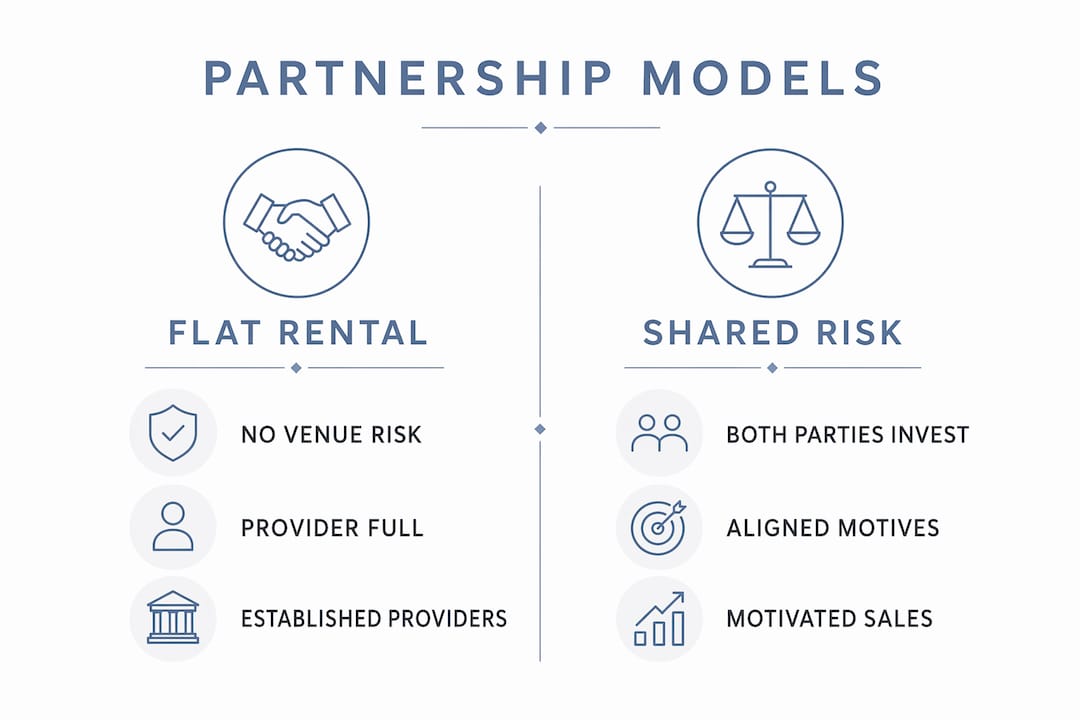
- Flat rental (four-wall): The provider pays a set fee and keeps all ticket revenue. The venue bears zero financial risk but also captures no upside beyond the rental.
- Guarantee plus split: The provider pays a guaranteed minimum, then splits revenue above a defined break-even threshold. Risk is shared; both parties have skin in the game.
- Co-promotion (joint venture): Both parties invest in costs and split profits, often 50/50. Higher risk for the venue, but higher reward if the event performs.
- Exclusive promoter deal: One provider gets first rights to book events, typically in exchange for financial guarantees or revenue commitments.
- Referral/commission model: The venue refers clients to a service provider and earns a commission per booking, with no shared production risk.
Shared-risk models tend to produce better outcomes because both parties are motivated to sell. As Ticket Fairy puts it, promoters push harder when their money is on the line.
| Model | Venue Risk | Provider Risk | Best For |
|---|---|---|---|
| Flat rental | None | Full | Established providers with strong sales history |
| Guarantee + split | Low | Medium | New partnerships testing audience fit |
| Co-promotion (50/50) | Medium-High | Medium | High-stakes events with mutual marketing investment |
| Referral/commission | None | None | Low-volume or niche service providers |

What should every venue partnership agreement include?
RCMA practitioners consistently report that clear written agreements prevent the most common post-event disputes. The contract is not just paperwork; it is the operational blueprint for every event night.
Core commercial terms:
- Revenue split mechanics and the exact definition of "event revenue"
- Guarantee amounts and payment schedule (advance deposit, final settlement)
- Expense responsibility: who covers production, security, box office, and cleaning
Operational clauses:
- Priority hold and confirmation process (first hold, second hold, release timeline)
- Client ownership rules: who retains contact details after the event
- BEO deadlines and union staffing timelines where applicable
Risk management:
- Insurance and indemnity language for both parties
- Force majeure and cancellation terms with refund mechanics
- Dispute-resolution process (mediation before litigation)
"Many professionals wish they'd negotiated written agreements up front for revenue splits, expense liability, and cancellation clauses — these often resolve the most common conflicts before they start." — RCMA
Pro Tip: Define "event revenue" and "documented show expenses" in writing before signing. Ambiguity in these two terms causes most post-event reconciliation fights.
How do you set up a partnership step by step?
- Prepare your value proposition. Build a one-page document showing your audience demographics, past-event metrics, and marketing reach. Venues want to see proof you can fill seats.
- Identify and vet prospects. Look for audience overlap, financial stability, and operational reliability. Request references from their current partners.
- Request a meeting with the booking manager. Bring your value proposition and a proposed pilot structure. Ask about their calendar gaps and preferred event types.
- Design a low-risk pilot event. Define scope, budget, and a simple marketing plan. Agree on KPIs (ticket sales, ancillary spend, repeat-client rate) before signing anything.
- Sign a short memorandum of understanding. Cover the pilot's financial terms, responsibilities, and a post-event review date. Keep it concise.
- Execute the launch timeline: date hold confirmed, artist or ensemble booked, marketing assets live, production specs exchanged, event day, settlement within two weeks.
- Run the post-event reconciliation. Compare actual sales against projections, settle financials, and schedule a debrief to decide whether to scale.
How do you choose the right partner and spot red flags?
Selection criteria to prioritize:
- Audience overlap: their clients should already want what you offer
- Marketing capability: active email list, social following, and a history of promoting events
- Financial stability: ability to meet guarantee obligations without delay
- Operational reliability: documented run-of-show processes and responsive communication
- References: ask for two or three venues or providers they have worked with in the past 12 months
Red flags that should stop a deal:
- Opaque accounting or unwillingness to share expense documentation
- Refusal to sign basic terms around client ownership or priority holds
- Repeated date-hold conflicts or last-minute cancellations in their history
- Slow communication during the vetting process — that pace only gets worse under pressure
Questions to ask during vetting: Who retains the client's contact details after the event? How are refunds handled if the event cancels? What sales reporting will you provide, and on what timeline? Who handles box-office fraud prevention?
Day-to-day workflows and co-marketing tactics that work
Operational workflows:
- Assign a single point of contact for all date holds and confirmations on both sides.
- Use a shared calendar with clear hold statuses (first hold, second hold, confirmed, released).
- Exchange production spec templates (tech rider, load-in schedule, curfew) at least four weeks before the event.
- Schedule a BEO review call two weeks out to catch conflicts before they become day-of problems.
Co-marketing tactics:
- Co-branded email campaigns sent to both parties' lists, timed four to six weeks before the event.
- Shared social assets with consistent branding, posted on a coordinated schedule.
- A dedicated partner listing or booking link on the venue's website.
- Bundled packages that combine venue rental with the service provider's offering at a slight discount.
For live-music partnerships specifically, customizing the ensemble to the event's audience and theme is one of the most effective co-marketing differentiators — it gives both parties a concrete story to tell in promotional content.
How do you measure whether a partnership is working?
Key KPIs to track:
- Nights booked per quarter through the partnership
- Ticket sales per event vs. projection
- Average ancillary spend per attendee (bar, merch)
- Customer acquisition cost from partnership-sourced leads vs. direct leads
- Repeat-client rate: how many attendees book again within 12 months
Reporting cadence: Weekly holds calendar during active booking periods. Post-event reconciliation within 7–14 days of the event. Quarterly performance review comparing KPIs against the targets set at the pilot stage.
Decision rules: Three consecutive profitable events is a reasonable threshold to scale the partnership. Repeated KPI misses across two consecutive quarters, or any breach of contract, should trigger a formal review and potential termination clause.
A partnership that fills three consecutive nights profitably has already proven its model. Scale it before a competitor notices the same venue gap.
A live-music partnership case study
Scenario: A mid-size Philadelphia venue and a live-music provider agree to a pilot co-promoted cocktail reception. The structure: a $1,500 guarantee to the music provider, with a 50/50 profit split on ticket revenue above the break-even point.
Operational snapshot:
- Load-in at 4:00 PM, soundcheck complete by 6:00 PM, doors at 7:00 PM.
- The venue handled bar staffing, security, and ticketing. The music provider delivered a jazz trio, managed the set list, and supplied the tech rider two weeks in advance.
- Promotional timeline: co-branded email sent five weeks out, social posts three weeks out, a final reminder one week before.
Outcomes:
- Ticket sales covered the guarantee and generated a profit split for both parties.
- Bar revenue per attendee exceeded the venue's typical Friday-night average.
- Several attendees inquired about booking the same ensemble for private events, generating direct leads for the music provider.
- Post-event debrief identified one lesson: the marketing email needed to go out six weeks in advance, not five, to capture early-bird ticket buyers.
RCMA's guidance on transparent paperwork proved accurate: the written run-of-show and pre-agreed expense list meant zero disputes at settlement. The flawless execution came from having every responsibility documented before the first note played.
Financial templates and reconciliation examples
Sample guarantee vs. 50/50 split scenario:
| Line Item | Amount |
|---|---|
| Ticket revenue at standard pricing | Example amount |
| Documented show expenses | Example amount |
| Music provider guarantee | Example amount |
| Net profit available for split | Calculated accordingly |
| Venue share (50%) | Half of net profit |
| Provider share (50%) | Half of net profit |
Break-even calculation: Total expenses plus guarantee equal the break-even amount. Tickets sold above this number generate split revenue.
Reconciliation workflow:
- Ticketing platform exports final sales report within 24 hours of event close.
- Provider submits itemized expense receipts within 48 hours.
- Both parties review and approve the reconciliation sheet within 7 days.
- Final settlement invoice issued; payment due within 14 days of the event.
Documentation required: Box-office report, expense receipts with dates and amounts, ticketing platform export, and a signed reconciliation sheet from both parties.
Key Takeaways
A venue booking partnership generates compounding revenue and marketing leverage only when both parties document terms, agree on KPIs, and treat the relationship as a collaboration rather than a transaction.
| Point | Details |
|---|---|
| Define terms in writing | Specify "event revenue" and expense categories before signing to prevent post-event disputes. |
| Choose shared-risk models | Guarantee-plus-split and co-promotion structures align effort and reward for both parties. |
| Pilot before scaling | Run one low-risk event with agreed KPIs; three consecutive profitable events is a sound threshold to expand. |
| Measure the right KPIs | Track nights booked, ancillary spend per attendee, and repeat-client rate to evaluate partnership health. |
| Alexlevinmusic as a partner | Alexlevinmusic offers co-promoted live-music packages for venues in Philadelphia, New York, and beyond, with full run-of-show support and documented reconciliation processes. |
Why partnerships changed how we approach every event
Most live-music providers treat venue relationships as one-off transactions. Book the date, play the show, invoice, repeat. That model works until it doesn't — a slow season, a venue that double-books, a client who goes directly to the venue next time.
The shift to genuine partnership thinking changes the math entirely. When a venue actively promotes your ensemble on its website, includes you in its preferred-vendor list, and calls you first when a corporate client asks for entertainment, you stop competing for every booking from scratch. The pipeline becomes self-reinforcing.
What I've found matters most in these agreements is specificity. Not the length of the contract, but the precision of its definitions. Who owns the client after the event? What counts as a deductible expense? When does the reconciliation happen? Venues that answer those questions clearly before the first event are the ones worth building long-term relationships with. The ones that hedge on those details rarely improve.
For anyone considering a live-music partnership, the video samples and performance proofs matter more than a pitch deck. Show the venue what the room will feel like. That conversation closes faster than any proposal.
Live music partnerships with Alexlevinmusic
Alexlevinmusic brings co-promoted live entertainment to venues across Philadelphia, New York, and beyond, with ensemble options ranging from jazz trios and string quartets to solo piano and hybrid DJ/live setups. For venues looking to fill off-peak nights with a polished, guest-ready experience, the partnership model includes co-branded promotional assets, a detailed run-of-show, and post-event reconciliation support.
Corporate event planners can explore jazz ensemble options tailored to upscale gatherings, or review the full corporate event entertainment packages to find the right fit. To start a partnership conversation, reach out directly through the site to discuss available dates, pilot event structures, and what a first co-promoted event could look like for your venue.
Useful sources
- Ticket Fairy Promoter Blog: Detailed breakdown of venue-promoter financial structures, contract essentials, and shared-risk models. Primary reference for the partnership models and financial templates sections.
- RCMA — Partnering with Venues: Industry-practitioner guidance on transparent paperwork, agreed timelines, and the contract clauses that prevent most post-event disputes.
- Venue109 — Mindset Shift: Explains the practical difference between a vendor relationship and a true partnership, including the indicators (branded profile, priority holds, client ownership) that signal genuine collaboration.
- AMW Events Glossary — Venue Partnership Development: Clean definition of venue partnership development and its strategic value for conversion and service delivery.
- Cvent — Growing Bookings Through Local Partnerships: Practical tactics for venues building referral channels and repeat-booking pipelines through planner relationships.