
A resident musician program is a scheduled, curated performance series where one or more artists perform at your venue on a predictable recurring basis. Launch it right and it stops being background noise; it becomes the reason guests come back. The fastest path to a working program: run a 6–12 week pilot with a single weekly or biweekly slot, a defined sonic identity, and three KPIs that you track from night one.
Three things to do this week:
- Walk your space during service hours and note acoustic dead zones, sightlines, and load-in access.
- Build a rough budget: artist fee, sound tech, and a small promotion budget per show.
- Reach out to two or three musicians whose recorded samples fit your venue's mood and ask for availability.
Table of Contents
- What should your resident musician program actually accomplish?
- How do you choose the right program format and schedule?
- How do you build a sonic narrative that keeps guests engaged?
- How do you hire and audition musicians for a residency?
- What venue logistics do you need to lock down before launch?
- What should you budget and how do you measure ROI?
- How do you promote the residency and build repeat attendance?
- What does an 8-week pilot timeline look like?
- What do sample setlists and programming scenarios look like?
- Who manages the program day-to-day?
- How should venue staff, musicians, and promoters communicate?
- What happens when an artist cancels or an emergency comes up?
- How do you build community ties and support local artists?
- Key Takeaways
- What running a residency actually teaches you
- Alexlevinmusic makes it easy to launch your residency
- Useful sources and further reading
What should your resident musician program actually accomplish?
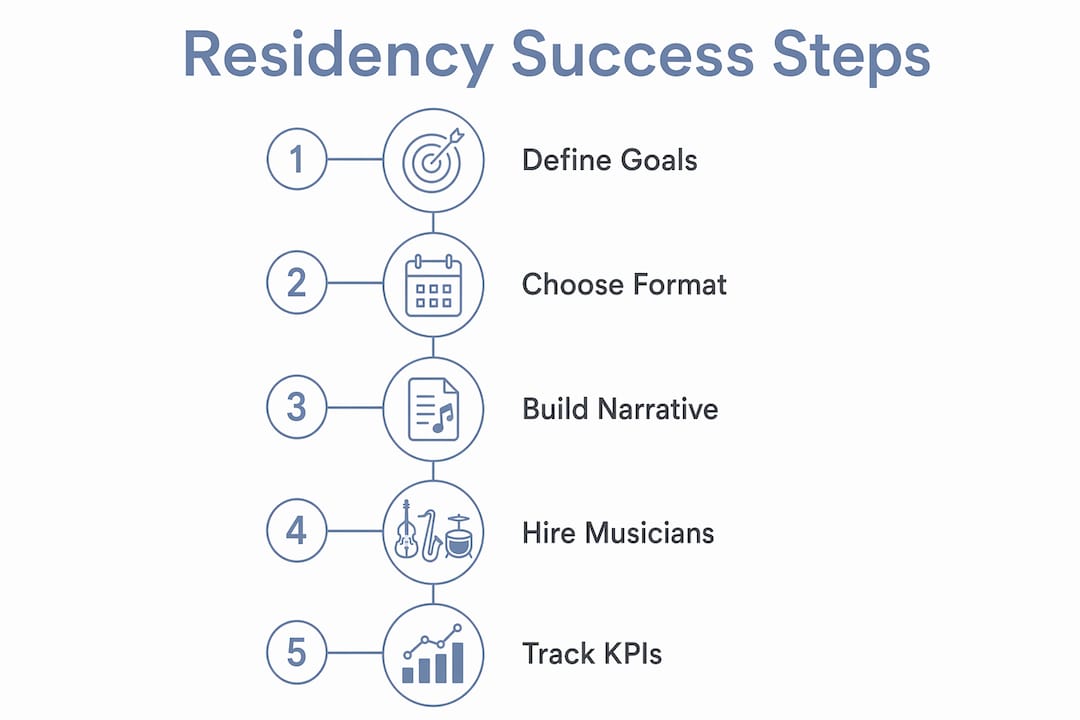
Before you book anyone, write down what success looks like in numbers. Common goals fall into four buckets: building a loyal regular crowd, lifting food and beverage revenue on slow nights, positioning the venue as a destination, and creating cross-promotion opportunities with local brands or hotels.
Your target guest profile shapes every programming decision. A corporate client crowd wants polished, unobtrusive jazz that supports conversation. A destination-dining crowd wants something memorable enough to post about. Regulars want consistency they can plan around. Pick one primary profile for the pilot and let it govern set times, volume levels, and repertoire tone.
Pilot KPIs worth tracking from week one: door count, average check on music nights versus comparable non-music nights, ticket or reservation conversion rate, and repeat attendance percentage. Set a realistic baseline before launch so you can measure movement, not just activity.
How do you choose the right program format and schedule?
Three models cover most venues. A single weekly resident builds the strongest audience habit because guests associate a specific artist with a specific night. A rotating 2–3 artist roster gives you stylistic variety but requires more curation discipline to keep a coherent identity. A monthly themed residency works well for special-event venues where each night is its own draw.
For a pilot, 6–12 weeks is the right window. Six weeks is enough to see attendance trends; twelve weeks gives you a full cycle of repeat guests and word-of-mouth. Repeat programming at the same time each week is what converts casual visitors into regulars.
On scheduling: dinner venues do best with a first set starting around 7:00 PM, 45–60 minutes long, and a second set at 8:30 PM. Late-night venues can push the first set to 9:00 PM with longer 75-minute blocks. Two sets per night is the standard; three is possible for high-energy late-night formats but increases artist fatigue and cost.
How do you build a sonic narrative that keeps guests engaged?
The difference between a memorable night and background noise is curator thinking: constructing an artistic arc rather than assembling a playlist. A sonic narrative means you choose instrumentation and repertoire that create tension, contrast, and resolution across the evening.
Practical instrumentation paths by venue mood:
- Cocktail hour / upscale bar: Jazz trio (piano, bass, drums) or solo piano. Familiar standards with occasional originals keep energy conversational.
- Dinner service: Acoustic guitar-vocal duo or string quartet. Lower volume, melodic focus, minimal percussion.
- Ceremony or reception: String-led ensemble for ceremony; hybrid DJ/live band for reception dancing.
- Late-night lounge: Saxophone-led quartet or a DJ/live hybrid that can shift from ambient to dance.
Set sequencing follows a simple arc: open with mid-energy material that welcomes guests without demanding attention, support the mid-course with melodic, lower-dynamic playing, build toward a peak-energy set as the room fills, then wind down gracefully in the final 20 minutes.
Pro Tip: Never force concert-hall dynamics into a room that isn't built for them. As Aaron Holloway-Nahum argues, curation requires asking what the music needs to succeed in a specific space — not what sounds impressive on paper. A loud, technically demanding set in a low-ceiling dining room loses the room every time.
How do you hire and audition musicians for a residency?
Selection criteria in order of importance: professionalism (on-time, prepared, communicative), repertoire flexibility, technical rider fit, verifiable references, and recorded or video samples. For matching musician skillset to event goals, ask candidates to submit a 20-minute representative setlist performed live or on video, using the same mic and monitor setup your venue provides.

Evaluate on three things: does the repertoire fit your sonic identity, can the artist adjust volume and energy on request, and do they communicate professionally before and after the audition?
Key contract clauses to include: flat fee or per-show rate, payment schedule (50% deposit, 50% day-of), cancellation terms for both parties (typically 30 days' notice), rider basics (PA specs, monitor mix, hospitality), recording and use rights for any video you capture, and a replacement policy naming who sources a substitute if the artist cancels within 72 hours.
What venue logistics do you need to lock down before launch?
Sound and staging checklist:
- PA system sized for the room (a 200-seat room typically needs at least two full-range mains and a subwoofer)
- Two floor monitors minimum for a duo or trio
- DI boxes for keyboards and acoustic instruments
- Stage footprint: 8×8 feet minimum for a trio, 12×12 for a quartet
- Dedicated circuit for audio equipment
Operational needs: confirm a load-in window at least 90 minutes before doors, a secure storage area for cases, a green room or quiet space for artists, and parking or a clear drop-off point. Hospitality basics (water, a meal or meal credit) are standard in most riders and cost less than the goodwill they buy.
On permits and licensing: confirm your venue's public performance license covers live music (ASCAP, BMI, and SESAC licenses are the three main U.S. performing rights organizations). Check local noise ordinances for your start and end times. Verify your general liability insurance covers live performance events; some policies require a rider for amplified music.
What should you budget and how do you measure ROI?
Three payment models cover most situations. A flat weekly fee is simplest and easiest to budget; it works best when you have a single resident and a predictable schedule. A per-performance fee gives you flexibility for rotating rosters. A hybrid model (base fee plus a percentage of ticket or cover revenue above a threshold) aligns artist incentives with attendance growth.
Budget line items for a typical pilot night: artist fee, sound technician (if not in-house), promotion (social ads, email, print), hospitality, and a 10–15% contingency. Project incremental F&B revenue by comparing average check on music nights against your baseline. Break-even attendance is the number of covers at your average check that covers the night's total cost; track it weekly.
How do you promote the residency and build repeat attendance?
Promotion checklist for a 6–12 week pilot:
- List every show on Google Events, your venue website, and local event calendars (Eventbrite, Do512, local city guides)
- Send an email sequence: announcement four weeks out, reminder one week before, last-call 48 hours before, post-show follow-up with next date
- Post short video clips from each show within 24 hours; Instagram Reels and TikTok clips are the highest-reach format for live music
- Pitch local lifestyle press and neighborhood newsletters three weeks before launch
- Partner with nearby hotels, corporate offices, or wedding vendors for cross-promotion
The single most powerful loyalty tactic is predictable scheduling: same night, same time, same artist. Guests build habits around certainty. Layer in a simple loyalty incentive (a complimentary dessert on a third visit, priority reservation access) and you accelerate the repeat-attendance cycle.
What does an 8-week pilot timeline look like?
| Week | Key Tasks | Owner |
|---|---|---|
| 1–2 | Site audit, budget approval, artist shortlist | Program manager |
| 3 | Auditions, contract negotiations, rider review | Program manager + GM |
| — | Contracts signed, tech rehearsal scheduled, promo assets created | All stakeholders |
| — | Announcement email sent, social posts go live, press outreach | Marketing lead |
| 6 | Tech rehearsal, soft preview night for staff and partners | Tech + artist |
| 7 | Public launch, post-show KPI capture, email follow-up | All |
| 8–12 | Weekly shows, weekly KPI review, mid-pilot artist check-in | Program manager |
Post-show feedback: collect a short three-question survey (How did you hear about tonight? Would you return? What would improve the experience?) via QR code at the table. Review attendance and average-check data weekly, not monthly, so you can adjust set times or promotion before the pilot ends.
- Confirm tech setup and sound check protocol before week six.
- Schedule a mid-pilot review at week six to assess attendance trends.
- Decide on continuation, rotation, or format change before week ten.
What do sample setlists and programming scenarios look like?
Cocktail trio (60 minutes): Open with "Autumn Leaves" or a Jobim bossa nova, move into a Monk standard mid-set, close with a Chet Baker ballad. Volume stays conversational throughout.
Ceremony to reception arc: String quartet plays Pachelbel's Canon and a Bach prelude for the processional, transitions to contemporary acoustic arrangements (a Coldplay or Ed Sheeran piece in a classical arrangement) for cocktail hour, then hands off to a jazz trio or DJ/live hybrid for the reception.
Dinner-to-dance hybrid: Solo piano for the first 45 minutes of dinner service, acoustic duo for the second set, then a DJ/live saxophone pairing that gradually lifts the energy toward dancing after 10:00 PM.
For performance samples, host short video clips (90 seconds to 3 minutes) on YouTube or Vimeo and embed them on your venue's event page. Collect written testimonials after each show and publish them in a dedicated guestbook section on your site. Video evidence and a live guest testimonial record are the two assets that convert the most skeptical future clients.
Who manages the program day-to-day?
Assign a single program manager: the person who owns artist communication, KPI reporting, and week-to-week decisions. This is typically the venue's events director or a designated F&B manager. Without a named owner, decisions stall and artists get inconsistent information.
Decision-making protocol: the program manager handles scheduling, set-time adjustments, and minor rider requests independently. Budget changes above a set threshold (say, adding a second artist or upgrading the PA) require GM sign-off. Creative direction changes (swapping genres, adding a themed night) go to a quarterly stakeholder review with the GM and marketing lead.
How should venue staff, musicians, and promoters communicate?
Set up a shared communication channel before the first show. A group thread in a messaging app works for most venues; larger programs benefit from a shared project board. The program manager is the single point of contact for the artist; venue floor staff should not negotiate directly with musicians about set times or volume.
Pre-show protocol: the program manager sends a confirmed run-of-show to the artist, sound tech, and floor manager 48 hours before each performance. It covers load-in time, sound check window, set start and end times, hospitality details, and the contact number for the night's floor manager. Post-show, the program manager collects KPI data and sends a brief recap to the GM within 24 hours.
What happens when an artist cancels or an emergency comes up?
Every contract should name a replacement protocol. The standard approach: the venue has the right to source a substitute artist of comparable style and fee if the resident cancels within 72 hours. The original artist forfeits the deposit for cancellations inside 48 hours unless the cause is a documented emergency.
Keep a short bench of two or three pre-vetted substitute artists in the same genre. Audition them during the pilot phase so they already know your room and your rider. A cancellation with a strong substitute is a minor inconvenience; a cancellation with no backup is a reputational problem.
For venue-side emergencies (equipment failure, venue closure), the contract should specify a force majeure clause and a rescheduling window of 30 days. Pay the artist a kill fee (typically 25–50% of the agreed rate) for cancellations inside 14 days that are the venue's responsibility.
How do you build community ties and support local artists?
The strongest resident musician programs treat local artist development as a feature, not an afterthought. The Kranzberg Arts Foundation's Musicians in Residency in St. Louis, for example, pairs paid performance guarantees with professional development and marketing support, creating a model where the venue and the artist both grow.
Practical tactics: reserve one slot per month for an emerging local act as an opening set. Partner with a local music school or conservatory for student showcases. Co-present with a neighborhood arts organization to share promotion costs and reach new audiences. These moves cost little and generate genuine goodwill, press coverage, and a pipeline of pre-vetted talent for your roster.
Key Takeaways
A well-run resident musician program requires a defined sonic identity, a named program manager, and consistent weekly scheduling to convert first-time guests into regulars.
| Point | Details |
|---|---|
| Run a 6–12 week pilot | Short enough to limit risk, long enough to see real attendance trends and repeat-guest data. |
| Define a sonic narrative | Choose instrumentation and set sequencing that match your venue's mood, not just your personal taste. |
| Lock logistics before launch | Confirm PA specs, load-in windows, performance licenses, and a substitute artist bench before week one. |
| Track three KPIs weekly | Door count, average check on music nights, and repeat attendance tell you whether the program is working. |
| Alexlevinmusic as your partner | Alexlevinmusic designs and books resident programs for venues and corporate clients across Philadelphia, New York, and beyond. |
What running a residency actually teaches you
Most venues approach a resident musician program as a marketing add-on. That framing sets them up for disappointment. The programs that actually build loyal audiences treat the music as a core product decision, not a promotional tool. That means the program manager has real authority, the artist has a real contract, and the KPIs get reviewed every week, not every quarter.
The other thing most guides skip: the sonic narrative is not about prestige. A solo pianist playing Gershwin standards in a 60-seat wine bar can outperform a headline jazz quartet in the same room if the repertoire, volume, and pacing fit the space. Fit beats fame every time. The venues that figure this out early stop chasing names and start building identity, and that identity is what guests describe when they recommend the place to a friend.
Alexlevinmusic makes it easy to launch your residency
Planning a resident musician program from scratch takes time most event directors don't have. Alexlevinmusic handles the parts that slow programs down: artist selection matched to your venue's sonic identity, contract and rider management, technical production coordination, and a launch promotion plan built around your calendar.
Whether you're programming a weekly jazz night at a Philadelphia restaurant, a recurring corporate lounge series in New York, or a multi-event wedding season package, Alexlevinmusic brings the full scope: curated live music from jazz trios and string quartets to DJ/live hybrids, with every detail confirmed before the first note. For corporate clients, the corporate event entertainment page shows exactly what a managed residency looks like in practice. Ready to get started? Contact Alexlevinmusic to check availability and build your pilot program.
Useful sources and further reading
- Kranzberg Arts Foundation Musicians in Residency — A detailed real-world model of a paid venue residency with performance guarantees, professional development, and marketing support; useful for structuring your own program terms.
- New Music USA: Curation Is Not a Form of Marketing — Aaron Holloway-Nahum's argument for space-specific curation thinking; essential reading before you finalize your sonic narrative.
- Rock & Roll Hall of Fame Artist in Residence Program — A strong example of a structured residency with defined weekly hour commitments and public performance requirements; useful for governance and scheduling benchmarks.
- Banff Centre Fuse Music Residency — Illustrates how formal residencies structure mentorship, collaborative creation, and public presentations; helpful for designing your program's creative development component.
- ASCAP, BMI, and SESAC — The three U.S. performing rights organizations. Confirm your venue holds current licenses with all three before your first public performance. Check each organization's website directly for current licensing rates and venue categories.
- Local permitting: Contact your city or county clerk's office to confirm noise ordinance hours and any special event permit requirements for amplified live music at your venue before launch.