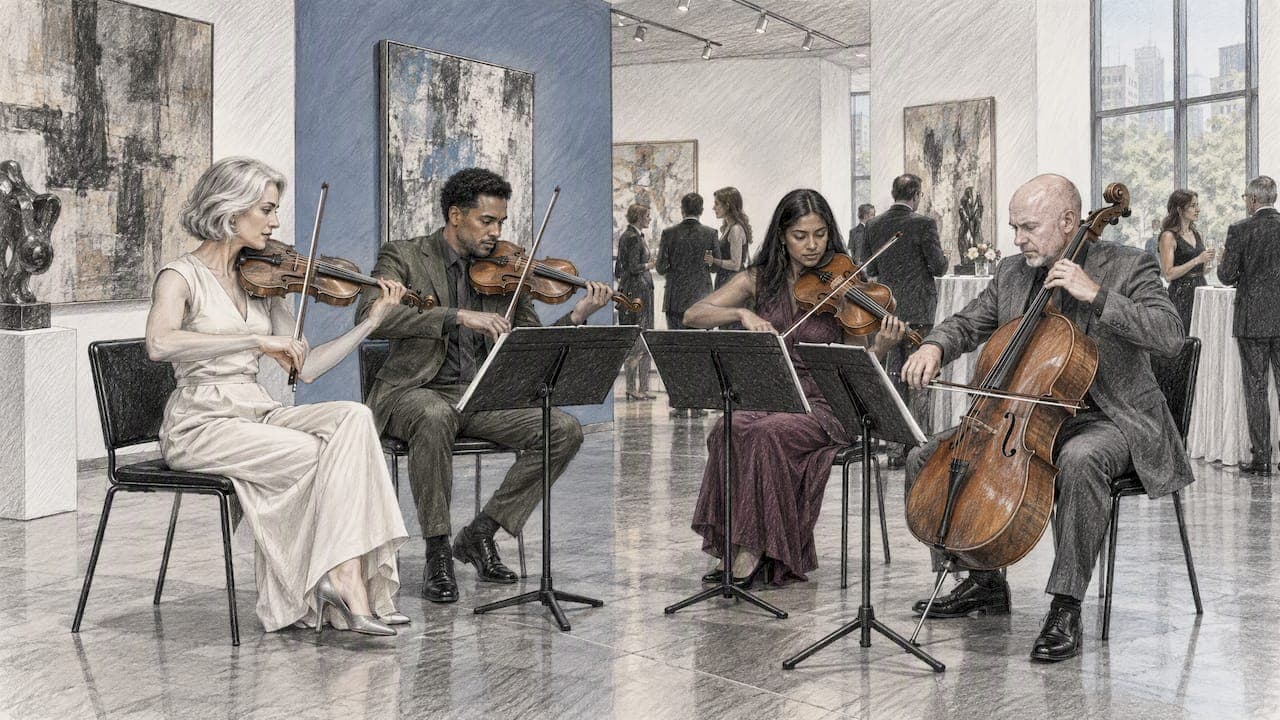
A string quartet suits corporate events where the room should feel polished and people should still be able to talk: receptions, dinners, galas, award evenings, client appreciation nights and holiday parties. Two violins, a viola and a cello fill a room without overpowering it. They play from a small footprint and need very little from the venue. The rest of this guide covers how to choose the right kind of event, repertoire, setup and timing, and what to put in a quote request.
TL;DR
- A quartet works best during arrivals, cocktail receptions, seated dinners and award moments, where music should support conversation instead of replacing it.
- Choose repertoire by the job each part of the evening has: classical for formality, string arrangements of pop and jazz standards for warmth and recognition.
- Settle space, power, sound, load-in and break coverage with the venue before you sign, not the week of the event.
- Send your date, venue, guest count, program flow and dress code when you ask for a quote, so the answer is a real number and not a range.
- Book early for the fall and holiday season, and ask whether a quartet, a jazz ensemble or a hybrid with a DJ fits your evening best.
Table of Contents
- What a string quartet adds to a corporate event
- Which corporate events suit a string quartet
- Choosing the music and the style of performance
- What to check before you book: space, sound and the venue
- How long a quartet plays and how breaks work
- What a string quartet costs
- When to book and what to send with your request
- Our perspective: plan the music like a part of the program
- Plan your event with us
- FAQ
- Sources
What a string quartet adds to a corporate event
Most corporate events have a problem that has nothing to do with music: the first twenty minutes are awkward. People arrive from different teams and different companies, they hold a drink, and nobody wants to be the first to speak into a silent room. A live quartet changes that atmosphere. The sound signals that the evening is considered and that the host paid attention to detail. It also gives guests a low-pressure backdrop that covers the silence between conversations.
There is also a design argument. Event professionals describe music as one of the tools for creating intentional transitions and keeping momentum through a program. PCMA's account of the eXpcon 2025 redesign, a 90-day meeting makeover, supports the broader insight that entertainment layered into production helps hold attendee energy and engagement. The point for a planner is that music should be placed deliberately, not dropped in as wallpaper.
Live music can also express where you are and who you are. PCMA's coverage of how the American Veterinary Medical Association shaped its 2024 convention, an only-in-Austin annual meeting, shows live music occupying several event locations and shaping the attendee experience, instead of living only in a single concert slot. A quartet can do the same in a smaller way: one ensemble can greet guests at the door, move to the cocktail area and then play through dinner.
What a quartet adds in practice:
- Tone. Strings read as formal and refined without being stiff, particularly if the repertoire includes familiar songs.
- Volume you control. An acoustic ensemble sits naturally under conversation. You can ask the players to play softer or louder in the moment.
- A visual focal point. Four musicians in formal attire give a room a look as well as a sound, which matters for photos and branded spaces.
- Flexibility. The same group can play a processional-style opener, a dinner set and a closing piece.
If you want more on why organizers invest in live sound at all, our own piece on why live music is essential at corporate events goes through the reasons in more detail.
Which corporate events suit a string quartet
A quartet is not the answer to every event. It fits best where the audience is mingling, dining or arriving, and where a refined atmosphere is part of the brief.
| Event type | Why a quartet fits | What to watch |
|---|---|---|
| Corporate gala or awards dinner | Elegant background for arrivals and dinner, easy to pause for speeches | Cue the players for each award block |
| Client appreciation or VIP reception | Upscale mood that invites conversation | Keep volume low enough for networking |
| Holiday party | Seasonal arrangements add warmth | Decide early between classic carols and lighter pop arrangements |
| Product launch or brand reveal | Contrast with a modern brand can feel memorable | Match repertoire to the brand message |
| Conference welcome reception or opening dinner | Gives a large foyer a defined mood | Plan the placement so music does not compete with registration |
| Board dinner or executive retreat | Quiet and unobtrusive | Consider a smaller or softer setup |
| Retirement or anniversary celebration | Personal and sentimental | Take requests for meaningful pieces |
A quartet is a weaker fit for a high-energy dance party, a loud open-bar mixer in a very large hall, or a daytime trade show floor where the noise level is already high. For those, a swing band, a jazz ensemble or a DJ and live hybrid will carry the evening better. We cover that range of options on our corporate event entertainment page, and the guide to what corporate entertainment is and how to plan it can help you decide where music sits in the overall program.
Choosing the music and the style of performance
The common mistake is to pick a playlist first. Pick the job of each segment first, then match the music to it.
Match repertoire to each part of the evening
- Arrival and registration. Light, familiar, mid-tempo pieces. You want guests to relax, not to stop and listen.
- Cocktail reception. String arrangements of pop, soul and jazz standards. People recognize the tunes and start talking about them, which is an easy icebreaker.
- Seated dinner. Softer, slower selections and classical favorites. Dinner is where volume discipline matters most.
- Awards or speeches. Short fanfare-style moments or a gentle underscore, then silence. Agree on cues in advance.
- Close of evening. A warm, recognizable finish, or a handover to a DJ or band if the party continues.
Formal or fun?
Corporate rooms vary. A law firm's partner dinner and a tech company's holiday party need different energy, even if both want strings. Ask yourself who the guests are, what the company culture is like, and whether the evening is about prestige or celebration. Our post on striking the right tone between formal and fun walks through that decision. A good quartet can move along that range within a single evening, from classical during the first hour to contemporary arrangements later.

When a quartet is not the only option
Some clients want strings for the formal part of the night and something more danceable afterward. That is a normal request. Hybrid formats let a live ensemble carry the reception and a DJ take over for dancing, with one team handling the transitions. If your event has a sit-down dinner followed by dancing, read our guidance on seamless music planning from dinner to dancing.
What to check before you book: space, sound and the venue
A quartet is easy to host, but small details cause most of the day-of problems. Go through this list with the venue and the musicians before you sign anything.
- Performance area. Four musicians seated with instruments, chairs and stands need more floor than people expect. Ask the ensemble for the footprint they need and mark it on the floor plan, away from doorways and service traffic.
- Seating. Armless chairs are standard for string players. If the venue cannot provide them, the ensemble should say so ahead of time.
- Amplification. Many quartets play acoustically in intimate rooms. In a large ballroom, or if they must be heard over a crowd or a speech, they may need discreet microphones or a small sound system. Decide who provides it, and confirm any house audio rules.
- Power. Stand lights and any amplification need outlets nearby. Confirm this on the venue walkthrough.
- Load-in and parking. String instruments are valuable and delicate. Give the group a loading route, parking details, an elevator if needed, and a contact person at the venue.
- Dressing and warm-up space. A private room, even a small one, matters for players who arrive early. Note that instruments are sensitive to temperature, so avoid placing the group beside a cold entrance or direct heating.
- Weather and outdoor settings. Outdoor receptions, tents and patios bring heat, wind and humidity. Tell the musicians if any part of the event is outside, and have an indoor backup.
- Venue rules. Some hotels and convention centers have restrictions on outside vendors, insurance, or union labor. Ask your venue contact early whether they require a certificate of insurance from performers.
- Coordination. Give the musicians a single point of contact on the day, usually the event producer or planner, and make sure the emcee, AV technician and catering captain know the music cues.
How long a quartet plays and how breaks work
There is no single rule, because the right length follows your program. What matters is the structure of the sets and what fills the gaps.
The most common arrangement for a reception is a continuous performance block over the cocktail hour, and a second block over dinner, with a break between them. A quartet is made of four people playing instruments that tire the hands and arms, so a performance of several hours needs planned breaks. When you ask for a quote, specify the total event time, the exact windows when you need live sound, and what should happen during the pauses.
Options for covering breaks:
- Staggered breaks. If the ensemble is larger, one or two players step away while the rest continue. This is less common with a quartet because the sound changes noticeably.
- Recorded music. A short, curated playlist bridges a break. Ask the ensemble whether they can provide it, so the sound and volume stay consistent.
- Program-driven breaks. Plan the pause for a speech, a toast, a video or an awards segment, when music is not wanted anyway. This is the cleanest option.
As a working approach, we suggest planning performance blocks around your program and building breaks into natural silences instead of cutting into a good moment. Confirm the arrangement in writing in the contract, including overtime terms in case the event runs long.
What a string quartet costs
Prices vary widely across the United States, and they depend on the city, the date, the length of the performance, the repertoire, the travel involved and any amplification. Be skeptical of a flat national number. Instead, ask each ensemble for a quote built on your specific details.
What moves the price:
- Duration. Total performance time and any overtime.
- Date and season. Holiday and peak-season dates are in demand.
- Location and travel. Distance, parking, lodging for a destination event.
- Custom work. Special arrangements, learning a new piece, a company song, or a custom program.
- Equipment. Amplification, lighting, and any extra stands or chairs.
- Ensemble size and format. A quartet costs differently from a trio, a jazz group or a hybrid with a DJ.
For reference, our published packages for cocktail hour music and reception music start from $3,000 per event. Corporate events are quoted individually, because length, setup and format differ so much from one program to the next. If you are comparing quotes, line them up on the same terms: hours of live music, setup and breakdown time, equipment, overtime, travel and cancellation. A low number that leaves out amplification or travel is not low.
When to book and what to send with your request
Book as soon as the date and venue are firm. Corporate calendars concentrate in spring and in the November and December holiday season, and the best ensembles fill their weekends well ahead. A few months of lead time is a sensible target for a larger event, and earlier is better for peak dates. For a smaller or off-peak event, shorter notice can still work, so ask.
A complete request gets a faster and more accurate quote. Include:
- Event date and start and end times.
- Venue name and address, indoor or outdoor, and any restrictions.
- Guest count and the type of event (gala, reception, dinner, launch).
- The program flow: arrival, speeches, dinner, awards, dancing.
- The exact windows when you want live music.
- Musical preferences, must-play pieces and anything to avoid.
- Dress code and the tone you want, formal or relaxed.
- Any amplification, AV and power details the venue can provide.
- Your budget range, if you have one. It lets the ensemble propose what actually fits.
Our perspective: plan the music like a part of the program
We work with corporate hosts in Philadelphia, New York and beyond, and the pattern we see is consistent. The events that go best treat the music as part of the run of show, not as an add-on. The musicians know when the doors open, when the speeches start and what the room should feel like at each point.

A few things we would tell a planner over coffee. First, do not ask a quartet to fight a loud room. If your cocktail area is a crowded atrium with a bar, think about placement, or consider a different format. Second, familiar tunes in string arrangements do more for guests than a purely classical program, unless the event calls for formality above all. Third, share the schedule and the cues, and let the musicians suggest the repertoire. They have played rooms like yours before.
And if you are not sure strings are right, say so when you inquire. We would rather match you with a jazz trio, a swing band or a hybrid format that fits the evening than sell you something that does not. Our live music corporate gala planning guide lays out how we think through the full evening.
— Alex
Plan your event with us
If you are planning a corporate dinner, gala, launch or holiday party in Philadelphia, New York or elsewhere, we can build a live program around your schedule, with a string quartet, jazz ensemble, solo piano or a live and DJ hybrid. Tell us your date, venue and the feel you want, and we will propose a format. Start on our corporate event entertainment page or reach us through alexlevinmusic.com.
FAQ
Is a string quartet too formal for a corporate party?
Not if you choose the repertoire with care. Quartets regularly play arrangements of pop, jazz and contemporary songs, which keeps the sound elegant but approachable. Tell the ensemble the company culture and the guest profile, and they can set the balance between classical and modern.
Does a string quartet need a microphone or sound system?
In a small or medium room, a quartet can often play acoustically. In a large ballroom, outdoors, or if you need them heard over a crowd or a speech, light amplification may help. Ask the ensemble what they recommend after they see the room, and confirm who supplies the equipment.
How many musicians should I book for a corporate event?
Four is the classic size for strings and fills most reception and dinner rooms well. For a very large space, or if you want a fuller sound, a larger ensemble or a different format may fit better. If the evening moves into dancing, a hybrid or a band is usually the better tool.
What should I include when I ask for a quote?
Send the date, venue, guest count, event type, program schedule, the windows for live music, dress code and any musical requests. Mention whether the space is indoor or outdoor and what power and sound the venue provides. The more specific you are, the more accurate and comparable the quote.
How early should I book?
Book once the date and venue are confirmed, and earlier for the spring and holiday seasons when demand peaks. Smaller or off-peak events can sometimes be arranged on shorter notice, so it is worth asking.
Sources
- Inside a 90-Day Meeting Makeover, PCMA
- How the AVMA Curated an Only-in-Austin 2024 Annual Convention, PCMA