
Musicians adapt to corporate culture by combining cultural fluency with professional logistics and clear performance boundaries. Before you sign any contract, run through this checklist:
- Appearance: Attire matches the event's dress code (business formal, cocktail, branded uniform)
- Set type confirmed: Background (ambient, 60–70 dB) vs. feature (announced, spotlit) agreed in writing
- MC coordination: Musician has spoken with the MC or AV lead before load-in
- Load-in and PA: Power requirements, mic types, and riser needs documented in the rider
- Contract items locked: Deposit amount, overtime rate, cancellation window, and recording rights all specified
Ensembles to consider for corporate work: a jazz trio, string quartet, solo piano, DJ, or a hybrid DJ-live setup. Alexlevinmusic offers all five, with video samples and detailed service pages for each.
Table of Contents
- How musicians adapt to corporate culture — and why planners should care
- What do musicians actually change for corporate gigs?
- How should you brief and contract a musician for a corporate event?
- Which ensemble fits your corporate event format?
- How do experienced musicians think about corporate work?
- Red flags to watch for before you sign
- Key Takeaways
- A note on working with corporate clients
- Book Alexlevinmusic for your next corporate event
- Useful sources and where to learn more
How musicians adapt to corporate culture — and why planners should care
Corporate audiences measure event success differently than wedding guests do. They track brand alignment, executive comfort, and whether anything went wrong. That risk-averse calculus shapes every entertainment decision.
"Corporate entertainment decisions are frequently driven by social caution and copycat booking behavior — planners often choose 'safe' options until a peer benchmark proves otherwise."
Once a novel act succeeds at a peer company's gala, it becomes the new safe benchmark. Musicians who reduce planner risk by communicating process and sharing references break that cycle faster than any demo reel alone.
Three consequences for planners who skip this vetting:
- Guest experience suffers when volume or repertoire clashes with the room's energy (a jazz trio playing at bar-band volume during a CEO's remarks).
- Brand alignment breaks down when a musician improvises a set that contradicts the event's theme or sponsor messaging.
- Format compliance fails when a musician scheduled for background cocktail hour launches into a feature set mid-program.
What do musicians actually change for corporate gigs?
Experienced musicians shift five dimensions when they take a corporate booking. Here is what each looks like in practice and what you should confirm before the event.
-
Repertoire and arrangement. Corporate-ready musicians pre-build two set lists: one for background (instrumental standards, low-key originals) and one for feature moments (arranged medleys, branded song requests). Ask to see both before signing. A well-matched repertoire is the single fastest way to set the right tone.
-
Volume and set mix. Background sets sit at conversational volume so guests can network. Feature sets are announced and amplified. Confirm which mode applies to each segment of your run-of-show, and get it in writing.
-
Stage demeanor and dress. A string quartet in black tie reads differently than a DJ in streetwear. Neither is wrong — but both must match your event's dress code. Ask for photos from a comparable corporate gig.
-
Client communication and MC coordination. The musician should contact your MC or AV lead at least 48 hours before the event. They need to know cue words, announcement timing, and any no-play zones (during awards, during a moment of silence).
-
Logistics and business practices. Professional logistics — a written rider, punctual load-in, and a clear contract — often matter as much to corporate buyers as musical quality. A musician who cannot produce a rider is a musician who has not done this before.
Pro Tip: Ask the musician to play 60 seconds of the same song at two different volumes on a video call. A musician who can genuinely shift style on short notice will do it without hesitation. One who cannot will stall or redirect.
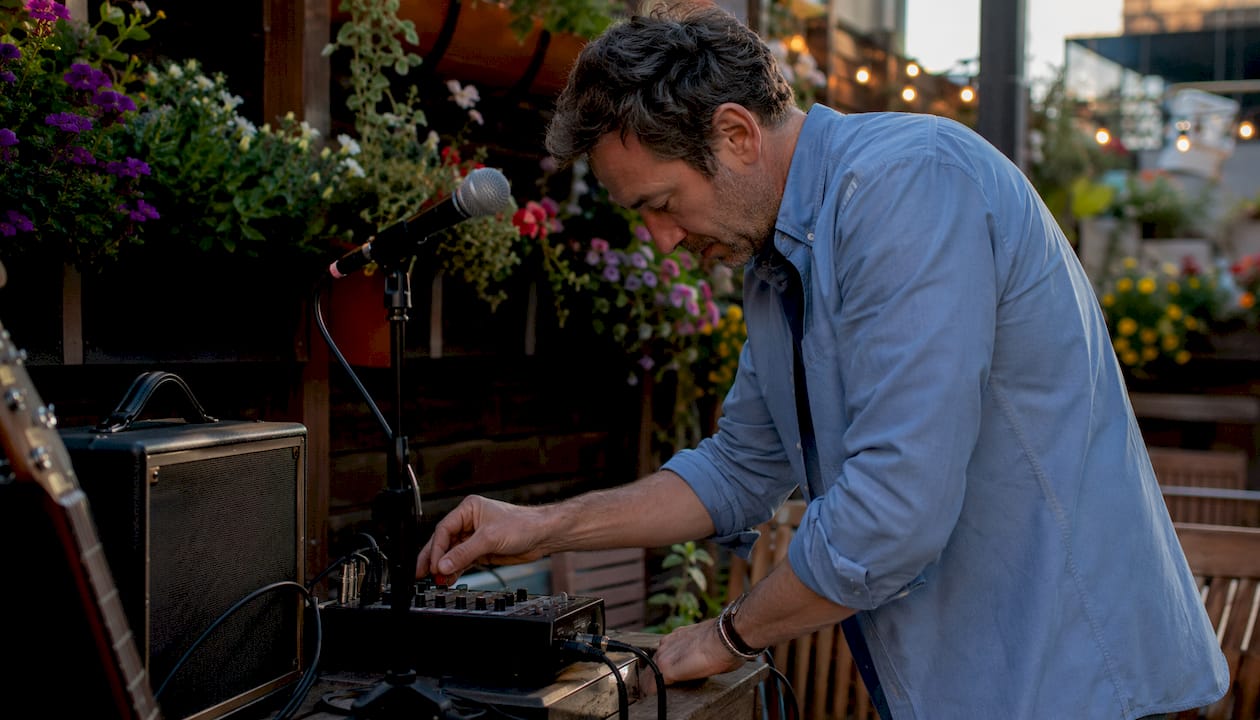
Stage-plot items to request in the rider: two 20-amp circuits, one vocal mic on a stand, one instrument DI or mic, a 6×8-foot riser (optional but preferred for visibility), and a clear load-in path confirmed with venue ops.
How should you brief and contract a musician for a corporate event?
A clear brief paired with a concise contract removes surprises and protects the musician's ability to perform well within your constraints. The briefing conversation is where adaptation actually begins.
Contract and brief items to include:
- Performance windows (start time, end time, break schedule)
- Set length per segment and mode (background vs. feature)
- MC and announcement coordination protocol
- Branding and mention rules (can the musician name a sponsor? reference a product?)
- Exclusivity and recording rights (no audience livestreaming without consent)
- Deposit amount and due date
- Overtime rate per 30-minute increment
- Cancellation terms (typically 50% deposit non-refundable inside 30 days)
- Rider items (power, backline, parking, hospitality)
Musicians who package themselves as structured businesses with clear riders and promo kits are consistently easier to book and manage. That infrastructure signals corporate experience before you even hear them play.
| Milestone | Typical Lead Time | Action |
|---|---|---|
| Booking confirmed | 8–12 weeks out | Sign contract, pay deposit |
| Run-of-show draft | 3–4 weeks out | Share program with musician |
| Final briefing call | 5–7 days out | Confirm MC cues, set times, dress |
| Load-in | 90 min before doors | Venue access, soundcheck |
| Performance | Per contract window | Background or feature per brief |
Sample contract language you can paste into a booking email:
- "Musician will perform in background mode (ambient volume) during cocktail hour (6:00–7:00 PM) and transition to a 20-minute feature set beginning at 8:15 PM, as cued by the MC."
- "Overtime beyond the contracted window will be billed at $[rate] per 30 minutes, invoiced within 48 hours."
- "No audio or video recording of the performance may be distributed publicly without written consent from the musician."
Which ensemble fits your corporate event format?
Choose the ensemble by matching the event phase, audience expectation, and space constraints. The table below maps each format to its best use case.
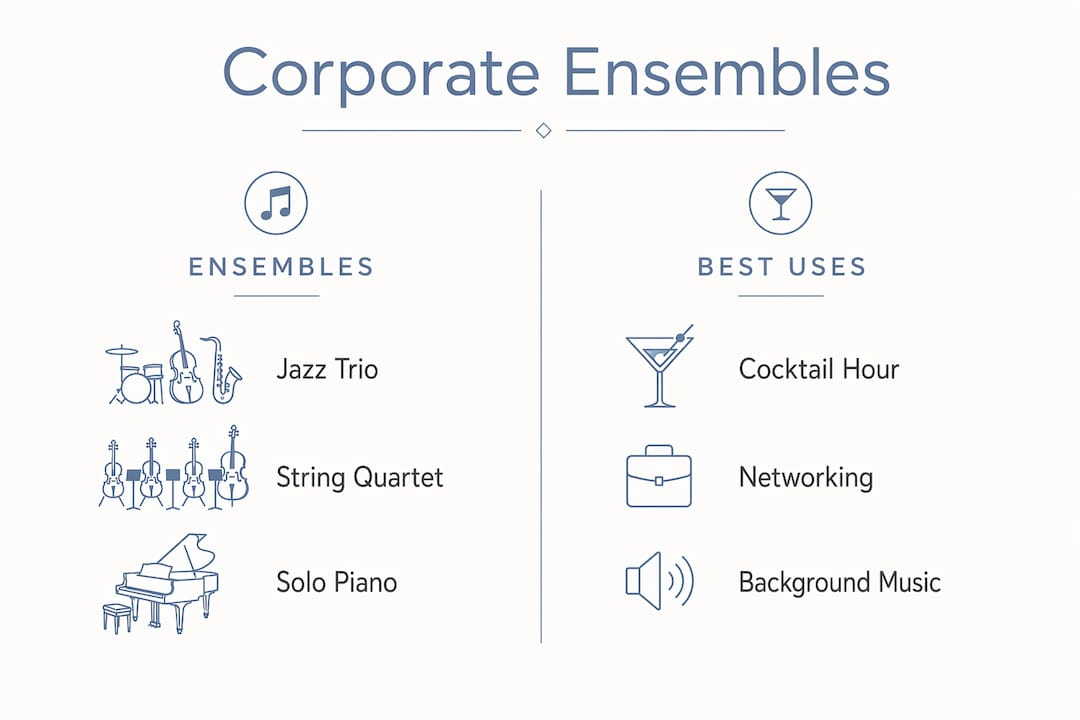
| Ensemble | Best use | Space and PA needs |
|---|---|---|
| Jazz trio | Cocktail hour, networking reception | Medium room; needs 2 mics, 1 DI, PA optional if room is small |
| String quartet | Award dinner, formal gala, ceremony | Quiet room; acoustic or light PA; no drums |
| Solo piano | Intimate dinner, executive reception | Requires in-house grand or digital piano; minimal PA |
| DJ | Afterparty, product launch, high-energy reception | Full PA, lighting rig, 20-amp circuit |
| Hybrid DJ-live | Multi-phase event (cocktail + dinner + afterparty) | Modular setup; confirm changeover time between modes |
For a corporate cocktail reception, a jazz trio or solo piano typically works best: the volume stays conversational, the repertoire is familiar without being distracting, and the visual presence adds polish without demanding attention.
A product launch cocktail benefits from a hybrid DJ-live setup. The live element (say, a saxophonist over DJ tracks) creates shareable moments for social content without the full commitment of a band changeover. For a formal award dinner, a string quartet during arrivals followed by a DJ for the afterparty covers both ends of the energy spectrum cleanly.
Pro Tip: When booking a hybrid setup, confirm the changeover time between live and DJ modes in writing. A 15-minute gap in music mid-event kills momentum. The best hybrid acts can switch in under five minutes with no dead air.
How do experienced musicians think about corporate work?
Experienced musicians treat corporate gigs as a distinct professional category, not a compromise. Mark Morton of Lamb of God describes diversifying across tours, festivals, private shows, and corporate work as standard portfolio management. The business changes; you adapt.
Cultural fluency in corporate settings means learning unwritten rules, aligning communication styles, and proactively seeking feedback. For musicians, that translates to reading the room before the first note, not after.
Pro Tip: When you want creative latitude without adding risk, frame unusual requests as a controlled feature set. Tell the musician: "We'd love something unexpected for the 8:15 PM moment — here's the 90-second window and the tone we're after." That gives them room to be interesting without derailing the program.
Red flags to watch for before you sign
Ask targeted operational and reference questions. Vague or defensive answers are the clearest signal that a musician lacks genuine corporate experience.
Red flags:
- No written rider or vague PA requirements ("I just need a speaker")
- Cannot name a corporate client or provide a reference contact
- Refuses to coordinate directly with your MC or AV lead
- Inconsistent availability or slow response to logistics questions
- No clear cancellation or overtime policy
Question template for your vetting call or email:
- Can you send me your technical rider and a sample set list for a corporate background set?
- Who should I connect you with on our AV team, and when can you reach out to them?
- Do you have a reference from a corporate event in the past 12 months?
- What is your policy if we need you to extend by 30 minutes?
- Are there any recording or livestreaming restrictions we should know about?
- How do you handle a last-minute repertoire request from an executive during the event?
- What does your load-in process look like, and what do you need from the venue in advance?
Key Takeaways
Musicians who adapt to corporate culture combine cultural fluency, tailored repertoire, and professional logistics to reduce planner risk and deliver a polished guest experience.
| Point | Details |
|---|---|
| Confirm set mode in writing | Specify background vs. feature for each program segment before the event date. |
| Match ensemble to event phase | Jazz trio or solo piano for cocktail hour; string quartet for formal dinners; DJ or hybrid for afterparties. |
| Require a written rider | A clear technical rider signals corporate experience; missing one is a red flag. |
| Vet with targeted questions | Ask for a corporate reference, a sample set list, and overtime policy before signing. |
| Alexlevinmusic for corporate events | Offers jazz trio, string quartet, solo piano, and DJ/hybrid ensembles with video samples and detailed service pages. |
A note on working with corporate clients
Corporate events ask something specific of a musician: show up prepared, stay flexible, and never make the planner explain the same thing twice. That means reviewing the run-of-show before load-in, confirming MC cues in writing, and having a background set and a feature set ready to deploy on short notice.
Alexlevinmusic approaches every corporate booking with a pre-event briefing call, a documented rider, and ensemble options that can shift between ambient and feature modes without a gap in the program. Video performance samples are available on the site, and client references are provided on request.
Book Alexlevinmusic for your next corporate event
Alexlevinmusic offers corporate-ready ensembles that move between background and feature performance without missing a beat. Whether you need a jazz trio for a cocktail hour, a string quartet for a formal gala, a solo pianist for an executive dinner, or a DJ and hybrid setup for a multi-phase event, every option comes with a clear rider, pre-event coordination, and video samples you can share with stakeholders before you commit.
Check availability and view corporate packages on the Alexlevinmusic site. Video samples, ensemble descriptions, and booking contacts are all there. If you know your date, reach out directly to confirm availability and get a quote.
Useful sources and where to learn more
- Beyond The Booking: Lou Gramm — Covers copycat bias and social caution in corporate entertainment booking; supports the risk-calculus claims in the adaptation and red-flags sections.
- Mark Morton on 30 Years in Music — Artist perspective on treating different performance types as separate professional activities; supports the portfolio-thinking section.
- Yvonne Chaka Chaka: Music Into Business — Case study on structured artist infrastructure and why corporate clients prefer it; supports the briefing and contracting section.
- Cultural Fluency in Corporate Settings — HR and career guidance on aligning communication styles and seeking feedback; supports the cultural fluency framing throughout.
- Corporate Cocktail Reception Best Practices — Timing, spatial flow, and AV guidance for cocktail receptions; supports ensemble selection and set-length recommendations.
- Alexlevinmusic Corporate Event Entertainment — Primary service page covering ensemble options, booking process, and corporate packages.
- From Booking to Encore — Step-by-step logistics guide covering load-in, run-of-show, and soundcheck coordination.
- How to Choose the Right Musician — Planner-facing decision guide for matching musician type to event style and audience.