
What is corporate entertainment?
Corporate entertainment describes private events and performances that companies organize for employees, clients, or stakeholders. The goal is always some combination of engagement, recognition, relationship-building, and creating an experience people actually remember. It is not the same as a standard business meeting with a catered lunch. The entertainment component is deliberate, curated, and tied to a specific outcome.
Common settings include:
- Product launches — performances or experiences that generate excitement around a new offering
- Conferences and conventions — keynote entertainment, musical acts, or interactive breaks that sustain energy across a full-day program
- Awards galas — polished live performances that match the prestige of the occasion
- Team retreats — activities designed to build trust and loosen the formality of the office
- Holiday parties and milestone celebrations — entertainment that rewards and unites the team
The core elements that define corporate entertainment are live performances, themed activities, hospitality, and interactive experiences. Each of these can be scaled up or down depending on audience size and event format. A private concert for 20 executives and a jazz trio playing a cocktail hour for 300 guests are both corporate entertainment. What they share is intentionality: the entertainment serves the event's purpose rather than filling dead air.
The corporate event industry is projected to reach $1.6 trillion by 2028, which reflects how seriously companies treat these moments.
Why corporate entertainment matters for your business
Entertainment at a corporate event is not decoration. It is the mechanism through which the event actually achieves its goals. 85% of companies use corporate events to improve employee engagement, reinforce client relationships, and consolidate internal culture. That figure shows how the business world has come to view these gatherings: not as optional perks, but as tools.
The benefits of corporate events fall into a few clear categories:
- Employee morale and motivation — recognition events and celebrations signal to employees that their work is seen and valued, which directly affects retention and performance
- Client and stakeholder relationships — shared experiences create trust faster than any sales call; a well-run client dinner or gala leaves a lasting impression
- Company culture — entertainment that reflects the brand's values reinforces what the organization stands for, especially for newer employees
- Networking — the right entertainment creates natural conversation starters and lowers social barriers between people who might otherwise stay in their professional lanes
- Brand perception — how a company entertains its guests says something about the company itself; a polished event signals competence and care
Corporate events also serve as internal communication tools. Kick-offs, town halls, and conventions use entertainment to reset energy and keep large groups engaged across long programs. Without it, even the best content loses the room by mid-afternoon.
Popular types of corporate entertainment to consider
Choosing the right type of entertainment starts with understanding how the room will function during the event. A networking reception needs something different from a seated awards dinner. The wrong choice does not just fall flat; it actively works against the event's purpose by making conversation difficult or pulling attention away from the agenda.
Here are the main categories, with notes on when each works best:
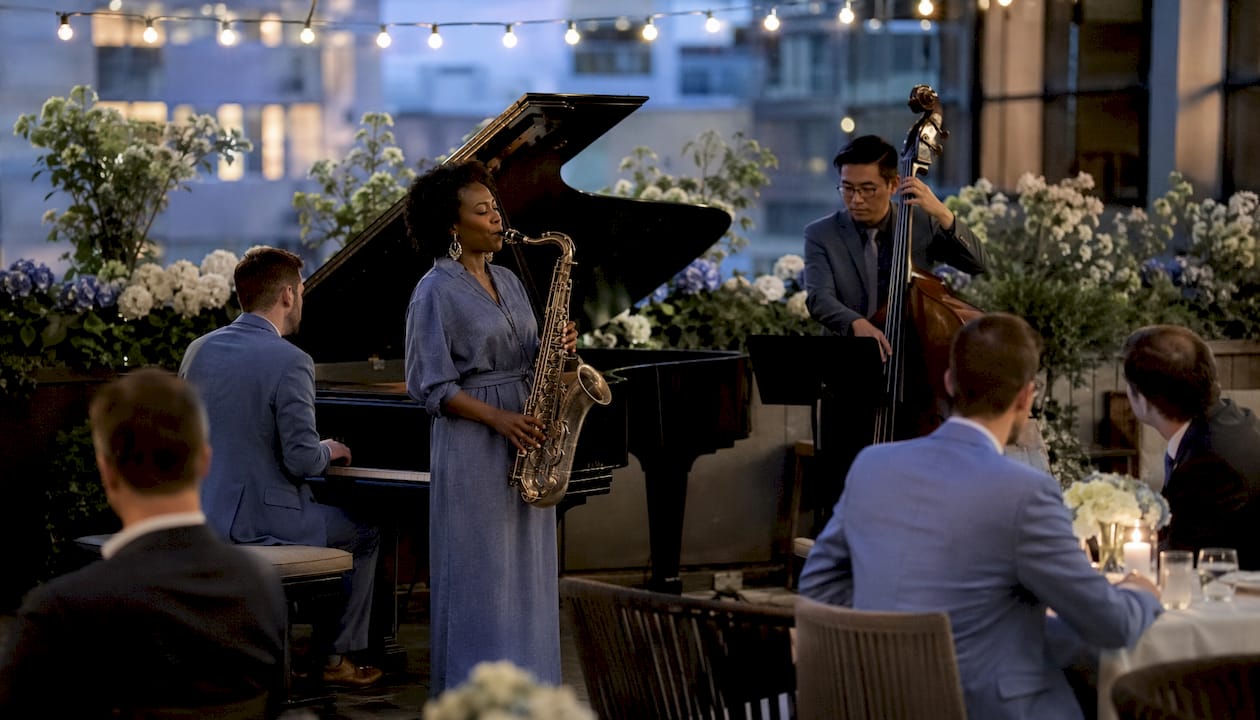
- Live musical acts — jazz trios, string quartets, solo piano, or full bands. Jazz and acoustic formats work especially well for cocktail hours and receptions because they create atmosphere without overwhelming conversation. Full bands suit larger, higher-energy celebrations.
- Keynote comedy — a comedian who understands corporate audiences can reset energy after a long day of sessions. The key word is "understands": a performer who reads the room and keeps material clean and inclusive lands well; one who does not can derail the evening.
- Magicians and mentalists — close-up magic works particularly well at receptions and networking events. It creates small moments of surprise and conversation without requiring guests to stop what they are doing.
- Interactive games and game shows — trivia, team challenges, and branded game show formats work for internal events where the goal is engagement and cohesion. They require more floor space and guest participation, so they fit better in team-building contexts than client-facing ones.
- Photo booths and experiential activations — low-commitment, high-return options that give guests something to do and take home. Branded photo booths generate social content and work across almost any event format.
- Mixology and cooking classes — hands-on experiences that double as team-building. Guests work together, which creates natural conversation and a shared memory. These fit best in smaller groups.
- Themed parties and immersive environments — the entertainment is the environment itself. These work well for product launches and client appreciation events where the goal is a specific emotional impression.
- Virtual and hybrid entertainment — virtual and hybrid formats have expanded significantly, allowing companies to include remote attendees without sacrificing production quality. Live-streamed performances, virtual escape rooms, and hybrid game shows all fall here.
- DJ services — a skilled DJ reads the crowd and adjusts in real time, making them a flexible choice for receptions, after-parties, and celebrations where the energy needs to build across the evening.
The distinction that matters most is between low-profile entertainment (jazz, acoustic performers, mentalists) that supports conversation, and high-impact entertainment (bands, comedians, game shows) that commands the room's attention. Neither is better by default. The right choice depends entirely on what you need the room to do.
How to plan corporate entertainment that actually works
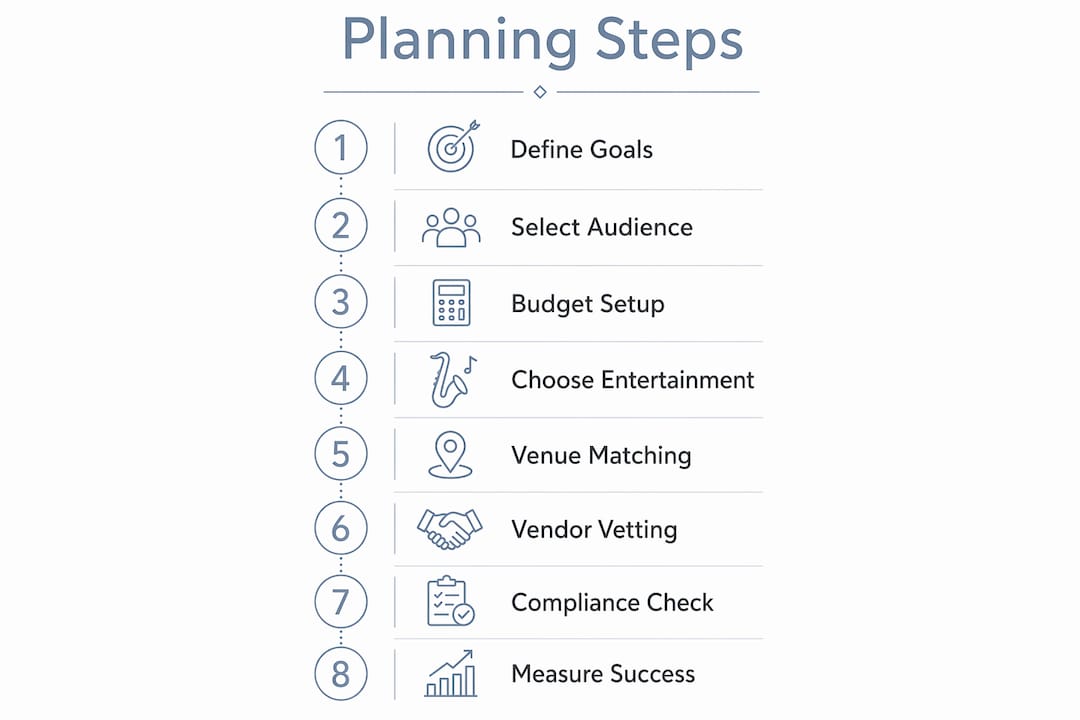
The most common planning mistake is choosing entertainment based on what sounds fun in theory, then discovering it does not fit the venue, the schedule, or the audience. Effective planning means working backward from the event's objectives, not forward from a list of options.

Start with your event goal and audience. A client-facing gala calls for polished, restrained entertainment. An internal team celebration can go louder and more interactive. Professional audiences, especially senior executives, generally prefer entertainment that respects their time and does not force participation. Opt-in formats, where guests can engage or step back, tend to land better than mandatory group activities.
Budget realistically and early. Entertainment costs cover more than the performer's fee. Technical setup, AV equipment, staging, lighting, and contingency funds all add up. Most companies allocate a portion of the total event budget to entertainment, depending on event goals and audience size. Budget per attendee varies widely by event type, with team-building events generally costing less per attendee than large conventions. Planning for these costs early prevents the common problem of booking a great act you cannot actually support technically on the day.
Vet vendors carefully. A performer's demo reel tells you what they can do in ideal conditions. Ask specifically about their experience with corporate audiences, how they handle schedule changes, and what their technical requirements are. A professional entertainer adapts to the event; an amateur expects the event to adapt to them. For a detailed look at corporate gathering setup steps, including vendor coordination, that resource covers the logistics in depth.
Match entertainment to the venue layout. Sound levels, sightlines, and floor space all affect whether the entertainment works. If guests have to leave the room to hear each other, the entertainment is working against the event.
Consider legal and compliance factors. In the US, corporate entertainment expenses are subject to IRS rules on business deductions. Entertainment costs are generally not deductible under current tax law following the Tax Cuts and Jobs Act of 2017, though meals associated with business events may qualify under specific conditions. Always confirm with your tax advisor before budgeting entertainment as a deductible expense. For events involving alcohol, verify local licensing requirements and liability coverage.
Measure success after the event. Collect attendee feedback through post-event surveys. Track specific outcomes: Did networking goals get met? Did the entertainment hold energy through the full program? Did client relationships advance? These metrics help you make better decisions for the next event.
Pro Tip: Balance active and passive entertainment across the event timeline. A cocktail hour with ambient jazz followed by a featured performance during dinner gives guests both a low-pressure social window and a shared focal point. Stacking two high-energy interactive segments back to back exhausts the room.
Why live music works so well in corporate settings
Live music occupies a unique position among corporate entertainment options because it scales across almost every event format. A jazz trio at a reception creates warmth and elegance without demanding attention. A full band closing an awards gala energizes a room of 500 people. The same core format, adjusted in size and style, serves both ends of the spectrum.
Low-profile acts like acoustic jazz support networking by providing an engaging ambiance without overwhelming conversation space. This is why jazz trios and solo piano are consistently favored for cocktail hours and reception-style formats. The music gives guests something to respond to without requiring them to stop talking. That balance is harder to achieve than it sounds, and it is why the choice of ensemble and repertoire matters as much as the choice to have live music at all.
Live music adds elegance and encourages interaction, adaptable to event tone from formal galas to casual mixers. Professional musicians maintain high standards of performance suited to corporate audiences, reading the room and adjusting tempo, volume, and repertoire in real time to serve the event rather than the performance.
For event planners who want to understand why live music outperforms a playlist in almost every corporate setting, the answer comes down to responsiveness. A playlist cannot read the room. A skilled musician can.
Alexlevinmusic specializes in exactly this kind of corporate entertainment, offering jazz trios, string quartets, solo piano, and DJ services across Philadelphia, New York, and beyond. The ensembles are built for corporate settings: polished, professional, and adaptable to the event's tone. For planners navigating the question of how to strike the right tone between formal and fun, that is precisely the kind of expertise worth having in your corner.
Pro Tip: When booking a live ensemble for a corporate event, ask for a set list review before the event. Repertoire that fits a wedding may not fit a client gala. A professional musician will welcome the conversation; it is a sign they take the brief seriously.
Alexlevinmusic's corporate event entertainment services are designed for planners who want live music that serves the event's goals, not just fills the room. Whether you need a jazz trio for a cocktail reception or a full ensemble for a gala, the booking process is straightforward and the performance quality is consistent. Explore the full range of options and reach out to discuss your event.
Key Takeaways
Corporate entertainment works best when the entertainment choice is made in service of the event's specific goal, audience, and venue, not as an afterthought.
| Point | Details |
|---|---|
| Definition is clear | Corporate entertainment covers private, company-hosted events with performances, activities, and hospitality for employees, clients, or stakeholders. |
| Business case is strong | 85% of companies use corporate events to improve engagement, client relationships, and internal culture. |
| Entertainment type must match the room | Low-profile acts like jazz trios support networking; high-impact performances suit seated, attention-focused programs. |
| Budget beyond the performer fee | Entertainment costs include AV setup, staging, lighting, and contingency funds, with most budgets allocating 5%–15% of total event spend. |
| Live music scales across formats | From ambient cocktail-hour jazz to full gala performances, live music adapts to event tone in ways a playlist cannot. |