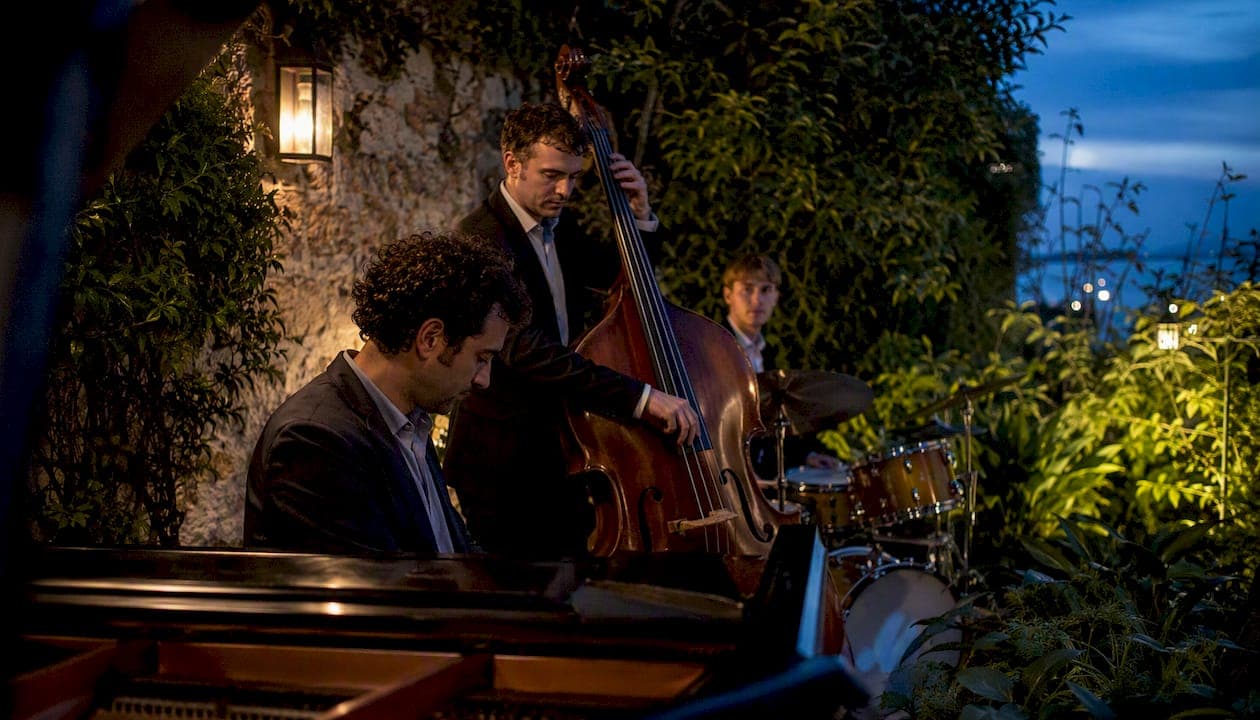
Small venue live music means booking a live act sized and equipped to perform inside an intimate room: a private dining space, a boutique loft, a corporate atrium, a backyard tent. For most events under 150 guests, the right call is a self-contained trio or quartet that carries its own compact PA, arrives with a written technical rider, and guarantees the exact players named in your contract. That last point trips up more hosts than anything else. Before you book anyone, confirm these basics:
- The act type fits your guest count and room footprint
- You've seen real event video, not a studio reel
- Named players are written into the contract, not "similar caliber substitutes"
- A technical rider covers power, stage space, and sound needs
- A deposit and cancellation policy are in writing
Alex Levin Music books ensembles this way for weddings and corporate events, with video samples and a direct booking contact available for planners who want specifics before committing.
Key Takeaways
The right small venue live music booking matches ensemble size to room and guest count, locks named players in writing, and confirms a technical rider before the deposit is paid.
| Point | Details |
|---|---|
| Match size to space | Use a trio for up to 80 guests, a quartet up to 150, and a five or six piece band for 100 to 200 guests with dancing. |
| Confirm named players | Get the specific musicians written into the contract to avoid substitutions on event day. |
| Lock the technical rider | Confirm power access, stage footprint, and soundcheck timing with the venue in writing. |
| Book 4 to 9 months out | Reserve popular acts early with a standard deposit, especially during peak wedding season. |
| Alexlevinmusic fits small rooms directly | Offers trios, quartets, solo piano, and hybrid DJ/live formats sized for intimate weddings and corporate events, with named-player guarantees and real event video available before booking. |
Table of Contents
- Which Small Venue Live Music Formats Work Best
- Matching Band Size to Your Guest Count and Room
- What Small-Scale Live Music Typically Costs
- Production Checklist for Small Venues
- Consultation Questions That Reveal Real Professionalism
- Booking Timeline, Deposits, and Contract Essentials
- Sound Management and Acoustics in Small Rooms
- Getting Guests Engaged in an Intimate Setting
- Legal and Licensing Rules for Small Venue Performances
- Planner's Perspective: What Actually Makes a Small-Venue Set Work
- Booking Alex Levin Music for Your Small Venue Event
- Where to Read More
- Sources
Which Small Venue Live Music Formats Work Best
Room size and event moment decide format more than budget does. A solo pianist or acoustic guitarist fills a cocktail hour without overwhelming conversation. A duo adds vocal or instrumental color for ceremonies and dinner. A jazz trio (piano, bass, drums or piano, bass, sax) is the workhorse for full-evening coverage in a tight space. A string quartet suits ceremonies and formal dinners where the sound needs to stay elegant and unamplified.
For dancing, you need more energy than four musicians in most rooms can generate acoustically, which is where a hybrid DJ and live act, a saxophonist or vocalist layered over a DJ set, earns its reputation as the most flexible option for events that shift from quiet ambience to a dance floor within a few hours.
- Ceremony: solo piano, classical guitar, or string duo
- Cocktail hour: jazz trio or roaming duo
- Dinner: trio or quartet, seated and low volume
- Dancing: quartet-plus or hybrid DJ/live setup
Pro Tip: If your room has under 400 square feet of usable floor space, ask specifically whether the act has performed in rooms that size. A band that's great in a ballroom can overwhelm a private dining room.
Matching Band Size to Your Guest Count and Room
Guest count and footprint together determine ensemble size, not guest count alone. A trio comfortably covers events up to about 80 guests. A quartet extends that range to roughly 150. Once you're hosting 100 to 200 guests with a dance component, industry sizing guides recommend stepping up to a five or six piece band, since a smaller group simply can't generate enough sound energy to carry a dance floor once the room fills.
- Count actual usable space, not room square footage. A stage or performance corner needs roughly 8 by 10 feet for a trio, more for a quartet with drums.
- Check outlet proximity. Musicians need power within reasonable cable-run distance of the performance area, ideally on a dedicated circuit for sound equipment.
- Decide if roaming makes sense. For cocktail receptions in irregularly shaped rooms, a wireless duo or trio that can move between clusters of guests often works better than a fixed stage, eliminating dead zones where sound doesn't carry.
- Confirm mic placement for ceremonies. Outdoor or multi-room ceremonies often need a wireless lavalier for officiants and vows, which is a separate technical need from the musical setup.
If your venue has a load-bearing floor concern, low ceiling, or unusual layout, mention it during booking. It changes what equipment the band brings, not just where they stand.
What Small-Scale Live Music Typically Costs
Pricing scales with player count, hours booked, and equipment needs, not a flat per-event rate. Industry data on corporate bookings shows fees ranging broadly by band size, with a median booking landing around $2,000 for a mid-sized act on a standard event night. Solo and duo acts run lower; quartets and small bands with sound engineers run higher.
What actually moves the number on your invoice:
- Player count. Each added musician adds a flat fee, not a percentage.
- Hours booked. Most quotes cover a set block (often 3 to 4 hours); overtime is billed separately, usually per 30-minute increment.
- Sound engineer. Larger rooms or outdoor setups may require a dedicated engineer, adding a line item most hosts don't anticipate.
- Travel. Distance beyond a base service radius typically adds a flat travel fee.
- Arrangement or rehearsal requests. A custom first dance arrangement or ceremony processional often carries a separate fee.
Read every quote for what's included versus what's an add-on. A "band fee" that excludes sound equipment, travel, and overtime looks cheaper on paper but often costs more once the actual invoice arrives.
Production Checklist for Small Venues
A short technical rider prevents almost every last-minute production failure event hosts run into. Before the event, confirm these items in writing with both the venue and the band:
- Power access. Specify the number of outlets, amperage, and distance from the performance area to the nearest circuit.
- Stage dimensions. Even a marked-off corner needs minimum dimensions confirmed, especially for a trio or quartet with a keyboard and amp.
- PA requirement. Decide whether the room's house sound system covers your needs or whether the band needs to bring a self-contained PA.
- Soundcheck window. Lock a specific soundcheck and load-in time in writing. Small venues often run tight turnarounds between setup crews, catering deliveries, and guest arrival, and a vague "sometime in the afternoon" window causes real problems on event day.
- Load-in logistics. Confirm parking, elevator access, and whether stairs are involved. A fourth-floor walkup changes what equipment a band can realistically bring.
Outdoor or unconventional spaces need extra planning: backup power in case a generator fails, weather shelter for instruments and electronics, and enough extension cabling rated for outdoor use. A self-contained PA is worth requiring any time the venue's built-in system is unclear, outdated, or simply doesn't exist, which is common in private residences and non-traditional event spaces.
Pro Tip: Ask for the rider before you sign anything, not after. A band that can't produce a basic technical rider probably hasn't performed in rooms like yours very often.
Consultation Questions That Reveal Real Professionalism
A short consultation call tells you more than any website ever will, and it's worth doing before you commit to any act, even one you found through a strong online portfolio. Ask directly:
- "Are the musicians in your video samples the same people who would perform at my event?"
- "Can you name the specific players you'd assign to my date?"
- "How do you coordinate with our venue's AV team and catering timeline?"
- "What happens if a named player becomes unavailable?"
- "What's included in the quoted fee, and what counts as an add-on?"
Vague answers are the red flag to watch for. A professional act names players readily, coordinates run-of-show details without hesitation, and has a documented backup plan if someone can't perform. Reluctance to commit to specific musicians, no written contract, or resistance to coordinating with your other vendors are all signs to walk away. Alexlevinmusic's guide to booking questions breaks down sample good and bad answers in more detail.
Booking Timeline, Deposits, and Contract Essentials
Lock your date early. Peak wedding season (late spring through fall) fills popular acts fastest, and booking 4 to 9 months out with a deposit is standard practice, often around 50% of the total fee as a retainer.
Before signing, confirm the contract includes:
- Named-player guarantee. The specific musicians you were quoted, not "comparable substitutes."
- Cancellation and force majeure terms. What happens if the event is postponed or canceled, and by whom.
- Overtime rate. Stated per-increment pricing if your event runs long.
- Payment schedule. Deposit amount, balance due date, and accepted payment methods.
- Travel fees. Whether they're flat or mileage-based, and at what distance they kick in.
Most professional acts also request a final run-of-show roughly two weeks before the event, listing ceremony cues, first dance timing, and any special announcements. Get this request in writing early so you're not scrambling to build a timeline the week of your event.
Sound Management and Acoustics in Small Rooms
Small rooms amplify problems that larger venues absorb. Hard floors, low ceilings, and glass walls bounce sound in ways that make a band feel too loud even at moderate volume, while soft furnishings and heavy drapery swallow sound and make a band feel underpowered. Neither extreme is fixable mid-event without the right equipment going in.
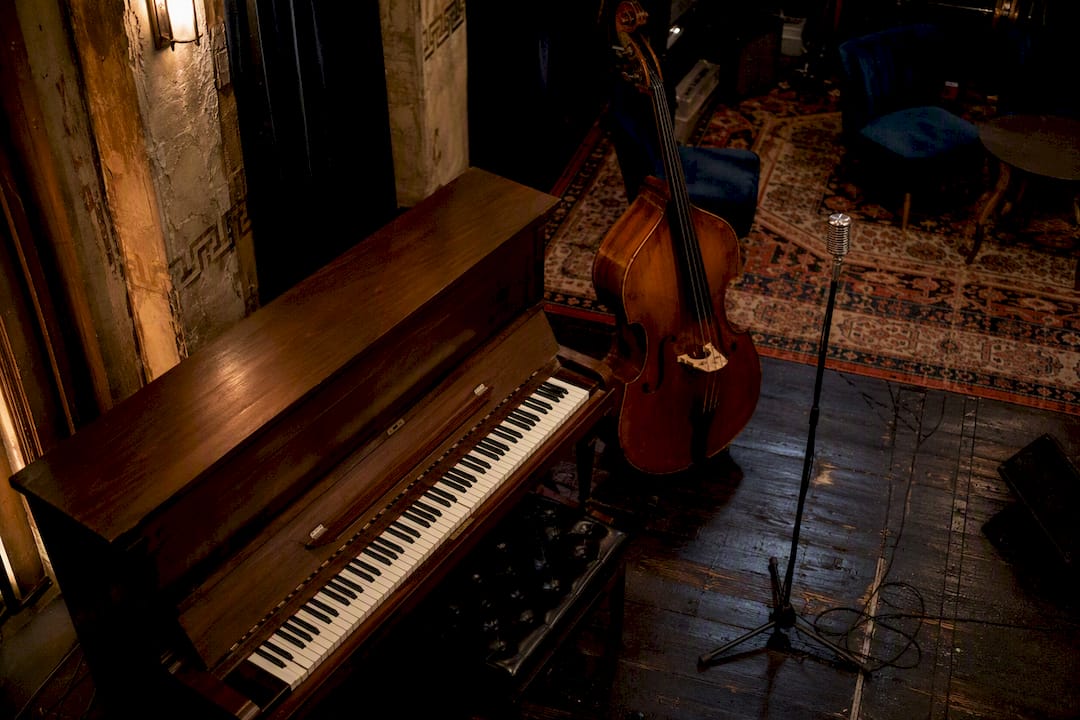
A trio or quartet playing acoustically, without amplification, works well in rooms under roughly 600 square feet with reasonable ceiling height and some soft surfaces (carpet, drapery, upholstered furniture). Once a room exceeds that footprint, or has hard reflective surfaces throughout, some amplification becomes necessary just to maintain even coverage across the room, not to increase volume.
Placement matters as much as equipment. A band positioned in a corner projects sound unevenly, favoring guests on one side of the room. Positioning against a flat wall, ideally one without windows directly behind the performers, gives more even coverage and reduces feedback risk if any amplification is in use.
Volume control is a separate conversation from sound quality. Guests having dinner conversation need background-level volume; the same room during a dance set needs significantly more. A band experienced in small-venue work adjusts continuously throughout the night rather than setting one volume and leaving it. This is also why a sound engineer, even for a small ensemble, earns its cost in larger or acoustically difficult rooms: someone needs to be watching levels instead of playing an instrument at the same time.
Getting Guests Engaged in an Intimate Setting
Proximity changes everything about how a live act connects with a room. In a small venue, musicians can see individual guest reactions, take song requests mid-set, and adjust energy in real time in a way that's simply impossible in a ballroom with 400 people and a stage 30 feet from the nearest table.
The most effective intimate acts use that proximity deliberately. A pianist might invite a guest to pick the next song during cocktail hour. A trio might dedicate a number to the couple's grandparents by name during dinner. A vocalist might walk the room during a slower set rather than staying planted at a microphone stand. None of this works in a large venue, and it's one of the clearest advantages small-scale live music has over a bigger production.
Reading the room matters more than following a fixed setlist. A skilled act treats the printed set list as a starting point, not a script, adjusting tempo and song choice based on how guests are actually responding. If the dance floor fills early, that's a cue to keep the energy going rather than sticking rigidly to a planned cooldown song. If dinner conversation is still active at the scheduled first dance time, a good bandleader coordinates with the planner on the fly rather than forcing the moment.
This is also where hybrid formats shine in intimate rooms. A DJ handling recorded tracks between live sets, paired with a saxophonist or vocalist who steps in for key moments, lets the act stay engaged with the room continuously instead of taking hard breaks between sets.
Legal and Licensing Rules for Small Venue Performances
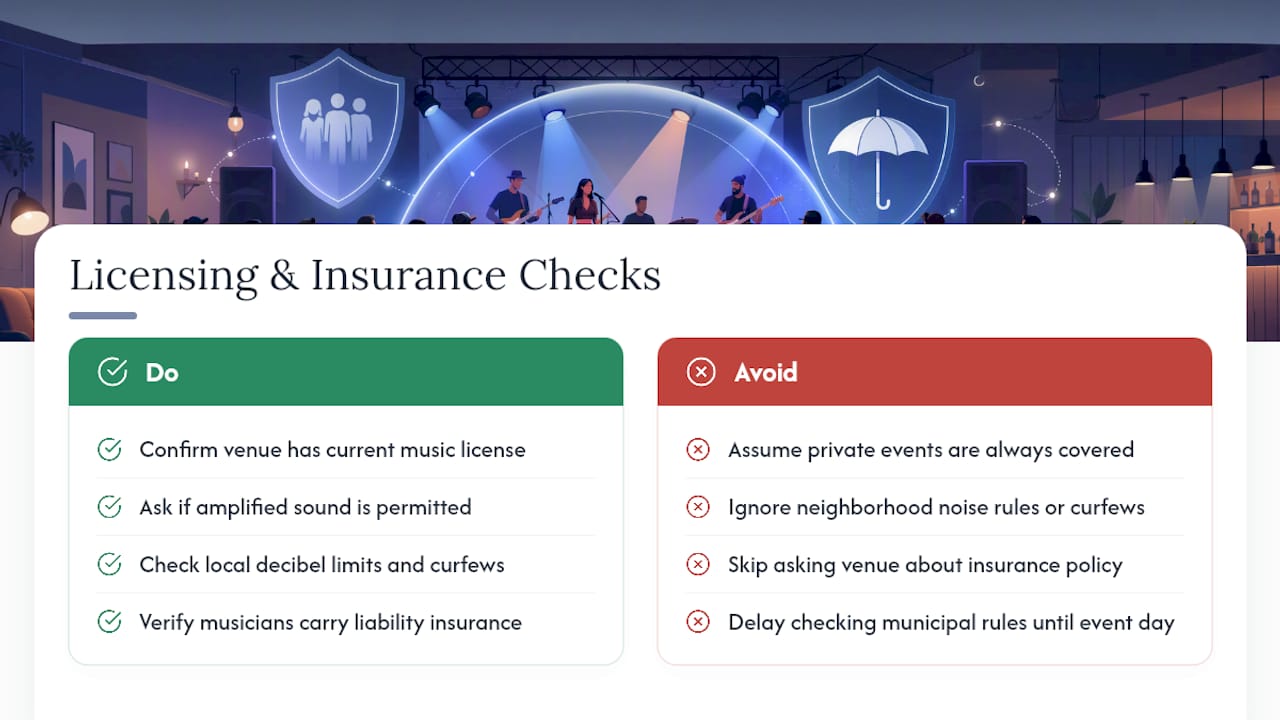
Live performances at private events, weddings, corporate parties, and similarly closed-guest-list gatherings generally don't require the performing act to hold a separate performance license, since most private venues and event spaces already carry music licensing through performance rights organizations like ASCAP, BMI, or SESAC covering the venue itself. That said, licensing obligations shift depending on venue type, so this isn't a blanket rule you can assume applies everywhere.
Check with your venue directly on two points: whether they hold a current music license, and whether amplified sound is permitted under any local noise ordinance that applies to the address. Residential neighborhoods, in particular, often have specific decibel limits or curfew times for amplified music, and those rules apply regardless of whether your event is private. A backyard wedding with a live band running past 10 p.m. can run into real problems with neighbors or local ordinance enforcement if this isn't checked in advance.
Insurance is the other piece hosts frequently overlook. Many venues require the performing act to carry general liability insurance, and some require proof of that coverage before load-in. Ask your musicians directly whether they carry liability coverage, and ask the venue whether they require a certificate of insurance on file before the event date.
None of this is a substitute for confirming directly with your specific venue and local authority. Rules vary by municipality and by venue type, and a professional act that's performed regularly in your area usually already knows the local quirks worth flagging.
Planner's Perspective: What Actually Makes a Small-Venue Set Work
Alex's process for a small event starts with a consultation, moves to a written run-of-show, and ends with a final confirmation call days before the date. That order matters more than people think: skipping the run-of-show step is where most timing mistakes happen. Energy management is the real skill, easing into arrivals, holding steady through dinner, then building deliberately into the dance set rather than jumping straight to full volume. Video samples and named-player details exist on Alexlevinmusic's site precisely because hosts deserve to see that process before they commit to it.
— Alex
Booking Alex Levin Music for Your Small Venue Event
Alexlevinmusic builds ensembles specifically for rooms like yours: a jazz trio for a 60-guest dinner, a string quartet for an intimate ceremony, solo piano for a cocktail hour, or a hybrid DJ and live setup that carries an evening from quiet arrival music into a full dance set without a hard break between the two. Every option is sized to match a real room, not scaled down from a bigger production.

You can review real event video, ensemble details, and service coverage across the ensembles and soloists page, which lays out what each format actually sounds and looks like in a room your size. Named players are confirmed in writing, not swapped for "similar caliber" substitutes on event day, and the consultation process walks through your room, your timeline, and your technical needs before anything gets locked in. If you're planning a wedding, start with the guide to finding your wedding band or DJ and request availability for your date directly.
Where to Read More
- How to choose the right musician for your event for genre and professionalism fit
- Questions to ask before booking a band with sample answers
- Hiring a band for a corporate event for pricing and format norms
- Jazz band booking and sizing guide for guest-count sizing rules
- Dynamic ticket pricing guide for background on event pricing mechanics
Sources
- How to Hire a Band for a Corporate Event (2026 Guide) - FixTheMusic
- How to Hire a Jazz Band for Events: Price, Cost, Band Sizes & Booking Guide (2026)