
Live music theme party planning is the process of building an immersive celebration around live musical performances, a carefully chosen theme, and coordinated logistics that keep guests engaged from start to finish. Done well, it transforms an ordinary gathering into a night people talk about for years. The difference between a forgettable party and a memorable one often comes down to three decisions made early: the right theme, the right venue size, and the right artist. This guide walks you through every step, from picking your music concept to troubleshooting the day of the event, with budgeting benchmarks and permit timelines included.
What is live music theme party planning, and where do you start?
Live music theme party planning begins with one defining choice: your theme. A well-chosen music theme simplifies every planning decision that follows, from decorations and invitations to the style of performer you book. It gives guests a clear expectation and gives you a consistent creative framework.
The most effective themes connect directly to your guest list. A jazz night works beautifully for a milestone birthday crowd that appreciates sophisticated atmosphere. Festival vibes suit outdoor summer gatherings with a younger, high-energy group. A karaoke showdown is perfect when guest participation is the main goal. Matching the theme to your audience is not optional. It is the foundation of the entire event.
Popular music party themes that consistently deliver strong guest engagement include:
- Jazz and swing night: Ideal for intimate venues, cocktail receptions, and milestone celebrations
- Rock and roll throwback: High energy, works well with live bands and themed costumes
- Festival vibes: Outdoor settings, multiple acts, food trucks, and casual dress
- Motown and soul: Dance-focused, works across age groups, strong singalong potential
- Classical evening: Elegant and refined, suited to formal dinners or corporate receptions
- Karaoke party: Guest-led, low performer cost, high interaction
Thematic cohesion matters more than most planners expect. Themed lighting, music, and costumes keep guests immersed in the experience without requiring a full production budget. A few well-placed visual details, like Edison bulb strings for a jazz night or neon signs for a rock theme, reinforce the atmosphere at low cost.
How do you choose the right venue for a live music party?
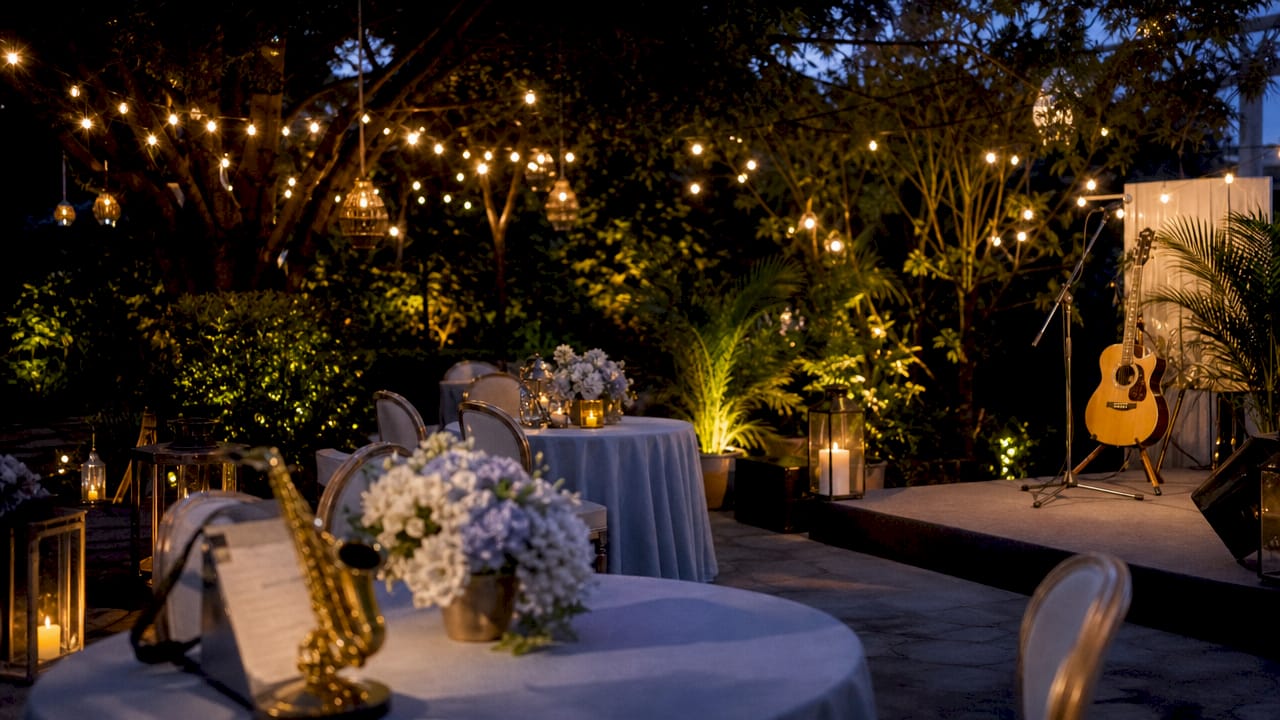
Venue selection is where many first-time planners make their most expensive mistake. The instinct is to book a large space to avoid feeling cramped. The reality is the opposite. A 100-capacity room filled 60–70% creates far better energy than a 300-capacity venue at 25% attendance. Empty space kills the atmosphere that live music is supposed to generate.
Beyond size, check these venue requirements before signing anything:
- Stage or performance area: Confirm dimensions fit your act (a jazz trio needs less space than a five-piece band)
- PA system and backline: Ask whether the venue provides in-house sound equipment or if you need to rent
- Lighting rigs: Basic stage lighting is often included; theatrical effects usually cost extra
- Noise curfew: Most urban venues have a hard stop time, typically 11:00 PM or midnight
- Loading access: Artists need a clear path for equipment, ideally separate from the guest entrance
For venue selection logistics, the cost breakdown for a small event of roughly 100 guests typically includes venue rental, sound equipment, and a contingency buffer. Budget roughly 10% of your total spend as a contingency. Unexpected costs appear in almost every live music event, and having that buffer prevents last-minute stress.
Pro Tip: Negotiate with the venue on in-house sound engineering before hiring an external crew. Many venues include a house engineer in the rental fee, which can save you $200–$500 and eliminates the coordination headache of bringing in outside technicians.
How do you book artists and manage live performance logistics?
Booking the right act is the single biggest driver of whether your themed party succeeds. The type of musical act should match both your theme and your expected guest count. A solo pianist fills a cocktail hour for 40 guests beautifully. A jazz trio handles up to 150 guests in a mid-size room. A full band with a horn section needs a larger stage, more setup time, and a bigger sound system.
Contract essentials protect both you and the artist. Every booking agreement should specify:
- Performance time and duration: Start time, set length, and number of breaks
- Artist fee and payment schedule: Deposit amount, final payment deadline, and accepted methods
- Technical rider: Equipment the artist requires you to provide
- Cancellation terms: What happens if either party cancels within 30, 14, or 7 days of the event
Artists should arrive at least 4 hours before doors open. That window covers staging, sound system calibration, lighting checks, and backstage preparation. Cutting that buffer to two hours is the most common mistake first-time planners make, and it almost always results in a delayed start or a compromised sound check.
Pro Tip: Send your artist a detailed day-of schedule 48 hours before the event. Include load-in time, sound check window, doors open, set start, and set end. Artists who feel organized and respected deliver better performances.
For guidance on choosing the right musician for your specific party style and guest profile, match the ensemble size to the room and the energy level to your theme. A string quartet signals elegance. A DJ with live saxophone signals celebration.
What permits and timelines does a music-themed party require?
Permits are the part of music event planning that catches the most planners off guard. Standard permits include noise permits, event permits, music performance licenses from BMI or ASCAP, liquor licenses, and fire-safety clearance for indoor venues. Outdoor events may also require street closure permits.
Permit applications need at least 60 days of lead time. Special clearances, such as pyrotechnics or large outdoor amplification, require 90 or more days. Missing these deadlines does not just delay paperwork. It can shut down your event entirely.
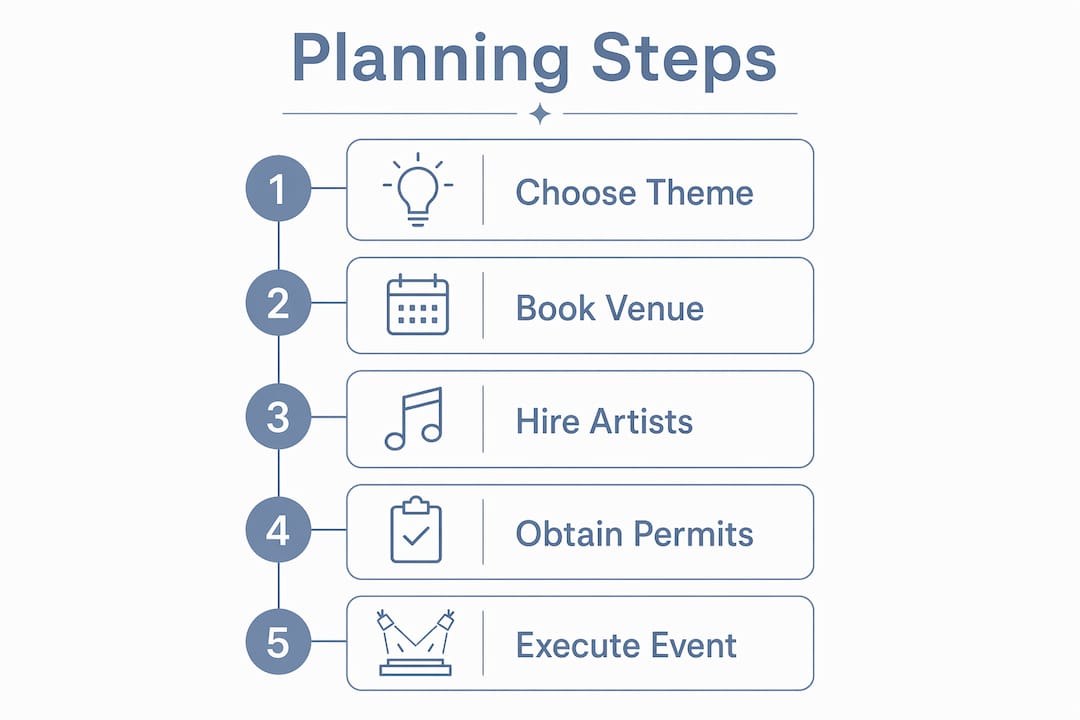
The recommended planning timeline for a live music themed party:
- 5–6 months out: Lock in your theme, set your budget, and identify venue options
- 4–5 months out: Book your venue and headline act; begin permit applications
- 3–4 months out: Confirm supporting acts, finalize the technical rider, and launch promotion
- 6–8 weeks out: Run multi-channel promotion across social media, email, and local event listings
- 2–3 weeks out: Confirm all vendor logistics, finalize the day-of schedule, and brief all staff
- Event week: Send artist schedule, confirm load-in times, and do a venue walkthrough
| Planning phase | Key action | Lead time |
|---|---|---|
| Theme and budget | Set goals, estimate guest count, define budget | 5–6 months before |
| Venue and artist booking | Sign contracts, submit permit applications | 4–5 months before |
| Promotion launch | Multi-channel campaign across 4–5 platforms | 6–8 weeks before |
| Final logistics | Confirm vendors, brief staff, send artist schedule | 2–3 weeks before |
| Event day | Sound check, setup, doors open on time | Day of |
A first event needs 4–5 promotional channels running across 6–8 weeks to build ticket momentum. Relying on a single social media post the week before is the fastest way to an empty room. For corporate event entertainment ideas that translate well to private music parties, multi-channel promotion combined with a clear theme produces the strongest attendance results.
How do you execute the event day without problems?
Event day execution is where preparation either pays off or falls apart. Start your setup checklist at least three hours before doors open.
- Confirm artist arrival and direct them to the load-in entrance
- Run a full sound check with the performing act before any guests arrive
- Verify lighting positions and test all stage lighting cues
- Position merchandise tables near exits with adequate power and lighting, as well-lit merchandise areas near exit power sources drive significantly more sales
- Brief all staff on the schedule, emergency exits, and their specific roles
- Confirm bar and catering are ready before doors open
Technical problems happen at nearly every live music event. The difference between a smooth recovery and a derailed night is having a plan. Keep a spare microphone cable and a direct box backstage. Know who your venue's house engineer is and have their phone number saved. If a performer runs late, have a playlist ready to fill the gap without killing the atmosphere.
The best live music parties feel effortless to guests because the host spent weeks making sure nothing was left to chance. Every contingency you plan for is one less crisis you manage in front of your guests.
After the event, send a thank-you to your artists within 24 hours. Request feedback from guests through a short survey. Both habits build relationships that make your next event easier to organize. For a complete walkthrough of managing live music logistics from booking through the final performance, the process is repeatable once you have done it once.
Key Takeaways
Successful live music theme party planning requires locking in your theme, venue size, and artist contract at least four months before the event date.
| Point | Details |
|---|---|
| Theme drives all decisions | Choose a music theme first; it guides decor, invitations, and artist selection. |
| Right-size your venue | A room filled at 60–70% capacity creates better energy than a large, half-empty space. |
| Book artists early and contract clearly | Confirm performance time, fee, technical rider, and cancellation terms in writing. |
| Start permits at 60+ days out | Noise, liquor, and performance licenses require at least 60 days of lead time. |
| Promote across 4–5 channels | Multi-channel promotion over 6–8 weeks is the most reliable way to fill a room. |
What I've learned from planning live music events
The mistake I see most often is planners treating the music as the last item on the checklist instead of the first. They spend months on catering and decor, then book a performer two weeks before the event. By that point, the best acts are already committed elsewhere, and the budget has been spent on things that matter far less to guests than the live performance itself.
Atmosphere is not decoration. Atmosphere is the feeling in the room when the music starts and the crowd responds. I have watched beautifully decorated venues fall flat because the performer was wrong for the crowd. I have also watched simple rooms with modest decor come alive because the music was exactly right. The performer is the event. Everything else supports that.
Budget constraints are real, but they are rarely as limiting as planners assume. A well-chosen jazz trio at a correctly sized venue outperforms a full band in a room that is too large. Spending less on the venue and more on the right act is almost always the better trade. The impact of live music on event atmosphere is not subtle. Guests feel it immediately, and it shapes every memory they take home.
The planners who get this right share one habit: they decide on the music first, then build everything else around it.
— Alex
Live music services from Alexlevinmusic for your next event
Planning a themed music party in the Philadelphia or New York area means you have access to one of the most experienced live music booking resources available for private events.
Alexlevinmusic specializes in jazz trios, string quartets, solo piano, and DJ services tailored to match your specific party theme and guest profile. Whether you are organizing an intimate cocktail reception or a large celebration, the team customizes every performance to fit the atmosphere you are building. Explore the full range of live music party services or learn more about why live music outperforms a playlist at every type of event.
FAQ
What is live music theme party planning?
Live music theme party planning is the process of organizing a celebration built around a specific musical style, live performers, and coordinated logistics. The theme guides every decision from venue selection and decor to artist booking and promotion.
How far in advance should you book a live music party?
Start planning 3–6 months before your event date. Permit applications require at least 60 days of lead time, and the best performers book out quickly, especially for weekend dates.
How much does a small live music event cost?
A small live music event for roughly 100 guests typically requires budgeting for venue rental, artist fees, sound equipment, promotion, and a 10% contingency. Total costs vary based on location and artist level.
What permits do you need for a music-themed party?
Most live music events require a noise permit, an event permit, music performance licenses from BMI or ASCAP, and a liquor license if alcohol is served. Outdoor events may also need fire-safety clearance and street closure permits.
How do you keep energy high during a live music party?
Right-size your venue so the room feels full, schedule the performer's set during peak guest attendance, and brief your staff to manage guest flow actively. A room filled at 60–70% capacity consistently produces better crowd energy than a larger, partially empty space.