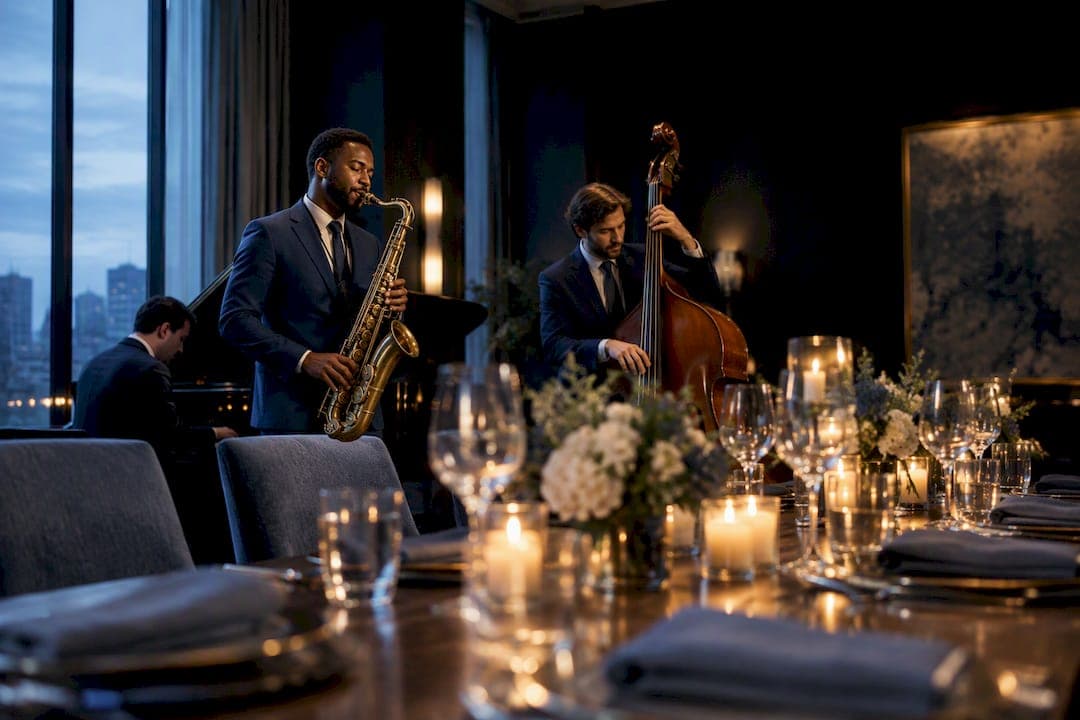
For an elegant dinner reception, use mellow instrumental jazz, played live by a piano trio when your budget allows, or a carefully curated recorded playlist that moves from slow to midtempo across the meal. Two things to do right now: cue up a prepared mellow dinner playlist as a fallback, and ask a live pianist or trio for a sample 45 to 60 minute set so you can hear the pacing before you book. Alex, a working musician who programs these sets regularly, breaks down both paths below.
TL;DR:
- Live musicians excel in the quieter early phases of the reception for real-time mood adjustments, while recorded playlists ensure consistent volume across larger rooms.
- The music pacing should gently accelerate from slow ballads during cocktails to light swing as dessert approaches, matching the meal's energy progression.
- Solo piano suits intimate settings of up to 80 guests, whereas a trio or larger ensemble is better for medium or large formal events of over 80 guests.
- For a 45 to 60-minute dinner, instrumental sets start with "Blue in Green," move into "Autumn Leaves," and end with "In a Sentimental Mood," with vocal sets adding warmth.
- Confirm soundcheck needs, set volume targets, and prepare backup gear in advance to ensure smooth music management during the event.
Table of Contents
- Picking playlist categories for a reception dinner
- Song picks and two ready-to-use dinner setlists
- Live musicians vs. recorded music: what actually changes
- Setting the tempo and dynamics through the meal
- Choosing the right ensemble for your room
- A planning checklist for the day of the event
- What I emphasize when programming a dinner set
- Booking live jazz for your reception through Alex Levin Music
- Sources
- FAQ
Picking playlist categories for a reception dinner
Most dinner receptions move through four musical zones, and matching each to the right sound keeps the room feeling intentional rather than accidental. Cocktail and welcome time calls for soft bossa nova or gentle vocal ballads, low enough that new arrivals can chat without raising their voices. The first course favors solo piano or guitar, spare and unobtrusive, since guests are still settling in and conversation is just starting to build.
Once the main course lands, a mellow trio or a vocalist singing at low volume works well: there's more energy in the room by then, and the music can carry a touch more presence without competing with dinner conversation. Dessert and the transition toward speeches or dancing is the moment to bring in light swing or a few recognizable standards, songs that plant the idea of movement without pulling anyone onto a dance floor too soon.
- Cocktail hour: soft bossa or ballads, recorded or solo guitar, background level.
- First course: solo piano or guitar, live if possible, very low volume.
- Main course: mellow trio or soft vocals, moderate presence.
- Dessert and transition: light swing and familiar standards, building energy.
Live musicians shine in the earlier, quieter slots because they can read the room and stretch a song if service runs long. Recorded playlists are more reliable for consistent volume across a large space. Whichever you use, order your tracks by key and tempo so one song leads naturally into the next instead of jolting the room with a sudden mood shift.
Song picks and two ready-to-use dinner setlists
A strong dinner reception program leans on a mix of familiar standards and quieter modern jazz, so the room feels both elegant and unforced. Consider this a starting shortlist:
- "My Funny Valentine"
- "Autumn Leaves"
- "Blue in Green"
- "The Girl from Ipanema"
- "Skylark"
- "Someone to Watch Over Me"
- "Corcovado"
- "In a Sentimental Mood"
- "Body and Soul"
- "Nature Boy"
- "Waltz for Debby"
- "Everything Happens to You"
For a 45 to 60 minute plated dinner, an instrumental setlist might open with "Blue in Green" and "Waltz for Debby" during the first course, move into "Autumn Leaves" and "Corcovado" for the main, and close with "In a Sentimental Mood" as plates clear. A vocal-leaning version swaps in "My Funny Valentine," "Someone to Watch Over Me," and "Body and Soul" at the same points, giving the room a warmer, more intimate feel.
- Instrumental set: piano-forward, best for formal or quieter rooms.
- Vocal-leaning set: warmer and more personal, best for smaller guest counts.
If you're building a recorded playlist through a streaming service, check the venue's policy on public performance licensing before the event. Most reception halls already carry blanket licensing, but it's worth a quick confirmation call.
Live musicians vs. recorded music: what actually changes
Live music gives you flexibility that a playlist can't match: a pianist can stretch a song while the kitchen catches up, soften the dynamics during a toast, or read the room and adjust on the fly. Recorded music is cheaper and gives you exact control over the setlist and running order, which matters if you have a very specific vision. Live jazz suits dinner gatherings especially well when the room is intimate enough for a solo pianist or small ensemble to shape the mood in real time.
A hybrid approach often works best: solo piano live through dinner service, then a recorded playlist for quieter transitional moments or once the meal wraps.
- Live: flexible tempo, real-time dynamic control, bespoke arrangements.
- Recorded: lower cost, predictable setlist, no soundcheck needed.
- Hybrid: live piano for the meal, recorded music for transitions.
Pro Tip: Ask any live musician how much space and power they need well before the event, not the week of, so the venue can plan around it.
Setting the tempo and dynamics through the meal
The meal should feel like it's gently accelerating, not lurching from mood to mood. Start with slow ballads during the cocktail hour and first course, move into gentle midtempo pieces as the main course lands, and let a little light swing creep in by dessert to hint that dancing is coming.
- Cocktail and starter: slow ballads, soft dynamics, conversation-friendly.
- Main course: gentle midtempo, slightly more presence.
- Dessert onward: light swing, building toward the evening's next phase.
Keep volume low enough that two people standing close together can talk without raising their voices, and have a plan to drop the music further during toasts or speeches. Save a recognizable standard for the handoff into dancing: it gives guests a natural cue that the tone is shifting.
Choosing the right ensemble for your room
Ensemble size should match your guest count and the formality of the room, not just personal taste. A solo pianist works well for intimate gatherings of up to roughly 80 guests, where subtlety matters more than volume. A piano trio fills a medium room of 80 to 200 guests without overwhelming it, while a quartet or string ensemble suits larger, more formal events where the music needs to carry across the room.
- Solo piano: intimate rooms, up to about 80 guests.
- Piano trio: medium rooms, roughly 80 to 200 guests.
- Quartet or strings: larger, formal rooms and bigger guest lists.
Instrumentation also shapes repertoire and staging: a trio can lean into swing standards that a solo pianist would have to simplify, and larger ensembles typically need at least light amplification and a dedicated staging area near a power source.
A planning checklist for the day of the event
A short checklist saves most of the day-of headaches that come from music logistics.
- Confirm arrival time and soundcheck window with the musician or venue staff.
- Share a copy of the setlist or playlist with the point of contact managing the room.
- Identify who cues transitions between dinner, speeches, and dancing.
- Set a volume target: soft enough that guests seated 2 to 3 feet apart can talk comfortably.
- Pack backup gear: a spare playback device, extra cables, and charged batteries.
Pro Tip: Designate one person, not the couple or the host, as the go-to contact for timing cues during the reception.
Menu pairing can shape these decisions too. Gourmet pairings for jazz nights suggests matching mellow jazz to delicate starters and richer, more textured songs to heartier mains, which lines up neatly with the tempo plan above. For broader menu ideas that pair well with an evening built around live music, Wild Foodz's festive meal guide is a useful companion resource.

What I emphasize when programming a dinner set
Dynamic control matters more than song choice. A pianist who can sense when a table is deep in conversation and pull back the volume, or notice when energy is dipping and lift the tempo slightly, does more for a reception than any perfectly curated list. I've watched a single held chord during a toast do more for a room than a whole verse of the "right" song. Programming for a dinner reception is really about listening to the room as much as playing for it, a point I return to often on the blog.
— Alex
Booking live jazz for your reception through Alex Levin Music
If you'd rather hand off the playlist building and the pacing decisions, that's exactly what Alex Levin Music handles. You bring the guest count, room layout, and rough timeline; we bring the ensemble, the repertoire, and the on-the-fly adjustments that a recording can't offer.
- Cocktail Hour Music for the welcome period, before dinner service begins.
- Reception Music covering the full arc from first course through dancing.
- Solo Piano or Jazz Piano Trio, sized to your room and guest count.
- DJ & Hybrid Music for events that need live sets and recorded transitions.
Reception Music packages start from $3,000, and Cocktail Hour Music follows the same starting rate from $3,000. If you're ready to talk through your room and guest list, get in touch about reception music and we'll build the program from there.
Sources
For menu and mood pairing, see Marky's jazz night pairing guide. For ensemble sizing, see choosing a jazz ensemble for events.
- Gourmet pairings for jazz nights: Music-inspired menus for at-home sophistication
FAQ
What are some good food ideas for a jazz party?
Dishes with layered but not overpowering flavors work well alongside jazz, since both the food and the music are meant to be savored slowly. Marky's pairing guide suggests matching lighter starters to mellow songs and richer mains to fuller, more textured arrangements.
What are some good smooth jazz songs to play at dinner?
Standards like "Autumn Leaves," "Skylark," and "Corcovado" work well as smooth, low-key dinner music because they stay gentle without becoming background noise. Modern mellow jazz pieces can be mixed in for variety as long as they keep a similarly relaxed tempo.
What is the best dinner music for a wedding reception?
Mellow instrumental jazz, played live by a solo pianist or trio, is the most reliable choice for a wedding dinner because it can flex with the timing of toasts and service. A well-ordered recorded playlist following the same slow to midtempo arc works as a lower-cost alternative.
What is the best jazz song to play at a wedding reception?
There's no single best song, since the right choice depends on the moment: a slow ballad like "My Funny Valentine" fits the meal itself, while a familiar swing tune works better as a bridge into dancing later in the evening. Choosing songs by moment rather than picking one favorite track tends to serve the reception better.