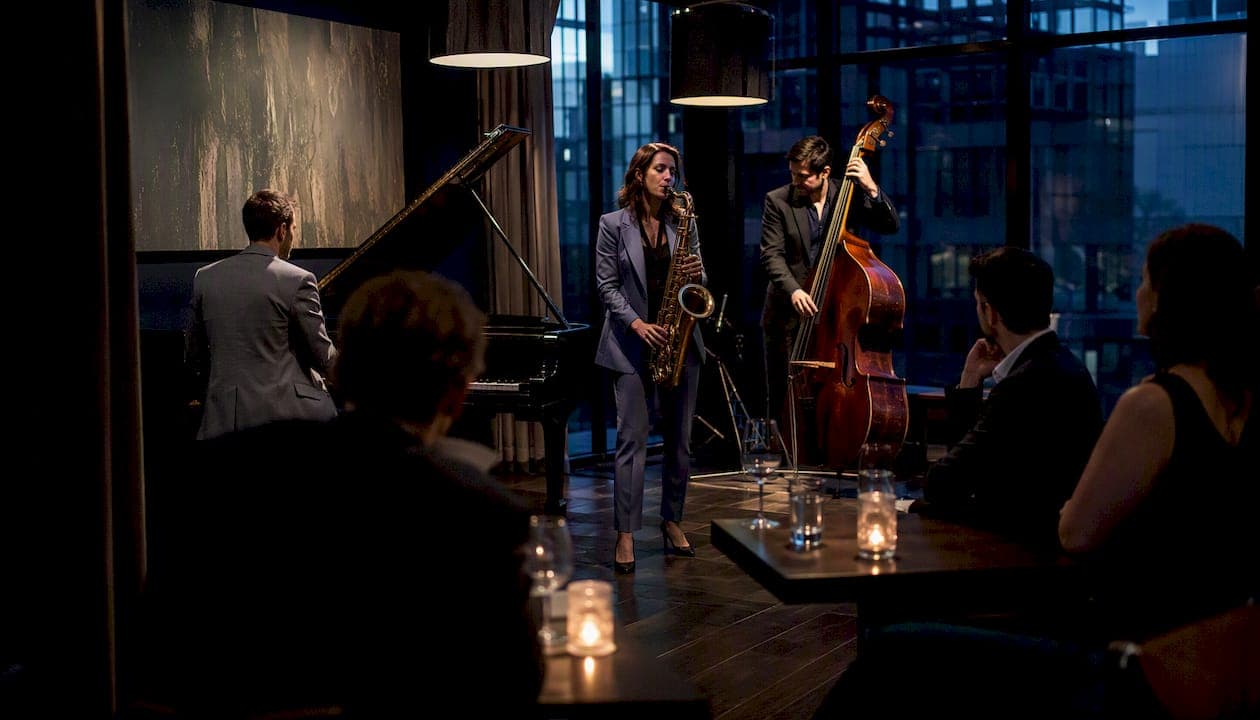
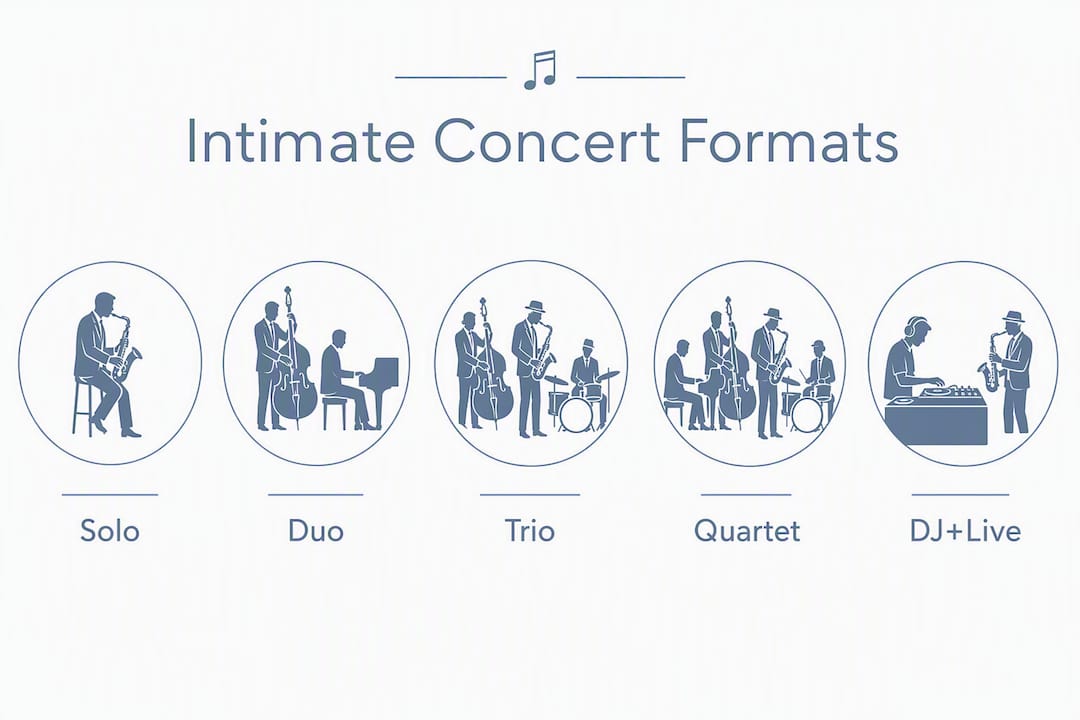
The most effective intimate concert experience formats for private events are: solo acoustic, acoustic duo, jazz trio, string quartet, salon-style mini-concert, roaming soloist, small chamber ensemble, hybrid DJ+live, short show-style sets, and duo-plus-solo rotations. Each format serves a different event moment, guest count, and venue footprint.
- Solo acoustic — ceremony or dinner; small to moderate guest counts; minimal footprint, no PA required in quiet rooms
- Acoustic duo — cocktail hour or dinner; small to medium guest counts; roughly 6x6 ft, light PA optional
- Jazz trio — cocktail hour or reception; medium guest counts; 10x10 ft, small PA recommended
- String quartet — ceremony or formal dinner; moderate guest counts; 12x12 ft, typically unamplified
- Salon-style mini-concert — seated salon or living-room performance; small guest counts; single instrument or small group, no PA
- Roaming soloist — cocktail hour or reception; any size; no fixed stage, wireless mic or acoustic only
- Small chamber ensemble — formal dinner or awards event; medium guest counts; 12x15 ft, light PA
- Hybrid DJ+live — reception or after-dinner dancing; medium to large guest counts; 15x15 ft, full PA required
- Short show-style sets — reception or corporate gala; medium to large guest counts; brief 20–30 min featured performance, then background
- Duo-plus-solo rotations — multi-phase events; any size; one musician covers breaks while the other rests
Alexlevinmusic offers all of these formats, with ensembles ranging from solo piano to jazz trios, string quartets, and hybrid DJ+live packages, customized to match each event's theme and guest flow. Live musicians adapt tempo and dynamics in real time in ways no recorded playlist can replicate.
Table of Contents
- What does each intimate concert format actually sound like in practice?
- Which format fits your event moment?
- What logistics do you need to confirm before the event day?
- How do you choose the right format and vet the musicians?
- Sample run-sheets for ceremony, cocktail hour, dinner, and salon sets
- Key Takeaways
- Why "serve the room" is the only metric that matters
- Alexlevinmusic brings every intimate format to your event
- Sources and further reading
What does each intimate concert format actually sound like in practice?
Understanding the practical differences between formats saves you from booking a string quartet for a rooftop cocktail hour where the wind will swallow every note, or a full hybrid rig for a 30-person salon dinner where the PA will rattle the wine glasses.
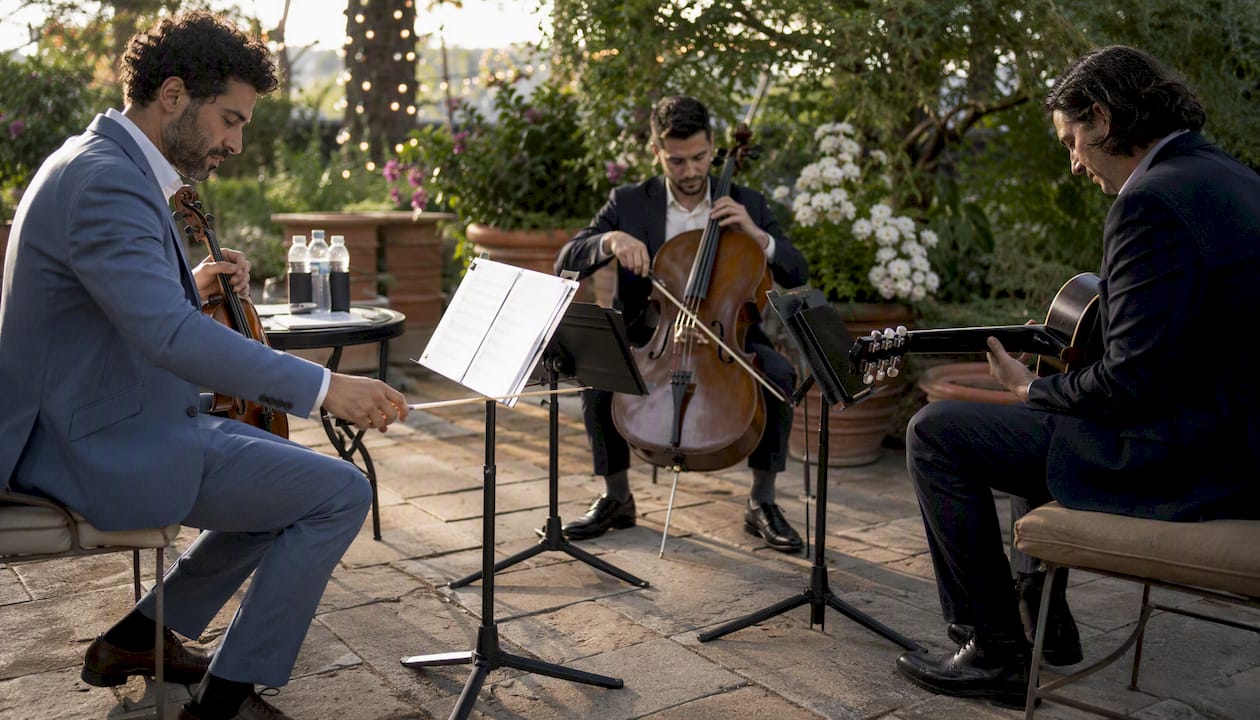
- String quartet: — Two violins, viola, cello. Rich, formal, unamplified. Carries naturally indoors; outdoor use requires acoustic support.
Pro Tip: Ask any small ensemble whether they can shift from background to a brief feature moment mid-event without a formal cue from the MC. The best performers read the room and make that transition feel natural, not announced.
Which format fits your event moment?
Matching the format to the event moment matters more than matching it to your personal taste. A jazz trio that sounds perfect on a recording can feel intrusive during a ceremony processional.
| Event moment | Recommended format(s) | Why it works | Amplification note |
|---|---|---|---|
| Ceremony | Solo acoustic, string quartet, acoustic duo | Controlled volume; emotional without overpowering vows | Unamplified or light PA; wireless mic for officiant |
| Cocktail hour | Jazz trio, roaming soloist, acoustic duo | Light acoustic options encourage mingling without competing with conversation | Small PA or acoustic; avoid full drum kit |
| Seated dinner | Solo piano, acoustic duo, small chamber ensemble | Background presence; tempo matches dining pace | Low PA or unamplified; check room acoustics |
| Reception/dancing | Jazz trio, hybrid DJ+live, short show-style sets | Energy builds naturally; hybrid format bridges dinner and dancing | Full PA; coordinate with venue on decibel limits |
| Salon performance | Salon-style mini-concert, solo acoustic | Guests are seated and attentive; music is the event | No PA; room acoustics do the work |
A few special cases worth flagging. For intergenerational audiences, interactive formats like guest requests help different age groups connect. For formal awards dinners, a small chamber ensemble or jazz trio keeps the room elegant without pulling focus from speakers. For themed corporate experiences, a hybrid DJ+live package lets you match the energy of a branded moment while keeping the sophistication of live instrumentation.
What logistics do you need to confirm before the event day?
Logistics are where good bookings go wrong. A performer who sounds perfect in a demo video can create a day-of crisis if nobody confirmed the power supply, the load-in window, or the noise ordinance cutoff.
Setup and load-in by format:
- Solo acoustic: 30–45 minutes, one power outlet, minimal gear
- Acoustic duo: 45–60 minutes, one to two outlets, light PA stand
- Jazz trio: 60–90 minutes, two to three outlets, PA system and monitor
- String quartet: 45–60 minutes, no power needed (unamplified), four chairs and stands
- Hybrid DJ+live: 90–120 minutes, dedicated 20-amp circuit, full PA and DJ rig
Confirming a small ensemble's precise footprint and setup time early avoids day-of conflicts. A duo may require a 10x10 ft space and a longer load-in than a compact soloist.
Venue type considerations: Ballrooms carry sound well and often need less PA. Rooftops lose high frequencies to wind and ambient noise, so acoustic-only formats struggle. Restaurants and estates with hard floors amplify bass, so a jazz trio should use brushes on drums. Outdoor garden events almost always need a PA, even for a solo performer.
Pricing drivers: Musician experience and reputation, travel distance, event duration, overtime rates, PA and tech rental, and repertoire customization all push the final number up or down. Matching ensemble size and genre to the audience and venue consistently produces better results than defaulting to the largest act available.
Live music functions as a social magnet at corporate events, increasing cross-group engagement and the perceived quality of the host's investment in the guest experience.
Always ask about venue noise ordinances. Many urban venues enforce decibel limits after 10 PM. A wireless mic for the soloist and a limiter on the PA board are standard solutions.
How do you choose the right format and vet the musicians?
The right format is the one that fits the room, the moment, and the guest count. The right musician is the one who can adapt dynamics and repertoire to match event cadence without being told.
Selection checklist:
- Event moment alignment: does the format suit ceremony, cocktail, dinner, or reception?
- Guest count: solo for under 50, duo/trio for 50–150, larger ensemble or hybrid for 150+
- Venue footprint: confirmed space in square feet before booking
- Amplification plan: PA provided by musician or venue? Who sets levels?
- Repertoire flexibility: can they cover your genre and era requests?
- Professionalism markers: liability insurance, backup plan for illness, references, video samples
Questions to ask before signing:
- What is your typical setup time, and what do you need from the venue?
- Do you carry your own PA, or do we need to provide one?
- What is your backup plan if a musician cancels?
- What are your overtime rates, and how are they billed?
- Can you share a recent event video or live sample?
Red flags: No video samples of live performances. Evasive answers about setup requirements. Flat-rate quotes with no line items for travel or tech. Planners consistently value performers who work with timelines and treat the event flow as a shared responsibility.
Pro Tip: Ask for a clip from an event similar to yours in size and setting, not a studio recording. A ballroom performance sounds very different from a 30-person salon, and you want to hear how the musician handles the actual environment.
Sample run-sheets for ceremony, cocktail hour, dinner, and salon sets
Ceremony run-sheet
- T-45 min: Musician arrives, sets up, sound checks
- T-20 min: Prelude music begins (soft instrumental, 3–4 pieces)
- T-0: Processional cue from coordinator; musician shifts to processional piece
- During ceremony: Musician holds until cue for recessional
- Recessional: Upbeat piece; musician continues for 5 minutes as guests exit
- Setlist note: Prelude in major keys, moderate tempo; processional in 4/4, clear melody
Cocktail hour run-sheet
- T-0: Guests enter; musician begins Set 1 (45 min, background jazz or acoustic pop)
- T-45: Short break (5 min); recorded playlist or roaming soloist covers
- T-50: Set 2 begins; cocktail hours benefit from unobtrusive music that invites conversation
- Setlist note: Mix standards and contemporary covers; keep tempo moderate, avoid ballads
Seated dinner run-sheet
- T-0: Guests seated; musician begins low-volume background set
- T-30: MC introduces speakers or toasts; musician pauses, resumes after
- T-60: Dessert service; musician may shift to slightly more present playing
- Coordinate with: Caterer on service timing; AV on mic levels during speeches
- Setlist note: Slow to mid-tempo; avoid percussion-heavy arrangements
Salon mini-concert run-sheet
- T-0: Host introduces performer (60 seconds)
- T-2: Performance begins; 20–35 minutes, 5–7 pieces
- T-35: Brief intermission or Q&A; guests mingle
- T-45: Optional second short set (15 min) or close
- Setlist note: Program arc from familiar to unexpected; end on a recognizable piece
Key Takeaways
The single most important rule: choose the format that serves the room first, then customize the repertoire around your guests.
| Point | Details |
|---|---|
| Footprint decides format | Confirm square footage and power before choosing ensemble size to avoid day-of conflicts. |
| Trio for 50–150 guests | Duos and trios provide presence and flexibility for mid-size events without overwhelming the room. |
| Adaptability over setlist | The best performers modulate volume and repertoire in real time based on guest behavior and acoustics. |
| Ask for live video samples | Request a clip from a similar event setting, not a studio recording, before signing any contract. |
| Alexlevinmusic for all formats | Alexlevinmusic offers solo piano, jazz trios, string quartets, and hybrid DJ+live packages with custom setlists. |
Why "serve the room" is the only metric that matters
Most planners spend their energy choosing between a quartet and a trio, when the real question is whether the musician can read a room and respond to it. A technically brilliant performer who plays at the same volume and energy level regardless of what the guests are doing is a liability at an intimate event.
The best intimate performances I have seen share one quality: the musician is listening as much as playing. When a dinner conversation gets loud and animated, a skilled soloist pulls back. When the room quiets for a toast, they stop without being asked. That responsiveness is what separates live music from a playlist, and it is what makes a 30-person salon feel like a private concert rather than background noise.
The formats that enable this best are the smaller ones: solo, duo, trio. A hybrid DJ+live rig has too much infrastructure to pivot quickly. A string quartet is committed to its arrangement. But a jazz trio with an experienced leader can shift from a Bill Evans ballad to an upbeat Jobim bossa nova in eight bars, based entirely on what the room needs.
When vetting musicians, watch the video samples not for technical skill but for awareness. Is the performer making eye contact with guests? Are they adjusting volume between pieces? Do they look like they belong in the room, or like they are performing at it?
Alexlevinmusic brings every intimate format to your event
Alexlevinmusic covers every format on this list, from solo piano for a 20-person salon dinner to a full jazz trio or hybrid DJ+live package for a 200-person reception. Every booking includes a custom setlist consultation, clear logistics coordination, and access to video performance samples so you can hear exactly what you are getting before the contract is signed. The From Booking to Encore planning process walks you through ensemble selection, timeline coordination, and day-of cues. Client testimonials are available in the guestbook on the site. For corporate events, the corporate event music packages page covers DJ, live band, and hybrid options with pricing guidelines. For weddings and receptions, the reception music services page outlines package options. Contact Alexlevinmusic to check availability, request a tailored quote, and review live performance clips matched to your event type.
Sources and further reading
- Why live music makes every event better (SkopeMag) — live music as a social magnet and engagement driver at corporate and private events
- Cocktail hour soundscapes (Alexlevinmusic) — specific guidance on cocktail-hour music and setlist flow
- How musicians customize private events (Alexlevinmusic blog) — how professional musicians read a crowd and adjust performances
- From dinner to dancing: seamless music planning (Alexlevinmusic) — practical timeline and coordination advice across event phases
- Intimate gathering jazz benefits (Alexlevinmusic blog) — why jazz ensembles work especially well for intimate private events