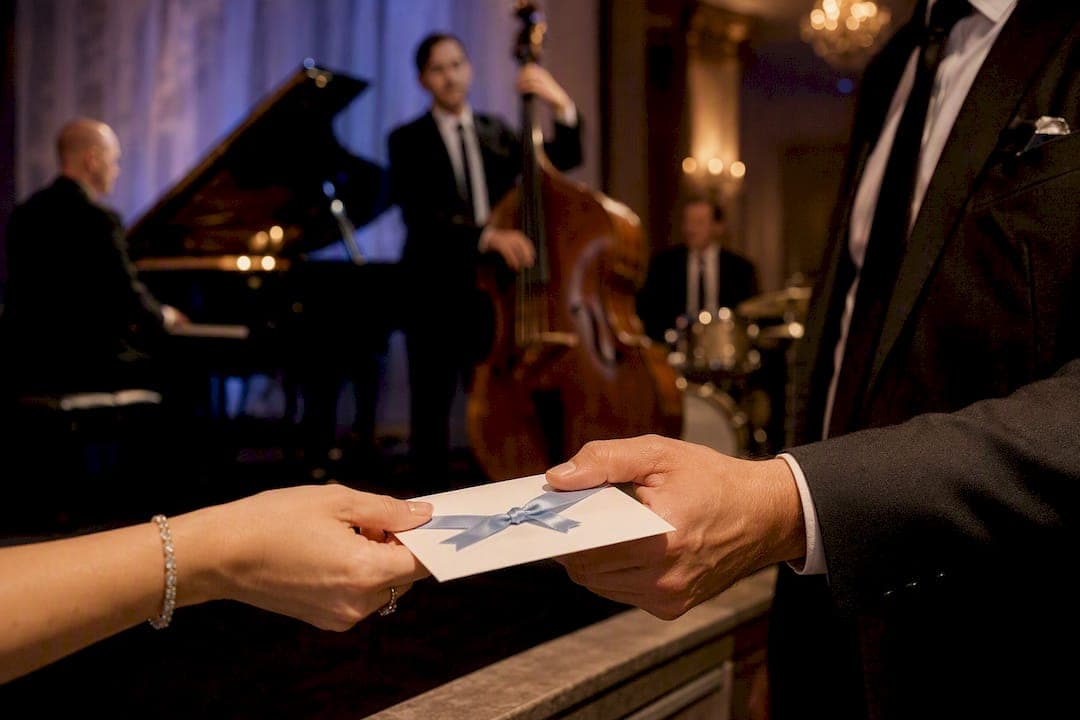
Tipping a wedding band is customary in the United States, though never legally required, and most couples budget $25 to $50 per musician plus an extra $50 to $150 for the bandleader. Before you write a single check, pull out your contract. Some bands already build gratuity or a service charge into their price, and tipping on top of that is generous but optional.
TL;DR:
- Tipping a wedding band typically involves $25 to $50 per musician, with an additional $50 to $150 for the bandleader, depending on the performance scope.
- The total tip often correlates with 1% to 5% of the total entertainment cost, adjusted for factors like performance length, set complexity, travel, and band size.
- Tipping should be done at the end of the night in labeled envelopes, preferably handed to a designated person like the bandleader or a trusted attendant.
- Many venues or packages include a service charge or gratuity, so confirm whether extra tips are necessary to avoid double tipping.
- Additional tips of $15 to $50 per person are appropriate for ceremony musicians, DJs, sound techs, and other entertainers involved in the wedding day.
Table of Contents
- Wedding Band Tipping Etiquette: A Quick Checklist
- How Much to Tip a Wedding Band (and Why the Math Works This Way)
- When and How to Tip Your Wedding Band
- Contracts, Service Fees, and Avoiding Double Tips
- Tipping Other Wedding Entertainment Vendors
- Alternatives to Cash for Tipping Musicians
- What Musicians Actually Value on Your Wedding Day
- Tipping Mariachi, Jazz, and Other Specialty Ensembles
- Do Tipping Norms Change by Region?
- Tipping When Your Band Comes From a Package Deal or Venue
- Why the Numbers Matter Less Than the Plan
- Booking a Band That Makes Tipping Simple
- Where These Numbers Come From
- Sources
Wedding Band Tipping Etiquette: A Quick Checklist
Print this out, tape it inside your wedding binder, or just screenshot it. It covers the math you actually need before your reception, not the theory behind it.
- Per musician: $25 to $50 each, handed out or bundled into one envelope.
- Bandleader bonus: Add $50 to $150 on top of what everyone else gets, since they're usually handling contracts, set lists, and your last-minute requests.
- Percentage method: If flat rates feel confusing, tip 1% to 5% of your total entertainment invoice instead. A $4,000 band bill puts you at roughly $40 to $200 total.
- Sound tech or roadie: $20 to $50 per person if they're not already counted as a "musician" on your contract.
- 3-piece band example: 3 musicians at $30 each ($90) plus $75 for the leader equals $165 total.
- 5-piece band example: 5 musicians at $35 each ($175) plus $100 for the leader equals $275 total.
- 8-piece band example: 8 musicians at $30 each ($240) plus $125 for the leader equals $365 total.
Notice the per-musician cost tends to shrink slightly as the band grows. That's normal. Larger bands often split additional fees among more people, so couples adjust the baseline down a little to keep totals reasonable. What doesn't shrink is the bandleader's bump. Whether you're paying a trio or an eight-piece horn section, that person is doing extra coordination work all night, and the tip should reflect it.
How Much to Tip a Wedding Band (and Why the Math Works This Way)
The $25 to $50 per-musician range isn't arbitrary. It roughly mirrors hourly gratuity norms for skilled service work, scaled up because bands typically perform for three to five hours and haul serious gear. Common guidance puts most weddings at $25 to $50 per musician plus $50 to $100 extra for the bandleader, with totals usually handed over as one lump sum rather than divided into individual envelopes.
Several factors push that number up or down:
- Performance length. A band playing a four-hour reception plus a cocktail hour earns more than one that shows up strictly for the reception.
- Set complexity. Learning your first dance song from scratch, adding a horn section for one number, or performing in two languages for a bilingual crowd justifies a bump.
- Travel distance. A band driving three hours with a trailer of gear works harder than a local trio.
- Band size and instrumentation. More musicians generally mean a slightly lower per-person rate, balanced by the leader's bonus.
Here's where it gets more nuanced: if the bandleader owns the company, that changes how you think about the tip. Business owners often build their profit margin into the base fee already, so a smaller supplemental tip is common practice. Sideline musicians hired on a per-gig contract, though, are usually working for a flat rate with no ownership stake, which is exactly why the extra $25 to $50 per person matters more to them financially.
A hybrid example: say you book a 5-piece band where the leader owns the business and two backup singers are contracted separately. Tip the leader $75 to $100, the four other band musicians $30 each ($120), and treat the two singers the same as any other musician unless your contract already folds gratuity into their fee.
When and How to Tip Your Wedding Band
Timing matters more than most couples realize. The right moment to hand over tips is at the very end of the reception, once the band has finished its last song and started breaking down equipment. Tipping mid-set is awkward, tipping too early risks the number being wrong once you see the full performance, and tipping days later by mail should be reserved for vendors without a deliverable moment, like a florist.
Here's how to keep it simple:
- Prepare cash in labeled envelopes the week of your wedding, one per musician or one lump envelope for the whole band.
- Write names or roles on each envelope ("Bandleader," "Sax," "Sound Tech") so there's no confusion in the chaos of load-out.
- Assign distribution to a maid of honor, best man, planner, or parent, not yourselves. Delegating this task to a trusted attendant is standard advice, since you'll be busy saying goodbye to guests.
- Decide in advance: one envelope to the bandleader for the group, or individual envelopes for each player.
A single lump envelope to the bandleader is faster and less awkward in the moment, and it lets the band handle fair internal distribution without you guessing who played what role. Individual envelopes take more prep but guarantee everyone gets exactly what you intended, which matters if one musician clearly went above and beyond.
Don't forget the people not standing in the spotlight. Sound technicians and roadies who load in early and strike the stage late deserve $20 to $50 each, even if they never touched an instrument.
It is advisable to give the envelope to your distributor before the ceremony begins, rather than during cocktail hour when distractions are likely.
Contracts, Service Fees, and Avoiding Double Tips
Before you tip a dime, read your contract twice. Vendors sometimes bake in a "service charge," an "administrative fee," or "gratuity included" line that changes what you owe on top.
Here's the difference that trips people up:
- Service charge: Often covers overhead, insurance, or venue logistics. It does not automatically go to the performers.
- Administrative fee: Usually pays for booking, contracts, or agency coordination, not the band members playing your reception.
- Gratuity included: This one actually should reach the musicians directly.
A mandatory service charge on your invoice isn't automatically the same as gratuity paid to staff, so don't assume the fee covers your tipping obligation without asking.
Use this script when you call your vendor or venue coordinator: "I see a service charge listed on our contract. Does that go directly to the performers, or does it cover overhead?" A straight answer tells you whether extra cash on the night is generous or genuinely necessary.
If gratuity is already included and confirmed in writing, additional tipping becomes purely discretionary, reserved for exceptional performances rather than baseline expectation.
Tipping Other Wedding Entertainment Vendors
Your band isn't the only act deserving cash at the end of the night. A full wedding day often involves several entertainers, and each has its own informal range.
- Ceremony musicians: $15 to $50 per person, lower if it's a short 20-minute prelude, higher for a full string quartet playing processional through recessional.
- DJs: $50 to $150 flat, or 5% to 10% of the total DJ fee, whichever feels more proportional to your budget.
- Sound technicians and road crew: $20 to $50 each, separate from the band's tip pool unless your contract lists them as band members.
- Hybrid DJ and live-band setups: Split tips proportionally to time performed. If the band plays two hours and the DJ covers three, weight the DJ's tip slightly higher, or simply tip each service at its own standard rate rather than trying to merge the math.
Coordinating a mixed lineup gets easier with a clear reception music checklist that maps out who performs when, so tipping and thank-yous don't get tangled at the end of the night.
Alternatives to Cash for Tipping Musicians
Cash isn't always the right move, especially if a contract restricts additional payment or you're simply tight on bills the week of your wedding. A few alternatives carry real weight.
- Public reviews and social tags. Referrals, glowing reviews, and social media shoutouts matter just as much as cash to musicians running independent businesses, since word-of-mouth drives their next booking.
- Electronic payments. Venmo or Cash App work well if you send the tip within a day or two of the wedding, before the moment loses its impact. Confirm the bandleader's handle in advance so you're not scrambling for a username at 11 p.m.
- Thank-you gifts. A handwritten note, a small gift basket, or a bottle of something nice works when a business owner has already built their profit into the fee and cash feels redundant.
A short, specific review on Google or The Knot, mentioning the band by name and what they nailed, often does more for a musician's business than an extra $20 in an envelope.
What Musicians Actually Value on Your Wedding Day
Cash matters, but it's rarely the only thing a band remembers about your wedding. A clear schedule handed to the bandleader before the event, easy access to water and a place to set down gear between sets, and reasonable advance notice on song requests make a much bigger difference to how smoothly the night goes than most couples expect.
A labeled lump-sum envelope handed to the bandleader solves a problem couples don't always see coming: awkwardness. Nobody wants to stand there dividing cash while guests watch, and musicians don't want to count money in front of your family either. One envelope, one moment, no math in public.
Tips and reviews serve different purposes in a musician's mind. A tip says "you did great tonight." A five-star review or a referral to a friend says "you'll do great next month, too." Bands that live on repeat referrals, which describes most working wedding musicians, weigh both, but the long-term value of a specific, honest review often outlasts a single night's gratuity.
Pro Tip: Ask your bandleader directly, a week before the wedding, whether they'd prefer a lump sum or individual envelopes. Most have a clear preference, and asking saves you from guessing wrong on the day.
Tipping Mariachi, Jazz, and Other Specialty Ensembles
Cultural and specialty bands, mariachi groups, jazz combos, klezmer ensembles, often work slightly differently than a standard pop and rock wedding band, and that changes the tipping math a little.
Many mariachi bands price per song or per set rather than a flat multi-hour rate, which means the "per musician" range still applies, but couples should ask whether the quoted fee already includes a per-member split before adding a full tip on top. Jazz trios and quartets booked for cocktail hour often work shorter sets than a full reception band, so a $15 to $30 per-musician tip is reasonable for a 90-minute cocktail set, scaling up toward $50 if they extend into dinner.
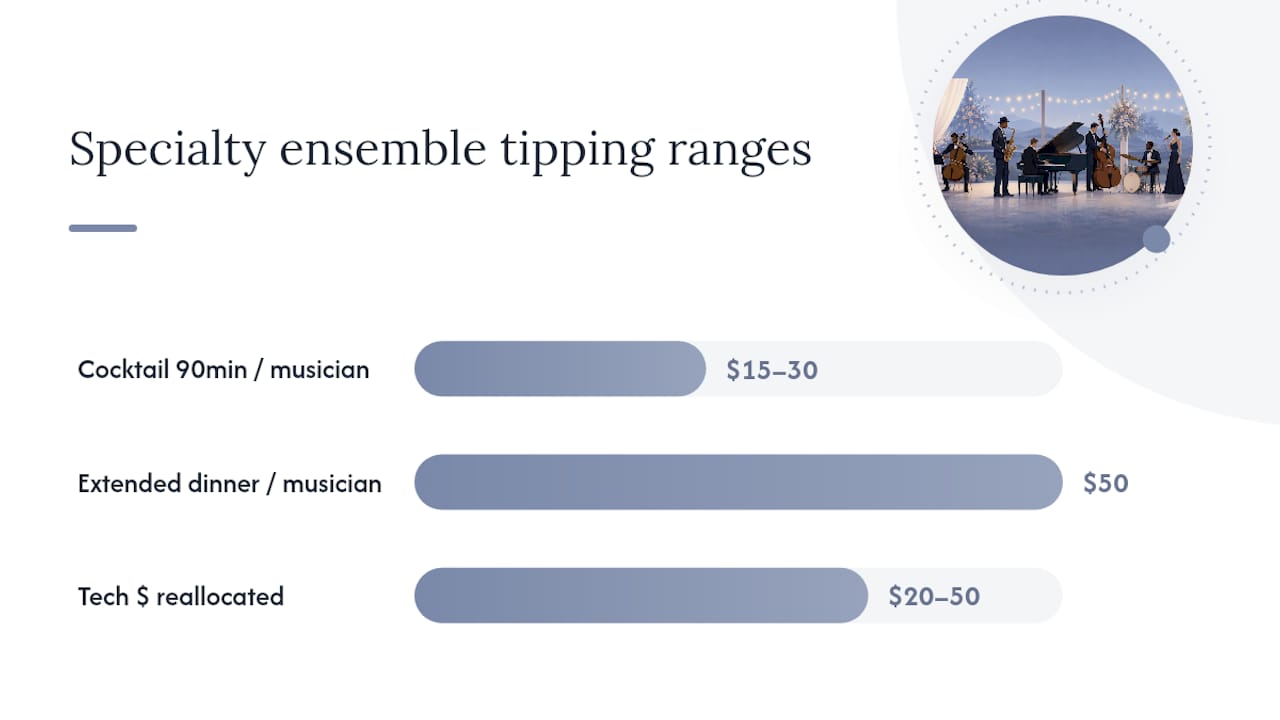
Specialty ensembles frequently travel with their own sound gear and fewer crew members, so there's often no separate sound tech to tip. That $20 to $50 you'd otherwise set aside for a tech can shift toward the musicians instead. If the group performs cultural traditions specific to your family's heritage, wedding vendors in this space report that a genuine, specific thank-you (naming the songs, acknowledging the tradition) alongside the tip carries real weight, more so than with a generic cover band.
The core math doesn't change. What changes is making sure you understand exactly what's included in the quoted fee before assuming a tip covers extra costs the band already priced in.
Do Tipping Norms Change by Region?
Tipping a wedding band skews slightly by region and local wage norms, though the core range holds nationwide. In higher cost-of-living markets like New York, Los Angeles, and San Francisco, couples often land at the top of the $25 to $50 per-musician range, or slightly above it, simply because local musician rates and living costs run higher across the board.
In the Northeast and parts of the Mid-Atlantic, tipping culture tends to mirror restaurant norms: generous, expected, and rarely skipped even when a service charge is present. In parts of the South and Midwest, some couples treat tipping as more discretionary, especially for smaller local bands where the base fee already reflects a fair local rate.
Cultural background plays a role too. Latino and Mediterranean wedding traditions often build a stronger expectation of tipping the entire vendor team generously, sometimes bandleader included, as a mark of respect and celebration rather than a strict service transaction. None of this changes the baseline math this article has laid out. It just means couples in different parts of the country, or from different cultural backgrounds, may land naturally at different points within that $25 to $150 range depending on local norms and family expectations.
Tipping When Your Band Comes From a Package Deal or Venue
Plenty of couples don't book a band directly. The band shows up bundled into a venue's all-inclusive package, or through a wedding planner's preferred-vendor list. Tipping etiquette shifts slightly in that scenario, and it's worth sorting out early rather than guessing on the wedding day.
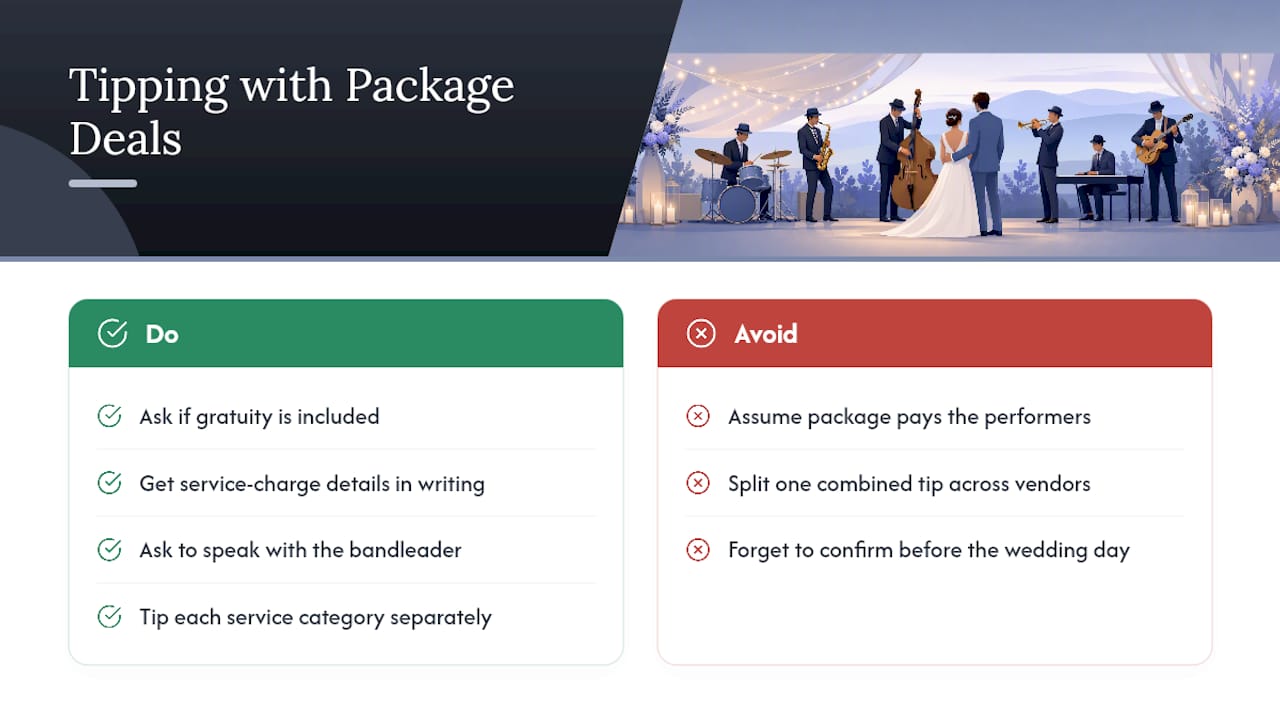
Start by asking the venue coordinator or planner one direct question: is gratuity for the band already included in the package price? For more tips on managing this, see our guide to booking local performance venues in Colorado. Many all-inclusive venue packages fold a service charge into the total, and that charge sometimes does reach the performers, sometimes it goes to the venue instead. Get this in writing if you can, the same way you'd verify a service charge with an independently booked band.
If gratuity isn't included, the same per-musician and bandleader ranges apply, regardless of how you found the band. The booking channel doesn't change how hard the musicians work that night. What does change is who's easiest to ask. A venue coordinator managing multiple vendors on your date may not know the band's internal tipping preferences the way a bandleader booked directly would, so when in doubt, ask to speak with the bandleader themselves a week or two before the wedding.
Package deals also sometimes bundle the band with lighting, a DJ, or a photo booth under one vendor umbrella. In that case, tip each service category separately using its own standard range rather than trying to split one combined tip across unrelated vendors.
Why the Numbers Matter Less Than the Plan
The dollar ranges in this piece aren't complicated, and most couples get the math right on their own. Where things actually fall apart is logistics: nobody assigns a distributor, the envelopes get left in a hotel room, or the bandleader gets cornered mid-breakdown by a slightly drunk uncle trying to hand over cash.
Conventional wedding advice spends most of its energy on the "how much" question and treats the "how" as an afterthought. That's backwards. A couple who tips $20 below the recommended range but hands it over smoothly, in a labeled envelope, through a person the band already knows, leaves a better impression than a couple who tips generously but makes the moment awkward or forgets entirely in the chaos of goodbyes.
If there's one thing worth prioritizing first, it's naming your distributor before the wedding week even starts. Everything else, the exact per-musician number, the bandleader bonus, whether you go percentage or flat rate, is negotiable within a reasonable range. Who hands over the envelope and when is not something you want to figure out at 10:45 p.m. on your wedding night.
— Alex
Booking a Band That Makes Tipping Simple
Some bands handle tipping logistics for you by coordinating set times, breakdown schedules, and crew details directly with clients, so you don't have to guess who to hand an envelope to or when the band is actually done for the night.

Lineups often include jazz trios, string quartets, solo piano, and hybrid DJ and live-ensemble setups, designed for weddings where the music shifts smoothly from ceremony to cocktail hour to a packed dance floor. An experienced bandleader can know when to signal the last song, helping the end-of-reception tip handoff feel well timed rather than rushed. If you're still comparing reception music options, start by checking date availability and getting a quote through the Alex Levin Music services page.
Where These Numbers Come From
- The Knot: recommended tip ranges and end-of-reception timing.
- Brides: envelope prep and contract caveats.
- Zola: percentage-based tipping guidance.
- WeddingTipCalculator: worked per-musician and per-band-size examples.
- Here Comes the Guide: practical ranges and who to tip.
Sources
- How Much to Tip Wedding Vendors With a Printable Guide — The Knot
- Complete list of wedding vendors and gratuity — Brides
- How Much to Tip a Wedding Band in 2026: Per Musician Amounts — WeddingTipCalculator
- How to tip wedding vendors — Zola