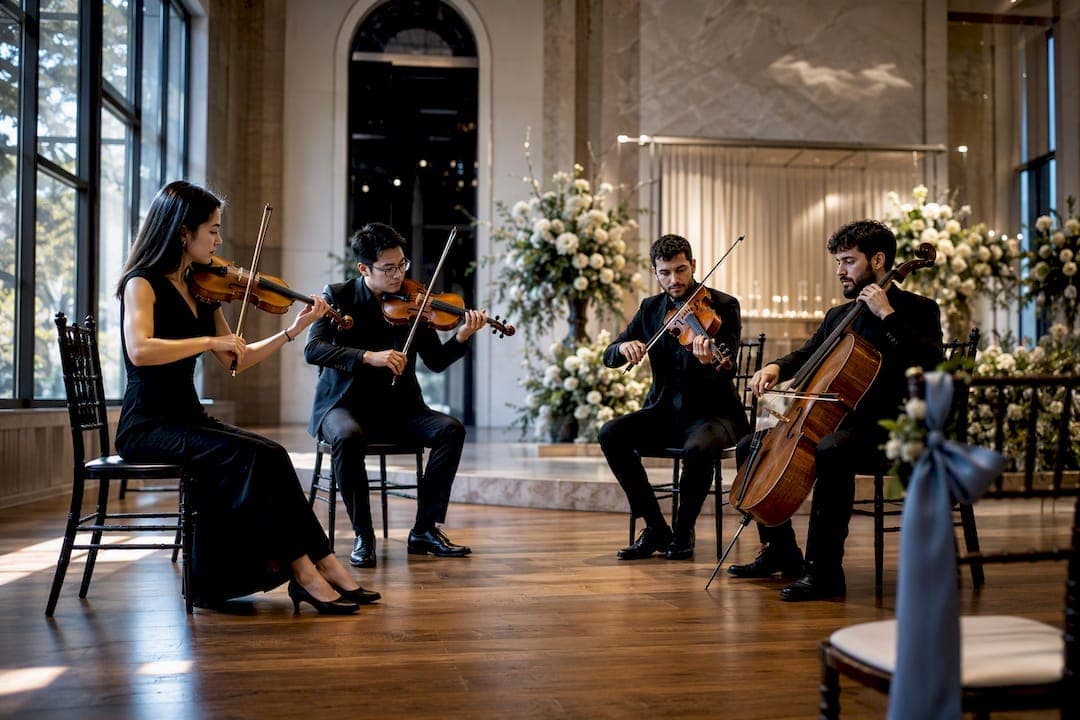
Choose a string trio for intimate ceremonies, tight budgets, or smaller venues where warmth matters more than scale. Choose a string quartet when you want a fuller, more orchestral wall of sound for a large room or a formal processional. The fourth player mostly adds harmonic layering, not decibels, so start by listening to the same arrangement played both ways and checking your venue's footprint before you decide.
TL;DR:
- String quartets provide richer texture for dense arrangements, but they do not significantly increase volume compared to trios, especially in smaller venues.
- A trio suits intimate venues and small guest counts better, while a quartet is generally more appropriate for larger spaces and formal moments like processions.
- Pricing differences are often minimal per player because travel and setup costs are mostly fixed, making quartets more about fullness than cost-effectiveness.
- Custom arrangements are more common and necessary for dense pop and cinematic pieces, with trio arrangements requiring more deliberate revoicing.
- Effective decision-making depends on venue size, guest count, repertoire needs, and specific moment highlights, with samples and footprint considerations guiding the choice.
Table of Contents
- String Trio vs Quartet: What Each Ensemble Actually Sounds Like
- Do Quartets Actually Sound Louder, or Just Fuller?
- Which Ensemble Fits Your Venue and Guest Count?
- What Drives the Price Difference Between a Trio and a Quartet
- Repertoire: What Works and When You Need a Custom Arrangement
- Space, Amplification, and Logistics Your Venue Coordinator Will Ask About
- How to Choose Between a String Trio and Quartet in Five Steps
- How String Trios and Quartets Developed Over Time
- Composers and Repertoire That Define Each Ensemble
- Why Arranging for Three Voices Is Harder Than It Looks
- How Group Roles Shift Between a Trio and a Quartet
- Notes From the Field: What Actually Changes Couples' Minds
- Book Your String Ensemble With Alex Levin Music
- Sources
- FAQ
String Trio vs Quartet: What Each Ensemble Actually Sounds Like
A standard string quartet consists of two violins, one viola, and one cello, a lineup that has stayed remarkably stable since the 18th century. First violin usually carries the melody, second violin fills harmony and rhythm underneath it, viola anchors the middle register, and cello handles the bass line and harmonic foundation. That four-way division of labor is why the string quartet became the central medium of chamber music: every voice gets independent material.
A string trio strips that down to three parts, most commonly violin, viola, and cello, though some ensembles swap in two violins plus cello for a brighter top end.
- Quartet: first violin (melody), second violin (harmony/rhythm), viola (mid range), cello (bass and harmonic support)
- Trio (violin/viola/cello): violin carries melody, viola and cello split harmony and bass duties between two voices instead of three
- Trio (two violins + cello): brighter, more treble forward sound with less low end presence
The practical tradeoff: four independent voices let an arranger write true inner harmony. With three, one instrument almost always does double duty.
Do Quartets Actually Sound Louder, or Just Fuller?
Here's the myth worth killing before you spend another minute comparing prices: a quartet is not "louder" than a trio in any way your ceremony guests will consciously register. Volume grows on a logarithmic curve as you add players, so a fourth voice barely nudges the decibel meter. What it does change is texture. The extra part fills in harmonic gaps, so chords sound complete instead of implied, and the overall effect reads as richer rather than as louder.
That difference matters most on specific repertoire. Dense pop covers and cinematic film-score arrangements were often written with four (or more) parts in mind, and trimming one out can leave an audible hole. Simpler folk-inspired pieces, standards, and most classical processional repertoire translate to three parts with minimal loss.
- Songs that usually need four parts: layered pop ballads, film scores, anything with a prominent countermelody
- Songs that adapt well to three parts: hymns, simple classical standards, acoustic-style arrangements
Quick gut check: if a song has more than one harmony line happening under the melody at any given moment, a trio arranger will need to make choices. A quartet doesn't have to.
There's also a visual dimension nobody talks about enough. Four musicians in matching formal wear, positioned symmetrically at the altar, simply photographs as more formal and more expensive than three. Quartets create a balanced dialogue among four voices that reads as fuller both to the ear and to the eye, which is part of why they've become the default "upgrade" option for larger, more traditional weddings.
Which Ensemble Fits Your Venue and Guest Count?
Guest count and room size drive this decision more than personal taste does; if you're still planning other details, check our comprehensive wedding gift list for helpful resources. A gorgeous trio arrangement can still sound underpowered in a cavernous ballroom, and a quartet can feel like overkill crammed into a restaurant private room.
- Micro weddings (40 guests or fewer): a trio almost always wins here. Intimate rooms don't need extra harmonic weight, and three musicians take up noticeably less space near a small altar or fireplace.
- Small weddings (40 to 75 guests): either works, but lean trio if the venue is a restaurant, boutique event space, or garden with limited backdrop room.
- Medium weddings (75 to 150 guests): this is quartet territory for most couples, especially if the ceremony includes a formal processional or a featured solo moment like a first dance transition.
- Large weddings (150 guests and up): a quartet in a ballroom, large church, or outdoor marquee gives you the fullness needed to fill the room without amplification for most of the ceremony.
Moment matters as much as headcount. A processional or a spotlighted musical moment benefits from a quartet's fuller texture, while background music during cocktail hour, when guests are talking and moving around, usually does fine with a trio. If you're planning a smaller ceremony and want more detail on scaling the music down without losing polish, acoustic ensembles for small weddings cover that exact scenario. For larger rooms, string quartets suit ballroom venues in ways a trio sometimes can't match acoustically.
What Drives the Price Difference Between a Trio and a Quartet
Most vendors price string ensembles per player, then add travel, rehearsal or arrangement time, amplification if needed, and any overtime past the contracted window. A quartet isn't simply "25% more than a trio" across the board. Travel and setup costs often stay flat regardless of headcount, so the per-player premium shrinks once you factor in fixed costs.
Ask any vendor these questions before comparing quotes side by side:
- Does the quoted price include setup and sound check time, or is that billed separately?
- Are custom or rejoiced arrangements included, or do they carry an extra fee?
- What's the overtime rate if the ceremony or cocktail hour runs long?
- Is travel built into the quote, or added after booking based on venue distance?
Two quotes that look identical on paper can differ substantially once these line items surface.
Repertoire: What Works and When You Need a Custom Arrangement
Quartet repertoire is deep. Centuries of classical writing plus decades of arranged pop and film covers means most requests already exist in a proven quartet arrangement. Trio repertoire is thinner by comparison, and not every quartet chart shrinks cleanly to three parts.
- Classical standards and popular processional pieces: widely available for both trio and quartet
- Dense pop or cinematic covers: usually need a custom revoicing for trio to avoid sounding like "a quartet missing a part"
- Ask your musicians for audio or video of the exact arrangement, not just the song title, before you commit
Custom arrangements typically add both cost and lead time, so requesting them early matters. Practitioners recommend bespoke trio writing rather than simply dropping a part, since a properly revoiced trio arrangement sounds intentional instead of incomplete. If your must-play song is a modern pop cover, custom arrangements for quartet pop covers are worth requesting regardless of which ensemble size you book.
Space, Amplification, and Logistics Your Venue Coordinator Will Ask About
A quartet needs more physical footprint than a trio, not just for four chairs but for bowing room. Violinists and violists need elbow clearance on both sides, and cramped positioning affects both sound and safety around candles or floral arrangements.
- Confirm floor space with your venue coordinator, especially near altars, arches, or fireplace mantels
- Plan amplification for outdoor ceremonies or rooms with poor acoustics; it changes the tone slightly but is often necessary
- Coordinate load-in timing so setup doesn't collide with guest arrival or the wedding party's staging
Pro Tip: Walk your ceremony space with the exact chair and music stand count you're booking, not just an estimate. A quartet's four stands take up more room than couples expect, especially in aisles with tight turns.
How to Choose Between a String Trio and Quartet in Five Steps
Work through this order and the decision usually makes itself by step five.
- Check venue fit first. Walk the ceremony and cocktail hour spaces with footprint in mind.
- Lock your guest count. Larger, more formal gatherings lean quartet; intimate ones lean trio.
- Set your budget range. Get itemized quotes before comparing ensemble sizes.
- Match repertoire to your must-play songs. Dense arrangements may need a quartet or a custom trio chart.
- Listen to matched samples. Request the same song played by both ensemble sizes if possible.
When you listen, pay attention to three things: whether the inner harmony sounds complete or thin, whether the balance between instruments feels even, and whether the volume would hold up over quiet guest conversation during cocktail hour.
| Decision Factor | Trio Fits Best When | Quartet Fits Best When |
|---|---|---|
| Guest count | 75 or fewer | 75 or more |
| Venue type | Restaurant, small chapel, garden | Ballroom, large church, marquee |
| Budget | Tighter budget, fewer moving costs | Willing to pay for fuller texture |
| Repertoire | Simple, classical, or acoustic style | Dense pop, cinematic, layered harmony |
| Moment | Cocktail hour, background music | Processional, featured performance |
Score vendor responses quickly: a vendor who answers footprint, arrangement, and pricing questions clearly in one email is usually easier to work with than one who needs three follow ups to get straight answers.
How String Trios and Quartets Developed Over Time
The string quartet's rise traces back to the mid 1700s, when composers began writing specifically for two violins, viola, and cello as a self-contained conversational unit rather than a scaled-down orchestra. That format caught on fast because it let four equal voices trade melodic material back and forth, something a smaller group structurally can't do without one instrument working overtime.
String trios actually predate the quartet's dominance in some respects, evolving out of Baroque trio sonata traditions that paired melodic instruments over a bass line. Early trios often felt like a transitional format, one voice short of the "complete" texture composers were reaching for. But that changed as composers began writing trios as their own art form rather than a quartet substitute.
By the Classical era, the quartet had become the preferred vehicle for serious chamber composition, while the trio persisted as a leaner, more intimate alternative valued for its clarity. That historical split still echoes today: quartets get requested for grand, formal moments, while trios get chosen when couples want something that feels closer and less orchestral. Neither format displaced the other. They settled into different roles, and wedding musicians still book work based on exactly that distinction centuries later.
Composers and Repertoire That Define Each Ensemble
The string quartet's repertoire is enormous, largely because composers treated it as a serious compositional challenge rather than a lightweight format. Haydn is often credited with establishing the quartet's four-movement structure, and later composers used the format to write some of the most demanding chamber music ever composed, dense, contrapuntal pieces that only work because four independent voices can carry four independent lines.
String trio repertoire is smaller and, in some ways, more exposed. With one fewer voice to hide behind, trio writing tends to favor clarity and lean counterpoint over dense harmonic stacking. Composers who wrote for trio often used the format specifically because they wanted transparency, not because they were working with a reduced palette. That distinction matters for weddings too: a well written trio arrangement isn't a lesser version of a quartet chart, it's written with different priorities in mind.
For modern ceremonies, most couples never hear the difference between "quartet repertoire" and "trio repertoire" in the classical sense. What they encounter instead is arranged pop, film score, and contemporary crossover material, most of which was composed with a fuller ensemble in mind and then adapted down. That's precisely why a good trio arrangement of a modern song requires deliberate revoicing rather than a simple subtraction of one part.
Why Arranging for Three Voices Is Harder Than It Looks
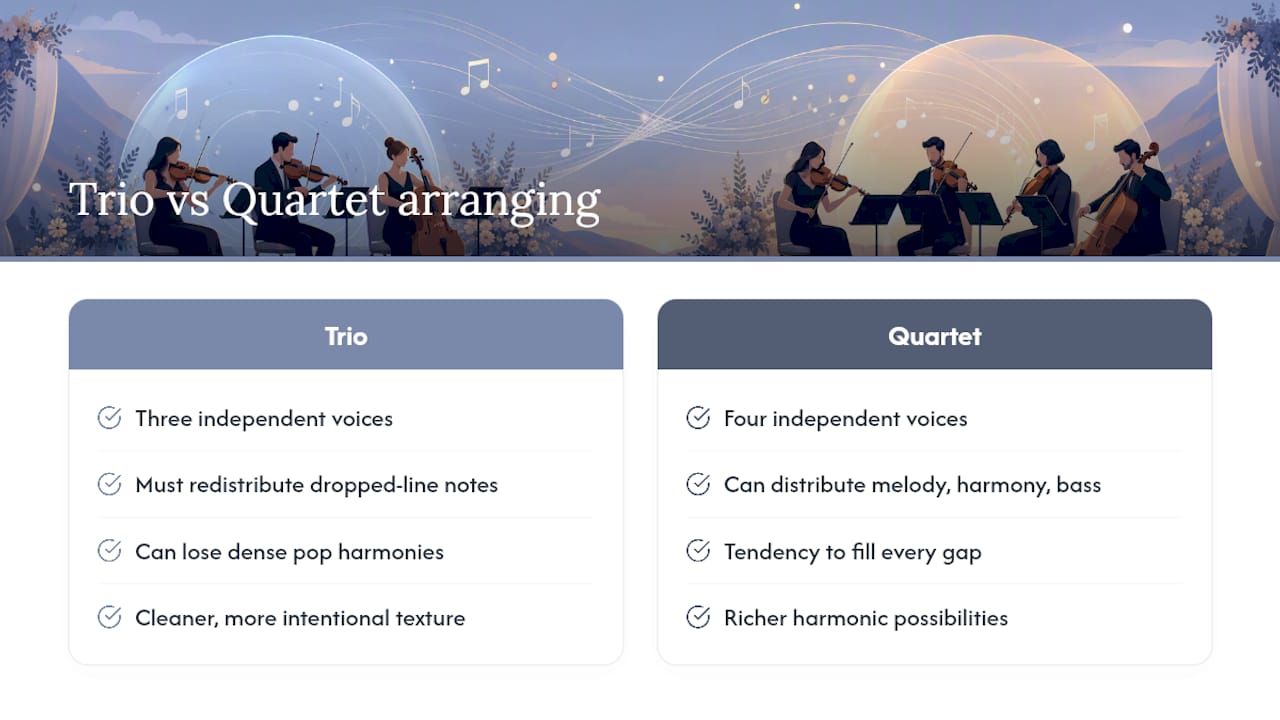
Arranging for a quartet gives a composer four independent lines to distribute harmony, melody, and bass across. Arranging for a trio removes one of those lines entirely, and every note that voice used to carry has to go somewhere or disappear.
That constraint sounds like a disadvantage, and in some ways it is. Dense pop harmonies with multiple internal moving parts genuinely lose information when compressed to three voices, and a lazy arrangement will sound like exactly what it is: a quartet chart with a hole in it. Experienced arrangers instead revoice the piece from scratch, deciding which harmonic notes matter most and which can be implied rather than played outright.
The upside is that trio arrangements, done well, often sound more intentional and less cluttered than quartet versions of the same song. With fewer voices competing for sonic space, melody lines can breathe more, and the overall texture reads as clean rather than sparse. Quartet arranging has the opposite challenge: with four voices available, it's tempting to fill every gap, which can occasionally produce a busier texture than the song actually needs. The best quartet arrangers know when to leave a voice silent just as much as trio arrangers know when to imply a harmony rather than state it outright.
Neither format is objectively harder to arrange for. They demand different skills, and a musician who's excellent at one doesn't automatically transfer that skill to the other.
How Group Roles Shift Between a Trio and a Quartet
Add or remove one musician and the entire internal dynamic of the ensemble changes, not just the sound. In a quartet, roles are relatively fixed: first violin leads, second violin supports, viola bridges the middle, and cello anchors the bottom. Each player has a defined lane, and rehearsals tend to focus on blending those four lanes into one voice.
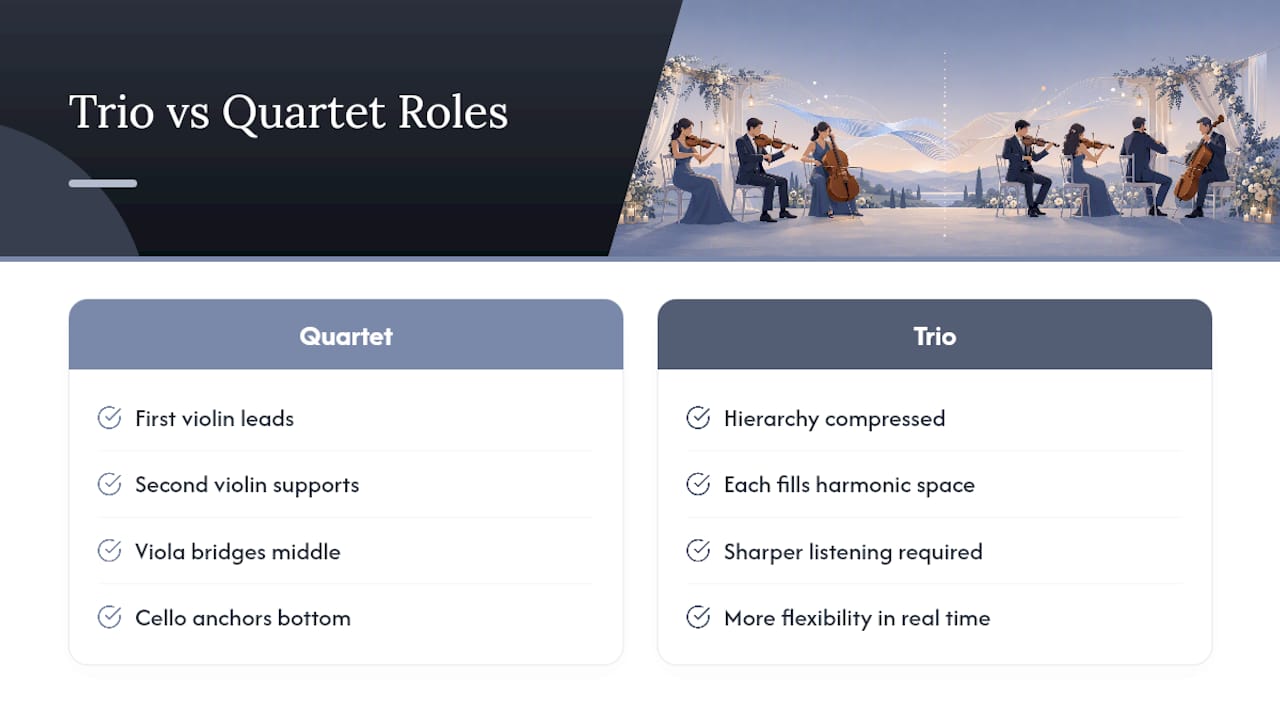
A trio compresses that hierarchy. With one fewer part, each musician typically carries more responsibility for filling harmonic space, which means trio musicians often need sharper listening skills and more flexibility in real time. There's less room to hide behind another player if intonation or timing drifts, since three exposed voices reveal inconsistency faster than four blended ones.
That changes the rehearsal dynamic too. Quartets often rehearse balance, four musicians learning exactly how loud or soft to play relative to each other so no single voice dominates. Trios rehearse more toward interdependence, since losing one voice mid phrase is more audible in a three part texture than a four part one. Neither dynamic is better, but couples booking musicians for a live event should know that a trio isn't simply "a quartet minus one player" in terms of how the musicians work together. It's a genuinely different ensemble with its own internal logic.
Notes From the Field: What Actually Changes Couples' Minds
Most couples walk in assuming louder equals better and leave the conversation realizing texture is what they actually noticed in every sample they liked. The upgrade decision usually comes down to one moment: a processional, a first look, a featured cover song, where a couple wants that fuller sound specifically because it's a spotlight moment, not because the room demands it.
The biggest logistics surprise is almost always footprint, not budget. A ballroom with a tight altar area can make four chairs and four stands genuinely awkward, something photos from past ceremonies make obvious immediately. When couples ask for proof that a quartet is worth it for their ceremony, sample recordings settle the debate faster than any explanation can.
— Alex
Book Your String Ensemble With Alex Levin Music
Alexlevinmusic gives you what most vendor comparisons can't: a musician who has actually arranged the same song for both trio and quartet and can tell you which one fits your ceremony before you sing anything. That saves you from guessing based on price alone.

You'll get straightforward help across the moments that matter most for your day:
- Ceremony music tailored to your processional, readings, and recessional, with sample recordings sent before you book
- Cocktail hour ensembles sized to keep conversation easy while still sounding intentional, not like background filler
- Custom arrangements for pop or film covers so a trio version sounds crafted rather than incomplete
Logistics get handled directly, from load-in timing to amplification decisions, so you're not relaying technical questions between your venue coordinator and a vendor you've never spoken with. Wedding ceremony music packages start from $3,000, with clear quotes upfront so you know exactly what's included before you compare it against anyone else. Reach out with your venue details and guest count, and you'll get a straight answer about whether a trio or quartet fits your day, not a sales pitch.
Sources
- Cambridge Dictionary — 'string quartet'
- Wikipedia — String quartet
- ClassicalAurum — String quartets explained
FAQ
What Is the Most Famous String Trio?
There's no single universally agreed "most famous" string trio the way there is for certain quartets, largely because trio repertoire developed with more variety in instrumentation across history. Beethoven's string trios are among the most performed and studied works in the format, with several sets that composers and performers still treat as benchmarks for trio writing.
What Is the Trio Version of a Quartet Called?
There isn't a special name. It's simply called a string trio, and it typically drops one of the two violin parts a quartet uses, most often keeping violin, viola, and cello. Good trio arrangements are usually written from scratch for three voices rather than created by deleting a quartet's second violin part.
What Is a String Trio Called?
A string trio is the standard term, referring to an ensemble of three string instruments, most commonly violin, viola, and cello. Some ensembles substitute two violins and a cello instead, depending on the sound and repertoire they're aiming for.
What Is the Five Piece Version of a String Quartet?
A five piece expansion of a standard quartet is typically called a string quintet, most often built by adding a second viola or a second cello to the standard two violin, viola, cello lineup. For weddings, quintets are far less common than trios or quartets, mainly because the added fullness rarely justifies the extra cost and footprint for most ceremony or reception settings.