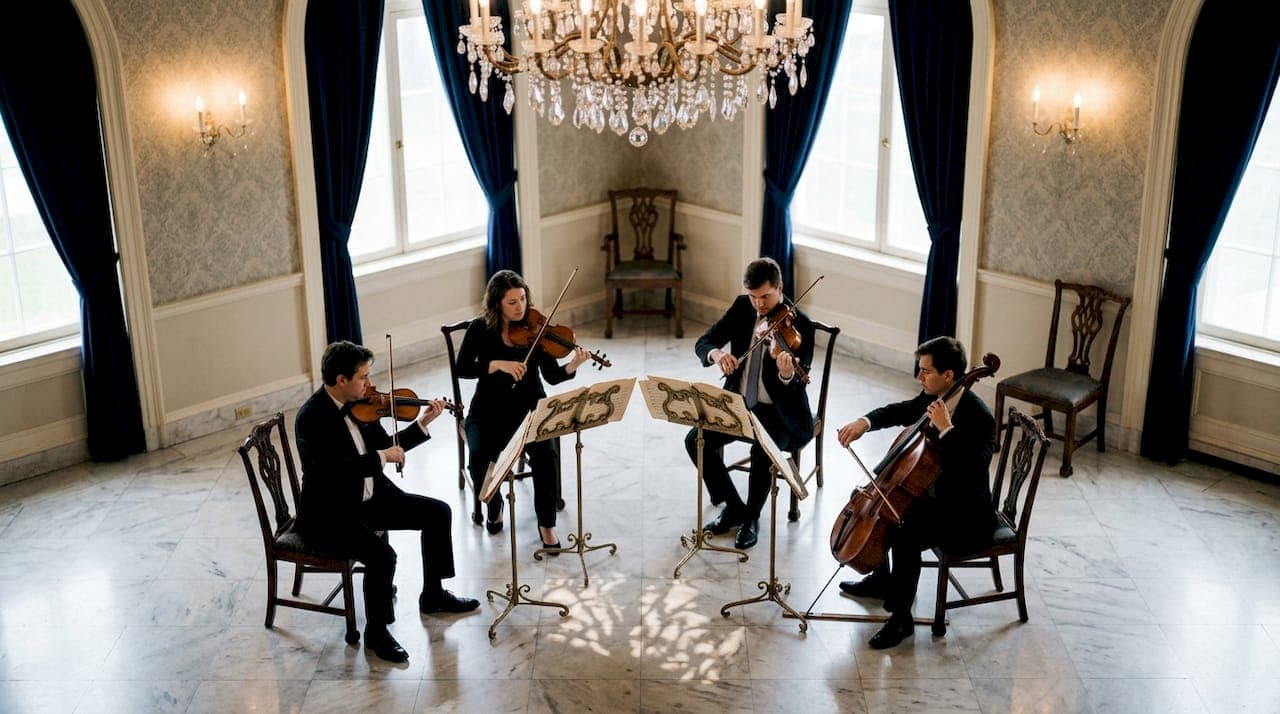
A string quartet is the most acoustically and atmospherically suited live music ensemble for a ballroom venue. The combination of two violins, a viola, and a cello produces a full harmonic spectrum that fills large formal spaces without amplification, creating an experience that recorded music simply cannot replicate. Live string music increases dopamine levels and lowers stress markers, giving guests a physiological reason to feel more relaxed and engaged from the moment they walk in. For event organizers and couples weighing their ballroom music options, understanding why string quartets suit ballroom venues so well makes the decision far easier.
Why string quartets suit ballroom venues acoustically
The acoustic fit between a string quartet and a ballroom is not accidental. Ballrooms are designed with high ceilings, reflective surfaces, and open floor plans that amplify and distribute natural sound. A string quartet works with those physics rather than against them.
Professional string quartet performances exhibit spectral broadening and greater acoustic stability than amateur groups. Spectral broadening means the sound occupies a wider range of frequencies, filling a room more completely and giving listeners a sense of being surrounded by music rather than simply hearing it from one direction. That quality is nearly impossible to reproduce with speakers.
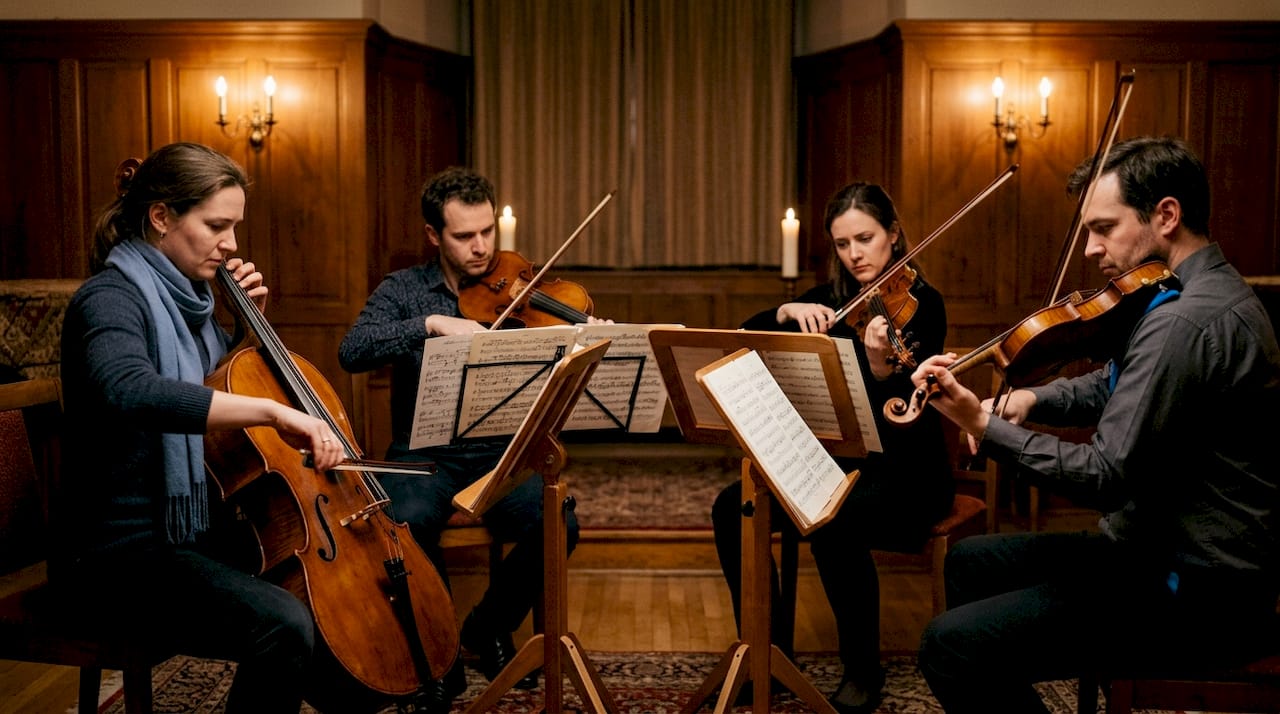
Amplified music in a ballroom creates a different problem. Speakers project sound in a fixed direction, which causes uneven coverage. Guests near the speakers hear too much; guests at the far end hear too little. A string quartet radiates sound in all directions naturally, so the acoustic experience stays consistent across the room.
| Feature | String quartet | Recorded or amplified music |
|---|---|---|
| Sound directionality | Omnidirectional, natural diffusion | Fixed speaker projection |
| Frequency range | Full spectral broadening | Limited by speaker quality |
| Emotional arousal | Higher, linked to acoustic stability | Lower, lacks live presence |
| Room integration | Works with venue acoustics | Can conflict with room resonance |
| Visual engagement | Musicians visible and expressive | None |
Pro Tip: Ask your venue coordinator about the room's natural reverberation time before booking. Ballrooms with longer reverb times (above 1.5 seconds) benefit most from the natural decay of string instruments, which blend beautifully with the room's echo rather than fighting it.
How does the collaborative nature of a string quartet enhance a live event?
A string quartet is not a miniature orchestra. It is a chamber ensemble built on intimate, non-hierarchical collaboration, and that distinction matters enormously for the atmosphere it creates in a ballroom.
The give and take that audiences feel
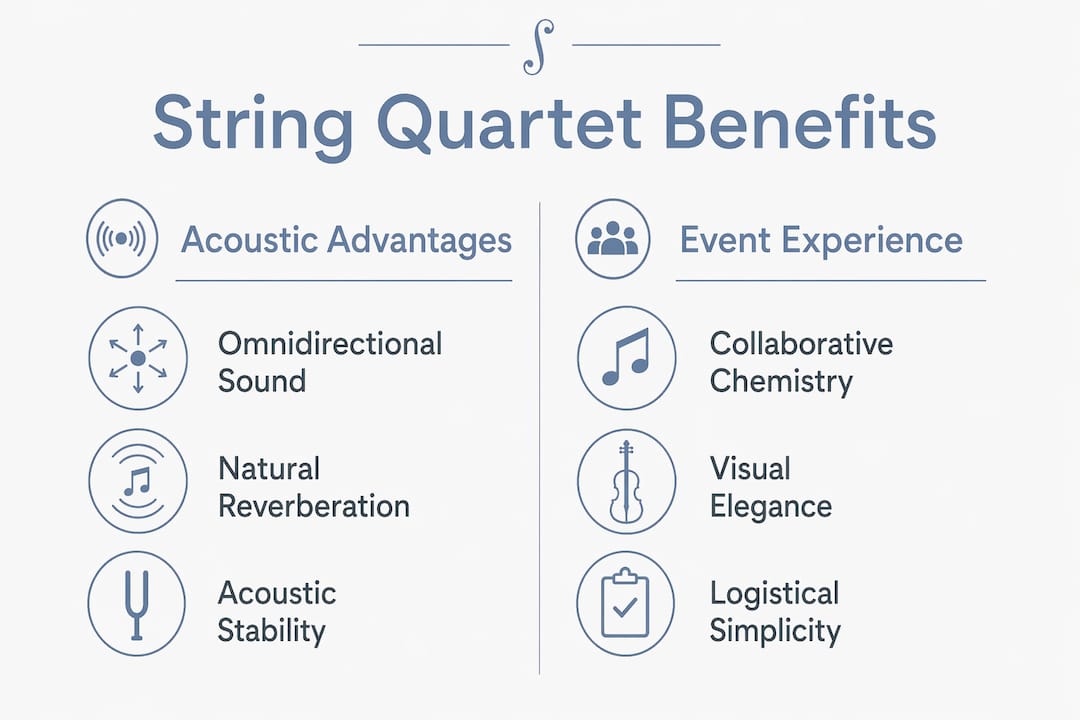
Chamber musicians describe quartet rehearsal as a process of artistic negotiation, where each player balances individual expression with group cohesion. There is no conductor dictating tempo or dynamics. Instead, four musicians listen, respond, and adjust to each other in real time. Audiences feel that responsiveness even when they cannot name it.
"Playing in a string quartet creates a kind of electricity that is hard to describe. You are simultaneously leading and following, pushing and pulling, and the audience senses that live negotiation happening in front of them. It is intimacy at work." — Strings Magazine
That spontaneity is what separates a live quartet from any pre-recorded alternative. Every performance is slightly different because the musicians are genuinely reacting to the room, the energy of the guests, and each other. A ballroom filled with that kind of live interplay feels alive in a way that a playlist never can.
Social bonding as a byproduct of live chamber music
Audience members at live quartet concerts report stronger social bonding compared to remote or recorded listening experiences. That finding has a practical implication for event planning. Guests who feel socially connected early in an event are more likely to engage with each other, participate in the occasion, and remember it positively. A string quartet placed during cocktail hour or a formal dinner does not just provide background sound. It actively shapes the social temperature of the room.
Pro Tip: Position the quartet where guests can see the musicians clearly, not tucked into a corner. Visual engagement with performers deepens the emotional impact and encourages guests to pause, listen, and connect with each other.
What are the practical advantages of a string quartet for ballroom events?
Beyond acoustics and atmosphere, string quartets offer concrete logistical benefits that event organizers and couples consistently underestimate until they have experienced them firsthand.
String quartets require no amplification, which means no speaker stacks, no sound board, no cables running across the floor, and no sound check that eats into setup time. That simplicity translates directly into a cleaner venue aesthetic and fewer moving parts on the day of the event.
The five most practical benefits for ballroom event planning are:
- No amplification required. The quartet sets up with four music stands and four chairs. Setup takes under 20 minutes.
- Full venue mobility. The ensemble can relocate from a ceremony space to a cocktail area to a dining room without any technical reconfiguration.
- Repertoire flexibility. A professional quartet can move between Baroque, Classical, Romantic, and contemporary arrangements within a single set, matching the mood of each event moment.
- Scalable to room size. A quartet fills an intimate 50-person dinner room and a 300-person grand ballroom with equal effectiveness because the sound scales naturally with the space.
- Formal aesthetic alignment. Event professionals prefer string quartets for upscale venues because the visual presence of four musicians in formal attire reinforces the event's tone before a single note is played.
The ability to set the mood with live music across multiple event phases, without logistical disruption, is one of the strongest arguments for choosing a quartet over any other format.
How do string quartets compare to other live music options for ballrooms?
Choosing the right ensemble for a ballroom event requires understanding what each format does well and where it falls short. The comparison is not about which option is objectively best. It is about which one fits the specific demands of a formal ballroom setting.
String quartets uniquely balance elegant sophistication with dynamic expressive capacity, a combination that larger ensembles and solo performers struggle to match simultaneously.
| Format | Acoustic presence | Formality level | Flexibility | Logistical complexity |
|---|---|---|---|---|
| String quartet | Natural, full-spectrum | High | High | Low |
| Jazz trio or band | Amplified, directional | Medium to high | High | Medium |
| Solo pianist | Natural but limited range | High | Medium | Low |
| DJ or recorded music | Amplified, directional | Low to medium | High | Medium |
| Large orchestra | Natural, overwhelming in small ballrooms | Very high | Low | Very high |
A jazz trio or band brings energy and improvisation, but amplification is required, which reintroduces the coverage and aesthetic problems described earlier. A solo pianist offers elegance and natural acoustics but lacks the harmonic fullness and visual dynamism of four players. A DJ provides maximum song variety but zero acoustic presence and a formality level that rarely matches a black-tie ballroom event.
Live string performances reduce anxiety and enhance collective well-being through physical sound vibrations and visual musician engagement, a multisensory experience that no other format in the table above delivers as completely. That combination of acoustic purity, visual engagement, and emotional depth is the defining advantage of a string quartet in a formal ballroom setting. For couples and event organizers who want to understand why live music outperforms a playlist, the quartet makes the strongest case.
What should you consider when booking a string quartet for a ballroom?
Booking a string quartet well requires more than selecting a date and confirming availability. The decisions made before the event determine how well the music serves each moment of the occasion.
Timing and lead time
Book a professional quartet at least three to six months before the event date, and earlier for peak wedding season months like june, september, and october. Quality ensembles fill their calendars quickly, and last-minute bookings limit your options significantly.
Coordinating with event flow
Map the quartet's performance schedule against the event timeline before finalizing the program. A well-planned quartet performance covers three distinct phases: the ceremony or arrival, the cocktail hour, and the formal dinner. Each phase calls for a different repertoire mood, from ceremonial and reverent to warm and conversational to elegant and ambient.
Repertoire planning
Work with the ensemble to build a set list that reflects the event's tone and the couple's or client's preferences. A professional quartet can arrange almost any piece for four strings, from Bach to the Beatles, so the repertoire conversation is an opportunity to personalize the experience rather than accept a generic program.
The key considerations before finalizing a booking are:
- Confirm the quartet has experience performing in ballroom-sized venues specifically.
- Request a video sample of a live performance, not a studio recording, to assess stage presence.
- Clarify whether the ensemble provides their own music stands and lighting for low-light venues.
- Discuss break schedules and how the quartet handles transitions between event phases.
- Ask about contingency plans for last-minute player changes.
Alexlevinmusic specializes in planning live music for private events from ceremony through reception, with direct experience coordinating string quartet performances in ballroom settings across Philadelphia, New York, and beyond. That experience matters when the details of a formal event leave no room for improvisation on logistics.
Pro Tip: Ask the quartet to learn one or two pieces that are personally meaningful to the couple or client. That small gesture transforms a professional performance into a genuinely memorable one. Live music premieres and personalized moments create the kind of emotional resonance that guests talk about long after the event ends.
Key Takeaways
String quartets suit ballroom venues because they deliver natural acoustic coverage, emotional depth, and logistical simplicity that no other live music format matches at the same formality level.
| Point | Details |
|---|---|
| Acoustic fit | String quartets produce omnidirectional, full-spectrum sound that works with ballroom acoustics naturally. |
| Emotional impact | Live string performances increase dopamine and strengthen social bonding among guests. |
| Logistical simplicity | No amplification means faster setup, cleaner aesthetics, and full venue mobility. |
| Collaborative energy | The non-hierarchical quartet dynamic creates spontaneous, palpable energy audiences feel in real time. |
| Booking preparation | Plan repertoire by event phase and book at least three to six months in advance for best results. |
What 20 years of ballroom events taught me about string quartets
I have worked with string quartets in ballrooms ranging from intimate 80-person dinners to 400-person black-tie galas, and the one thing that never changes is the moment the quartet starts playing and the room shifts. Guests who were checking their phones put them away. Conversations slow down and deepen. The energy in the room becomes something you can actually feel.
What surprises most clients is how much the visual element contributes to that shift. Four musicians in formal attire, bows moving in coordinated arcs, making eye contact with each other as they navigate a phrase together. That image signals to every guest that this event is serious, that someone cared enough to bring something real and alive into the room.
The mistake I see most often is treating the quartet as background noise. A string quartet is not wallpaper. It is a living, breathing ensemble that responds to the room. When you position them well, brief guests on what to expect, and give them a program that matches the event's emotional arc, the quartet becomes the connective tissue of the entire occasion. Guests leave talking about the music even when they cannot name a single piece that was played.
The elegance of string quartets in formal settings is not a trend. It is a function of physics, psychology, and centuries of chamber music tradition working together in your favor. Trust the format.
— Alex
Live string quartet services for your ballroom event with Alexlevinmusic
Alexlevinmusic brings professional string quartet performance to weddings, corporate galas, and private celebrations across Philadelphia, New York, and the surrounding region. Every engagement is planned around your venue layout, event timeline, and personal repertoire preferences, so the music fits the occasion rather than the other way around.
Whether you are planning a formal ceremony, a seated dinner, or a full reception, Alexlevinmusic coordinates every phase of the live music experience from first consultation through the final note. Explore what makes live music special and see how a string quartet can transform your ballroom event. Ready to discuss your date and vision? Visit Alexlevinmusic ensembles and soloists to review options and reach out directly.
FAQ
Why do string quartets work well in large ballrooms?
String quartets produce omnidirectional, unamplified sound that diffuses naturally through large spaces, providing consistent coverage without the uneven projection that speakers create. Their spectral broadening fills the room's full frequency range, which amplified formats rarely achieve.
How far in advance should you book a string quartet for a ballroom event?
Book at least three to six months before your event date, and earlier for peak wedding season. Professional ensembles fill their schedules quickly, and early booking gives you more time to plan a personalized repertoire program.
Can a string quartet play modern songs, not just classical music?
A professional string quartet can arrange nearly any genre for four strings, including pop, jazz standards, film scores, and contemporary hits. Repertoire flexibility is one of the strongest practical benefits of string quartets for formal events.
How does a string quartet compare to a DJ for a ballroom wedding?
A string quartet delivers natural acoustic presence, higher formality, and a multisensory live experience that a DJ cannot replicate. A DJ offers broader song variety and higher volume for dancing, but lacks the acoustic depth and visual engagement that define a formal ballroom atmosphere.
Do string quartets need a sound system or special setup?
String quartets require no amplification, no speakers, and no sound board. Setup consists of four chairs and four music stands, which takes under 20 minutes and leaves the venue's aesthetic completely intact.