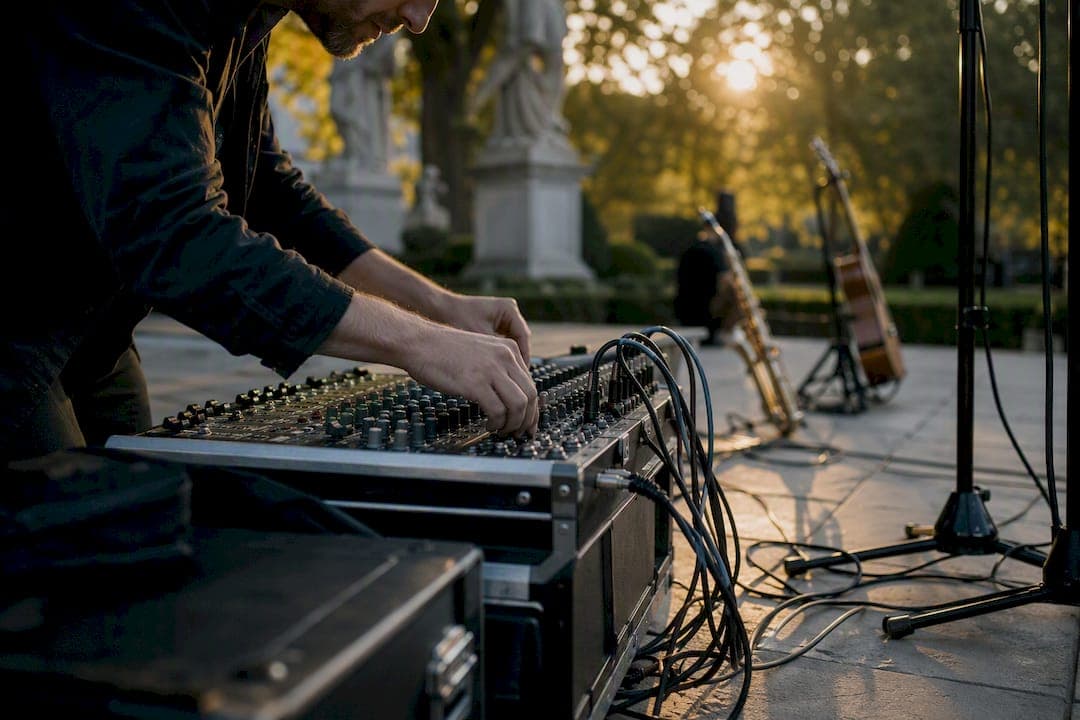
Plan on load-in first, then a dedicated soundcheck window that ends at least 30 minutes before guests walk in. For a full band, that means 2 to 3 hours for load-in and setup, plus another 30 to 60 minutes for the sound check itself. A small band or duo can usually do the whole thing, load-in through soundcheck, in 60 to 90 minutes. A solo musician or acoustic act needs 30 to 60 minutes total, since there's no drum kit or monitor mix to build.
Load-in and soundcheck are two separate events, not one blurry "vendor arrival" block. Load-in is trucks, cases, cables, and stands. Soundcheck is the band actually testing levels through the PA. Confusing the two on your timeline is how couples end up with a band still running cable when the doors open.
- Full band (6+ pieces): 2 to 3 hours load-in + 30 to 60 minutes soundcheck
- Small band or duo: 60 to 90 minutes total
- Solo or acoustic act: 30 to 60 minutes total
- Buffer after soundcheck, before guests arrive: 30 minutes minimum
Before you finalize anything, get three answers from your venue: what time the room actually opens for vendor access, where the power drops are located, and who your on-site point of contact will be during load-in.
Key Takeaways
Reliable soundcheck timing comes down to treating load-in and soundcheck as separate blocks, sized to your band, with a 30-minute buffer built in before guests arrive.
| Point | Details |
|---|---|
| Size the window to your band | Full bands need 2 to 3 hours load-in plus 30 to 60 minutes soundcheck; duos need 60 to 90 minutes total. |
| Separate load-in from soundcheck | Never treat them as one generic "vendor arrival" slot on your timeline. |
| Build a 30-minute buffer | Schedule soundcheck to finish at least 30 minutes before guests arrive, not right up against doors. |
| Confirm three things in writing | Room access time, power locations, and a named venue contact prevent most day-of delays. |
| Share the technical rider early | Sending the band's input list to the venue ahead of time avoids the most common setup scrambles. |
Table of Contents
- How Long Does Soundcheck Take for a Wedding Band?
- What Actually Happens During a Wedding Soundcheck
- Sample Timelines You Can Copy Into Your Schedule
- What to Confirm With Your Venue and Band in Writing
- Your Copy-Paste Load-In Checklist
- A Working Musician's Take on What Actually Goes Wrong
- Why the Standard Advice on Soundcheck Timing Falls Short
- Sources
How Long Does Soundcheck Take for a Wedding Band?
Band size drives almost everything about your timing math, but so does gear. A solo pianist and a nine-piece band with horns are not on the same planet timing-wise, even though both are technically "the entertainment."
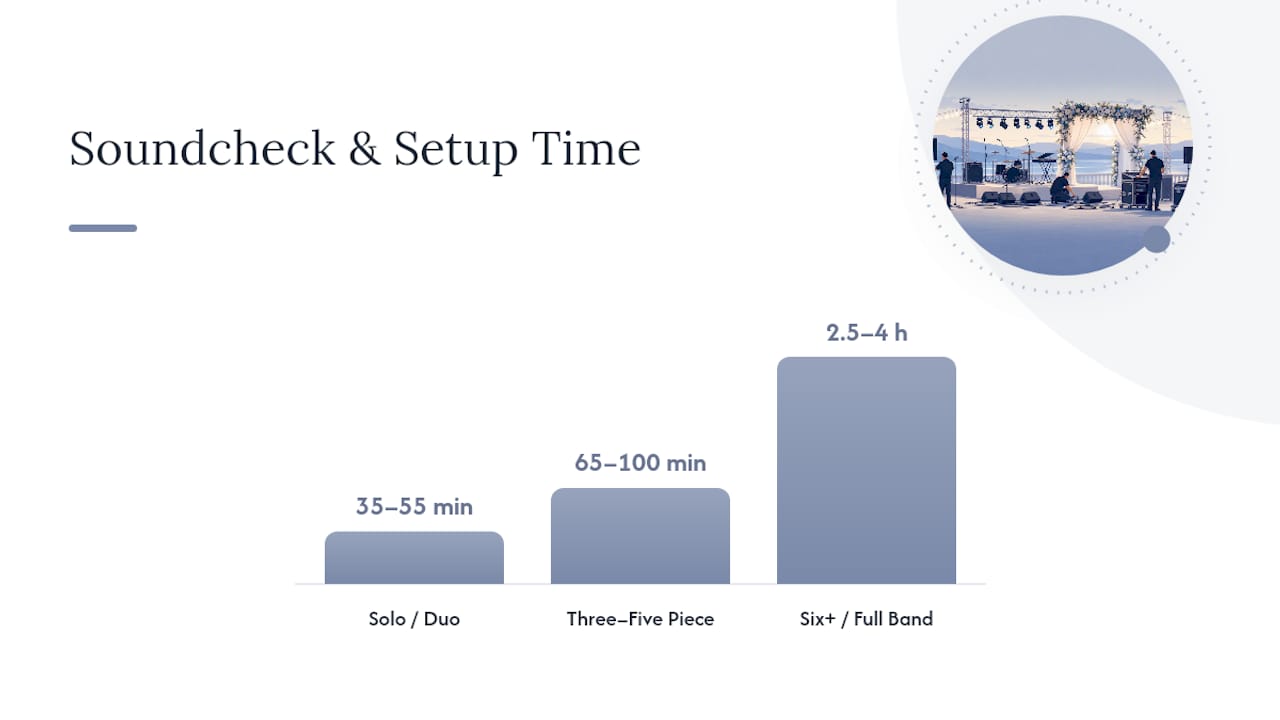
Solo and duo acts move fast. A pianist, guitarist, or acoustic duo typically needs 30 to 45 minutes to set up an instrument, a small amp, and maybe one vocal mic. Soundcheck is often just a quick level check, five to ten minutes, since there's no mix to balance between multiple musicians.
Three to five piece bands need more runway. Expect 45 minutes to an hour for instrument load-in and cable runs, plus time to build a monitor mix for each player. Soundcheck for this size band usually runs 20 to 40 minutes once everyone's plugged in, since you're balancing a rhythm section against vocals and maybe a horn or two.
Six or more pieces, or any full production setup, is where the 2 to 3 hour load-in plus 30 to 60 minute soundcheck window becomes standard rather than generous. A drum kit alone takes real time to build and mic. Add a front-of-house engineer running a separate mix from the monitors, and you've added a layer of coordination that a duo simply doesn't need.
Several variables stretch these ranges further, regardless of headcount:
- In-ear monitors add setup and calibration time per musician, since each performer needs an individually tuned mix.
- A front-of-house engineer running sound from a booth adds cable runs and a second point of calibration beyond the stage monitors.
- Elevated staging or lighting rigs need to go up before instruments can even be placed.
- Long load-in walks, stairs, or a service elevator can add 20 to 30 minutes before a single cable gets plugged in, since load-in time depends heavily on the physical path from the loading dock to the stage.
If your venue has a tricky access point, tell your band's production manager before the wedding week, not the morning of.
What Actually Happens During a Wedding Soundcheck
Soundcheck isn't the band noodling around while you wait. It's a specific sequence, and skipping steps is exactly how you end up with feedback squealing through your first dance.
- Line check and patching (10 to 20 minutes). Every instrument and microphone gets plugged in and confirmed as live at the mixing console. Nothing fancy happens here, it's just making sure every channel works.
- Rhythm section first, then harmony, then vocals. A common professional sequence checks drums and bass first, adds guitars and keys, then brings in vocals last, since the low end anchors everything else in the mix. Expect roughly 15 to 25 minutes for this stage.
- Full-band run-through at performance volume (15 to 25 minutes). The whole group plays a section of a real song at the actual volume they'll use during the reception. This step matters more than it sounds. Testing at a whisper and performing at full volume are two different acoustic environments, and feedback that never showed up at low volume can appear the moment the room gets loud.
- Final fine-tuning (10 to 20 minutes). Small EQ and monitor adjustments based on what came up during the run-through.
Pro Tip: Ask your band whether they'll run the full-band check at real performance volume, not just a quiet walk-through. Skipping that step is the single most common cause of feedback surprises during the first dance.
Sample Timelines You Can Copy Into Your Schedule
Every wedding's timeline looks a little different, but the load-in and soundcheck logic scales the same way across three common formats.
Micro-wedding (under 50 guests, duo or trio): Load-in at 3:00 PM, setup complete by 3:30 PM, quick line-check from 3:30 to 3:50 PM, buffer until 4:20 PM, doors at 4:30 PM. Minimal overlap with other vendors since the footprint is small.
Standard reception (75 to 150 guests, 4 to 6 piece band): Load-in from 2:00 to 4:00 PM, soundcheck 4:00 to 4:45 PM, buffer until 5:15 PM, cocktail hour starts 5:00 PM in a separate space, reception doors at 6:00 PM.
Large marquee or full production (150+ guests, full band plus lighting): Load-in from 11:00 AM to 2:00 PM, soundcheck from 2:00 to 3:00 PM, buffer until 3:30 PM, ceremony or cocktail hour begins 4:00 PM.
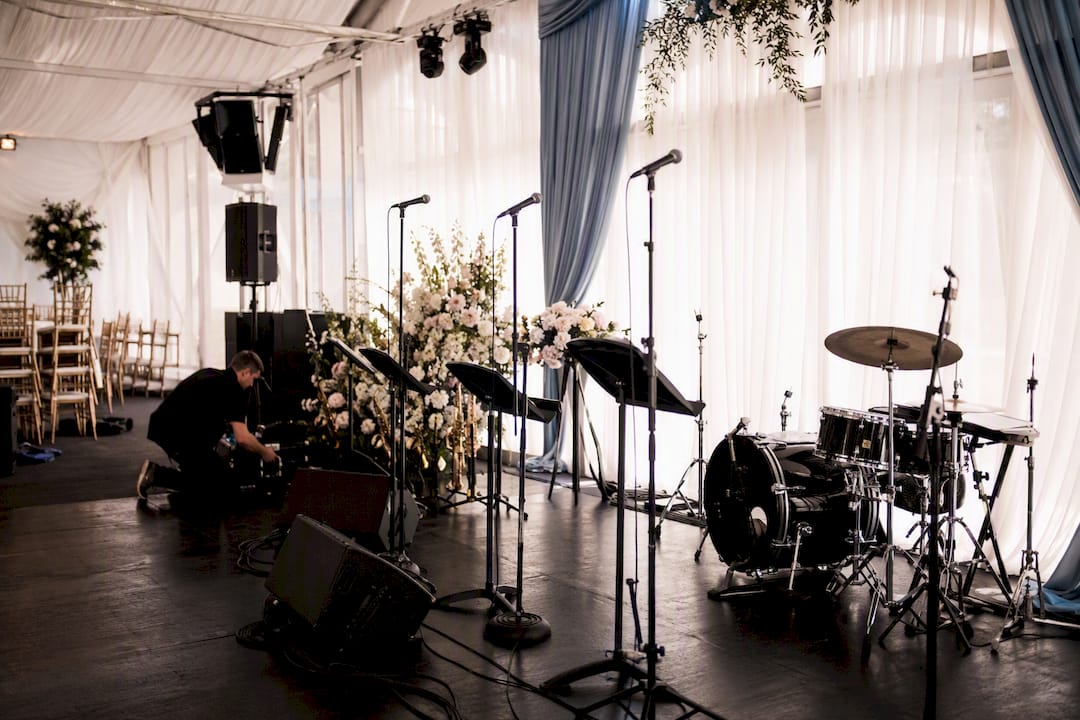
If your venue won't grant an empty-room window for load-in, ask about a "line-check" option instead, a shortened plug-and-test session run quietly during cocktail hour or dinner service, with the full band volume check saved for a narrow slot right before the reception opens.
What to Confirm With Your Venue and Band in Writing
Most soundcheck disasters trace back to something nobody wrote down. Venue access, power, and points of contact need to be locked in before wedding week, not assumed.
- Room access window. Confirm exactly when vendors can enter, not just when your reception starts. A "you're welcome anytime" answer from a venue coordinator isn't a real time, and it won't hold up if another vendor is still in the room.
- Loading dock, parking, and elevator or stair access. A three-minute walk from a loading dock is a different job than a fifteen-minute haul up a service stairwell, and that difference changes your load-in estimate significantly.
- Technical rider and input list. Share your band's technical input specification sheet with the venue ahead of time. This single document, listing exactly what inputs and power the band needs, prevents most day-of scrambling.
- Power locations and house PA rules. If the venue has its own sound system, the cleanest approach is usually for the band to bring their own gear unless the house system was specifically built for live music.
- Sound limiters and curfews. Some venues run decibel monitors and can cut power or end a performance if volume exceeds a set limit, so ask about this before booking, not during soundcheck.
- Overtime rates and named contacts. Get the load-in window, soundcheck window, and a specific coordinator's name and phone number in writing, not just an email thread everyone assumes someone read.
Pro Tip: If your venue can't give you a specific room-access time, that's worth treating as a scheduling risk, not a minor detail to sort out later. For couples weighing a band against other entertainment formats, our guide comparing live bands and DJs covers how load-in logistics differ between the two.
Your Copy-Paste Load-In Checklist
Send this to your band and venue coordinator as-is. It saves everyone a round of back-and-forth emails.
- Confirmed arrival time and vendor entrance location
- Primary on-site contact name and cell number
- Power drop locations relative to the stage
- Green room or private space for the band to store cases and change
- Meal timing and location for the band, ideally served during dinner service
- Stage dimensions and any elevation or backline restrictions
Example schedule to paste into an email:
- 2:00 PM: Band load-in begins, vendor entrance, contact Sarah (venue coordinator)
- 4:00 PM: Soundcheck begins
- 4:45 PM: Soundcheck complete, band breaks for meal
- 5:15 PM: Buffer, band on standby
- 5:45 PM: Cocktail hour music begins
Get the load-in window, power confirmation, and named contact acknowledged in writing by both band and venue. A verbal "sounds good" over the phone doesn't hold up when something shifts three days out. Our wedding reception music checklist walks through the rest of the music-related planning items that pair with this schedule.
A Working Musician's Take on What Actually Goes Wrong
At Alex Levin Music, most on-site delays trace back to one thing: nobody confirmed the room access time in writing, so the band shows up expecting an empty space and finds catering still setting tables. Sharing the technical input list with the venue a week ahead, not the morning of, resolves the majority of these issues before they happen.
A few habits worth adopting:
- Always build a 30-minute buffer after soundcheck. Unforeseen technical issues surface during tuning more often than couples expect, and that buffer is what absorbs them quietly.
- Label power circuits ahead of time if you can, it saves real minutes during load-in.
- A private space and a hot meal for the band during dinner service keeps energy up for a four-hour reception.
If a venue can't give you a definite load-in window, can't point to where the power is, or won't hand over a contact list, treat that as a scheduling risk worth resolving before the contract is signed, not after.
Why the Standard Advice on Soundcheck Timing Falls Short
Most wedding planning guides give you a single number, "the band needs two hours," and call it done. That's not wrong, but it skips the part that actually causes problems: nobody tells couples that load-in and soundcheck are two different negotiations with two different failure points.
Load-in fails because of physical logistics, a locked loading dock, an elevator that's slower than anyone remembered. Soundcheck fails because of communication, a technical rider nobody sent, a power drop nobody labeled. Treating both as one generic block on a timeline is why couples get blindsided.
If you take one thing from this, prioritize the written confirmation over the estimated time. A band that knows its exact room-access window can adapt to almost any timeline. A band guessing at access, power, and contacts cannot, no matter how much buffer you build in. Get the specifics in writing first. The minutes matter less than most guides suggest.
— Alex
Sources
- Reception Planning Checklist: Entertainment Steps to Cover
- Wedding Band Logistics Without the Chaos
- Booking A Wedding Band: How To Ensure Everything Runs Smoothly On Your Wedding Day
Ready to lock in your band's timing details early? Alex Levin Music works directly with couples and planners to confirm load-in windows, technical needs, and soundcheck schedules well before the wedding week. Explore our ensembles and soloists to find the right lineup for your reception, and see why live music consistently outperforms a playlist when it comes to keeping a wedding timeline running smoothly.