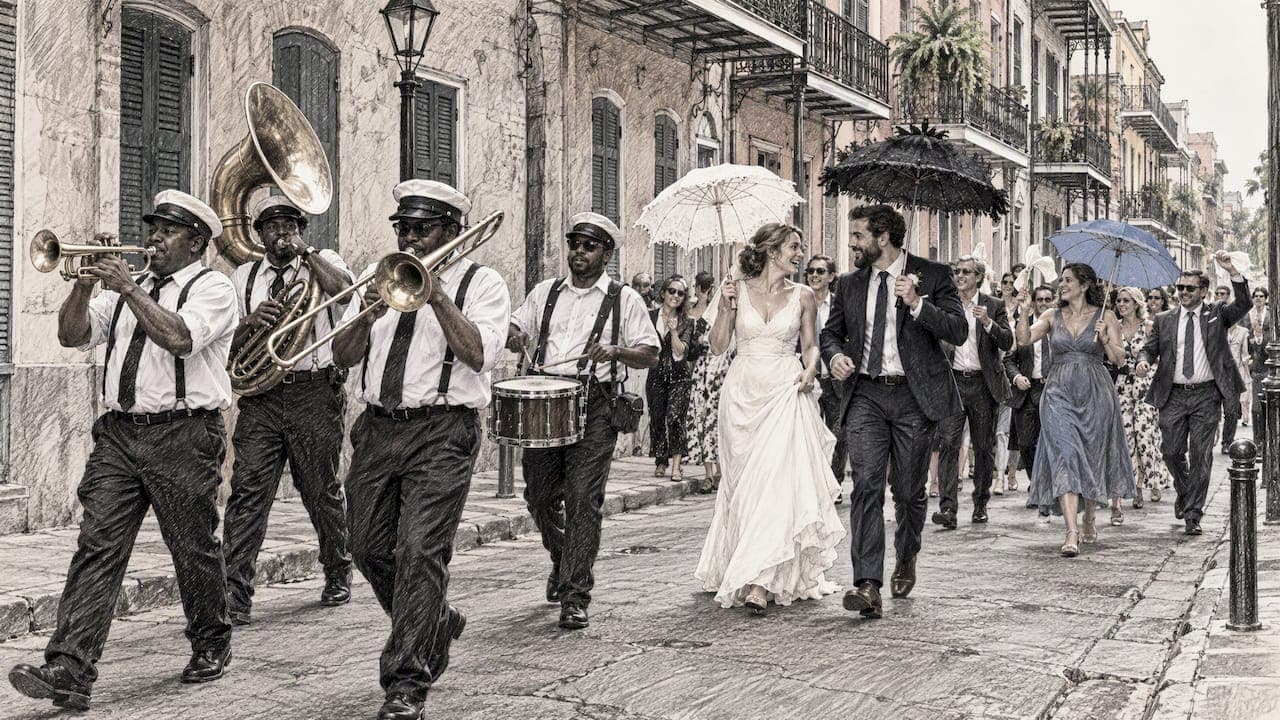
A second line at a wedding is a short, upbeat parade led by brass band music, the fastest way to turn guests into a moving, dancing celebration. The single best move is to hire an experienced brass band or build a tight playlist around classic anthems, keep the route short, and lock in permits early. Skip the planning piece and even great music falls flat.
TL;DR:
- Open with When the Saints Go Marching In, build with Iko Iko, and close with Mardi Gras Mambo for a clear musical arc.
- Wedding professionals recommend routes of six to eight blocks with police support, while planners often need about six months to arrange permits and escorts.
- A DJ costs less and controls song choice, but a hype person can lead call and response when recorded brass lacks live crowd energy.
- Appoint a grand marshal to cue the crowd, hand out parasols or handkerchiefs, and offer water or a golf cart to guests unable to walk.
Table of Contents
- What a second line is and why it works at weddings
- Curated song list and playlist ideas for a wedding second line
- How to plan a second line at your wedding: permits, route, and costs
- Choosing between a live brass band, recorded music, or a hybrid approach
- Props, choreography, and guest cues for a memorable, safe parade
- How a professional wedding musician adapts second-line music outside New Orleans
- Unique traditions and variations of second line weddings by region
- Coordinating musicians and participants for a smooth procession
- Music arrangements and instrumentation for different wedding settings
- Call-and-response techniques to boost guest participation
- Preserving the spirit while keeping logistics manageable
- How Alex Levin Music brings a second line to your wedding
- FAQ
- Sources
What a second line is and why it works at weddings
The tradition traces back to New Orleans brass bands and funeral processions, where mourners formed a solemn "first line" behind the casket while a looser crowd of musicians and dancers, the "second line," followed behind with upbeat music that turned grief into celebration. Wedding couples borrow that second half: the joyful parade, minus the funeral. According to Ethnomusicology Review, this evolution from dirge to celebratory parade music gave rise to the brass-band repertoire still played at parades and weddings today.
When you book a band for this moment, ask for specific musical features rather than a vague "New Orleans vibe":
- Driving brass lines with a tuba or sousaphone anchoring the bottom end.
- A steady, syncopated groove that invites walking and swaying, not just listening.
- Call-and-response phrasing between the bandleader and the crowd.
- Shout-along choruses that guests can join without knowing the words in advance.
The format works because it physically moves people. Guests leave their seats, follow a leader, wave handkerchiefs or parasols, and become part of the performance instead of watching it from a table.
Curated song list and playlist ideas for a wedding second line
Start with the anthems that define the genre, then round out a set with newer brass-funk tracks. Ethnomusicology Review names these as the core of the tradition:
- When the Saints Go Marching In: the most recognizable second-line song, ideal for the opening stretch when you want instant guest recognition.
- Paul Barbarin's Second Line: a horn-driven standard documented in Smithsonian Folkways archival notes as a staple of New Orleans parade repertoire.
- Iko Iko: a call-and-response favorite that gets guests shouting back within seconds.
- Hey Pocky A-Way: a funkier groove that works well mid-parade once the crowd has warmed up.
- Mardi Gras Mambo: a festive closer that signals the parade is winding toward the reception.
For a 20 to 30 minute parade, open with "When the Saints Go Marching In" to pull guests out of their seats, move into "Iko Iko" and "Hey Pocky A-Way" for sustained energy, then close with "Mardi Gras Mambo" as you arrive at the reception space. Mix in a modern brass-funk track or two if your band plays them well.
Briefing your musicians matters as much as the song list itself:
- Give a live band exact titles for the anthems, then let them improvise transitions and solos between songs.
- Tell a DJ to prioritize groove and tempo over strict song order if guests start dragging.
- Reserve full improvisation for a live band only once the core anthems are locked in.
How to plan a second line at your wedding: permits, route, and costs
Most cities treat a wedding second line as a parade, which means paperwork before it means music. Nola reports that wedding professionals recommend budgeting for permits and police escorts, and that planner lead times often run around six months.
Wedding professionals recommend routes of six to eight blocks with police support, according to NOLA.com, a length that keeps the parade lively without exhausting guests in formal attire.
Keep these planning basics in mind:
- A bandleader or planner often handles the permit filing and route logistics directly, which reduces your workload and lowers the risk of a safety issue mid-parade.
- Shorter routes, often 20 to 30 minutes, tend to keep energy high compared with longer parades, since guests in heels and suits tire quickly.
- Budget for the band fee, a permit and police-escort line item, and optional add-ons like a grand marshal, parasols, or pedicabs for guests who cannot walk the full route.
Because permit and escort costs vary by city and change over time, confirm current fees directly with your local permitting office rather than relying on a fixed number.
Choosing between a live brass band, recorded music, or a hybrid approach
Each format trades authenticity against cost and flexibility, so the right choice depends on your venue, budget, and how much you want the parade to feel handmade.
A live brass band delivers the most authentic energy: real horns, visible musicians marching with your guests, and the kind of improvisation that makes every performance unique. The tradeoff is cost and lead time, since bands need advance notice to coordinate permits and routing, as Neworleans notes when describing how bandleaders manage logistics for couples.
A DJ or hybrid setup gives you exact control over song selection and typically costs less, but it can feel thinner without live horns driving the crowd forward. You can still simulate second-line energy with a DJ by layering recorded brass tracks with a hype person who leads call-and-response cues.
- Live brass band: strongest authenticity and crowd energy, higher cost, requires lead time for permits and coordination.
- DJ or hybrid setup: lower cost and precise song control, less organic energy without a hype person directing the crowd.
- Hybrid pattern: a short live brass segment leads guests out of the ceremony, then a DJ takes over once the parade reaches the reception space.
Pro Tip: If budget limits you to a DJ, hire one hype person just for the second line segment, their job is to shout cues and wave a parasol so guests know exactly when to clap, chant, or step in time.
Props, choreography, and guest cues for a memorable, safe parade
Visible props do a lot of the storytelling work. NewOrleans.com points to parasols and handkerchiefs as the signature visuals, both of which are easy to source from party suppliers or have custom-monogrammed for the occasion.
- Hand out small parasols or handkerchiefs to the wedding party before the parade starts.
- Assign a grand marshal or hype person to walk ahead, wave a parasol, and shout simple call-and-response lines guests can echo.
- Route the parade through shade where possible and keep water available at the end point.
- Offer a seating or golf cart option for guests who cannot walk the full distance.
Pro Tip: Give your grand marshal three or four short, memorable call-outs in advance, something as simple as "Who dat!" repeated back by the crowd keeps momentum without requiring rehearsal.
How a professional wedding musician adapts second-line music outside New Orleans
We build second-line sets that scale to the venue: a brass-forward trio for intimate spaces, brass plus rhythm section for larger receptions, or horn lines voiced for a string quartet when a full brass band isn't practical. We recommend locking in arrangements and routing details early so a bandleader can coordinate with your planner and secure any needed permits well before the wedding date. For a deeper look at how customized arrangements shape a reception, see our notes on personalized jazz music at weddings.
Unique traditions and variations of second line weddings by region
The core format, brass band, parasols, a grand marshal, travels well, but couples adapt it to fit their own backgrounds. Some blend a traditional New Orleans brass repertoire with songs tied to their own heritage, swapping in a cultural anthem partway through the route while keeping the horn-driven groove underneath. Others shorten the tradition into a single song played during the recessional rather than a full walking parade, especially at venues without street access.
Outside Louisiana, couples often reshape the second line to fit a reception hall or backyard rather than city blocks, looping through a garden or around a pool instead of down a public street. This version skips the permit question entirely but keeps the brass band, the parasols, and the call-and-response energy intact. Some couples incorporate a jazz funeral style "dirge into celebration" structure for a ceremony exit, starting slow and somber before the band breaks into an uptempo number, a nod to the original first line to second line transition.
Multicultural weddings sometimes layer a second line into an existing processional tradition, using the brass parade as a bridge between a ceremony rooted in one culture and a reception celebrating another. The through line across every variation is the same: a band or playlist that builds energy, a visible leader, and guests who become part of the performance rather than spectators of it.

Coordinating musicians and participants for a smooth procession
A second line only feels effortless when someone has mapped out who does what before the music starts. Share the route and timing with your bandleader at least a few weeks ahead so musicians know exactly where to start, pause, and end.
Designate one point person, often the grand marshal or a planner, to signal the band when to begin, since guests rarely line up on cue without a visible prompt. Brief your wedding party separately from general guests: they often lead the parade and need to know prop placement, pacing, and where to peel off once you reach the reception.
Walk the route in advance if possible, even informally, so the band knows where sidewalks narrow, where to pause for photos, and where the parade needs to pick up pace. For larger guest counts, consider a secondary musician or hype person stationed partway down the route to keep energy consistent from front to back, since sound carries differently across a long procession. Coordination here matters more than rehearsal: a band that knows the route and a point person who knows the cues will outperform a note-perfect set with no plan behind it.
Music arrangements and instrumentation for different wedding settings
The right instrumentation depends on your space as much as your budget. A full brass band, trumpet, trombone, sousaphone, snare, and bass drum, delivers the loudest, most traditional sound and suits outdoor venues or long street routes where volume needs to carry.
For indoor receptions or smaller venues, a scaled-down brass trio or quartet keeps the energy without overwhelming the room. Couples who want a second-line feel without hiring a full brass section sometimes ask a jazz quartet or swing band to voice the horn lines on saxophone or trumpet, borrowing the groove and call-and-response structure without the full parade instrumentation.
Hybrid arrangements work well when a venue restricts amplified sound or outdoor processions: a few acoustic horns lead a short walking segment, then the band transitions into the reception set once everyone is inside. Whatever the setting, the instrumentation should serve the same goal, a groove strong enough to walk to and a sound loud enough to pull guests out of their seats.

Call-and-response techniques to boost guest participation
Call-and-response is the engine of a second line, and it works best when guests know their part without needing instructions. The simplest version: the grand marshal or bandleader shouts a short phrase, like "Who dat!", and the crowd echoes it back, repeated every block or two to keep attention on the parade rather than side conversations.
Songs like Iko Iko build call-and-response directly into the lyrics, so guests pick up the pattern within one chorus. For instrumental brass moments, a hype person can cue clapping on specific beats or wave a parasol as a visual signal to clap, step, or twirl.
Keep the vocabulary simple and repeat it early in the parade so guests feel confident joining in by the second round. A single well-timed phrase shouted three or four times does more for crowd energy than a long, unfamiliar chant guests have to learn on the spot.
Preserving the spirit while keeping logistics manageable
The tradition deserves real musicians who understand the groove, not just a playlist labeled "second line." At the same time, a parade that drags past 30 minutes in formal shoes stops being fun for anyone. A bandleader and planner working together, permits filed, route walked, cues rehearsed, is what makes a borrowed tradition feel earned rather than staged.
— Alex
How Alex Levin Music brings a second line to your wedding
We build second-line sets around your venue and guest count, whether that means a brass-forward reception band for a full walking parade or a DJ and hybrid setup that blends live horns with a DJ takeover once guests reach the reception. 
Booking typically starts with a planning call to map your route, timing, and must-play songs, followed by a custom arrangement built for your ensemble size.
- Reception Music covers the live band for your parade and reception set.
- DJ & Hybrid Music suits couples who want a shorter live segment paired with recorded music.
- Cocktail Hour Music and Ceremony Music round out the rest of your wedding day soundtrack.
Reach out through our ceremony and reception booking page to start planning your second line.
FAQ
What is a second line song?
A second line song is an upbeat brass-band tune built on a driving groove, often with call-and-response lyrics, originally played during the celebratory portion of New Orleans funeral processions. Classics include "When the Saints Go Marching In," "Iko Iko," and "Paul Barbarin's Second Line," according to Ethnomusicology Review.
How much does a second line band cost in New Orleans?
Costs vary by band size, route length, and whether a permit or police escort is required, so couples should confirm current pricing directly with vendors and their local permitting office. NOLA.com notes that couples should budget for permits and police escorts in addition to the band fee itself.
What are some good line dance songs for a wedding?
For a second-line style parade specifically, "Iko Iko" and "Hey Pocky A-Way" work well because their call-and-response structure invites guests to join in without choreography. Both are named among the genre's core songs by Ethnomusicology Review.
What are the top 3 wedding songs for a second line?
"When the Saints Go Marching In," "Iko Iko," and "Mardi Gras Mambo" cover the full arc of a parade, from an instantly recognizable opener to a festive closer. All three appear among the genre's defining tracks documented by Ethnomusicology Review.
How long should a wedding second line parade last?
Many bandleaders recommend a 20 to 30 minute route to keep energy high and guests comfortable, rather than a longer parade that risks losing momentum. NewOrleans.com notes that while some couples book a full 60-minute parade, a tighter route is often the more energetic choice.
Sources
- Ethnomusicology Review — New Orleans brass-band traditions
- Nola
- Neworleans
- Smithsonian Folkways — New Orleans brass bands (album notes)