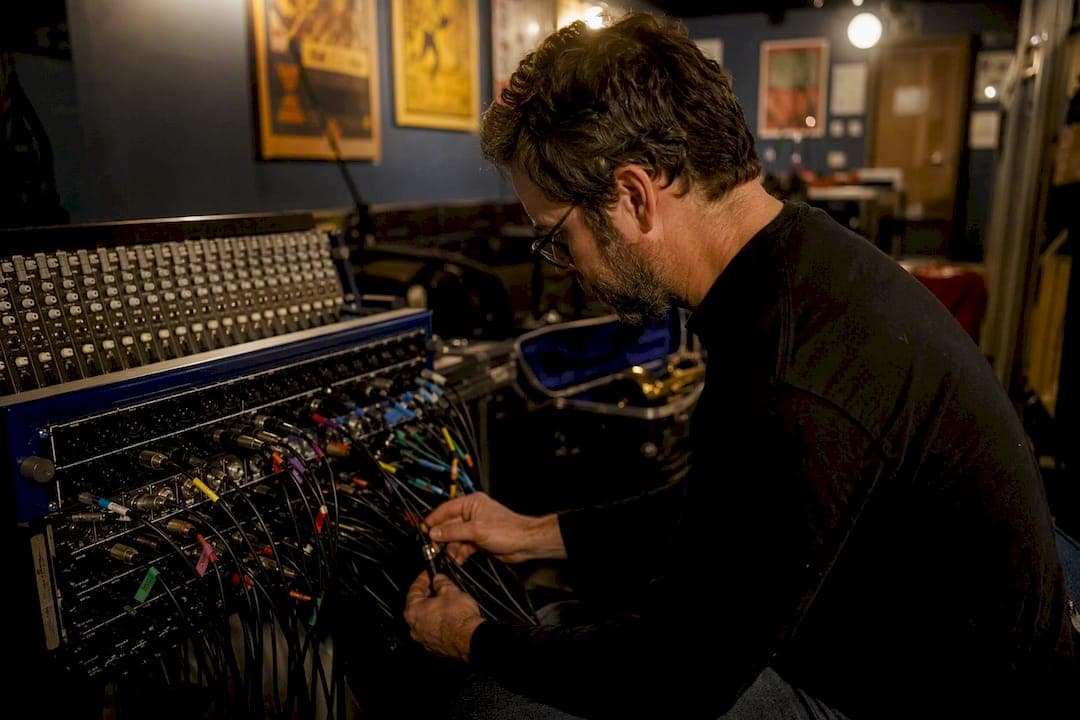
Venues manage live performance logistics by running one repeatable sequence: advance the show, build the timeline, execute the show, settle and load out. Skip any link in that chain and the cracks show up on stage, not in a spreadsheet.
Before doors open, five things need to be locked down. Confirm the booking details in writing. Get the technical rider and stage plot from the artist or their production manager. Name a single point of contact for both production and hospitality questions. Publish a load-in plan that every department can see. Define what happens if something breaks, from a blown speaker to a weather delay.
Get those five right and the payoff is obvious on show night:
- The set starts within minutes of the published time, not "whenever the band's ready."
- Sound, lighting, and power hold steady through the whole set.
- Guests move through doors, seating, and exits without bottlenecks.
- The artist gets paid the agreed amount, on the agreed schedule, with no settlement argument at 1 a.m.
Key Takeaways
Reliable live performance logistics depend on a structured advance, a protected soundcheck, sequenced load-in, and named owners for every stage of the show.
| Point | Details |
|---|---|
| Advance early | Start confirmation and rider collection at booking, not the week of the show. |
| Protect soundcheck | Treat soundcheck time as fixed in the schedule, not the first thing cut for delays. |
| Sequence load-in correctly | Rig and stage first, then lighting, then audio, then monitors last. |
| Name single points of contact | A named production contact and stage manager prevent confusion during show-day problems. |
| Match ensemble to venue capacity | Alex Levin Music sizes trios, quartets, and hybrid setups to fit your load-in window and stage constraints. |
Table of Contents
- Overview: The Logistics Workflow And Who Owns Each Stage
- Show Advance: What To Collect And When
- Production Timeline And Show-Day Sequencing
- Staffing, Safety, And Front-Of-House Operations
- Auditing Venue Infrastructure Against Artist Needs
- Contingency Planning For When Something Breaks
- Templates You Can Copy Into Your Next Advance Email
- What Alex Levin Music's Event Practice Adds To This Workflow
- What Most Advance Checklists Get Wrong
- Booking Live Music That Fits Your Venue's Logistics
- Frequently Asked Questions
- Sources
Overview: The Logistics Workflow And Who Owns Each Stage
Live event logistics management breaks into six stages, and each one needs a clear owner or it falls through the cracks between departments.
- Booking — the promoter or talent buyer locks the date, fee, and basic terms.
- Advance — a production manager or venue booker collects the rider, hospitality needs, and schedule.
- Technical prep — the venue's technical director or house engineer maps what the space can supply versus what needs rental.
- Load-in and soundcheck — the stage manager runs the floor while the FOH engineer takes ownership of sound.
- Doors and show — front-of-house staff and security manage the room while the stage manager runs cues backstage.
- Load-out and settlement — production manager and venue manager close out gear, paperwork, and payment together.
A repeatable process here isn't bureaucracy for its own sake. Venues that standardize these six stages report less overtime, fewer surprises on show day, and stronger relationships with touring acts who'd rather play a room that runs on time than one that improvises. Smaller venues without a dedicated advancing team can still pull this off using a consistent confirmation document and centralized info storage, which is often the difference between a one-person booker managing five shows a month and that same person burning out by summer.
Show Advance: What To Collect And When
The advance is the single document that prevents almost every avoidable show-day problem. A complete artist advance bundles confirmation details, the technical rider, hospitality requirements, the show-day schedule, production contacts, guest list process, and settlement terms, and venues that treat it as a living document, not a one-time email, tend to run tighter shows.
Here's what goes into it and when to collect it:
- Confirmation details (at booking): date, fee, set length, cancellation terms.
- Technical rider, stage plot, and input list (2 to 3 weeks out): what gear the artist brings versus expects the house to provide.
- Hospitality rider (2 to 3 weeks out): catering, dressing room needs, parking.
- Show-day schedule (1 week out): load-in, soundcheck, doors, set times, load-out, confirmed by both sides.
- Production contacts (1 week out): a named tour manager or FOH engineer, not a generic booking email.
- Guest list (48 to 72 hours out): a hard deadline for names, with a cap communicated up front.
- Settlement terms (48 to 72 hours out): payment method, timing, and who signs off.
A basic show advance built for beginners still needs every one of these fields even for a single acoustic act. Skipping the rider because "it's just a duo" is how you end up with two performers and one working DI box.
Pro Tip: Always ask for a machine-readable stage plot (PDF or image, not a photo of a napkin) and request a named production contact by name and cell number, not just an agency inbox. You'll need that person fast if a monitor dies twenty minutes before doors.
Production Timeline And Show-Day Sequencing
Managing live shows comes down to sequencing. Departments that load in out of order block each other, and that's how a 6 p.m. soundcheck becomes a 7:45 p.m. soundcheck with doors already open.
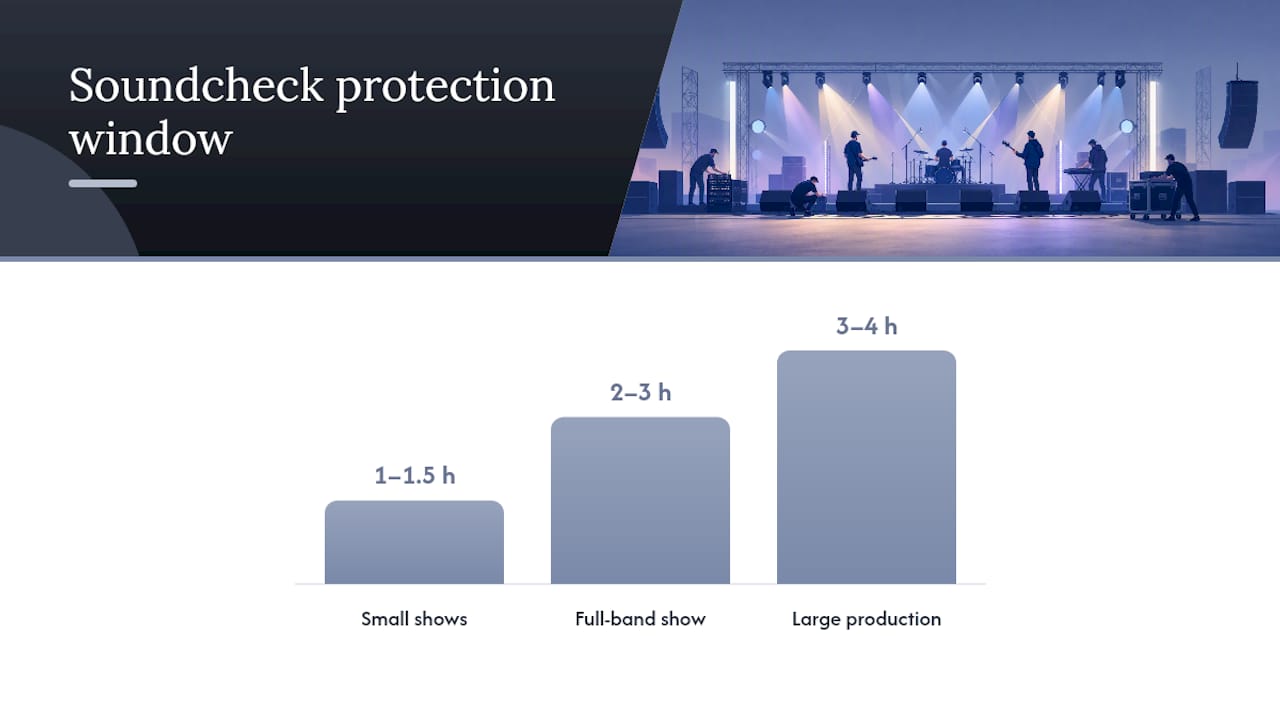
- Small acoustic or corporate sets: load-in 3 to 4 hours before doors, soundcheck protected 60 to 90 minutes before doors.
- Full-band club shows: load-in 5 to 6 hours before doors, soundcheck 2 to 3 hours before doors.
- Large productions with trucks and rigging: load-in 8 to 12 hours before doors, soundcheck protected 3 to 4 hours out.
The order of operations matters as much as the hour count. Rigging and staging go first, because lighting and audio crews need a stable structure to hang and mount gear on. Lighting typically follows, then audio, then monitors last, since monitor engineers need the PA already tuned to avoid fighting feedback all night. Skip this order and you get departments blocking each other's access to the stage, which eats the buffer you built into the schedule.
Soundcheck is the most commonly sacrificed item on a tight schedule, and it's the wrong one to cut. Multi-act nights need changeover windows built in from the start, not discovered when the headliner's gear is still on stage at doors. Load-out takes a few hours depending on production size, and efficient packing with clear artist-versus-venue gear labeling prevents the 1 a.m. scramble to find someone's cables.
Staffing, Safety, And Front-Of-House Operations
Venue performance coordination lives or dies on staffing. The core roles are the stage manager (runs the show backstage), the FOH engineer (owns the mix), stagehands (execute load-in and changeovers), and security (controls crowd flow and access). Staffing ratios scale with room capacity and act complexity, not just headcount on the door.
Front-of-house operations need their own workflow separate from production:
- Guestlist intake happens at a dedicated table, never at the main entrance line.
- Credentials (wristbands, laminates) get distributed before doors, not improvised at the door.
- Comms run on headsets or radios between stage management, FOH, and security so a problem in one zone doesn't require someone physically running across the room.
- A named medical liaison and a clear protocol for contacting local first responders should exist before doors, not get worked out mid-emergency.
Venue logistics planning that includes staffing plans, perimeter control, and emergency response coordination tends to correlate with fewer incidents and better repeat bookings from touring acts who talk to each other about which rooms run smoothly.
Auditing Venue Infrastructure Against Artist Needs
Every venue has a fixed set of technical capabilities, and knowing them cold before an advance call saves hours of back-and-forth. Run this audit once, keep it current, and hand it to production managers before they ask.
- Power: available circuits, amperage, and whether the stage has isolated power for audio gear.
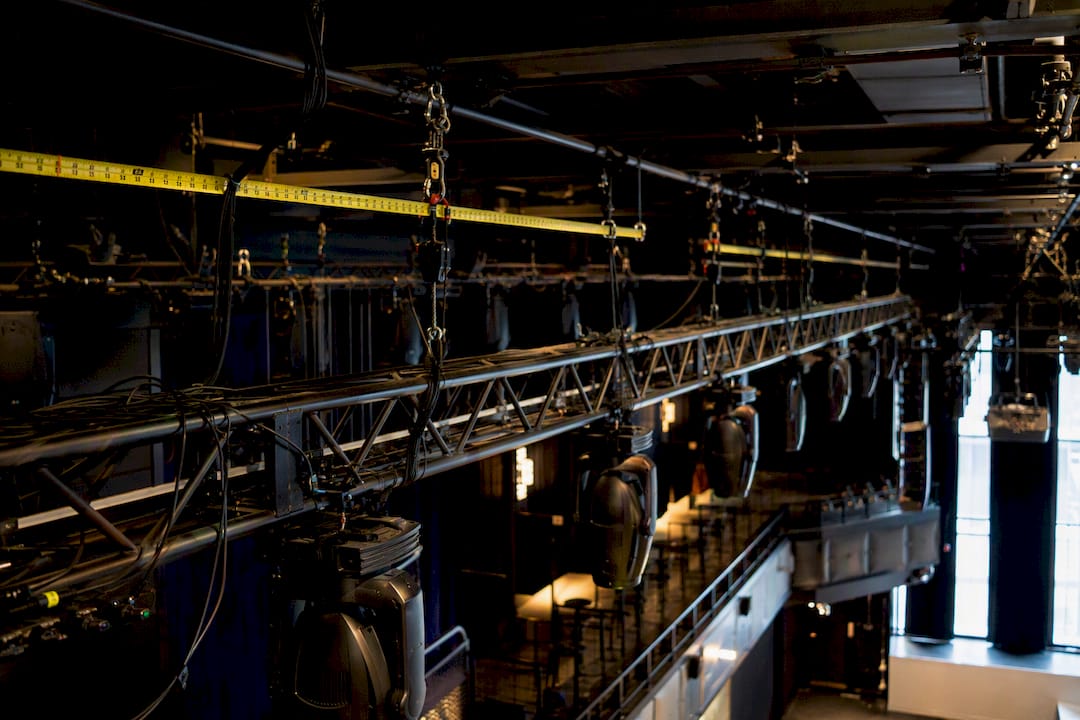
- Rigging: point locations, weight limits, and ceiling height.
- PA and line array: house system specs and coverage pattern for the room's actual shape.
- Stage access: dock size, load-in door dimensions, and distance from truck to stage.
- Dimmers and house lighting: what's already rigged versus what needs a lighting package brought in.
Reading a technical rider is really a matching exercise: what the artist requests against what the house already owns. Anything the venue can't supply becomes a rental decision, made early enough to actually book the gear. Professional-level freight manifests and CAD pre-visualization sound like overkill for a 200-seat room, but the underlying habit, documenting exactly what's coming through the door and where it goes, scales down fine.
Pro Tip: Send touring production a labeled stage plot with actual measurements, not a generic template. A rigger who can see your ceiling height and dock size before arrival day plans a tighter load-in, and that saved hour usually becomes your soundcheck buffer.
Contingency Planning For When Something Breaks
Every venue eventually loses a monitor, a mic, or an hour to weather. The difference between a manageable hiccup and a canceled set is whether you planned for it in advance.
- Keep a backup power source or a relationship with a local rental house on speed dial for gear failures.
- Build an alternate stage configuration for acts that lose a piece of backline mid-show.
- For outdoor events, set a documented go/no-go weather threshold and name who has the authority to call it.
- Add a 30 to 60 minute buffer into the show-day schedule specifically to absorb small delays without pushing doors.
Outdoor weddings and outdoor corporate events carry their own version of this risk, and outdoor live music logistics deserve a separate contingency plan built around shade, power access, and a covered backup location for the ensemble. The advance should name, in writing, who makes the call to move indoors and by what time.
Templates You Can Copy Into Your Next Advance Email
A modular advance template beats rebuilding a document from scratch every show, especially if your venue books both a solo pianist and a six-piece band in the same month.
- Advance checklist: confirmation, rider, hospitality, schedule, contacts, guest list, settlement.
- Stage plot fields: performer positions, monitor placement, power drops, DI locations, mic stand count.
- Input list fields: channel number, instrument or source, mic or DI type, phantom power needed.
- Crew call sheet: role, arrival time, contact number, department lead.
| Document | Core Fields | Deadline |
|---|---|---|
| Confirmation | Date, fee, set length, cancellation terms | At booking |
| Technical rider | Stage plot, input list, backline needs | 2 to 3 weeks out |
| Hospitality rider | Catering, dressing room, parking | 2 to 3 weeks out |
| Show-day schedule | Load-in, soundcheck, doors, set times | 1 week out |
| Guest list | Names, cap, submission method | 48 to 72 hours out |
Maintaining two versions of your crew call sheet, one lean for a solo act and one detailed for a full production, lets you scale documentation without rebuilding it from zero every time.
What Alex Levin Music's Event Practice Adds To This Workflow
Alex Levin Music books jazz trios, string quartets, solo piano, and DJ or hybrid ensembles for weddings, corporate events, and private celebrations across Philadelphia, New York, and beyond. Running that range of setups, from a single pianist in a hotel lobby to a full band on an outdoor tent stage, means production-aware advancing isn't optional. It's the job.
- Every booking includes a stage plot and input list sized to the actual ensemble, not a generic template.
- Outdoor and tented events get their own logistics conversation before contracts are signed, covered in outdoor wedding live music logistics.
- Venues booking recurring live music benefit from the same repeatable process outlined in hosting live music regularly.
A wedding venue that knows its power drops and load-in door width before the band arrives cuts a 90-minute setup down to 40, and that difference shows up directly in how relaxed the first dance actually feels.
What Most Advance Checklists Get Wrong
Most advance templates treat every field as equally important, and that's the mistake. Confirmation details and settlement terms matter, but they rarely break a show. The technical rider and the show-day schedule are what actually determine whether doors open on time, and those two documents deserve more scrutiny than the rest combined.
The bigger gap I see in conventional advice: it treats the guest list deadline as an afterthought, buried at the bottom of a checklist, when a late or uncapped guest list is one of the most common sources of door chaos on a busy night. Set that deadline as firmly as you set the load-in time, and enforce it the same way.
If you manage a venue that books a mix of small acoustic sets and full productions, don't build one advance template and stretch it to fit both. Build two, a lean version and a detailed version, and pick based on the act before you send the first email. That single decision saves more back-and-forth than any amount of extra rider detail.
Prioritize protecting soundcheck over almost anything else in the schedule. It's the one line item that, when cut, causes problems no amount of good staffing can fix in the moment.
Booking Live Music That Fits Your Venue's Logistics
Venues that get advancing and scheduling right still need the right ensemble for the room and the event. Alex Levin Music builds every booking around what a venue can actually support, sending a stage plot and input list sized to the act before contracts are signed, so production managers aren't guessing at power needs or monitor counts two weeks out.
For corporate events specifically, matching the right ensemble size to your load-in window and changeover schedule matters as much as the music itself. The corporate event planning services page walks through jazz trio, quartet, and hybrid DJ setups built for venues with tight production timelines. If you're planning a wedding or private event and want an ensemble that arrives with its logistics already sorted, get in touch through the ensembles and soloists overview to check availability for your date.
Frequently Asked Questions
What is the standard timeline for load-in before a live show? Small acoustic sets need 3 to 4 hours, full-band club shows need 5 to 6 hours, and large productions with trucks and rigging typically require 8 to 12 hours before doors.
Who should own the technical rider once it's received? The venue's technical director or house engineer should review it first to flag what the house can supply versus what needs external rental, then loop in the stage manager before finalizing the show-day schedule.
How far in advance should a venue collect the guest list? Set the deadline at 48 to 72 hours before the show, with a hard cap communicated to the artist or their management at the time of booking.
What happens if a technical rider isn't provided in time? The venue should assume standard house capabilities and flag gaps directly with production contacts as soon as possible. Waiting until load-in day to discover missing gear is the most common avoidable failure in live event logistics management.
Do small venues need the same advance process as large production venues? Yes, though the documents can be leaner. A modular template that scales from a solo pianist to a full band lets a small team run a repeatable process without extra headcount.
Sources
- How to Build an Artist Advance Process at a Grassroots Music Venue | Stage Portal
- What Actually Happens Behind the Scenes at a Major Concert - And OF Other Things