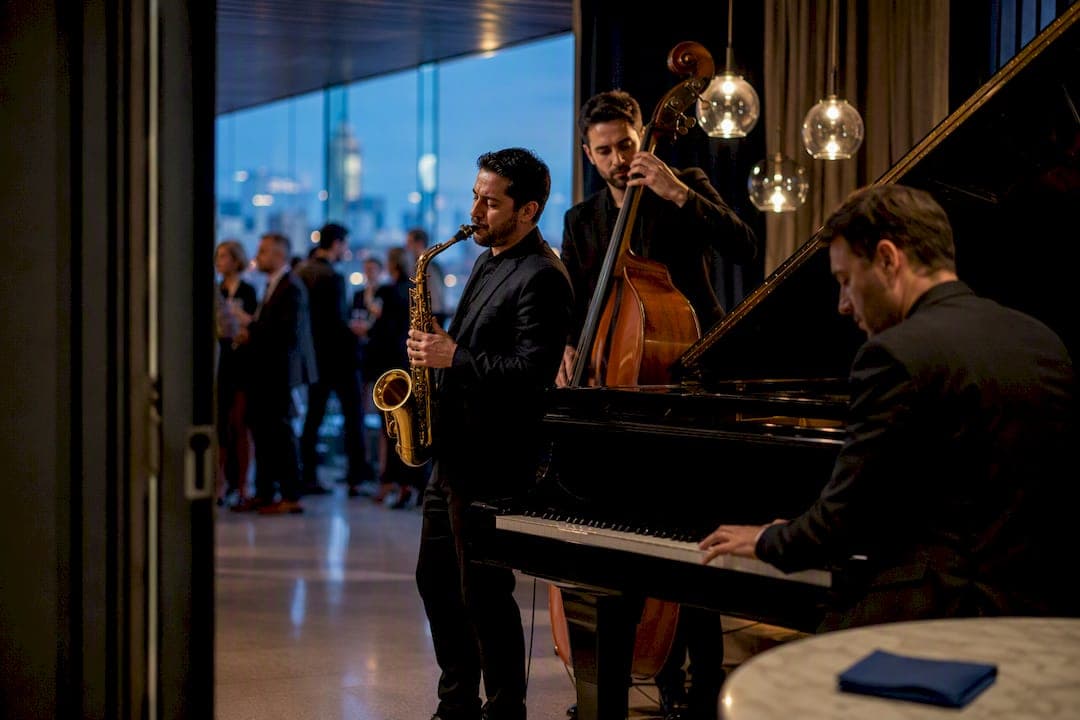
For a cocktail-only reception, book a soloist or small trio. For a seated dinner, add strings or a soft jazz quartet. For dinner plus dancing, layer a cocktail ensemble with a DJ or party band for the back half of the night. Confirm your format, guest count, and budget first, then book six to twelve weeks out since December calendars fill fast.
TL;DR:
- Acoustic acts like soloists, string quartets, or jazz trios are ideal for arrival, cocktail hours, and seated dinners for guest counts under 150.
- Layering acts, such as a jazz trio followed by a DJ or full band, enhances transitions from dining to dancing, which is critical for larger guest lists.
- Matching the music style to the event theme, like harp for Winter Wonderland or a jazz trio for classic glam, creates a more intentional and cohesive experience.
- Budget ranges vary from $500 for solo acts to over $20,000 for large ensembles with production support, depending on size and event duration.
- Book six to twelve weeks in advance, focusing on clear timelines, technical needs, and performance details to avoid logistical issues during peak holiday season.
Table of Contents
- Holiday Party Live Music Ideas: Which Acts Fit Which Moment
- Match Music to Party Format and Guest Count
- Themed Pairings That Make the Music Feel Intentional
- What Holiday Party Live Music Actually Costs
- Timing Your Music So Transitions Feel Effortless, Not Awkward
- Your Booking Checklist Before You Sign a Contract
- Why a Professional Act Earns Its Fee
- Planner's Perspective: The One Shortcut Worth Using
- Book Live Music for Your Holiday Party
- Sources
- FAQ
Holiday Party Live Music Ideas: Which Acts Fit Which Moment
The right act depends on what guests are actually doing at that moment: eating, mingling, or dancing. A jazz trio playing background standards during a plated dinner works beautifully. That same trio, asked to fill a dance floor at 9 p.m., will leave people standing around. Match the sound to the activity, not the season.
Here's a working catalog of live-music options for holiday parties, organized around the moment each one serves best.
- Solo pianist or guitarist. Ideal for arrival, cocktail hour, or a quiet luncheon. A single acoustic instrument fills a room without competing with conversation, and setup takes 15 to 20 minutes with minimal power needs.
- Jazz trio. The workhorse of holiday parties: piano, bass, and either drums or a horn. Works for cocktail hours, dinner service, and can stretch into light dance material later. Expect a 30 to 45 minute load in and a small stage footprint.
- String quartet. Two violins, viola, and cello read as formal and elegant, which makes them the standard choice for ceremony-style moments, seated dinners, or a "classic glam" theme. They're acoustic by nature and need almost no amplification in a mid-size room.
- Solo harpist. An underused option for lobby or entrance moments. A harp reads as luxurious without the volume of a full ensemble, and it pairs well with a "winter wonderland" aesthetic.
- Carolers or vocal groups. Strolling carolers at arrival or during cocktail hour give guests an immediate, unmistakable holiday cue. They're acoustic, mobile, and need no stage at all, just floor space to move through the crowd.
- Brass ensemble. A trio or quartet of horns brings festive energy fast and works especially well for outdoor arrivals, tree lightings, or a punchy 10-minute cocktail-hour moment. Brass carries volume naturally, so it suits larger or higher-ceilinged rooms.
- Party or cover band. A full band with vocals, rhythm section, and horns is built for the dancing portion of the night. This is where amplification becomes non-negotiable. You're looking at a full PA, stage lighting, and 45 to 60 minutes for setup and sound check.
- DJ. The most flexible dance-floor option, and often the most budget-friendly for pure volume of music across a long night. A DJ needs a compact footprint but still requires house sound or a rented PA.
- Specialty acts. Roving magicians paired with a solo guitarist, or a saxophonist sitting in with a DJ set, can add a memorable layer without the cost of a full band. According to the Music Trust, pairing a live instrumentalist like a saxophonist or violinist with a DJ creates a layered sound that feels upscale without the expense of a large ensemble.
The acoustic-versus-amplified line matters more than most planners realize. A string quartet or solo pianist can usually go fully acoustic in a room for under 100 guests with decent acoustics. Push past 100 guests, add a ballroom with hard floors and high ceilings, or plan any dancing at all, and you need amplification, which means a sound tech, not just a talented musician plugging into a house system.
Pro Tip: Ask any prospective act one question before anything else: "What's your setup and sound check time?" A trio that needs 45 minutes of setup in a room with a tight cocktail-hour turnover will eat into your guest arrival window if nobody planned for it.
For a deeper look at how jazz ensembles specifically get selected for corporate settings, this guide to choosing a jazz ensemble breaks down instrumentation choices by room size and formality.
Match Music to Party Format and Guest Count
Format determines act choice more reliably than budget, theme, or guest preference. Deciding on the event format before booking entertainment is the single planning step that prevents the most common holiday party mismatch: a band too big for the room, or a soloist too quiet for the crowd.
Here's how to think through it by format:
- Cocktail-only reception. A solo pianist, guitarist, or a duo is usually enough. Guests are standing, talking, and moving. Music should support conversation, not compete with it.
- Sit-down dinner (no dancing). A string quartet or jazz trio at low volume works well. For 50 guests or fewer, a soloist can carry the whole room.
- Dinner plus dancing. This is where layering pays off. Book a trio or quartet for cocktails and dinner, then transition to a DJ or full band once dinner plates clear. Guest counts above 150 usually justify a full band with horns and vocals.
- Luncheon. Keep it acoustic and low key. A soloist or duo suits a midday office gathering far better than anything amplified.
- Drop-in open house. Guests arrive and leave on their own schedule, so a solo act or small ensemble that can play for hours without a formal "set" structure fits best.
- Hybrid (in-person plus virtual). Budget for a dedicated production person. Assuming the performer can handle streaming production alone is one of the most common and costly hybrid-event mistakes.
A sample timeline for a 150-guest dinner-and-dancing corporate party: cocktail trio from 6:00 to 7:00 p.m., dinner music (same trio, softer) from 7:00 to 8:15 p.m., a 20-minute handoff to the DJ or band, then dancing from 8:35 p.m. to close.
The most common mistake planners make is booking one act for the entire night because it seems simpler. A jazz trio can't fill a dance floor, and a loud party band during a plated dinner drowns out toasts and conversation. The second most common mistake: underestimating guest count growth. A trio booked for 80 confirmed guests can sound thin once 120 people actually show up.
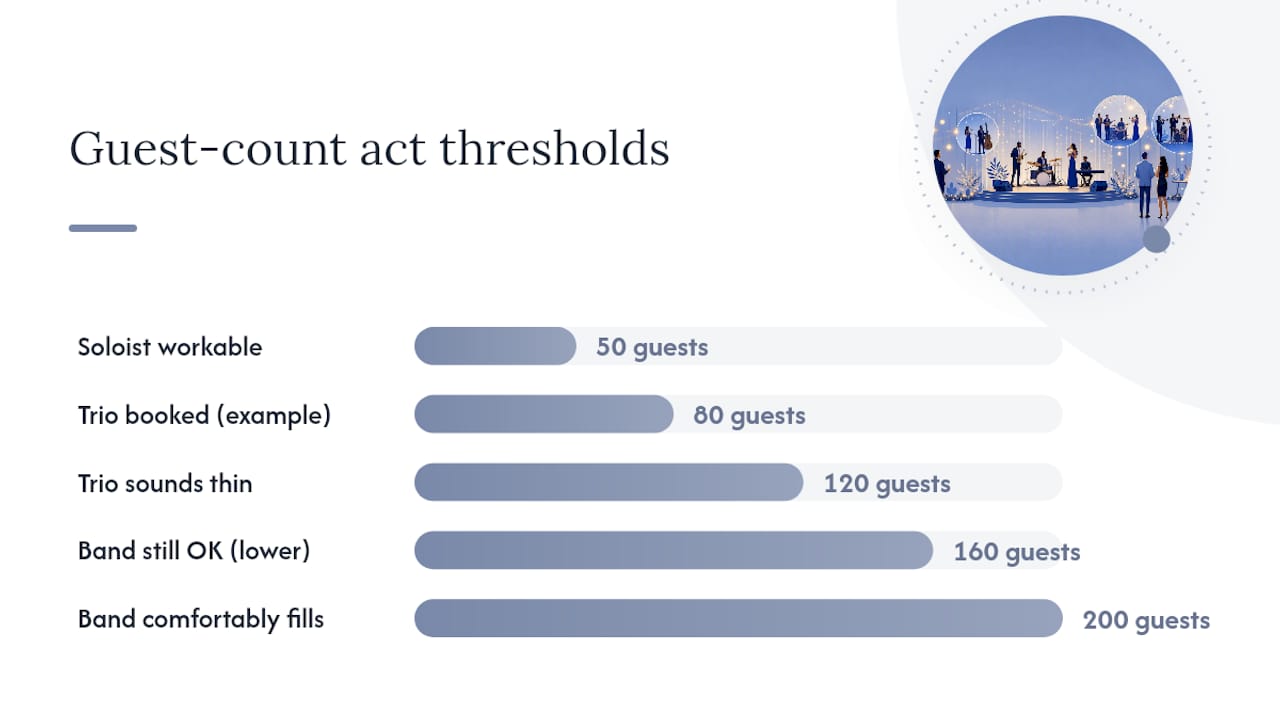
Pro Tip: When guest counts are still soft, book for your upper estimate. It's far easier to have a band that comfortably fills a room with 200 when only 160 show up than to have a quartet struggling to cover a room that swelled past capacity.
For more on balancing formal dinner music against a livelier back half of the night, see this breakdown of striking the right tone between formal and fun.
Themed Pairings That Make the Music Feel Intentional
A theme without matching music reads as decoration, not experience. A theme with the right music reads as a designed evening. Pairing a theme with the right music gives guests an instant cue about the tone of the night, no costume required.
A few pairings that consistently work:
- Winter Wonderland. A harpist at the entrance and a string quartet through dinner reinforce the icy, elegant aesthetic without a single line of dialogue needed to explain the theme.
- Classic Glam (think 1940s supper club). A jazz trio with a vocalist nails this instantly. Add a standing bass and brushed drums, and the whole room feels like it stepped into an old film.
- Decades party (70s, 80s, 90s). A cover band that specializes in era-specific sets does more work than any decoration budget. Pair it with an era-appropriate photo booth for a low-cost activation that guests use all night.
- Family-friendly gathering. Carolers strolling during arrival, followed by a duo playing familiar, upbeat instrumental holiday songs, keeps things warm without leaning on any one religious tradition.
Inclusive, non-denominational programming matters more at office parties than almost anywhere else. Lean on instrumental holiday standards, winter imagery (snow, lights, evergreens), and general "festive season" language rather than material tied to one specific holiday. A skilled trio or quartet can build an entire set list around "winter" and "celebration" themes without ever touching a carol with religious lyrics, which keeps the evening welcoming for a mixed audience.
Simple activation ideas pair naturally with these choices: strolling carolers at the door as guests check in, an era-specific photo backdrop next to a decades-themed cover band, or a "request a song" card on cocktail tables that a jazz trio can work into their set. None of these require a big budget. They just require deciding on the pairing before you book, not after.
What Holiday Party Live Music Actually Costs
Live music for a holiday party typically runs from a few hundred dollars for a solo act to several thousand for a full band, and the spread depends heavily on act size and event length.
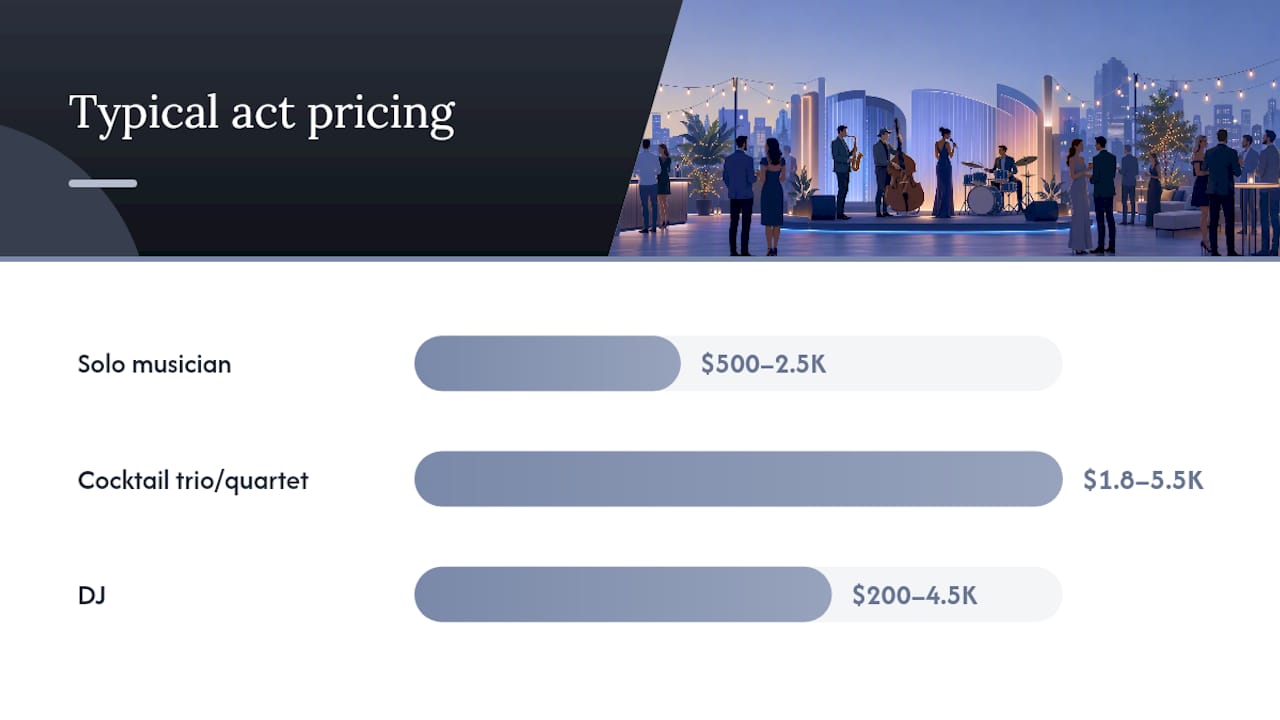
According to industry pricing data, a solo musician typically runs $500 to $2,500, a cocktail trio or quartet runs $1,800 to $5,500, and a DJ can range anywhere from $200 to $4,500 depending on experience level and equipment.
Budget snapshot: A cocktail trio or quartet for a holiday party generally costs $1,800 to $5,500, while a solo pianist or guitarist runs $500 to $2,500 for the same evening.
Sample budgets by event size:
- Small private party (20 to 40 guests): A soloist or duo for cocktail hour and dinner, roughly $800 to $2,000 total.
- Mid-size corporate event (75 to 150 guests): A trio or quartet for cocktails and dinner, plus a DJ for a two-hour dance set, roughly $3,500 to $8,000 combined.
- Large gala (200-plus guests): A quartet or brass ensemble for arrival, a full party band for dancing, plus production support, often $8,000 to $20,000 or more depending on market and act tier.
Spend where guests notice most: the transition moments and the dance-floor act, since a weak handoff or a thin-sounding band during the peak of the night sticks in memory far more than background music during dinner. Save by trimming set length for lower-priority windows, like arrival, rather than downgrading the act guests will actually watch.
Hidden costs trip up more budgets than the base performance fee. Sound and lighting rental, travel fees for acts coming from outside your immediate metro area, and basic hospitality (a green room, water, a meal for the band) all add up and rarely appear in a quoted "starting price."
Timing Your Music So Transitions Feel Effortless, Not Awkward
Ask any performer to arrive at least 60 to 90 minutes before doors open. That window covers load in, sound check, and a buffer for hotel loading-dock delays, which happen more often than anyone expects during the December booking rush.
- Cocktail hour: 45 to 60 minutes of music, low volume, acoustic or lightly amplified.
- Dinner: 60 to 90 minutes, softer still, since guests need to hear table conversation and toasts.
- Dancing: 90 minutes to two hours, full volume, full production.
The handoff between acts is where most events actually stumble. Build a 20-minute transition window: the outgoing act finishes on a soft closer, the incoming DJ or band's sound is already patched into the same system during the last song, and an MC or event lead cues the lighting shift as the first act steps off. Scheduling a clean handoff between acts rather than leaving it to chance is what separates a seamless night from an awkward silent gap on the dance floor.
Pro Tip: Ask both acts to share the same sound system whenever possible. Swapping entire PA setups mid-event is the single biggest cause of dead air between a dinner ensemble and a dance-floor band.
Confirm a basic technical checklist before the event: available power (most bands need multiple dedicated circuits), a defined stage area with sightlines to the dance floor, and mic count for any speeches or toasts that share the same sound system as the music.
Your Booking Checklist Before You Sign a Contract
Before locking in any act, get these details in writing.
Logistics and contract terms:
- Confirmed arrival, setup, and sound check times
- Cancellation and rescheduling policy, especially for weather-dependent outdoor events
- Deposit amount and due date
- Travel fees if the act is based outside your immediate area
Performance specifics:
- Full repertoire or genre range, plus whether they take holiday-specific requests
- Whether they perform copyrighted covers of current pop or holiday hits, since some acts stick to originals or public-domain material
- A sample set list from a similar past event
- Ask for video of a live, unedited performance, not just a studio demo.
- Ask for at least one reference from an event of similar size and format.
- Confirm payment schedule: most acts require a deposit to hold the date, with the balance due before or on the event date.
Also worth a quick read before finalizing plans: SHRM's guidance on minimizing employer liability at holiday parties, particularly if alcohol service overlaps with amplified music and a later end time.
Why a Professional Act Earns Its Fee
A professional ensemble reads the room and adjusts, something a playlist never does. Alex Levin Music books soloists, jazz trios, string quartets, and hybrid DJ-and-live configurations, each shown with sample video and matched to a client's format and venue rather than sold as a one-size package.
That range matters because a five-piece band and a solo pianist solve completely different problems. Professional acts also manage the parts hosts rarely think about until they go wrong: sound check timing, the handoff into a DJ set, and hybrid production for a livestreamed portion of the party. A trio that has played 100 corporate holiday parties knows how to read a lukewarm dance floor and adjust the set on the fly. A great playlist can't.
Planner's Perspective: The One Shortcut Worth Using
The layered instrumentalist-plus-DJ pairing keeps showing up at the best holiday parties I've watched come together, and it's not just a trend for trend's sake. It solves the actual problem: a DJ alone can feel flat during arrival, and a full band alone is overkill for a three-hour office party.
The real shortcut, though, is deciding your format before you touch a single vendor quote. Every entertainment decision, room layout, and even catering timeline follows from that one choice. Skip it, and you're negotiating backward for weeks.
— Alex
Book Live Music for Your Holiday Party
Live music acts including soloists, jazz trios, string quartets, and hybrid DJ-and-live configurations can be booked for corporate and private holiday parties, with ensembles matched to room, guest count, and theme rather than sold as fixed packages.
When you request a quote, include five things: your event format (cocktail-only, dinner, or dinner plus dancing), guest count, venue name or type, target budget range, and your date. That's enough for a first, accurate proposal rather than a generic price sheet. From there, the process is simple: a short consultation call, a sample set list matched to your theme, and a straightforward contract covering deposit, setup time, and cancellation terms before anything gets signed.
If you already know you want dinner music that transitions cleanly into dancing, start with the corporate event entertainment page to see ensemble and DJ/hybrid configurations built for exactly that handoff, or reach out directly to check availability for your date.
FAQ
What are some entertainment ideas for a Christmas party?
Strolling carolers at arrival, a jazz trio through cocktails and dinner, and a DJ or party band for dancing cover most holiday formats well. Specialty touches like a roving magician or a saxophonist sitting in with a DJ set add memorable moments without a big budget jump.
What are some popular themes for holiday parties?
Winter Wonderland, classic glam supper-club looks, and decades parties (70s, 80s, 90s) remain reliable choices because each pairs naturally with a specific music style, from harp and strings to an era-specific cover band.
What are some unique themes for a holiday party?
A decades theme paired with a specialty tribute band and an era photo booth stands out because guests get an instant, low-effort way to participate. Pairing a live instrumentalist with a DJ, rather than booking either alone, also creates a fresher sound most guests haven't heard at other office parties.
What are unique party entertainment ideas beyond a standard DJ?
A harpist at the entrance, a brass ensemble for an outdoor arrival moment, or a live saxophonist layered into a DJ set all read as more distinctive than a standard DJ-only setup. Some hybrid ensemble configurations are built around this kind of layered pairing.
How far in advance should I book live music for a holiday party?
Book six to twelve weeks ahead for most events, since December calendars fill quickly for both individual musicians and full bands. Popular dates in the first two weeks of December often book out even earlier.