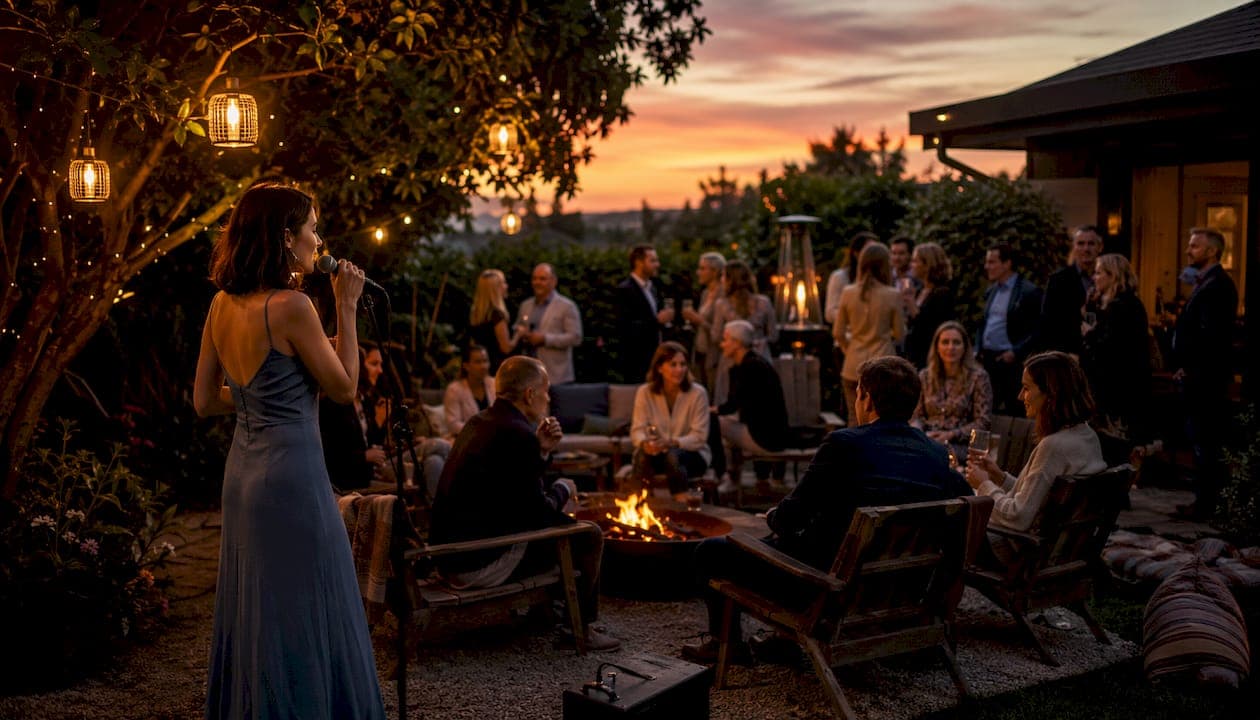
Live music transforms house parties in a way no playlist ever can. The physical presence of musicians triggers measurably higher heart rates and emotional arousal in listeners, according to a randomized controlled study comparing live concerts to simultaneous livestreams. Guests feel more moved, more connected to each other, and more alive in the room. That is not a vibe you can fake with a Spotify queue.
What makes live music so different at a private gathering comes down to a few things happening at once:
- Physiological engagement: A live performer raises audience heart rate in ways recorded music does not, signaling deeper emotional involvement.
- Collective effervescence: Guests share a sense that something special is happening right now, together, in this room.
- Spontaneous interaction: Musicians read the crowd, improvise, and respond. No algorithm does that.
- Memory formation: Shared peak experiences at live events create stronger, longer-lasting positive memories than passive listening.
- Social bonding: The energy of a live performance gives strangers a reason to turn to each other and react.
The rest of this guide breaks down exactly how these effects work, which formats fit which party sizes, and how to pull it off without blowing your budget or annoying your neighbors.
Why live music profoundly transforms private gatherings
The science behind live music at social events has gotten sharper in recent years, and the findings are worth knowing before you book anyone.
The physiological case
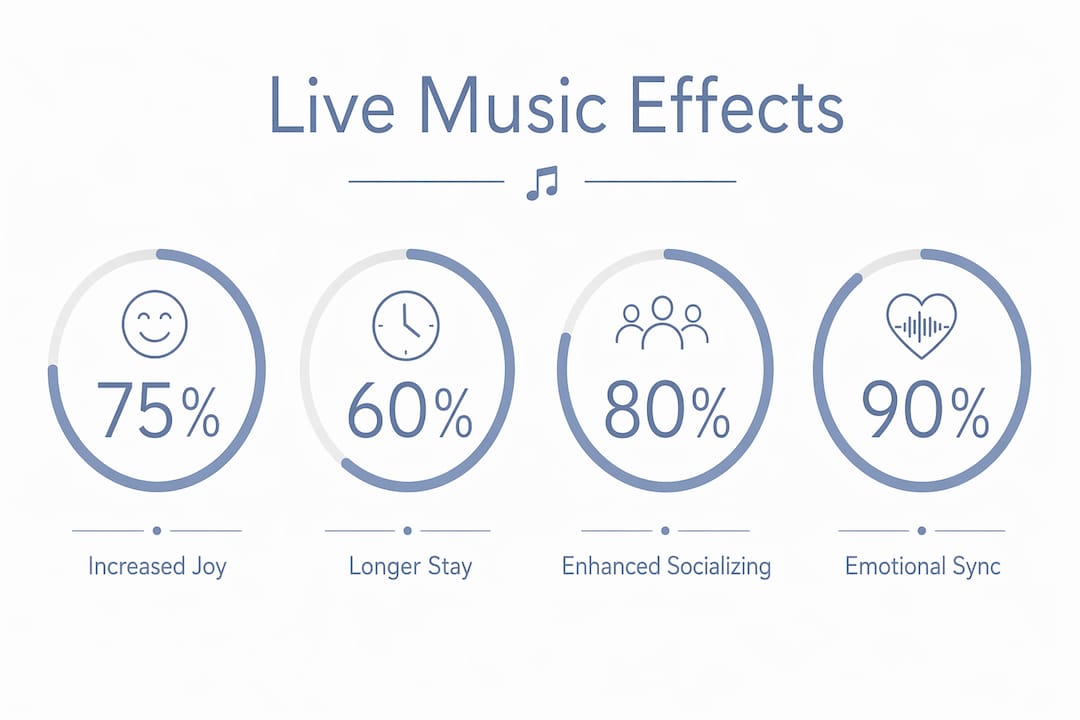
A randomized controlled pilot study with a group of participants compared live classical and pop concerts against a simultaneous cinematic livestream of the same performance. Guests in the live condition reported greater appreciation, higher emotional arousal, and stronger feelings of being moved (a state researchers call kama muta). Their mean heart rate was also significantly higher. The livestream group sat in the same building, heard the same music, and still had a measurably different experience. The only variable was whether the musicians were physically in the room.
Collective effervescence and lasting happiness
Research published through Duke University found that live music events foster collective effervescence, a state where guests feel simultaneously connected to each other and aware that something meaningful is occurring. This is not just a pleasant feeling in the moment. The same research found that these effects produced lasting positive outcomes in the days after the event. Attending a live performance with friends turns out to be one of the more reliable ways to get a genuine boost in happiness and sense of meaning.
The "third space" effect
Live music events also function as what sociologists call "third spaces," places that are neither home nor work, where normal social hierarchies loosen and people feel free to be themselves. A systematic review of social outcomes at live music events found that these spaces support self-expression and reduce isolation across music genres and demographic groups. At a house party, this effect is compressed and intimate. The living room becomes a small concert hall, and guests who arrived as acquaintances often leave as friends.
Shared flow, awe, and emotional synchrony
Beyond collective effervescence, live music at gatherings tends to produce shared flow states and emotional synchrony, where guests' emotional responses align without anyone planning it. People sway together, laugh at the same musical moment, and feel the same lift when a song peaks. That synchrony is part of what makes the night feel cohesive rather than like a collection of separate conversations happening near a speaker.
| Effect | Mechanism | Outcome for your party |
|---|---|---|
| Higher heart rate | Physical co-presence of musicians | Guests feel more engaged and alert |
| Collective effervescence | Shared live experience | Stronger social bonds, lasting happiness |
| Third space creation | Separation from everyday context | Guests open up, self-expression increases |
| Emotional synchrony | Synchronized physiological responses | Room feels unified, energy builds naturally |
| Kama muta (being moved) | Live performance vs. recorded | Deeper emotional appreciation of the music |
1. Solo musicians for intimate, conversation-friendly settings
A solo guitarist, pianist, or vocalist is the most versatile option for a house party with 10–30 guests. The sound stays at a level where conversation is easy, and the performer becomes a natural focal point without dominating the room. Solo piano works especially well in open-plan spaces where the instrument can anchor the room visually. A solo vocalist with a backing track sits somewhere between a full live act and a playlist, which can be a practical middle ground when space is tight.
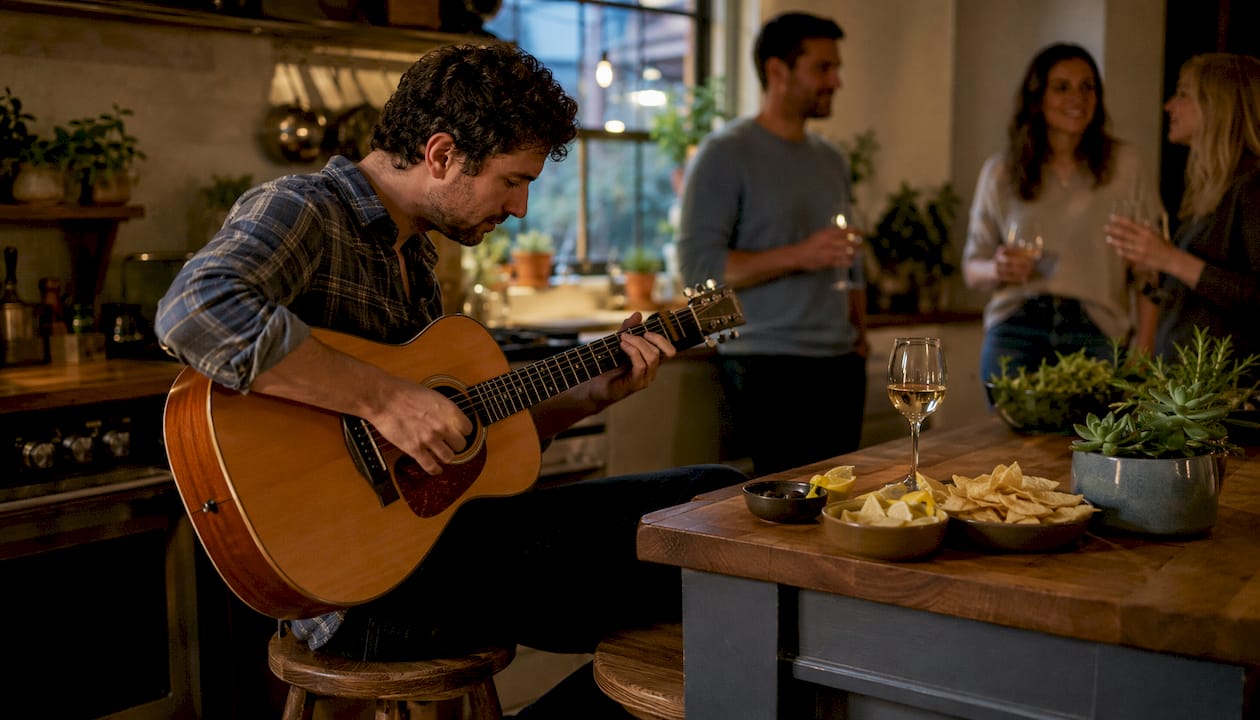
Best for: Dinner parties, cocktail hours, birthday celebrations with a relaxed tone.
2. Duos and small ensembles for moderate energy
A guitar-and-vocals duo, a piano-bass pair, or a small jazz combo (think piano, bass, and drums) adds texture and energy without requiring a full stage setup. These formats are flexible: they can play softly during dinner and push the energy up later in the night. Alexlevinmusic's ensemble options include jazz trios and similar small-group configurations that work well in residential settings where space is limited but the host wants something more than background music.
Best for: Parties of 20–50 guests, events with a defined arc from cocktails to dancing.
3. Full bands and jazz combos for peak energy and dancing
A full band, whether a four-piece pop group or a jazz combo with horns, changes the character of a party completely. The volume, the physical presence of multiple performers, and the visual spectacle all combine to push guests onto the dance floor. This format requires more space, a proper sound system, and advance coordination with neighbors. But when the room is right and the crowd is ready, nothing else comes close.
Best for: Larger house parties (50+ guests), milestone celebrations, events where dancing is the main goal.
4. Acoustic folk and Americana acts for outdoor or backyard parties
An acoustic duo or trio playing folk, Americana, or bluegrass translates beautifully to backyard settings. The natural reverb of an outdoor space suits acoustic instruments, and the genre tends to invite singalongs and casual participation from guests. This format also sidesteps many of the amplification concerns that come with indoor events.
Best for: Backyard gatherings, summer parties, casual celebrations with a laid-back feel.
5. Classical ensembles for elegant, upscale house parties
A string quartet or a solo classical pianist sets a tone that no other format replicates. The music signals sophistication without being loud, and guests tend to listen more attentively, which changes the social dynamic in interesting ways. Classical ensembles work best during the earlier, more formal portion of an event before the energy shifts.
Best for: Upscale dinner parties, engagement celebrations, events where the host wants a refined atmosphere.
6. Jazz acts for the most flexible private party format
Jazz is the format that adapts most naturally to private parties. A jazz trio can play quietly enough for dinner conversation, then shift into uptempo swing that fills a dance floor. The genre also carries a built-in sense of occasion without feeling stiff. Alexlevinmusic specializes in jazz, swing, and sophisticated styles precisely because these formats serve the widest range of private event needs, from a 15-person birthday dinner to a 60-person celebration.
Best for: Nearly any house party where the host wants live music that can shift energy across the night.
7. Hybrid sets combining live music and curated playlists
Integrating live music with ambient playlists or DJ sets maintains a dynamic atmosphere across the full event without requiring a band to play for five straight hours. A common approach: live musicians perform during the peak 60–90 minutes of the party while a curated playlist handles arrival and wind-down. This hybrid model keeps costs manageable and energy consistent.
Best for: Longer events, budget-conscious hosts who still want a live music moment, parties with distinct phases.
| Format | Space needed | Guest range | Energy level | Best moment |
|---|---|---|---|---|
| Solo musician | Minimal | 10–30 | Low to medium | Cocktails, dinner |
| Duo or small ensemble | Moderate | 20–50 | Medium | Dinner through early dancing |
| Full band | Significant | 50+ | High | Peak dancing |
| Acoustic folk/Americana | Flexible (outdoor) | Any | Low to medium | Backyard, casual |
| Classical ensemble | Moderate | 15–30 | Low | Formal dinner, cocktails |
| Jazz trio or combo | Moderate | 20–60 | Low to high | Full event arc |
| Hybrid live + playlist | Varies | Any | Variable | Long events, budget-aware |
How to choose the right live music for your house party
Getting the music right starts with being honest about what kind of party you are actually throwing, not the idealized version.
- Define the atmosphere goal first. A relaxed dinner party and a dance-focused birthday celebration need completely different formats. Decide whether the music is background texture or the main event before you contact anyone.
- Know your guests. A crowd of jazz fans will respond differently than a group of 30-year-olds who grew up on pop and hip-hop. The best live music for a house party is music your specific guests will recognize and respond to, not just music you personally love.
- Assess your space honestly. Measure the room where performers will set up. A grand piano needs roughly 5 by 8 feet of clear space. A full band with a drum kit needs significantly more, plus room for speakers. Overestimating your space is one of the most common mistakes hosts make.
- Plan the energy curve. Music tempo directly affects guest behavior: slow tempos promote conversation and intimacy, while upbeat tempos push people to move and interact. Map out what you want guests doing at each stage of the night, then match the music to that.
- Balance familiar and fresh. A set list built entirely on obscure material loses the room. A set built entirely on obvious crowd-pleasers can feel predictable. The best performers mix recognizable songs with selections guests have not heard before, keeping energy up without becoming a jukebox.
- Vet musicians before you book. Ask for video samples, not just audio recordings. Watch how the performer interacts with an audience. A technically skilled musician who plays with their eyes down the whole time will not create the same engagement as someone who reads the room and plays to it.
Pro Tip: Ask your musician to send you a rough set list 48 hours before the party. Review it against your planned schedule and flag any songs that feel mismatched to a specific moment. A quick conversation before the event is far easier than a mid-party adjustment.
Key considerations for hosting live music at a house party
Logistics make or break a live music experience at home. The music can be perfect and the night can still fall apart if the setup is wrong.
- Designate a clear performance area. Performers need a defined space that is not a thoroughfare. Guests walking through the performance area during a set kills the atmosphere and creates awkward moments for everyone.
- Arrange sound equipment in advance. Small acoustic ensembles may need no amplification at all. Larger groups will need a PA system, monitors for the performers, and someone who knows how to run a basic soundboard. Confirm this with your musicians before the day of the event.
- Schedule a sound check. A 20–30 minute sound check before guests arrive catches problems that would otherwise surface mid-performance. This is non-negotiable for any amplified setup.
- Plan set lengths and breaks. Most musicians play 45–60 minute sets with 15-minute breaks. Build this into your event timeline so breaks feel intentional rather than like the music just stopped.
- Coordinate with neighbors proactively. Tell your immediate neighbors about the event before it happens. A heads-up and a specific end time goes a long way. Offering a direct contact number so they can reach you instead of calling the police is a practical move.
- Think about performer logistics. Musicians need a place to set up their gear, a place to store cases, and access to power outlets. They also need a clear path in and out of your home. Confirm all of this when you book.
- Blend live music with other elements thoughtfully. Live music works best when it complements the party's other elements rather than competing with them. Keep the performance area away from the food and drink stations if possible, so guests are not forced to choose between listening and eating.
Expert insights on maximizing live music impact at house parties
The difference between a good live music experience and a genuinely memorable one usually comes down to planning the energy arc of the night with the same care you give to the guest list.
This sound plotting approach is standard practice among professional event planners and translates directly to house parties. The mistake most hosts make is booking a band and letting them play whatever they feel like. The better approach is a brief conversation about the arc of the night before the event, so the musicians know when to push and when to pull back.
Musician interaction is the other underused lever. A performer who takes requests, makes eye contact with guests, and occasionally addresses the room by name creates a fundamentally different experience than one who treats the living room like a concert hall stage. When you are vetting musicians, ask specifically how they handle crowd interaction at private events. The answer tells you a lot.
Alexlevinmusic's approach to private events reflects this philosophy. The focus on jazz and swing is not arbitrary: these genres are built around improvisation and responsiveness, which means the music adapts to the room rather than the room adapting to the music. Video samples on the site show performers engaging directly with guests, which is the clearest indicator of how a musician will actually behave at your party. For hosts who want to understand what makes live music special at a deeper level, the distinction between a technically proficient performance and a genuinely interactive one is where the real value lies.
For parties with distinct phases, combining live music with curated playlists gives you the best of both. Live musicians handle the peak moments; a well-designed playlist covers arrival and wind-down without requiring the band to play for five hours straight.
How live music shapes what guests actually do at your party
Live music does not just change how a party sounds. It changes how guests move, talk, and relate to each other.
Research on music tempo and event atmosphere confirms what experienced hosts already know intuitively: slow tempos lower activity levels and draw people into closer, more intimate conversations, while upbeat tempos get people on their feet and interacting across the room. A skilled live musician can shift between these modes in real time, reading the crowd and adjusting accordingly. A playlist cannot do that.
The spontaneous interaction between musicians and guests is the other major behavioral driver. When a performer takes a request, nods at a guest who is clearly enjoying a particular song, or plays a brief riff in response to something happening in the room, it creates a feedback loop. Guests feel seen. They engage more. They talk to each other about what just happened. That kind of organic social momentum is genuinely hard to manufacture any other way.
Live music also tends to keep guests at a party longer. When something interesting is happening in the room, people do not drift to their phones or start making exit plans. The presence of a live performer gives guests a shared focal point, which is one of the oldest social technologies humans have.
For hosts interested in how mixed-art live events combine musicians with other performance elements, the behavioral effects compound. Adding a visual or interactive element alongside live music deepens engagement further.
What does live music at a house party actually cost?
Pricing for live music at private events varies widely depending on format, location, and the musicians' experience level. Here is a realistic breakdown.
A solo musician in a major metro area like New York or Philadelphia typically runs $300–$800 for a a typical performance set duration. A duo or small jazz ensemble typically charges amounts commensurate with professional private event rates. Full bands generally command higher fees reflecting group size and profile, depending on the group's profile and travel requirements.
Several factors push costs up or down:
- Day of the week: Friday and Saturday bookings cost more than weekday or Sunday events.
- Travel and accommodation: Musicians outside your immediate area will charge for travel time and, for longer distances, overnight stays.
- Equipment rental: If the musicians do not bring their own PA system, you may need to rent one separately. Budget $150–$400 for a basic setup.
- Set length: Most musicians quote for a standard two-set performance (roughly 90 minutes of music). Additional sets cost more.
- Last-minute bookings: Booking within two weeks of the event often carries a premium, if the musician is available at all.
The most common budgeting mistake is treating the musician's fee as the only cost. Factor in equipment, any permits or fees (covered below), and a tip for performers is customary and often given as a percentage of the booking fee.
Permits, noise ordinances, and keeping the peace with your neighbors
This is the part most hosts skip until something goes wrong. Do not be that host.
Most American cities and counties have noise ordinances that set decibel limits and cutoff times for residential areas. In many jurisdictions, the local noise ordinances often set evening cutoff times for amplified music in residential areas (commonly around 10 or 11 PM) on weekends. Violating these ordinances can result in fines, and repeated complaints can escalate quickly.
Logistical and legal considerations for home events include checking your local ordinances before you book any amplified act. Your city or county's website is the most reliable source. Search for "noise ordinance" plus your city name, and look for the specific decibel limits and time restrictions for residential zones.
Permits are less commonly required for private house parties than for public events, but there are exceptions. If you live in a homeowners association, check your HOA rules. Some municipalities require a special event permit for gatherings above a certain guest count, even on private property. A quick call to your local city clerk's office takes five minutes and can save you a significant headache.
Practical steps that reduce risk:
- End amplified music by 10:00 PM regardless of local ordinance, unless you have confirmed a later cutoff with your neighbors directly.
- Keep windows and doors closed during amplified sets to reduce sound bleed.
- Use a sound level meter app (several free options exist for iOS and Android) to monitor decibel levels during the sound check.
- Have a plan for acoustic wind-down. Switching from amplified to acoustic instruments for the final 30 minutes of the night is a practical way to lower volume naturally while keeping the live music experience going.
Key Takeaways
Live music transforms house parties by triggering measurable physiological and emotional responses that recorded music cannot replicate, making it the single most effective way to create a memorable, socially connected gathering.
| Point | Details |
|---|---|
| Physical presence drives engagement | Live musicians raise audience heart rate and emotional arousal compared to recorded or streamed music. |
| Collective effervescence builds lasting bonds | Live music events foster shared connection and produce positive outcomes that persist beyond the event itself. |
| Format must match the space and crowd | Solo acts suit 10–30 guests; full bands need 50+ guests and significantly more space and coordination. |
| Energy arc planning is the expert move | Map arrival, warm-up, peak, and wind-down phases and brief your musicians on the arc before the event. |
| Noise and permits require advance attention | Check local noise ordinances and HOA rules before booking any amplified act, and notify neighbors proactively. |