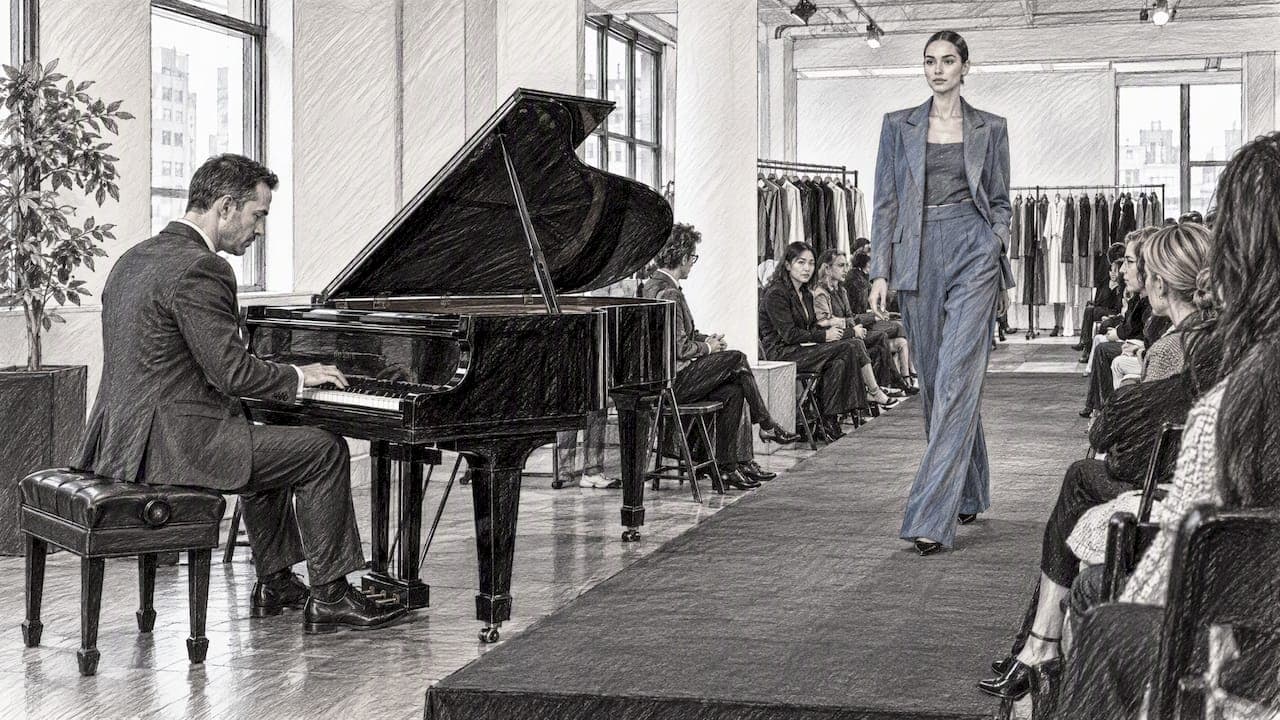
Live music at a fashion show works best when it is written into the show, not added at the end. Decide what the collection should feel like, choose the smallest ensemble that can deliver that feeling, rehearse it against the actual walk, and clear the music rights before doors open. Everything below follows from those four moves.
We are a live event music company, not a fashion house, so we write this from the musician's side of the stage: what a runway asks of a performer, what it asks of the designer, and where shows go wrong.
TL;DR
- Treat live music as a score for the collection, not entertainment. Brief the musicians on silhouette, fabric, pace and mood, and rehearse with the walk.
- Small ensembles (solo piano, a jazz trio, a string quartet) suit intimate shows and showrooms. Large productions need a stage plot, sound crew and much more budget.
- In the US, live music still needs public performance licensing, and a live stream needs separate permission. Check with ASCAP and BMI well before the event.
- Book early, hold a sound check on the real runway, and write down cues, tempo changes and the exit music.
- The same thinking applies to a gallery opening or a presentation: the music frames the objects, it does not compete with them.
Table of Contents
- Why designers are moving from playlists to live musicians
- Think of it as a score, not entertainment
- Which live format fits which kind of show
- Working with the musicians as collaborators
- Hiring emerging talent on a real budget
- Music licensing: the part people forget
- What it costs and what drives the price
- A planning timeline
- From the runway to the gallery: a note on opening-night music
- Our perspective: quiet confidence beats volume
- Booking live music for your show or opening
- FAQ
- Sources
Why designers are moving from playlists to live musicians
For years the runway soundtrack was a mix: a DJ or a sound designer cutting tracks to the pace of the walk. That is still the norm. But more designers now bring performers into the room. A Forbes report on the trend says that independent designers from London to Los Angeles are turning to live musical acts to give their shows an edge, and it notes that big-budget shows with global stars are only one end of the range.
The high-profile examples show the idea at scale. Prabal Gurung's Spring/Summer 2026 show in New York paired a live choir with a music platform designed to guide the audience's emotional response, as SURFACE described. Valentino used the singer Cosima to perform in Milan's Piccolo Teatro, and Vogue's interview with her frames that performance as part of how the collection tells its story.
You do not need a theater or a choir to use the same principle. A single pianist beside a showroom runway does the same job at a fraction of the scale: it tells guests how to feel about the first look before anyone has walked.
Think of it as a score, not entertainment
The most useful reframe we can offer is this: a runway musician is scoring a film that happens to be happening live. The audience is looking at clothes. The music should make the clothes read more clearly, not pull the eye toward the stage.

The music director Benji B, who booked the electronic act Cybotron for a Louis Vuitton menswear show, makes a related point in WWD: the sound works best when it is matched to what the collection is about, rather than being whatever is popular. The same article gives the reasoning that a mechanical, hardware-driven genre can echo the precision of handwork.
In practice that means asking questions a playlist never asks:
- What is the collection's texture? Fluid silk, structured tailoring, knitwear and denim each suggest a different instrument and attack.
- What is the pace of the walk? A slow, deliberate walk can carry a rubato piano line. A fast, graphic walk needs a steady pulse.
- Where is the emotional arc? Openers, mid-show lifts and the finale are three different jobs.
- What should the room remember? A single melody, a texture, a rhythm.
Which live format fits which kind of show
There is no single right ensemble. The format follows the room, the audience size and what the clothes need. Here is how we think about it.
| Format | Best for | What it gives the show | Watch out for |
|---|---|---|---|
| Solo piano | Showroom previews, capsule collections, small salons | Quiet, tactile atmosphere; the clothes stay the focus | Needs a good instrument or a quality stage piano, and a clear position that does not block sightlines |
| Jazz piano trio | Cocktail-style presentations, trunk shows, after-parties | Warm groove, flexibility in tempo, easy to shape cues | Drums need volume control in small rooms |
| Jazz quartet or swing band | Retro, tailoring-led or celebratory collections | Energy and a sense of occasion | Stage footprint and a larger sound check |
| String quartet | Bridal, eveningwear, couture-style presentations | Elegance, clean sustained lines, can play arranged covers or original cues | Intonation in warm, crowded rooms; amplification choices |
| DJ plus live musician (hybrid) | Fashion week-style shows with a strong beat | Continuous energy with live color over the top | Needs one person to own the transitions between recorded and live |
| Vocalist or choir | Narrative-driven, high-production shows | Strong emotional arc | Rehearsal time and rights clearance for the material |
The Chicago Symphony Orchestra shows how far the live idea can stretch: its Red Thread Fashion Show in January 2026 turned Orchestra Hall into a runway, with musicians from the Civic Orchestra of Chicago performing. Most designers will land at the other end of that range, and that is fine.
Working with the musicians as collaborators
Benji B's view, in the same WWD piece, is that the gap between a good show and a great one is collaboration: when a designer works with a musician before the show, the music stops being accompaniment. We agree, and we would add the practical version.
- Share the collection early. Mood boards, fabric swatches and a look order help far more than a genre name. Musicians think in textures.
- Share the run of show. How many looks, how long the walk, where the pauses are. A musician can then write to the clock.
- Rehearse on the runway. Walk a few models, even stand-ins, while the musicians play. Adjust tempo to the walk, not the other way round.
- Agree on cues. Who signals the first note, who ends the finale, what happens if the show runs late.
- Plan a fallback. A backing track or a shorter loop covers delays without silence.
The designers who get the most from this treat the performer as a creative partner, not a vendor you tell to "play something classy."
Hiring emerging talent on a real budget
Not every label can book a touring star. Forbes reports that independent designers often hire emerging performers, both for cost and for the chance to collaborate closely on the sound. The same piece quotes the performer Shannon K on why musicians like runway work: the room is small and the audience is captive, which makes for a closer connection than a typical concert.
That is useful negotiating context. A professional musician who sees an engaged, attentive, industry-heavy audience may value the booking differently than a sheer fee comparison would suggest. It is a reason to pitch your show honestly and tell performers who will be in the room.
If you are weighing how to approach and commission a musician for a bespoke piece rather than a standard set, this guide on commissioning handcrafted instruments and bespoke musical work shows how the maker-player relationship works in a neighboring craft, which is a helpful mindset for a designer briefing a performer.
Music licensing: the part people forget
Live music does not exempt a show from copyright. Many organizers assume that hiring musicians makes the licensing question go away, and WWD's overview of music licensing in fashion makes the point that unauthorized use of music owned by someone else can be copyright infringement, even though music is present at every runway show.
What to check in the US:
- Public performance rights. Songs are licensed through performing rights organizations such as ASCAP, BMI and SESAC. A venue may already hold a license, so ask. If it does not, the organizer may need one.
- Event-type licenses. ASCAP publishes a special events license and BMI publishes a limited use events license. Read the definitions. Fees depend on factors such as attendance, so have your headcount ready.
- Original music. If a musician plays only their own compositions and holds the rights, that changes the picture, but get it in writing.
- Live streaming and recording. An in-person license does not necessarily cover putting footage online. If you plan to stream the show or post a highlight reel, ask each rights holder or organization about the extra permission needed before you do it.
This is not legal advice. For a large or broadcast show, talk to an entertainment attorney and to the PROs directly. Rules and fees change, so confirm against the current documents rather than a blog post, including this one.
What it costs and what drives the price
We cannot give you a single number for a runway, because fashion shows are not one of our fixed packages and every show has different demands. What we can say is how the cost is built:
- Size of ensemble. A solo pianist and a six-piece band are different budgets.
- Length of engagement. Rehearsal and sound check time count, not only the show itself.
- Custom arrangements. Writing or arranging original cues costs more than playing a repertoire.
- Equipment and sound. Amplification, a stage piano, monitors and a sound technician.
- Rights and licensing. Usually paid by the organizer, separate from the musician's fee.
- Travel and date. Fashion weeks and wedding season are both busy.
For reference, our published starting price for reception music and cocktail hour music is from $3,000 per event. A fashion presentation is a custom project, so we quote it individually.
A planning timeline
| When | What to do |
|---|---|
| 3 to 4 months out | Set the concept, choose the format, contact musicians, check date availability |
| 2 to 3 months out | Confirm the booking, share the mood board and run of show, start rights research |
| 4 to 6 weeks out | Finalize repertoire or cues, secure licenses, confirm venue power, stage and load-in |
| 1 to 2 weeks out | Rehearse with the walk, lock the cue sheet, plan the backup track |
| Day of | Sound check on the real runway, quiet check of room acoustics with a full house in mind |
| After | Confirm any recording or posting rights before sharing footage |
From the runway to the gallery: a note on opening-night music
Readers who search for gallery opening music are solving a close cousin of the same problem. People circulate, they talk, and the objects on the wall are the point. The same rules apply: keep the volume under conversation, choose instrumentation that does not dominate the room (solo piano, a jazz trio or a small string group usually do), and give the musicians a spot that does not block traffic or sightlines. Our own writing on why live jazz works in an intimate gathering and on cocktail jazz tips for hosts covers that setting in more detail.
Our perspective: quiet confidence beats volume
We spend our working lives on weddings, cocktail hours, receptions and corporate events, and one lesson carries across to runways: the best live music is the music that makes the room feel more like itself. At a wedding it is the first dance. At a fashion show it is the first look.

When we plan an ensemble for a room, we start with the people in it, the pace of the evening and the feeling the host wants guests to take home. A jazz trio can lean in or pull back within a bar. A string quartet can make a long walk feel inevitable. A solo pianist can make a tailored jacket feel like the only thing in the building. That flexibility is why we like small ensembles for design-led events, and why we think a designer who invites a musician into the process early gets a better result than one who orders a genre.
Our advice is to resist the urge to fill every second. Leave space between looks. Let the finale breathe. And brief your musicians as you would brief a stylist: with a point of view.
— Alex
Booking live music for your show or opening
If you are planning a presentation, trunk show, showroom event or after-party and want live jazz, strings or piano, we build custom ensembles around the room and the theme, from solo piano to trios, quartets, swing bands and DJ-plus-live hybrids. Tell us the date, the venue, the guest count and the mood of the collection through our main site, or look at our DJ and hybrid music option if your show needs a continuous beat with live color on top. We work in Philadelphia, New York and beyond.
For a sense of how we think about arranging music for a room, see how musicians customize private events.
FAQ
What music do they play at fashion shows?
It ranges from DJ-mixed tracks and custom-edited sound design to live performers, depending on the budget and the brand. More designers now hire live acts, from solo musicians to choirs, to match the collection's mood. The common thread is that the music is chosen to support the clothes and the pace of the walk.
Can a small label afford live music at a runway show?
Often, yes, if you scale the format. Independent designers frequently hire emerging musicians and small ensembles rather than famous headliners, as Forbes reports. A solo pianist or a trio costs far less than a full band and fits most showroom spaces.
Do I need a license for live music at a fashion show in the US?
Usually something is required for the songs performed, whether by the venue's existing license or one you obtain through ASCAP, BMI or SESAC. Live streaming or posting video typically raises extra permission questions. Check the current ASCAP and BMI terms, and ask an attorney for large or broadcast shows.
How far ahead should I book musicians?
We suggest three to four months for a custom project, longer around fashion weeks and peak wedding season. That leaves time for arrangements, rights clearance and a rehearsal with the walk.
What works for gallery opening music?
Quiet, unobtrusive live music: solo piano, a jazz trio or a small string group, played below conversation level. Place the musicians away from the main traffic path and keep the set flowing rather than building to loud peaks.
Sources
- Fashion Designers Are Using Musical Acts To Bring Life To The Runway (Forbes)
- Prabal Gurung Tapped Spiritune to Guide His Runway Music's Emotional Resonance (SURFACE)
- Singer-Songwriter Cosima on Her Showstopping Performance at Valentino (Vogue)
- Benji B on Booking Cybotron for Louis Vuitton Men's Fall Show (WWD)
- The Red Thread Fashion Show (Chicago Symphony Orchestra)
- When It Comes to Copyright, Licensing Music Is Always in Fashion (WWD)
- Special Events License (ASCAP)
- Music License for Limited Use Events (BMI)