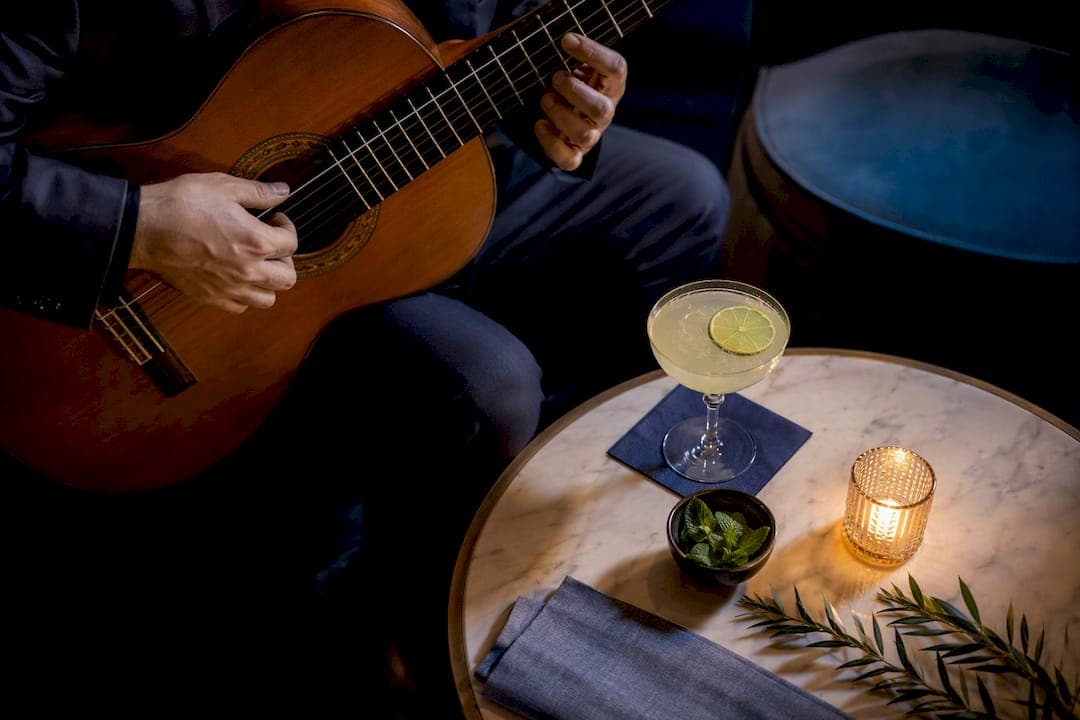
Bossa nova is the most reliable cocktail hour soundtrack for a sophisticated event: play a 45 to 60 minute set of soft, instrumental-heavy bossa nova at low conversation-friendly volume, either from a curated playlist, a live guitarist or trio, or a hybrid of both. If your budget allows it, a small live ensemble beats a playlist for pacing and presence. If it does not, a well-sequenced bossa nova playlist works nearly as well.
TL;DR:
- Live musicians offer dynamic control and repertoire flexibility that playlists cannot match, especially in adjusting pacing during toast or delayed transitions.
- A well-sequenced playlist should start with mellow tracks, gradually increase in energy, and then wind down, maintaining instrumental dominance to encourage conversation.
- Proper sound setup involves evenly distributed speakers, with volume levels checked to ensure guests can converse comfortably without raising their voices.
- Booking should prioritize early room energy with a confident 15-minute opening, as this sets the overall mood for the entire event.
- A caipirinha pairs best with the relaxed, tropical vibe of bossa nova, with a short, carefully curated playlist maximizing smooth transitions and low-volume dynamics.
Table of Contents
- What Format Fits Your Cocktail Hour Best?
- Why Bossa Nova Works So Well for Cocktail Hour
- Live Music vs Playlists: What a Working Musician Sees
- Bossa Nova Basics: Tempo, Rhythm, and Instruments
- Building a Playlist That Actually Holds Up
- A Ready-to-Use 60-Minute Bossa Nova Playlist
- Matching Decor and Lighting to the Music
- Cocktail Recipes That Match the Bossa Nova Mood
- Where Bossa Nova Comes From, and Why It Still Works
- Sound Setup for an Intimate Cocktail Hour
- What Actually Makes a Bossa Nova Set Work
- Live Bossa Nova, Handled for You
- Sources
- FAQ
What Format Fits Your Cocktail Hour Best?
Three delivery options cover almost every event, and the right one depends on budget, venue, and how much control you want over pacing.
- Curated playlist. The cheapest route, and genuinely effective when sequenced with care. The risk is dynamics: a jarring track shift or a loud vocal cut can kill a quiet conversation mid sentence.
- Live solo, duo, or trio. A guitarist reading the room can slow down, stretch a song, or drop volume the moment a toast starts. That kind of real-time adjustment is exactly what a curated small ensemble offers that a fixed playlist cannot.
- Hybrid. Run a playlist as the steady foundation, then bring in a live set for 20 to 30 minutes as a highlight, giving guests a moment of presence without paying for a full hour of live coverage.
Most planners land on live music for weddings and executive events, and playlists for larger corporate mixers where budget per guest matters more.
Why Bossa Nova Works So Well for Cocktail Hour
Bossa nova was built, almost by accident, for exactly this moment. The genre emerged in late 1950s Rio de Janeiro as a deliberate softening of samba, trading big percussion sections for hushed vocals and intimate guitar. That restraint is the whole point at a cocktail hour, where the goal is a room full of people talking, not a room full of people listening to the band.
Three traits make it work:
- Low dynamic range. Nothing spikes loud enough to interrupt a conversation, which is the opposite of what a horn-driven big band or a bass-heavy DJ set does.
- The batida. This signature guitar rhythm pattern gives bossa nova its gentle forward pull without ever feeling like dance music.
- Cross-generational reach. Standards by Antônio Carlos Jobim register with guests who grew up on them and guests hearing them for the first time, which matters at events spanning three generations.
A cocktail hour typically runs 45 to 60 minutes, and bossa nova's understated character holds up for that entire window without wearing out its welcome.
Live Music vs Playlists: What a Working Musician Sees
Booking a live musician for a bossa nova cocktail hour buys you three things a speaker system cannot replicate: dynamic control, pacing that bends around your timeline, and repertoire flexibility when a guest requests something specific. A trio can stretch a song out during a delayed receiving line or quietly wrap up the moment the officiant signals it's time to move guests to dinner. A curated ensemble also reads the room in ways a fixed track order never will, softening dynamics the instant a toast begins.
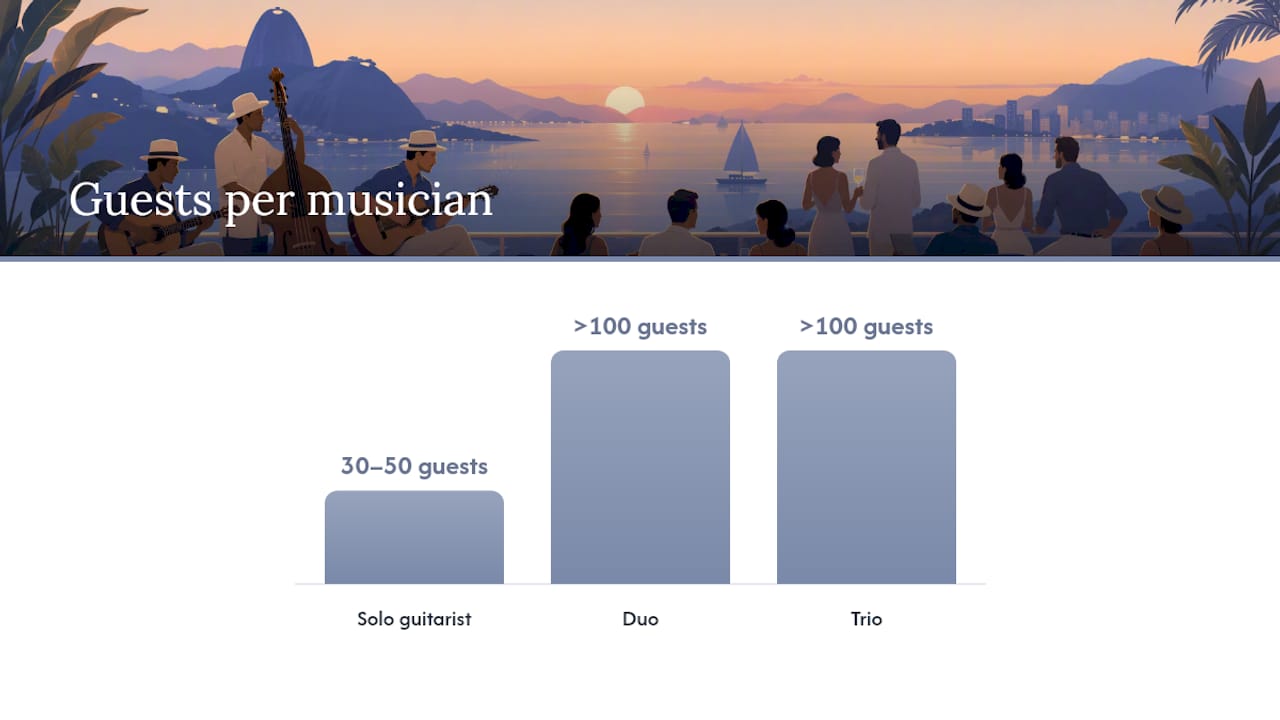
The tradeoff is logistics. A solo guitarist needs a quiet corner and a single outlet. A trio needs more space, a short soundcheck window, and usually a small amplifier even for an intimate room. Staffing ratios matter too: one guitarist covers a 30 to 50 person gathering comfortably, while anything past 100 guests benefits from a duo or trio just to project without cranking volume.
Before booking, ask:
- What are the set times and break schedule across the full hour?
- Does the venue allow amplification, and is there power near the performance area?
- How many musicians, and what's the standard staffing ratio for a room this size?
- Can they take specific repertoire requests, like a favorite Jobim tune or a first-dance preview?
Pro Tip: Ask the musician to hold a "quiet arrival" set for the first 15 minutes, then gradually build energy. It mirrors how guests actually warm up at a cocktail hour, from small talk to livelier conversation.
Bossa Nova Basics: Tempo, Rhythm, and Instruments
Bossa nova sits in a relaxed 4/4 feel around 120 to 140 BPM, though it feels considerably slower thanks to soft phrasing and understated delivery. That gap between the actual tempo and the perceived tempo is the whole trick: the rhythm keeps moving, but nothing about it demands attention.
Expect these instruments in an authentic set:
- Nylon-string guitar playing the batida pattern, the genre's rhythmic backbone
- Brushed drums or light percussion, never a full kit at performance volume
- Piano or upright bass filling out harmony without dominating
- Vocals delivered close to a whisper, often in Portuguese or English
When briefing a musician or DJ, ask specifically for the batida feel rather than just "Brazilian" or "lounge" music. That specificity is what separates an authentic bossa nova set from generic background jazz.
Building a Playlist That Actually Holds Up
A good bossa nova playlist is engineered, not just assembled. Follow this sequence:
- Open mellow. The first 10 to 15 minutes should be the quietest stretch, since guests are still arriving and finding their footing.
- Build modest energy mid-hour. Once the room fills, layer in slightly more rhythmic tracks to match the rising conversation volume.
- Wind down before the transition. The last 10 minutes should ease back down, cueing guests that dinner or the next event phase is approaching.
- Balance vocals and instrumentals. Lean toward roughly 60 to 70% instrumental tracks and 30 to 40% vocal cuts, a ratio that keeps the room talking instead of listening.
- Smooth the transitions. Crossfade each track by 3 to 6 seconds and normalize volume across the whole set so no track suddenly jumps out.
Keep a second backup playlist ready on a different device. Loudness normalization and crossfading matter more than song selection when it comes to avoiding jarring moments that snap guests out of conversation.
Pro Tip: Load your backup playlist on a phone with the venue's Wi-Fi password saved. Bluetooth speaker dropouts happen more than anyone admits, usually right when the toast is starting.
A Ready-to-Use 60-Minute Bossa Nova Playlist
Here's a sequence you can hand directly to a DJ or musician, built around the same open, build, wind-down logic covered above.
Minutes 0 to 15, arrival:
- "Águas de Março" (João Gilberto) — sparse guitar and vocal, ideal for a room still filling in
- "Corcovado" (instrumental cover) — slow, warm, functions almost like ambient sound
- "Desafinado" (Stan Getz and João Gilberto) — a genre-defining track that never overpowers a conversation
Minutes 15 to 40, mid-hour:
- "The Girl from Ipanema" (Astrud Gilberto) — the most widely recognized bossa nova standard, a safe crowd-pleaser
- "Wave" (instrumental piano trio version) — slightly more rhythmic, good for a room that's warmed up
- "Meditação" — keeps momentum without adding volume
- A modern bossa-tinged cover (contemporary artists frequently reinterpret Jobim) to signal the set isn't purely a museum piece
Minutes 40 to 60, wind down:
- "Chega de Saudade" — eases the energy back down
- "Água de Beber" (instrumental) — quiet enough to cue a transition
- "Insensatez" — a gentle closer that lets guests notice the shift toward dinner
When sourcing tracks, look for the original Verve or EMI studio recordings rather than live bootlegs, which often carry crowd noise and inconsistent volume. If you're booking live musicians instead, hand them this list as a repertoire starting point. Most working bossa nova players know these standards cold and can extend or trim the set on request.
Matching Decor and Lighting to the Music
The music sets a mood that decor and lighting either reinforce or undercut. Bossa nova reads as understated and warm, so heavy uplighting, harsh white light, or a brightly lit open bar area work against everything the music is trying to do.
Warm, low-level lighting, think amber tones around 2,700K, pairs naturally with the softness of a nylon-string guitar. Candlelight or string lights over a cocktail area reinforce the same intimacy the music carries, and dimmer switches matter more here than most hosts realize: a room lit for photography earlier in the day needs to shift down in tone once cocktail hour starts.
Texture matters as much as color. Bossa nova has a relaxed, tropical undercurrent (its roots run through Rio's beach culture), so natural materials like rattan, linen, and greenery echo that feeling better than stiff formal florals or metallic accents. A few well-placed palm fronds or monstera leaves on cocktail tables can nod to that Brazilian coastal origin without pushing the theme into costume territory.
Placement of speakers or musicians also shapes the room's energy. Positioning a guitarist near the bar or a lounge seating cluster, rather than centered and spotlighted, keeps the performance feeling like ambiance rather than a concert. The goal throughout is cohesion: guests should feel the lighting, the seating, and the music were chosen by the same person with the same mood in mind, because they should have been.
Cocktail Recipes That Match the Bossa Nova Mood
The right drink menu extends the same restraint the music brings. Bossa nova is unhurried and a little tropical, so cocktails that lean bright, citrus-forward, or lightly herbal fit better than heavy, dark spirits that feel more suited to a winter jazz club.
A caipirinha, Brazil's national cocktail, is the obvious anchor: cachaça, lime, and sugar muddled and served over crushed ice. It's simple to batch for a large guest count and carries the same unpretentious, breezy character as the music itself.
A whiskey sour or gin fizz, both bright and citrus-driven, work as a secondary option for guests who prefer something more familiar. For a nonalcoholic pairing, a lime and mint cooler with a splash of soda mirrors the caipirinha's profile without the cachaça, useful for events with a broad age range.
Keep the cocktail list to three or four options rather than a full bar menu. A shorter list moves faster, which matters during a 45 to 60 minute window, and it lets the bar staff keep pace with the music's easy rhythm instead of falling behind on complicated orders. Garnish with lime wheels, mint sprigs, or a thin cucumber ribbon, small visual details that echo the same warm, natural materials used in the decor.
Where Bossa Nova Comes From, and Why It Still Works
Bossa nova formed in Rio de Janeiro in the late 1950s when a small group of musicians and songwriters, most notably João Gilberto and Antônio Carlos Jobim, began fusing samba's rhythmic core with the harmonic language of cool jazz coming out of the United States. The result dropped samba's dense percussion in favor of a single guitar playing the batida, paired with quiet, conversational vocals that sounded more like speaking than singing.
The genre crossed into American popular culture fast. Stan Getz's collaborations with João and Astrud Gilberto in the early 1960s, especially "The Girl from Ipanema," turned bossa nova into an international sound almost overnight, and that crossover moment is exactly why the genre still reads as sophisticated rather than dated six decades later.
What makes that history relevant at a cocktail hour today is the built-in duality: bossa nova is Brazilian at its core but was shaped in direct conversation with American jazz, so it never feels foreign or novelty-themed at a wedding or corporate event in the United States. It reads as classic in the same way a jazz standard does, just with a different rhythmic accent. That's also why it pairs so naturally with jazz trios and piano sets already common at upscale events, rather than requiring a fully separate "Brazilian night" theme.
Sound Setup for an Intimate Cocktail Hour
The goal for cocktail hour audio is coverage, not volume. You want the music reaching every conversational cluster in the room evenly, without anyone standing near a speaker having to raise their voice.
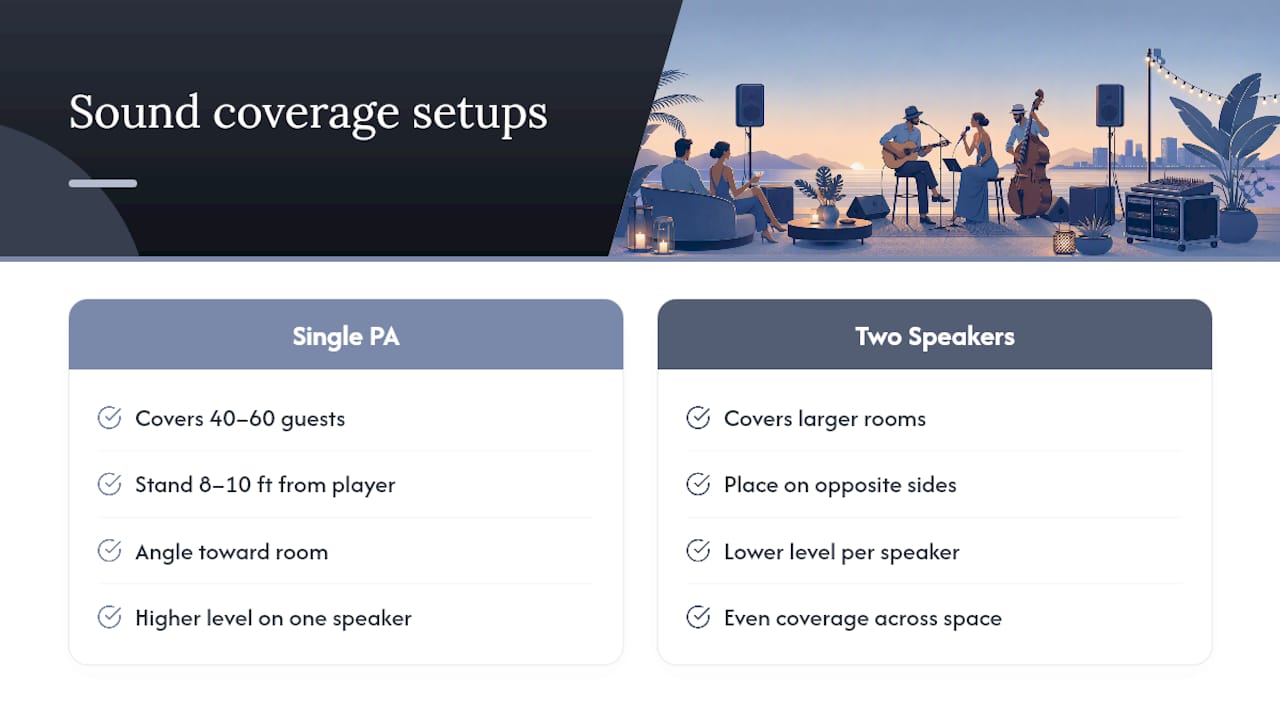
For a live guitarist or duo, a single small PA speaker on a stand, positioned 8 to 10 feet from the performer and angled toward the room rather than straight out, usually covers a space for 40 to 60 guests. Larger rooms or trios benefit from two speakers set on opposite sides, run at a lower individual volume each rather than one speaker pushed loud, which spreads sound more evenly and avoids a "wall of noise" near the source.
If you're running a playlist instead, avoid a single centrally located speaker blasting into an open room. Two or three smaller speakers distributed around the space, connected via Bluetooth or a simple mixer, keep volume consistent whether a guest is near the bar or by the window.
Whichever setup you use, do a level check before guests arrive, standing at the farthest corner of the space and confirming you can hold a normal conversation without raising your voice. If you can't, the volume is too high regardless of what the source material sounds like on headphones. Venues with strict sound ordinances or shared walls may cap acceptable decibel levels, so confirm any restrictions with the venue coordinator ahead of time rather than discovering them mid event.
What Actually Makes a Bossa Nova Set Work
The hosts who get this right almost always do one thing consistently: they treat the first 15 minutes as more important than the rest of the hour, because that's when the room's energy gets set and rarely resets afterward. A slow, confident opening does more for the mood than any clever song choice buried in the middle of the set.
If you're weighing whether to book a live musician or lean on a curated playlist, reach out and describe your event. A short conversation about your venue, guest count, and timeline will tell you faster than any guide which option actually fits.
— Alex
Live Bossa Nova, Handled for You
Live music booking platforms typically offer options for a live bossa nova cocktail hour, from solo guitarists for intimate gatherings to duos or trios for larger rooms, and sometimes string quartets or hybrid DJ-plus-live ensembles for events that need more range across the full evening.
When comparing quotes for live cocktail hour music, ask each option the same questions: set length and break schedule, travel fees for your venue, what amplification they bring versus what the venue needs to provide, and whether they'll take specific repertoire requests like a favorite Jobim standard or a song tied to your own story. Those answers tell you more about fit than price alone.
Explore the cocktail hour music page for formats and sound samples, or get in touch to talk through your venue, guest count, and timeline. Booking a live set for your cocktail hour locks in the pacing and presence a fixed playlist can't match, and it starts with a short conversation about what your event actually needs.
Sources
- Cocktail Hour — Triple Mountain Ranch
- Guide to Brazilian bossa nova music — MasterClass
- Cocktail hour — Make Me a Cocktail
- Bossa nova — Wikipedia
FAQ
What time signature is bossa nova usually in?
Bossa nova is typically written in a relaxed 4/4 time signature, driven by the guitar's batida pattern rather than a heavy drum kit.
What music should play during cocktail hour?
Soft jazz, bossa nova, acoustic covers, and understated classics all work well, as long as the mix stays instrumental-heavy and carefully sequenced to avoid sudden volume spikes. A live guitarist or trio playing bossa nova standards is one of the most reliable choices for a sophisticated event.
What cocktail specials pair well with a bossa nova theme?
A caipirinha, Brazil's national cocktail made with cachaça, lime, and sugar, fits the bossa nova mood best, alongside citrus-forward options like a whiskey sour or gin fizz for guests who prefer something more familiar.
What time is traditional cocktail hour?
Cocktail hour usually falls between 4:00 PM and 7:00 PM, functioning as the transition between a daytime ceremony or meeting and the main evening event. Most cocktail hours run 45 to 60 minutes, regardless of what time they start.