Wagner's Bridal Chorus, Pachelbel's Canon in D, and Christina Perri's "A Thousand Years" remain the three most requested piano wedding songs, but the smarter approach is choosing music by moment, not by popularity list. Processionals need steady, unhurried tempos; recessionals need lift; first dances need something that survives a piano-only arrangement. The sections below break down exactly which songs work where, how to time them with your pianist, and where to source the sheet music.
TL;DR:
- Processional music should have a steady tempo around 66 to 76 BPM, with detailed timing and cueing agreed upon in advance to prevent rushing or lagging.
- For the bridal entrance, songs like A Thousand Years or Clair de Lune carry emotional weight and work well both in traditional and modern arrangements; timing is crucial for impactful delivery.
- Recessional music must shift instantly from reverent to celebratory, with fast tempos like 80 to 100 BPM, using familiar songs such as Can't Help Falling in Love or Ode to Joy.
- Selecting and timing songs accurately depends more on clear communication with the pianist and venue logistics than on choosing popular melodies; preparation of flexible repeats and cues is essential.
- Choice of instrument (grand piano versus digital stage piano) hinges on venue logistics, with digital options favored for outdoor or space-constrained settings, while acoustics and proper tuning impact sound quality.
Table of Contents
- Piano Wedding Songs for Every Moment: Processional to First Dance
- How to Choose and Time Piano Songs for Your Ceremony
- Grand Piano vs Keyboard: Which One Fits Your Venue?
- Where to Find Reliable Piano Wedding Song Sheet Music
- How a Professional Prepares Piano Wedding Music
- Turning Pop Songs Into Piano Wedding Music
- Tips for Hiring and Working With a Wedding Pianist
- Making Your Piano Wedding Songs Feel Like Yours
- Why Live Piano Still Matters
- Hire a Pianist for Your Wedding Ceremony and Cocktail Hour
- Sources
Piano Wedding Songs for Every Moment: Processional to First Dance
Wagner's Bridal Chorus still shows up as the most-played entrance piece on piano, but it's far from the only option worth considering. The right choice depends on which moment you're scoring: the walk down the aisle plays differently than the walk back out. Here's how to organize your ceremony piano music by function rather than by generic "top songs" ranking.
Processional and seating music. This is the music guests hear while they're being seated and while the wedding party enters. It needs to feel steady and unobtrusive, not showy.
- Canon in D (Pachelbel) — the default for good reason. Its repeating chord progression loops cleanly, which matters when you don't know exactly how long seating will take.
- Bridal Chorus (Wagner) — traditionally reserved for the bride's entrance rather than general seating, though some couples use a piano arrangement earlier for a more classical feel.
- Jesu, Joy of Man's Desiring (Bach) — a gentler, more contemplative alternative for couples who want something reverent without the "here comes the bride" association.
- Nuvole Bianche (Ludovico Einaudi) — a modern instrumental favorite for couples who want emotional weight without going classical.
Bridal entrance. This is the single most scrutinized sixty seconds of the day, and the piece needs to carry real emotional weight on its own, since there's no orchestra to fill it out.
- A Thousand Years (Christina Perri) — the most requested contemporary entrance song, and one that translates cleanly to solo piano without losing its build.
- Clair de Lune (Claude Debussy) — for couples who want something instrumental, unattached to any pop-culture moment, and genuinely beautiful on a good instrument.
- Bridal Chorus (Wagner) — still the classic pairing with the entrance moment itself, especially for more traditional ceremonies.
- Nuvole Bianche (Einaudi) — works equally well here as a modern entrance piece; its slow build mirrors the emotional arc of walking down the aisle.
Recessional and exit. Once the ceremony is official, the music needs to flip from reverent to celebratory almost instantly. This is where tempo and register matter more than they did thirty seconds earlier.
- Can't Help Falling in Love (Elvis Presley) — an easy, joyful piano arrangement that works for nearly any wedding style.
- All of Me (John Legend) — arguably the most requested modern recessional piece; its chord voicings sit naturally under the hands and read as celebratory without feeling rushed.
- Ode to Joy (Beethoven) — the classical fallback when couples want triumphant without pop.
Prelude, cocktail hour, and dinner. This is background music, and it should stay that way. Jazz standards and lighter instrumental pieces work better here than anything with strong emotional associations, since guests are talking, not watching.
- Nuvole Bianche and River Flows in You (Yiruma) both work as ambient dinner music, since neither demands attention the way a vocal-driven pop song would.
- Jazz standards arranged for solo piano fill the same role and give the room a lounge feel rather than a ceremony feel.
First dance. Piano-only first dance arrangements need a song built on a strong melodic line, because there's no full band to lean on.
- All of Me and A Thousand Years both hold up as first dance choices when the couple wants continuity between ceremony and reception.
- Can't Help Falling in Love remains a first dance staple specifically because its melody carries the arrangement almost entirely on its own.
A comprehensive cross-genre list from TheKnot rounds out these categories with soundtrack and pop picks if you want more options beyond the staples above.
How to Choose and Time Piano Songs for Your Ceremony
Picking the song is the easy part. Timing it correctly is where most couples run into trouble, and it's almost always a communication gap between the couple and the pianist rather than a musical one.
Tempo drives pace more than people expect. A processional at 60 beats per minute reads as stately and deliberate; push it to 80 and the same song feels rushed, even if nobody in the aisle changed their walking speed. Most professional pianists default to 66 to 76 BPM for processionals and closer to 90 to 100 for recessionals, since the mood needs to visibly shift.
Here's what actually needs to happen before the ceremony starts:
- Confirm the procession length with your venue coordinator, not just your pianist. Aisle length and guest count both affect how long the walk actually takes.
- Tell your pianist how many people are processing and roughly how long each entrance should last, so the piece can be shortened or extended to fit.
- Agree on a repeat structure in advance. Pianists routinely prepare two or three workable keys and flexible repeats so they can extend a piece on the fly if the bridal party takes longer than rehearsed, or wrap it up early if things move faster.
- Set a clear cue for the bridal entrance, whether that's a nod from the coordinator, a specific bar number, or simply the doors opening.
- Rehearse the transition points, especially the moment between processional and recessional, since that's where tempo and mood both need to shift at once.
Pro Tip: Ask your pianist to prepare a "vamp," a short repeatable musical phrase, for any moment where timing is uncertain, like the walk from the ceremony space to the altar. It's far less jarring than a song simply cutting off.
Venue acoustics matter more than most couples realize until they're standing in the space. A piano in a stone chapel with high ceilings will sound reverberant and full; the same piece in a tented outdoor reception with no walls to reflect sound will feel thin unless it's amplified. Confirm with your pianist whether the venue needs a microphone or a small PA, and check load-in access and power outlets well before the wedding day.
Grand Piano vs Keyboard: Which One Fits Your Venue?
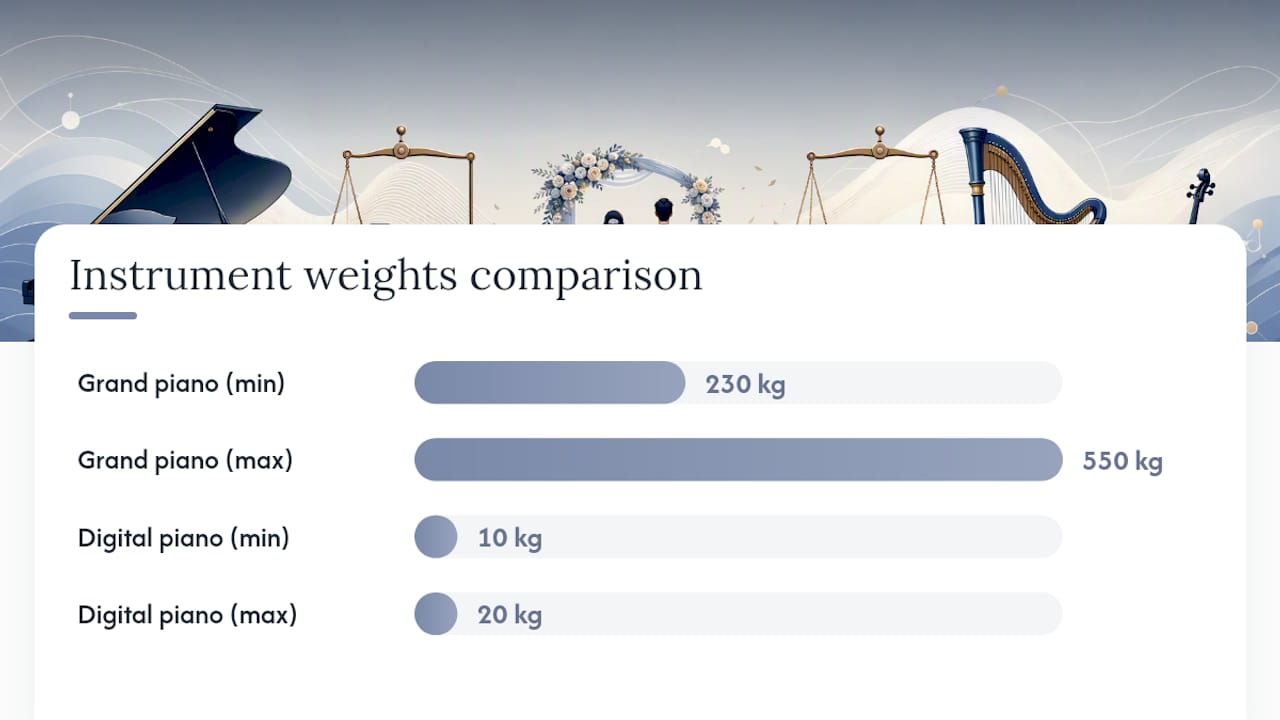
The instrument question usually comes down to logistics, not preference. An acoustic grand piano weighs between 230 and 550 kilograms, which means it needs a loading dock, a flat path with no stairs, and hours of setup and tuning time. A high-end digital stage piano weighs 10 to 20 kilograms and can be set up in minutes, which makes it the practical default for most tented, outdoor, or upper-floor venues.
Sound quality still favors the acoustic grand when one is available. It has richer overtones and dynamic range that a digital instrument approximates but doesn't fully replicate, especially in a room with good natural acoustics.
Use this quick checklist:
- Ask for an acoustic grand if: the venue has one on-site and tuned, floor loading isn't a concern, and there's no time pressure on setup.
- Accept a digital stage piano if: the ceremony is outdoors, on an upper floor without elevator access, or the venue simply doesn't own a piano.
- Always confirm: who is responsible for tuning (venue-owned grands are often neglected) and whether the digital instrument will be amplified for the room size.
Where to Find Reliable Piano Wedding Song Sheet Music
Dedicated wedding arrangements are inexpensive and widely available, so there's rarely a reason to work from a rough lead sheet. Sheet Music Plus sells a solo-piano Bridal Chorus edition with performance notes built in, and Musicnotes offers a transposable Canon in D wedding arrangement with preview audio, so you can hear it before buying.
- Sheet Music Plus and Musicnotes both carry printable, performance-ready wedding arrangements, often under $10 per piece.
- Arranger-written wedding pieces, like Bradley Sowash's "Wedding Tune", are built specifically with short intros and repeatable sections, making them easier for a pianist to stretch or shorten on the spot.
- Check licensing before printing multiple copies for a wedding program insert or a second musician; most digital sheet music licenses cover single-print personal use, not distribution, and some churches have their own copy policies worth confirming with the venue.
When briefing a pianist for a custom arrangement, give them the key you want, a target tempo, how many repeats you'll likely need, and any specific cue points, like a line in your vows or a specific moment you want musically marked.
How a Professional Prepares Piano Wedding Music
Before any wedding, Alex asks the same handful of questions every time: how long is the aisle, how many people are processing, and is there a specific song the couple is emotionally attached to versus one they think they're "supposed" to pick. Those answers shape everything else.
On-site adjustments happen more often than couples expect. A processional planned for ninety seconds sometimes needs to stretch to two and a half minutes because the flower girl stalled, or shrink because the officiant started early. Preparing a shortened coda and a flexible repeat structure in advance means those changes don't sound like mistakes.
One recent ceremony called for a instrumental arrangement of a couple's favorite song from their first date, adapted into a piano piece that could loop indefinitely if needed. It never needed the extra repeats, but having them ready meant zero risk if the timing had shifted. That kind of preparation, more than song choice alone, is what separates a smooth ceremony from an awkward one. Details on how that preparation typically works are outlined on the booking and logistics page.
Turning Pop Songs Into Piano Wedding Music
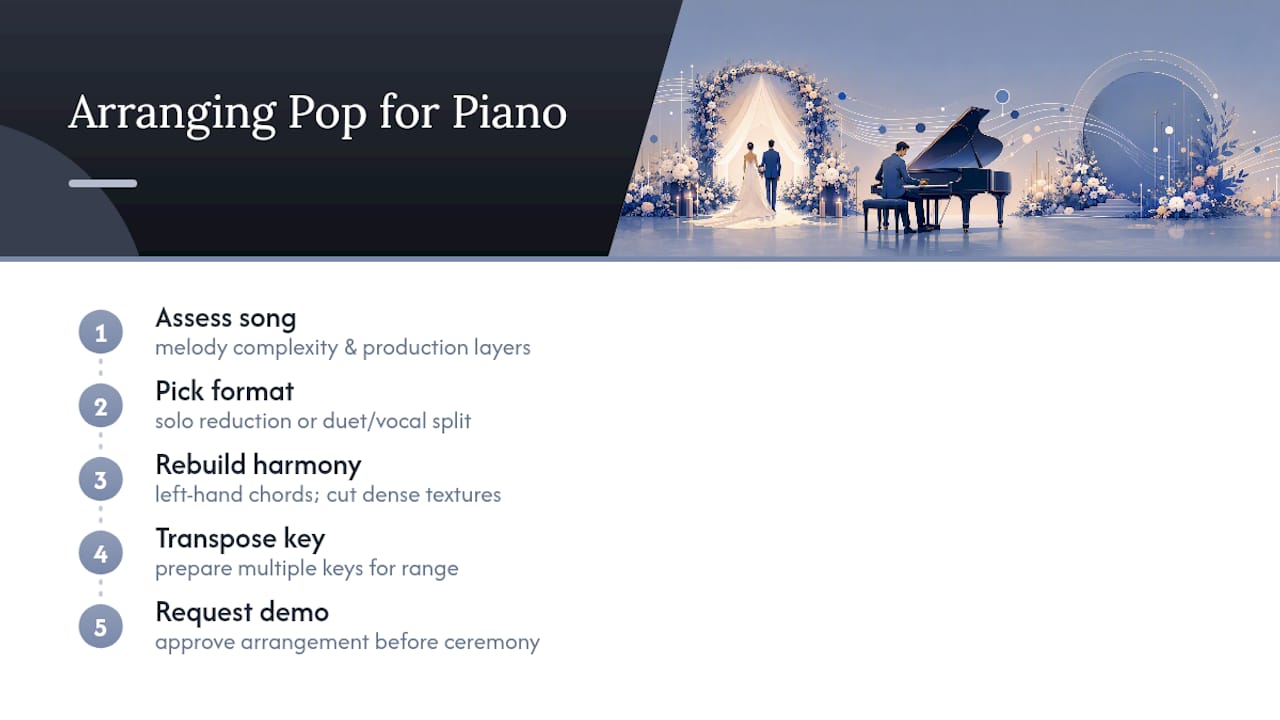
Most requested wedding songs weren't written for solo piano, which means someone has to decide what gets cut. A full pop production usually layers vocals, drums, bass, and synths; a piano arrangement has to imply all of that with two hands.
The most common approach is to keep the melody in the right hand exactly as sung, then rebuild the harmonic foundation in the left hand using the song's chord progression rather than its original bassline. Songs like "All of Me" and "Can't Help Falling in Love" work well because their chord structures were already simple enough to survive the reduction. Denser productions, layered synth-pop with constant harmonic movement, are harder to adapt and often need real simplification to avoid sounding cluttered.
Duet arrangements solve part of this problem by splitting the load: one pianist covers the harmonic bed while the second handles melody and embellishment, or a piano and a vocalist share the space so the piano isn't trying to do everything alone. This is also where key changes matter most. A song written for a male pop vocalist's range often needs to shift up or down a few steps to sit comfortably as an instrumental piece or to match a different singer, which is why professional pianists prepare multiple keys in advance rather than transposing cold on the day.
If you have a specific pop song in mind, ask your pianist to send a rough demo before the wedding. It's much easier to request changes to a recording than to discover the arrangement doesn't work during a live rehearsal.
Tips for Hiring and Working With a Wedding Pianist
Start the search earlier than you think you need to. Pianists who specialize in weddings tend to book out months in advance, especially for peak wedding season weekends, and the good ones are gone first.
When you reach out, come with specifics: your ceremony start time, roughly how long the processional and recessional need to run, and two or three songs you already know you want, even if the rest of the set is open to their suggestions. A pianist who specializes in weddings will usually have stock arrangements ready for common requests like Canon in D or "A Thousand Years," which cuts down on custom arrangement time and cost.
Ask directly about their backup plan. Does the pianist bring a portable amp for outdoor venues? Do they have a plan if a song request comes in after the rehearsal is already locked? These questions reveal more about reliability than a demo reel does.
Confirm logistics in writing: arrival and load-in time, whether they need a chair, bench, or specific piano height, and who handles tuning if the venue provides the instrument. Most professionals will send a short questionnaire covering all of this, but if they don't, ask for one. The couples who have the smoothest ceremony music are almost always the ones who over-communicated logistics rather than under-communicating song choice.
Making Your Piano Wedding Songs Feel Like Yours
The songs on every popular list, Canon in D, Bridal Chorus, "A Thousand Years," are popular precisely because they're broadly appealing, not because they're personal. The best ceremonies usually blend one or two of those staples with something that means nothing to anyone but the couple.
That personal layer can come from almost anywhere: a song that was playing the night you met, a piece from a grandparent's culture arranged for piano, a hymn tied to a family tradition, or a film score from the first movie you watched together. None of these need to replace the classical staples entirely. A couple might walk in to a traditional processional and then use a personal, culturally specific piece for the unity moment or the signing of the register, where the music can carry more individual meaning without disrupting the ceremony's overall flow.
Cultural blending works especially well on piano because the instrument doesn't force a specific genre. A traditional folk melody from either partner's background can often be reharmonized into something that still feels cohesive next to Debussy or Einaudi, as long as the arranger understands both the original piece and the ceremony's overall musical arc. If this matters to you, bring the reference recording to your pianist early. Melodies passed down orally or through family recordings usually need to be transcribed before they can be arranged, which takes more lead time than adapting a song that already has published sheet music.
Why Live Piano Still Matters
Recorded tracks can hit every note perfectly, but they can't feel the room. A live pianist hears when the officiant pauses a beat too long, notices the flower girl has stalled, and adjusts in real time, something event professionals point to as the real reason live music defines a ceremony's emotional arc rather than just soundtracking it. The shift from a reverent processional to a joyful recessional lands harder when a human is shaping that transition live. Recorded music can work fine for a tighter budget or a more casual event. For ceremonies where the emotional pacing matters, live piano earns its cost.
— Alex
Hire a Pianist for Your Wedding Ceremony and Cocktail Hour
Alexlevinmusic offers exactly what this guide has been building toward: solo piano coverage for ceremonies, cocktail hours, and dinner, with repertoire built around the moment-by-moment approach above rather than a generic playlist. Every booking starts with a consultation to confirm your ceremony timeline, then moves into repertoire confirmation, where staples like Canon in D or "A Thousand Years" get paired with any personal or cultural pieces you want included.
Logistics, load-in, instrument needs, venue acoustics, get handled as part of the booking process rather than left for you to coordinate the week of the wedding, as outlined on the booking and logistics page. For couples who also want jazz trio coverage for cocktail hour or reception, that option can be paired with solo piano under one booking; the full range of ensembles is detailed on the services page. If you're still comparing your ceremony music against a broader planning checklist, resources like US Novelty's wedding supplies guide cover the adjacent details worth sorting out early. Reach out through the Alexlevinmusic site to check availability for your date.
Sources
- 15 Wedding Songs You Should Know For Piano - Piano With Jonny
- Piano and Keyboard: Comparing Differences and Making the Right Choice — SoundHalo
- Wedding Tune - Solo Piano — Bradley Sowash Music