Get a temporary noise variance or a documented Noise Management Plan in hand before you finalize any outdoor or amplified performance, and assign a designated on-site monitor with a calibrated meter and the authority to cut levels on the spot. Those two steps alone prevent the majority of citations, complaints, and forced shutdowns that derail live events every year.
Three actions to take right now:
- Contact your local municipality's special events or permitting office to confirm whether a temporary noise variance or special event permit is required. Bring your event date, venue address, expected sound levels, and a rough site map.
- Prepare your core documents: a site map showing stage, speaker arrays, nearest residential receivers, and generator locations; predicted exterior sound levels; and a draft Noise Management Plan (NMP) outlining mitigation measures and monitoring procedures.
- Designate a noise monitor for the day of the event. That person needs a calibrated sound level meter, a real-time logging setup, and a direct radio or phone link to the FOH engineer. They must have the authority to reduce or stop amplified sound if levels exceed permitted thresholds.
Keep a printed copy of your permit conditions, the monitor's contact information, and at least 48 hours of pre-event calibration records in your production binder. If an inspector arrives, those documents are the first thing they will ask for.
Table of Contents
- What do municipal noise ordinances actually cover for live events?
- How do permits and temporary noise variances for special events work?
- How should you measure sound levels correctly at a live event?
- What should a Noise Management Plan include?
- What monitoring records should you keep during and after the event?
- What mitigation tactics actually reduce off-site noise impact?
- What happens when a complaint is filed or an inspector shows up?
- How and when should you notify neighbors and nearby stakeholders?
- When should you hire an acoustician, sound engineer, or legal counsel?
- Planner timeline and checklist: weeks, days, and hours before the event
- What municipal investigators actually check: common misconceptions
- Key Takeaways
- Why noise compliance is really a production problem, not a paperwork problem
- Live music that arrives compliance-ready
- Useful sources for finding local noise codes and applications
What do municipal noise ordinances actually cover for live events?
A municipal noise ordinance is a local law that sets limits on sound levels in specific zones, at specific times of day, measured at defined locations. For live events, the relevant concepts are the ordinance itself, the Noise Management Plan, the temporary noise variance, and quiet hours.
Municipal noise ordinance: A city or county code that defines maximum permissible sound levels, typically expressed in decibels, by land-use zone and time of day. Standard codes are written for ongoing commercial operations, not one-off events, which is why temporary variances exist.
Noise Management Plan (NMP): A written document submitted to the municipality that describes how an event will control sound. It covers predicted levels, monitoring methods, mitigation measures, neighbor notification, and contingency actions if limits are exceeded.
Temporary noise variance: A permit that allows an event to exceed standard code limits for a defined period, subject to conditions the municipality sets. Seattle's SDCI, for example, requires applicants to describe expected code exceedances, mitigation steps, monitoring procedures, and public notification as part of the variance application.
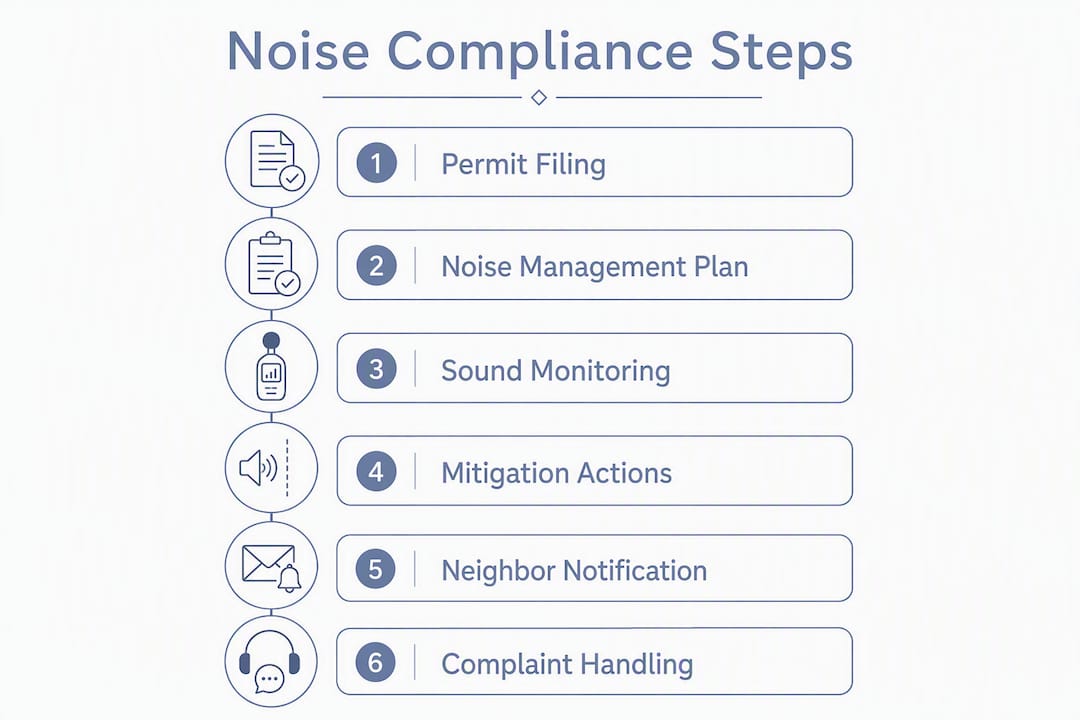
Quiet hours: The time window during which standard limits drop significantly. Austin's code prohibits amplified sound audible to adjacent residences between 10:30 p.m. and 7:00 a.m.. Seattle's quiet hours run from 10:00 p.m. to 7:00 a.m. on weekdays and 10:00 p.m. to 9:00 a.m. on weekends.
dB(A) vs. dB(C): why the weighting matters for music
Most ordinances cite limits in dB(A), a weighting that reduces the measured contribution of low and very high frequencies to approximate how the human ear perceives loudness. dB(C) applies much less filtering and captures low-frequency energy more accurately. For a rock concert or DJ set with heavy bass, a system that reads 75 dB(A) at the property line may simultaneously read 82 dB(C) because of subwoofer output. Some jurisdictions now specify both weightings, or set a separate low-frequency criterion, precisely because bass energy travels farther and penetrates buildings more effectively than mid-range sound.
Key measurement point: Sound is measured at the nearest residential property line, not at the front-of-house (FOH) mixing position. Denver's noise guidance sets amplified event limits at 80 dB(A) from 8:00 a.m. to 10:00 p.m. and 50 dB(A) from 10:00 p.m. to 7:00 a.m., measured at the nearest residential property. An FOH reading of 95 dB(A) tells you nothing about what the neighbor three hundred feet away is actually hearing.
How do permits and temporary noise variances for special events work?
Permits and variances are not interchangeable. A special event permit authorizes the event itself; a temporary noise variance specifically authorizes sound levels that would otherwise violate the code. Many events need both.
Step-by-step application sequence:
- Identify the correct office. Most cities route special event noise applications through a dedicated events office, a building and land use department, or an environmental health division. Austin routes outdoor music venue permits through its Entertainment Services Group. Seattle routes temporary noise variances through SDCI.
- Confirm the filing deadline. Timelines vary widely. Simple variances may be processed in two to three weeks; complex events near residential zones can take two to three months. File as early as possible, and never assume a prior year's approval carries over.
- Prepare the application package. Most municipalities require: a written event description (dates, hours, location, expected attendance); predicted exterior sound levels at the nearest residential receiver; a site map showing stages, speaker arrays, generators, and nearest residences on all four sides; a description of mitigation measures; a monitoring plan; and a public notification plan.
- Submit and respond to conditions. Reviewers often return conditions: a maximum dB limit at the property line, a curfew, a requirement for a designated monitor with authority to cut sound, and mandatory data logging.
- Post the permit on site. Keep the original permit and all conditions accessible during the event.
Fees vary by jurisdiction and event size. Some cities charge a flat application fee; others scale fees by event duration or expected attendance. Check your local code for the specific amount, since published fee schedules change annually.
Austin's OMV permit regime is a useful benchmark for how seriously some cities treat this: violations can be prosecuted as misdemeanors with fines up to $500, and a warning is not required before a citation is issued.
Treat the permit conditions as your operating contract with the city. Every condition the reviewer adds is a compliance task that belongs on your day-of checklist.
How should you measure sound levels correctly at a live event?
The meter type, calibration method, measurement location, and logging format all affect whether your data will hold up if a complaint is filed.
Pro Tip: Never rely solely on the FOH engineer's console meters for compliance. Those readings reflect what the system is putting out, not what the neighbor is hearing. Run a dedicated external meter at the property line simultaneously.
Meter types and when to hire a consultant
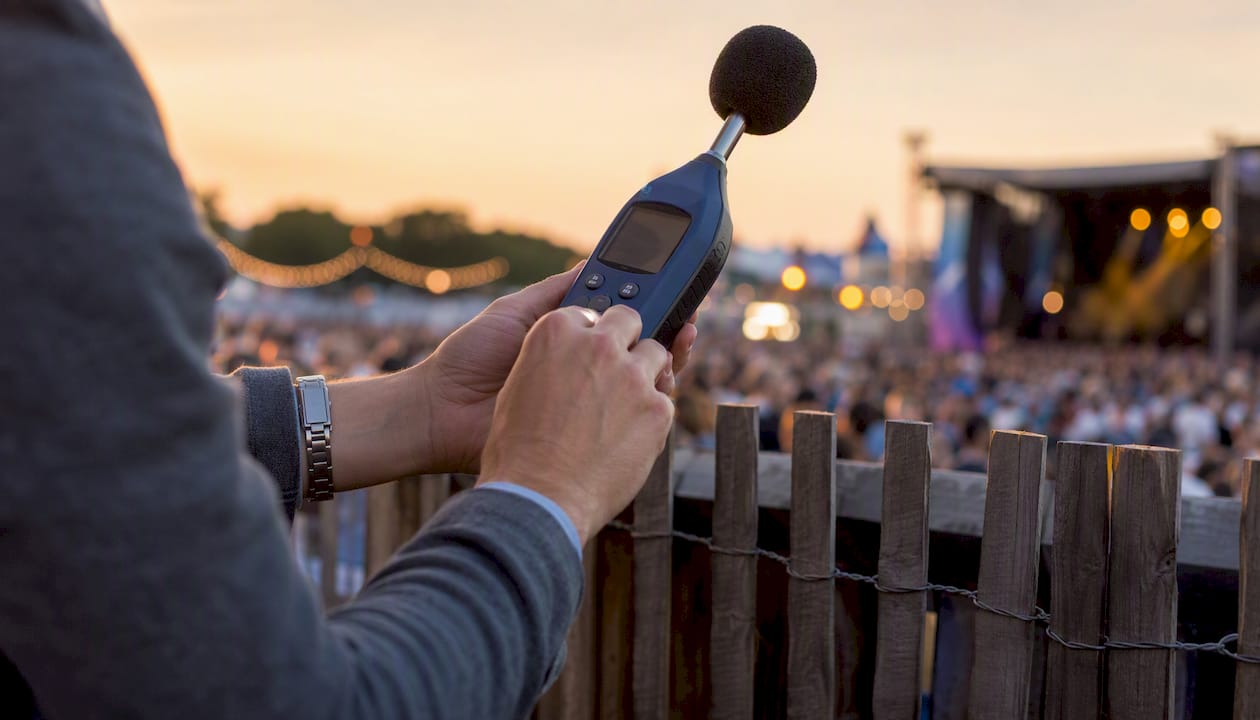
Sound level meters fall into two classes under IEC 61672. A Type 1 (Class 1) meter is laboratory-grade, with tighter tolerances, and is what enforcement officers typically carry. A Type 2 (Class 2) meter is acceptable for most event monitoring and is what most rental houses stock. For a small private event in a low-sensitivity location, a calibrated Type 2 meter is usually sufficient. For a large outdoor festival near residential properties, or any event where a variance condition specifies measurement accuracy, hire a noise consultant who brings Type 1 equipment and knows how to document the chain of custody.
How enforcement officers measure
Denver's investigators take readings at the nearest residential property line, not at the stage or FOH position. The metric is typically a 15-minute equivalent continuous sound level (Leq) or whatever averaging period the local code specifies. A single peak reading during a drum solo does not determine compliance; the averaged level over the measurement window does. That distinction matters in practice: a brief transient that spikes the meter will not necessarily trigger a violation, but sustained bass output that keeps the Leq elevated will.
Practical setup checklist
- Place the external monitor meter at the nearest residential property line or at the measurement point specified in your permit conditions.
- Calibrate the meter with a pistonphone or acoustic calibrator before and after each measurement session, and log both calibration readings with timestamps.
- Use data logging software that produces a timestamped record. Seattle's SDCI prefers a laptop running Smaart Live or an approved equivalent so that both the event team and any inspector can see real-time levels.
- Establish a radio or phone link between the external monitor and the FOH engineer so levels can be adjusted immediately when the external reading approaches the permit threshold.
- For events with significant bass output, add a third-octave or low-frequency analysis to capture dB(C) alongside dB(A).
What should a Noise Management Plan include?
A well-structured NMP gives municipal reviewers a single document that answers every question they are likely to ask. It also functions as your on-site operations manual.
Core NMP sections
Event summary: Event name, date(s), hours of amplified sound, venue address, expected attendance, and contact information for the responsible organizer and on-site noise monitor.
Predicted sound levels: Estimated dB(A) and dB(C) at the nearest residential receiver, based on propagation modeling or a prior-year measurement record. For complex events, this section should reference a propagation test conducted during rehearsal.
Monitoring plan: Meter type, calibration schedule, measurement location(s), logging method, and the name of the designated monitor.
Mitigation measures: Stage orientation, speaker array type and direction, subwoofer placement, acoustic barriers, curfew times, and any other controls that reduce off-site impact.
Neighbor notification: Who was notified, when, and how. Include a copy of the notice or a description of the delivery method.
Contingency actions: What happens if levels exceed the permit threshold. Typically: the monitor alerts FOH, the FOH engineer reduces output within a defined time window (often two minutes), and if levels remain elevated, amplified sound is suspended.
Site map requirements
Denver's guidance explicitly asks for site maps that show stages, speaker locations, generators, and the closest residential properties on all four sides of the event. Add your monitoring meter position(s) and the access route for inspectors to reach FOH and backstage. A reviewer who can visualize the layout approves applications faster.
Roles and responsibilities
| Role | Person | Key authority |
|---|---|---|
| Noise monitor | Named individual | Directs FOH to reduce or stop sound |
| FOH engineer | Named individual | Executes level changes on monitor's instruction |
| Event organizer | Named individual | Communicates with municipal officials |
| Site safety officer | Named individual | Coordinates inspector access |
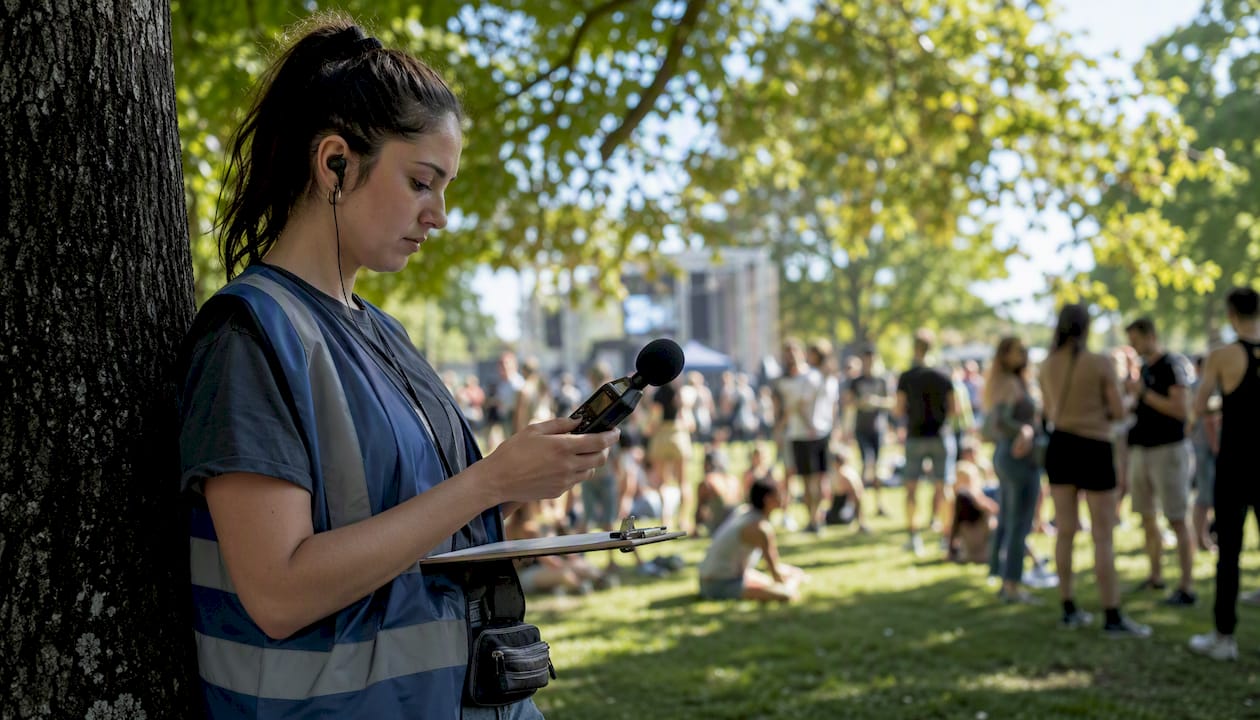
The monitor's authority is not ceremonial. Seattle's permit conditions specify that the monitor must have the actual authority to reduce or terminate amplified sound, and that the organizer must support that authority. If the FOH engineer can override the monitor, the plan fails its own conditions.
What monitoring records should you keep during and after the event?
A compliant log is the difference between a resolved complaint and a citation that sticks.
- Timestamped Leq readings at the external measurement position, recorded at intervals no longer than 15 minutes throughout the event.
- Meter identification and calibration record: meter make, model, serial number, and the pre- and post-event calibration readings with timestamps.
- Operator name and contact information on every log sheet.
- Event timeline markers: note when each set starts and ends, when soundcheck begins and ends, and any periods of reduced or suspended sound.
- Any incidents: time, description, and action taken for every complaint call, inspector visit, or level-reduction event.
Keep logs and any associated audio recordings for 30–90 days after the event. That window covers most municipal complaint investigation timelines. If a formal inquiry arrives, provide the complete log, the calibration record, and the permit or variance documentation as a single package.
Alert thresholds and escalation: Set your internal alert threshold 3–5 dB below the permit limit. When the external monitor reads at or above the alert threshold, the monitor radios FOH immediately. FOH reduces output. If the reading drops below the alert threshold within two minutes, log the incident and continue. If it does not, suspend amplified sound and notify the on-site organizer. Never wait for the permit limit to be breached before acting.
What mitigation tactics actually reduce off-site noise impact?
Ranked roughly by effectiveness for a typical outdoor music event:
- Stage orientation: Point the stage and main speaker arrays away from the nearest residential receivers. A 180-degree reorientation can reduce off-site levels by 6–10 dB without touching the PA system.
- Directional speaker arrays: Line arrays with tight vertical dispersion keep sound on the audience and off the surrounding neighborhood. Avoid wide-dispersion horns or stacked boxes pointed toward property lines.
- Cardioid subwoofer configuration: Arranging subwoofers in a cardioid pattern (typically one sub facing rearward for every two facing forward) reduces rear and side bass radiation by 10–15 dB. This is the single most effective low-frequency control tactic available without acoustic barriers.
- Temporary acoustic barriers: Solid barriers (minimum surface density of 10 kg/m²) placed between the stage and the nearest receiver can provide 5–10 dB of insertion loss for mid and high frequencies. They do less for low frequencies below 100 Hz.
- Stage height adjustments: Lowering the stage reduces the direct line of sight to distant receivers and can meaningfully cut high-frequency propagation.
Pro Tip: Low-frequency energy is the primary driver of neighbor complaints at music events, even when overall dB(A) levels are within limits. A cardioid sub arrangement and a high-pass filter on the main PA set at 60–80 Hz will do more to prevent complaints than any other single adjustment.
Schedule-based mitigations are often underused. A quiet soundcheck (line check only, no full-band levels) in the afternoon reduces the total duration of elevated sound exposure for neighbors. Hard curfews written into the NMP give you a defensible end time. Set-length management, meaning shorter sets with longer changeovers, keeps peak-level periods brief.
What happens when a complaint is filed or an inspector shows up?
Municipal enforcement for live events is often proactive, not reactive. Large public events in cities like Denver attract investigators who monitor independently, not just in response to complaints.
The typical complaint flow runs: a resident calls 311 or files an online complaint → a code enforcement officer or environmental health investigator is dispatched → the investigator takes independent measurements at the residential property line → a warning, citation, or order to reduce sound is issued. In Austin, a warning is not required before a citation. The first contact from an inspector may be a citation.
Typical penalties and immediate actions:
- An order to immediately reduce amplified sound to the permitted level.
- An administrative citation or summons. Austin's OMV regime allows fines up to $500 per violation, and violations can be prosecuted as misdemeanors.
- Event suspension or shutdown for repeated or severe violations.
- Permit revocation, which affects future applications.
How to respond when an inspector arrives:
- The designated noise monitor or event organizer, not the FOH engineer or a stage manager, speaks with the inspector.
- Present the permit or variance, the NMP, and the current monitoring log immediately. Do not make the inspector ask twice.
- Denver investigators have authority to require access to FOH and backstage for independent measurements. Grant that access without delay.
- If the inspector directs a level reduction, execute it immediately and log the time and the instruction.
- Do not argue about FOH meter readings. The inspector's measurement at the property line is the legally relevant one.
Your best protection against an immediate shutdown is a clean permit, a visible monitoring log, and a monitor who responds to instructions without hesitation.
How and when should you notify neighbors and nearby stakeholders?
Neighbor notification is both a permit requirement and a practical complaint-reduction tool. A resident who received advance notice and a contact number is far less likely to call 311 than one who woke up to unexpected amplified bass.
Who to notify and how far in advance:
- Residents and property managers within at least 300 feet of the event perimeter, ideally farther for large outdoor events.
- Nearby institutions: schools, houses of worship, hospitals, and senior living facilities.
- Notify at least 10–14 days before the event. Some municipal permit conditions specify a minimum notice period; check your conditions.
What a neighbor notice should include:
- Event name, date, and hours of amplified sound.
- A brief description of sound mitigation measures you are taking.
- A direct phone number or email address for complaints or questions during the event.
- The name of the on-site contact person.
- Any relevant permit or variance reference number.
Delivery options: Door-to-door flyer drop, first-class mail, or email to property managers. For large events, a combination of all three is worth the effort. Keep a delivery log (addresses, date, method) as part of your NMP documentation.
Reducing friction proactively:
- Offer a quiet period during the event (for example, no amplified sound between 2:00 p.m. and 4:00 p.m.) if the event runs all day.
- Provide parking guidance to reduce street congestion near residences.
- Follow up after the event with a brief thank-you note to the most affected neighbors. It costs nothing and builds goodwill for the next event.
When should you hire an acoustician, sound engineer, or legal counsel?
Not every event needs outside specialists. A small private reception in an established indoor venue with a prior compliance record probably does not. A large outdoor festival near a residential neighborhood almost certainly does.
Hire an acoustician or noise consultant when:
- The event is within 500 feet of residential properties and involves amplified music above 85 dB(A) at the stage.
- The permit application requires propagation modeling or a predicted noise impact assessment.
- The venue has a history of complaints or prior enforcement actions.
- The permit conditions are complex or the municipality is requesting technical documentation you cannot produce in-house.
What a noise consultant should deliver:
- A propagation model showing predicted dB(A) and dB(C) levels at all relevant receivers under different wind and atmospheric conditions.
- A monitoring plan specifying meter placement, calibration schedule, and logging format.
- Calibrated measurement reports from any pre-event propagation test or soundcheck.
- Representation or written testimony if a complaint escalates to a formal hearing.
Hire a specialized sound engineer (not just a general FOH engineer) when:
- The event uses large subwoofer arrays and low-frequency control is a primary compliance concern.
- The permit conditions specify cardioid subwoofer configuration or third-octave analysis.
- You need someone who can set FOH limits that guarantee off-site criteria are met, based on a propagation test rather than guesswork.
Hire legal counsel when:
- A citation has been issued and you are contesting it.
- The municipality is threatening permit revocation.
- The event involves a complex multi-day permit with conditions that carry criminal misdemeanor exposure (as in Austin's OMV regime).
For outdoor events where professional musicians are already part of the production, experienced performers and their crews often bring practical compliance knowledge that reduces the need for additional consultants. Professional musicians who regularly perform at permitted outdoor events understand permit conditions, know how to work within level limits, and can brief their own crew without additional training.
Planner timeline and checklist: weeks, days, and hours before the event
| Timeframe | Task |
|---|---|
| 8 weeks out | Identify the correct permitting office; confirm whether a variance is required; begin NMP draft |
| 6–8 weeks out | Submit permit/variance application with site map, predicted levels, and mitigation plan |
| 4–6 weeks out | Confirm permit conditions; hire noise consultant if required; schedule propagation test |
| 3–4 weeks out | Send neighbor notification letters/flyers; log delivery addresses and dates |
| 2 weeks out | Conduct propagation test during rehearsal; set FOH control limits based on results |
| 1 week out | Confirm monitor assignment; verify meter calibration; brief all production staff on permit conditions |
| 48 hours out | Final calibration check; print permit, NMP, and monitoring log templates for production binder |
| Day of event | Calibrate meter; brief monitor and FOH engineer; confirm radio/phone link; post permit on site |
| During event | Log Leq readings every 15 minutes; note all set start/end times; respond to any inspector visit |
| Post-event | Retain all logs and calibration records for 30–90 days; follow up with neighbors if appropriate |
Day-of pocket checklist:
- Calibrated meter at external measurement position before soundcheck
- Pre-event calibration reading logged with timestamp
- Permit and permit conditions in production binder
- Monitor and FOH engineer briefed and radio-linked
- Neighbor contact number posted at production desk
- Incident log template ready
- Post-event calibration reading logged
What municipal investigators actually check: common misconceptions
Three misconceptions consistently put event organizers at risk.
Misconception 1: Enforcement only follows complaints. For large public events, this is simply wrong. Denver investigators proactively monitor special events and can issue citations without any prior complaint being filed. Assume you may be measured at any time.
Misconception 2: A warning always precedes a citation. Austin's OMV permit regime explicitly removes that requirement. The first contact from an enforcement officer may be a citation, not a conversation.
Misconception 3: FOH meter readings determine compliance. Investigators measure at the nearest residential property line. Your FOH console reading is irrelevant to their determination. The only reading that matters legally is the one taken at the receiver.
What investigators actually focus on:
- Independent measurement at the nearest residential property line, not at the stage.
- Access to FOH and backstage for their own meter placement.
- Evidence of an approved NMP or variance on site.
- A designated on-site person with actual authority to reduce sound immediately.
- A visible, timestamped monitoring log.
Pro Tip: When an inspector arrives, the first words out of your monitor's mouth should be: "Here is our permit, here is our current log, and I have authority to reduce levels right now if needed." That posture resolves most inspections without escalation.
The guidance from Manchester's open-air concert code reinforces this: compliance with best-practice noise codes does not guarantee immunity. Effective control procedures and early consultation with the municipality are what actually protect you.
Key Takeaways
Noise ordinance compliance for live events requires a permit or variance, a documented NMP, real-time monitoring at the residential property line, and a designated on-site person with the authority to cut sound immediately.
| Point | Details |
|---|---|
| Permit or variance first | File 6 weeks out; include site map, predicted levels, and mitigation plan. |
| External monitoring is mandatory | Measure at the nearest residential property line, not at FOH; log every 15 minutes. |
| Monitor authority is non-negotiable | The designated monitor must have real authority to reduce or stop amplified sound on the spot. |
| Warnings are not guaranteed | Cities like Austin can issue citations without a prior warning; be ready from the moment sound starts. |
| Alexlevinmusic reduces your compliance burden | Experienced live music providers coordinate sound crew, work within permit conditions, and arrive briefed on level limits. |
Why noise compliance is really a production problem, not a paperwork problem
Most event organizers treat noise compliance as a bureaucratic hurdle: file the form, get the stamp, move on. That framing is what gets events shut down.
The permit is not the compliance. The permit is permission to attempt compliance. What actually keeps your event running is a sound crew that understands the permit conditions, a monitor who is watching the external meter in real time, and a FOH engineer who responds to level calls without pushback. Those are production decisions, not administrative ones.
The other thing most guides miss: low-frequency energy is almost always the real problem. An event can sit comfortably within its dB(A) limit and still generate complaints because the bass is traveling three blocks and rattling windows. A cardioid subwoofer arrangement and a disciplined low-end EQ strategy will do more to prevent a complaint call than any amount of paperwork. The Manchester guidance makes this point explicitly: even when published decibel limits are met, low-frequency energy can drive complaints, and successful events combine decibel control with stage orientation, speaker directionality, and community engagement.
The third underrated factor is the neighbor notice. A resident who received a flyer two weeks ago and has a phone number to call is a manageable situation. A resident who had no warning and no contact information is a 311 call and an investigator on site within the hour. The notice costs almost nothing. The investigator costs you the rest of the night.
Live music that arrives compliance-ready
Hiring a live music provider who already understands permit conditions, level limits, and on-site monitoring protocols removes a significant layer of coordination from your plate. Alexlevinmusic performs at corporate events, weddings, and private gatherings across Philadelphia, New York, and beyond, with ensembles ranging from jazz trios and string quartets to hybrid DJ/live setups. Every performance is coordinated with the venue and the organizer in advance, including a review of sound requirements, space constraints, and any applicable noise conditions.
For planners who need a corporate event music provider that arrives briefed on level limits and ready to work within them, Alexlevinmusic is a practical choice. The ensemble and production approach is calibrated for urban venues and outdoor settings where noise sensitivity is a real factor. If you are planning a corporate gathering, private party, or outdoor reception and want a music provider who treats compliance as part of the production, check availability and book a consultation to discuss your event's specific requirements.
Useful sources for finding local noise codes and applications
Finding your specific municipal code takes one search and one phone call. Here is where to look:
- Seattle SDCI Outdoor Amplified Sound page: A detailed example of a municipal variance process, including application requirements, permit conditions, and monitoring expectations.
- Austin Outdoor Music Venue Permits page: Shows how a major music city structures its permit regime, including enforcement authority and penalty ranges.
- Denver Events Noise Fact Sheet: A concise municipal document covering measurement points, dB limits by time of day, site map requirements, and investigator authority.
- Austin City Code, Title 9, Chapter 9-2: The underlying noise and amplified sound ordinance text, useful for understanding how quiet hours and permit requirements are written into law.
If you cannot find your city's specific code online, call the special events or code enforcement office directly and ask: "Does our event require a temporary noise variance, and where do I find the application?" That question gets you to the right person faster than any search.