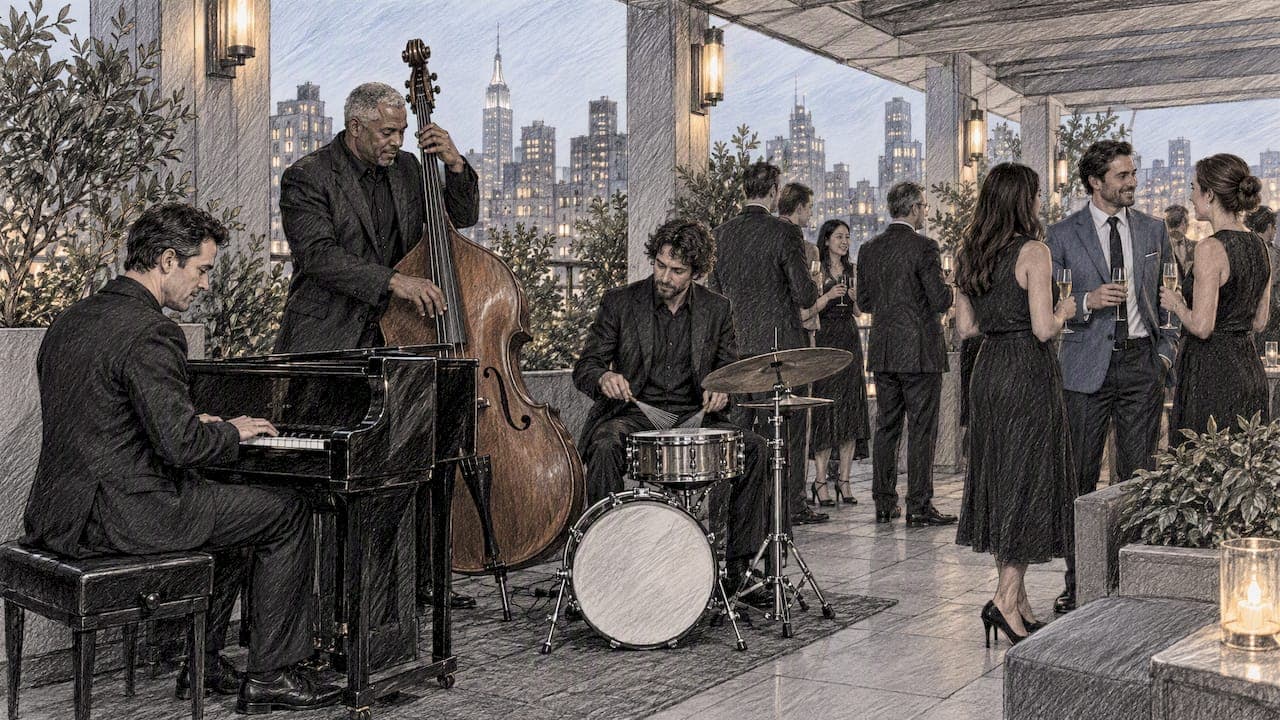
A jazz trio is an ideal cocktail-hour choice when you want elegant, conversational live music. We recommend our own trio at Alex Levin Music if you want a polished, planner-friendly experience from the first inquiry to the last song. Choose a duo or solo pianist instead when the space is tight or the budget is firm, and use the checklist below to request accurate quotes.
TL;DR:
- Choose piano, upright bass, and brushed drums for a quiet indoor room; saxophone suits larger outdoor spaces, while guitar or violin reduces setup needs.
- Send musicians your date, venue, guest count, exact times, lineup, song preferences, sound limits, access details, and whether they will play other event segments.
- Alex Levin Music lists a $3,000 starting price, but marketplace starting prices and typical spending differ; compare hours, personnel, travel, equipment, and overtime.
- Ask whether the quote includes a minimum of three paid hours, since a shorter set may not cost proportionally less.
- Position musicians near the bar but away from entrances and restroom routes, then coordinate power, weather cover, venue sound rules, and a final song cue.
Table of Contents
- Why a jazz trio works so well for cocktail hour
- Which jazz trio instrumentations fit which mood?
- What should a cocktail hour jazz setlist include?
- What do musicians need to give you an accurate quote?
- Why do jazz trio prices look so different across listings?
- How do you choose the right jazz trio?
- How do you weave a jazz trio into menus, lighting, and guest flow?
- Where can we play your cocktail hour?
- Alex's note on balancing music and conversation
- Book Alex Levin Music for your cocktail hour
- FAQ
- Sources
Why a jazz trio works so well for cocktail hour
Recorded playlists fill a room, but they cannot react to it. A live trio can lower its dynamics when guests cluster around the bar and open up when the crowd thins out. A full reception band, by contrast, is built to project, and its volume rarely suits a hour of introductions and small talk. We explain the difference between live atmosphere and background noise in our post on cocktail hour soundscapes.
Guests tend to describe the result the same way: warm, polished, and easy to talk over. The music signals that the event is thoughtful without demanding attention.
A trio is usually a strong match when the venue has a defined cocktail area, guests will be standing or loosely seated, and the style leans formal, garden-party, or black-tie. If the space is a packed hallway with no room for even a small setup, a solo pianist may serve you better.

Which jazz trio instrumentations fit which mood?
Our guide to jazz trio instrumentation goes deeper, but here is the short version.
Piano, upright bass, and light drums is the classic. It sounds warm, it is restaurant-friendly, and it suits seated or semi-seated indoor cocktail hours. Brushes on the snare keep the volume low enough for conversation.
A saxophone-led trio puts a recognizable melody at the front. It draws a little more attention, which works well for outdoor terraces or larger rooms. Marketplace profiles such as a San Diego saxophonist's listing on The Knot show how popular this solo-and-small-ensemble style is, with reviewers praising responsiveness and customizable setlists.
Guitar or violin in place of piano shrinks the footprint. It is a smart fit for venues without a piano, and it crosses naturally into classical or folk repertoire.
Vocal or percussion add-ons work for signature moments, such as a vocalist on one or two standards as the couple enters. Regional ensembles listed on The Knot commonly offer flexible lineups from solo to larger groups, so ask what can scale up or down.

What should a cocktail hour jazz setlist include?
Give your musicians a direction rather than a rigid list. The categories that work best are jazz standards, bossa nova, mellow pop covers in instrumental arrangements, and a few familiar film themes.
Three templates you can hand over:
- Formal and classic: "Fly Me to the Moon," "The Way You Look Tonight," "Misty," "All of Me," "Autumn Leaves"
- Relaxed bossa: "The Girl from Ipanema," "Corcovado," "Desafinado," "Wave," "Quiet Nights"
- Modern pop-jazz: instrumental takes on contemporary love songs and a couple of your own favorites, arranged in a swing or ballad feel
Plan a suitable number of songs for each set, with a short break between sets if the hour runs longer. Flag any must-play song in advance and tell the group whether on-the-spot requests are welcome. For more pacing ideas, see our tips for cocktail jazz at private gatherings.
What do musicians need to give you an accurate quote?
Vague inquiries get vague quotes. Musicians repeatedly ask for the same details, and WeddingWire's musician listings show the same lineup, repertoire, equipment, timing, and coordination variables as bookable choices. Copy this list into your first message:
- Event date and city
- Venue name, and whether the cocktail hour is indoor or outdoor
- Guest count
- Cocktail-hour start and end times
- Desired trio instrumentation
- Vocal or instrumental preference
- Repertoire direction and any must-play songs
- Sound restrictions or venue volume limits
- Load-in details, including stairs, elevators, and access times
- Whether the same musicians will also cover the ceremony, dinner, or reception
Pro Tip: Ask about the deposit amount, the contract deadline, and how long the date is held before it is released, then confirm power access, amplification needs, and a weather or venue backup plan in writing.
Why do jazz trio prices look so different across listings?
Because the numbers are not measuring the same thing. As one WeddingWire listing makes clear, marketplace pages mix starting prices, typical couple spend, duration, personnel, and included equipment. A "starting price" on one page is not comparable to a "typical spend" on another.
The real fee drivers are hours played, number of musicians, travel, amplification, and overtime. Our Cocktail Hour Music service starts at $3,000, which gives you one concrete reference point when you compare.
Timing matters too. Background-music work often carries minimum paid hours. One union working-conditions document gives example language of a minimum of three consecutive hours, with overtime rates for excess time. Your trio may not be bound by that, but it explains why a shorter booking is not always priced proportionally to a three-hour one.
How do you choose the right jazz trio?
Judge candidates on four things: how well the instrumentation and repertoire fit your event, how professional and responsive they are, whether they offer audio and video samples and references, and whether they can handle amplification for your space.
Then ask these on a call:
- Are you available on my date, and for how long can you play?
- What attire do you wear?
- Do you bring your own amplification, and what power do you need?
- What is your load-in time and any travel fee?
- What do the contract and deposit terms say?
We support each of these. Our Cocktail Hour Music page lists ensemble options, we share sample videos, and we help you plan the timeline. Smaller-ensemble packages labeled for cocktail hour, like this one on WeddingWire, show that couples often choose a duo, trio, or quartet depending on budget and scale, and we build all three.
How do you weave a jazz trio into menus, lighting, and guest flow?
Treat the music as part of the room design. Place the trio near, but not directly beside, the bar so guests can hear without shouting over the ensemble. A corner or alcove with a clear sightline tends to work better than the center of the floor, which can turn a cocktail hour into an audience.
Match the energy to the menu. Lighter, brushed arrangements suit passed hors d'oeuvres and signature drinks at the start, while slightly more rhythmic tunes can carry the room as it fills. Ask the group to build a short ramp-up so the music is gentle while guests arrive.
Lighting helps too. Warm, low-level light on the musicians keeps them visible without drawing a spotlight. Dim the area gradually as the sun sets if you are outdoors.
Think about flow. Keep the trio away from the main entrance and the path to the restrooms, so the music never blocks traffic. If guests will move to a separate dining room, agree on a cue for the final song, and let your planner or emcee announce the shift. A smooth handoff from the last tune to reception music prevents the awkward silence that sometimes follows a cocktail hour.
Finally, coordinate logistics early. A partner guide on venue booking details covers the load-in, power access, and event-flow questions that apply to any live entertainment, and it is a useful checklist to share with your venue manager.
Where can we play your cocktail hour?
We serve events around Philadelphia and New York, and travel beyond those areas. Tell us the venue address early so we can discuss the event logistics.
If you are planning in a different region, ask us whether we can travel to your date. We would rather give you a straight answer on availability than let you find out late. For destination weddings, remember that equipment may need to be sourced locally, which is worth discussing during the quote stage.
Check venue rules before you commit. Some historic buildings may have rules about amplification or insurance, and outdoor sites may need a tented or covered spot for the trio. Check with the venue. Send the venue contact our details so the logistics are settled before the week of the event.
If your guests are traveling in from out of town, a weekday or Sunday date can sometimes ease scheduling, though availability varies. Planning across two cities, such as a ceremony in one and a reception in another? Let us know, and we will map the travel so the trio arrives rested and set up on time. A short call with your planner and venue coordinator can help clear up geographic questions.
Alex's note on balancing music and conversation
The best cocktail hour is the one where guests forget the band is working. Start quieter than you think you should, pace the set so the energy climbs with the crowd, and watch the room: if people lean in to hear each other, bring the volume down a notch. A trio that reads the room beats a perfect setlist every time.
— Alex
Book Alex Levin Music for your cocktail hour
If you want a trio that keeps the room warm and the conversation flowing, we are ready to play your cocktail hour. We offer a jazz piano trio and solo alternatives, sample recordings, and we handle the details so you are not chasing quotes. Send us your date, venue, guest count, and timing through our Cocktail Hour Music page, and ask for sample tracks and an availability check in the same message.
FAQ
What jazz music would be good for a cocktail hour?
Mellow standards, bossa nova, and instrumental versions of familiar pop songs work best. Pieces like "Autumn Leaves," "The Girl from Ipanema," and "Misty" keep the mood relaxed and let guests talk comfortably.
How much does a cocktail hour band cost?
Cost depends on hours, personnel, travel, and equipment, and listings often mix starting prices with typical spend, as this WeddingWire note points out. Our Cocktail Hour Music service starts at $3,000.
How much does it cost to hire a band for two hours?
Two hours is often priced differently from a three-hour block, since some engagements follow minimum paid hour practices. Request a quote with your exact times so overtime and minimums are clear.
Is there usually music at cocktail hour?
Yes, live music is a common feature, and it sets the tone while guests mingle. Trios, duos, and solo pianists are the usual formats.
Sources
- Ibis Music Group - Reviews, Photos & Deals 2026 - Charlottesville, VA - WeddingWire
- Minimum Working conditions (2012-2014)
- Brian Pierini, Saxophone + Updated Prices - The Knot