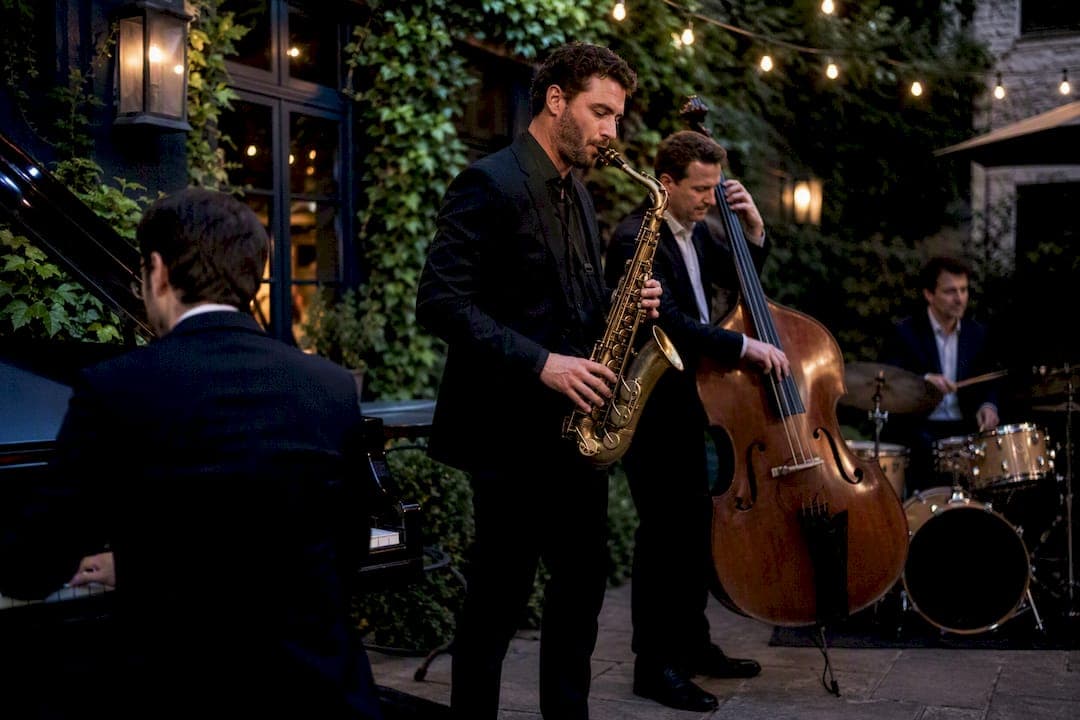
Instrumental jazz breaks down into seven practical mood categories: Relax/Chill (Miles Davis' Kind of Blue), Focus/Study (Bill Evans trio recordings), Upbeat/Social (Duke Ellington big band), Melancholic/Ballad (Chet Baker's muted trumpet ballads), Ambient/Cinematic (modal Coltrane), Danceable/Swing (classic big-band swing), and Latin/Groove (Antonio Carlos Jobim's bossa nova). Each maps to a recognizable subgenre. Cool Jazz slides into Relax/Chill. Bebop and post-bop push toward Upbeat/Active listening. A live band like the ones Alexlevinmusic books can shift any of these on the fly, since a quartet playing the same standard at a wedding reception will hit differently than the studio version.
- Relax/Chill — Miles Davis, "So What"
- Focus/Study — Bill Evans, "Waltz for Debby"
- Upbeat/Social — Duke Ellington, "Take the A Train"
- Melancholic/Ballad — Chet Baker, "My Funny Valentine"
- Ambient/Cinematic — John Coltrane, "Naima"
- Danceable/Swing — Count Basie style big-band swing
- Latin/Groove — Antonio Carlos Jobim, "The Girl from Ipanema"
Key Takeaways
Instrumental jazz sorts cleanly into seven mood categories, each defined by tempo, instrumentation, and improvisation density rather than era or subgenre label alone.
| Point | Details |
|---|---|
| Seven core categories | Relax/Chill, Focus/Study, Upbeat/Social, Melancholic/Ballad, Ambient/Cinematic, Danceable/Swing, and Latin/Groove cover most listening and event needs. |
| Cues beat labels | Check tempo, instrumentation, and improvisation density instead of trusting a genre name to predict mood. |
| Live performance shifts mood | The same standard can feel calm or urgent depending on tempo rubato, solo intensity, and dynamics in the moment. |
| Mood music isn't jazz | Background mood music limits improvisation on purpose; instrumental jazz usually keeps some improvisational core even when calm. |
| Ensembles map to moods | Alexlevinmusic pairs solo piano, trio, or quartet configurations to specific event moods rather than using one static playlist. |
Table of Contents
- Why Sort Instrumental Jazz Mood Categories This Way
- What Are the Main Instrumental Jazz Mood Categories?
- How Improvisation Changes a Track's Mood
- How Do You Choose Instrumental Jazz for a Specific Setting?
- Is It Mood Music or Improvisation-Driven Jazz?
- How I Think About Programming Mood Into Live Jazz
- How Live Jazz Delivers Mood a Playlist Can't
- Where to Listen and Learn More
- Frequently Asked Questions
- Sources
Why Sort Instrumental Jazz Mood Categories This Way
This taxonomy exists to solve one problem: matching musical cues to the moment you actually need them for, whether that's three hours of focused writing or the twenty minutes before a wedding processional starts, as detailed in why mood-matched playlists engage fans so deeply. It's not a musicology thesis. It skips the finer historical arguments about where Hard Bop ends and Post-Bop begins, because nobody curating a dinner playlist needs that distinction.
What it does instead is translate. Technical labels like "Modal Jazz" or "Cool Jazz" mean a lot to a music theory student and nothing to someone building a study playlist. This guide turns those subgenres into the mood language that playlist apps, event programmers, and hosts actually use: chill, upbeat, moody, background, danceable.
Pro Tip: If you're choosing music fast, skip the subgenre names entirely. Pick your mood first, then check the tempo and instrumentation cues below to confirm the track actually fits, since titles alone (especially on streaming platforms) are unreliable.
What Are the Main Instrumental Jazz Mood Categories?
Relax/Chill
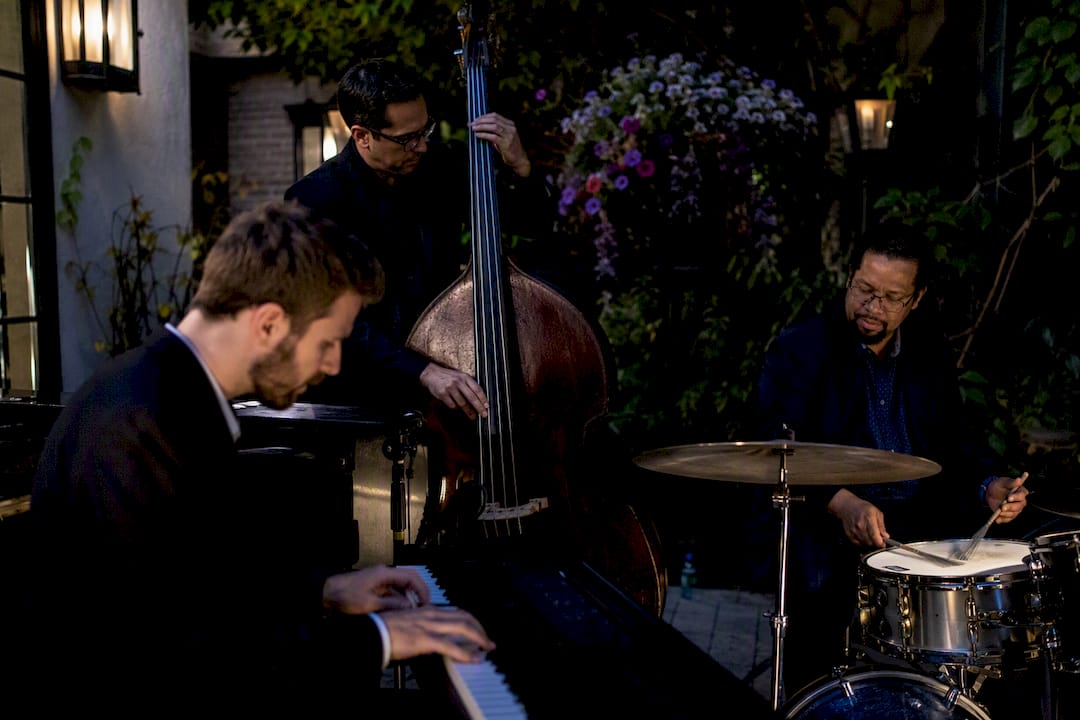
This is the category most people mean when they say "put on some jazz." The tempo sits slow to medium, the harmony stays consonant, and the arrangements leave space instead of filling it. Cool Jazz is the defining subgenre here. It takes bebop's vocabulary but plays it at more laidback tempos with a more atmospheric, moody quality, which is exactly why it dominates relaxed listening. Instrumentation tends toward muted trumpet, brushed drums, and a piano that comps sparsely rather than crowding the melody. Miles Davis' Kind of Blue is the reference point almost everyone reaches for, and Chet Baker's trumpet work sits right beside it. Improvisation happens, but it's restrained, more about tone than technical display. Use it for cocktail hours before guests are ready to be energized, spa or wellness settings, and any evening where you want sound in the room without demanding attention.
Focus/Study
Focus jazz shares Relax/Chill's slow tempo but trades atmosphere for structure. You want repetitive, predictable harmonic movement so your brain can tune it out and get to work. Piano trios do this best: Bill Evans' interplay with bassist Scott LaFaro on records like Waltz for Debby creates a rhythmic pulse that's steady without being boring. The instrumentation is usually sparse, piano, bass, brushed drums, with minimal horns to avoid vocal-adjacent distraction. Harmonic complexity can actually be moderate to high here (Evans loved reharmonizing standards), but the improvisation stays melodic rather than aggressive. This is the category streaming platforms label "Jazz for Study" or "Coffee Table Jazz", and it works for reading, writing, or any task needing sustained low-key attention.
Upbeat/Social
Here tempo climbs and the arrangements get busier. Big band swing and bebop both live in this category, though they get there differently. Duke Ellington's orchestral arrangements bring horn sections, driving rhythm, and call-and-response phrasing that fills a room and gets people talking. Bebop, meanwhile, brings faster tempos and denser improvisation, closer to active listening than background sound. Instrumentation runs full: horns, piano, upright bass, and a drummer keeping time with real drive rather than brushed subtlety. This is party and reception music, the stretch of a cocktail hour or corporate mixer where you want energy without full-on dancing yet.
Melancholic/Ballad
Slow tempo again, but the emotional register shifts from calm to wistful. Ballads lean on a single lead voice, usually trumpet or saxophone, playing long, held notes with heavy use of space and rubato (stretched, flexible timing). Chet Baker's "My Funny Valentine" is the textbook example: muted trumpet, minimal accompaniment, and a melody that lingers rather than resolves quickly. Stan Getz's tenor saxophone work carries a similar emotional weight, often with a breathy, vibrato-heavy tone that reads as vulnerable rather than technical. Harmonic movement is often simpler than in bebop, but the interpretation carries more emotional freight. This works for a first dance, a memorial, or any moment where the music needs to hold feeling rather than fill silence.
Ambient/Cinematic
This category overlaps with modal jazz, where harmony moves slowly across a handful of scales rather than cycling through fast chord changes. John Coltrane's modal work, particularly pieces like "Naima," creates a suspended, floating quality that film composers borrow constantly for underscore. Instrumentation can range from a spare quartet to something more textured, with saxophone or piano carrying long melodic lines over a droning or repetitive harmonic bed. Improvisation density is high but exploratory rather than showy, more about mood-building than displaying chops. Use it for film and video underscore, gallery openings, or any setting where music needs to color a space without becoming the focal point.
Danceable/Swing
Classic swing sits at a tempo built for movement, typically brisk and rhythmically insistent, with a strong backbeat that invites actual dancing rather than passive listening. This is rhythmic drive built into the genre itself, going back to the big band era of the 1930s and '40s. Horns trade riffs, the rhythm section locks into a groove, and the arrangement structure repeats in ways dancers can anticipate. It's the category for wedding receptions once the dance floor opens, retro-themed parties, and any event where the goal shifts from ambiance to participation.
Latin/Groove
Bossa nova and Afro-Cuban jazz define this category, built around syncopated, groove-forward rhythms that feel relaxed and danceable at once. Antonio Carlos Jobim essentially created the bossa nova template with "The Girl from Ipanema," pairing gentle nylon-string guitar or piano with soft percussion and understated vocals or horn melodies. The tempo sits medium, the mood reads warm rather than intense, and the electrified sounds and rhythmic patterns of Latin Jazz give it a groove that Cool Jazz lacks despite similar tempos. This is your late cocktail-hour or early-reception music, warm enough to keep energy pleasant without pushing guests toward a dance floor they're not ready for yet.
How Improvisation Changes a Track's Mood
The same jazz standard can feel completely different depending on who's playing it and when. Improvisation and arrangement are the two biggest levers here, and the same tune can produce highly personalized emotional experiences across different takes. A studio recording locks in one version. A live set never repeats itself exactly.
What actually shifts the mood:
- Tempo rubato — a soloist stretching or compressing time changes urgency instantly.
- Solo intensity — a restrained melodic solo versus an aggressive, high-register run on the same tune.
- Instrumentation swaps — muted trumpet reads intimate; open, unmuted horn reads bold.
- Reharmonization — substituting chords under a familiar melody can turn a bright standard somber.
- Dynamics — a quiet trio arrangement versus a full quartet at volume changes the room's energy entirely.
Pro Tip: If you're briefing a band for an event, don't just name a song. Describe the feeling you want ("keep this one intimate and quiet" versus "open this one up, let the sax stretch out") so the musicians know which direction to take the improvisation.
How Do You Choose Instrumental Jazz for a Specific Setting?
Match the setting first, then check tempo and instrumentation against it.
- Studying or focused work — aim for slow, sparse piano trio arrangements; avoid horn-heavy tracks or anything with a vocal-like lead melody that pulls attention.
- Dinner or intimate gatherings — medium-slow tempo, warm tone, light improvisation; a solo piano or duo keeps conversation easy.
- Cocktail hour — start soft with standards, then work in one upbeat swing tune roughly every 20 minutes to keep energy building without overwhelming early arrivals.
- Ceremony (wedding or formal) — slow, clean, minimal improvisation; solo piano or a restrained duo avoids distracting from the moment.
- Film or video underscore — modal or ambient textures with long, sustained lines that support a scene rather than compete with dialogue.
Three questions worth asking a band or playlist curator before you commit:
- What's the tempo range for this set, and does it match the room's energy at that hour?
- How much improvisation should we expect, restrained and melodic, or extended solos?
- Can the arrangement shift on the spot if the room's mood changes?
Alexlevinmusic often fields exactly these questions from clients planning multi-stage events, since moving from dinner to dancing usually means three or four mood shifts in a single evening, not one static playlist.
Is It Mood Music or Improvisation-Driven Jazz?
Mood music and instrumental jazz solve different problems, and mixing them up leads to picking the wrong thing for an event. Mood music is built for background ambiance, lushly arranged, melody-forward, with little to no improvisation. It's designed so you don't have to listen closely. AllMusic's own mood-music category groups it under easy listening for exactly this reason.
Instrumental jazz, even at its calmest, usually keeps some improvisational core. That's the difference between a Cool Jazz recording built around a real quartet trading ideas and a lounge album built around a fixed arrangement. Pick mood music for elevators, retail spaces, or a ceremony where zero distraction is the goal. Pick improvisation-driven jazz for a reception or dinner where you want the music to feel alive, not wallpapered in.
How I Think About Programming Mood Into Live Jazz
Mapping mood to ensemble size is the first decision I make with any client, before we talk song lists. A solo piano handles Focus and Ceremony moods because one instrument creates space without competing with speech or vows. A trio covers Relax and Dinner because bass and drums add warmth without adding volume. A full quartet or hybrid DJ-plus-live setup is what gets Upbeat/Social and Danceable moods off the ground once a room is ready to move.
One thing that reliably works: briefing musicians on the mood arc of the whole event, not just song titles, so the same tune can open the night soft and close it loud without ever feeling like a different band.
How Live Jazz Delivers Mood a Playlist Can't
A recorded playlist can hit a mood category. It can't adjust to the room. Live instrumental jazz reads the crowd and shifts tempo, dynamics, and solo intensity in real time, something no streaming queue will ever do for your cocktail hour or reception.
Alexlevinmusic builds ensembles around the mood categories covered here: a solo pianist for Ceremony or Focus moments, a trio for Dinner or Relax stretches, a full quartet when the room needs to shift into Upbeat/Social, and a bossa-leaning trio when you want that Latin/Groove warmth during a golden-hour cocktail hour. Every one of the ensemble and soloist configurations maps directly to a mood on this list, which makes planning a multi-stage event less about guessing and more about picking from a menu that already matches what you're after. If you're mapping out a wedding, corporate event, or private celebration and want the mood to actually shift on cue instead of playing on a loop, get in touch about ensemble options and describe the arc of your event. That conversation alone usually clarifies which ensemble fits which hour.
Where to Listen and Learn More
- List of jazz genres for subgenre background and era context.
- AllMusic's Mood Music entry to hear the background-music side of the spectrum.
- Styles of Jazz for a breakdown of subgenre feel and technique.
Listen to the artist and track pairs mentioned throughout this guide back to back. Nothing internalizes tempo and mood cues faster than direct comparison.
Frequently Asked Questions
What are the main mood categories for instrumental jazz? Most listeners and event programmers use seven working categories: Relax/Chill, Focus/Study, Upbeat/Social, Melancholic/Ballad, Ambient/Cinematic, Danceable/Swing, and Latin/Groove. Each ties to specific tempo ranges, instrumentation choices, and improvisation styles.
What's the difference between chill jazz and jazz for studying? Both sit at slow to medium tempo, but Focus/Study jazz uses sparser, more repetitive arrangements (often just piano, bass, and brushed drums) so it fades into the background. Relax/Chill jazz, especially Cool Jazz, adds more atmosphere and tonal color meant to be noticed a little more.
Is smooth jazz the same as instrumental jazz mood categories like Relax/Chill? Smooth jazz overlaps with Relax/Chill but leans more produced and downtempo, often in the 90 to 105 BPM range, with softer rhythmic backdrops than a live Cool Jazz combo would use.
Why does the same jazz song sound different live versus recorded? Improvisation and arrangement choices, tempo rubato, solo intensity, and reharmonization, change from performance to performance. A live band also reads the room and adjusts dynamics in ways a fixed studio recording never will.
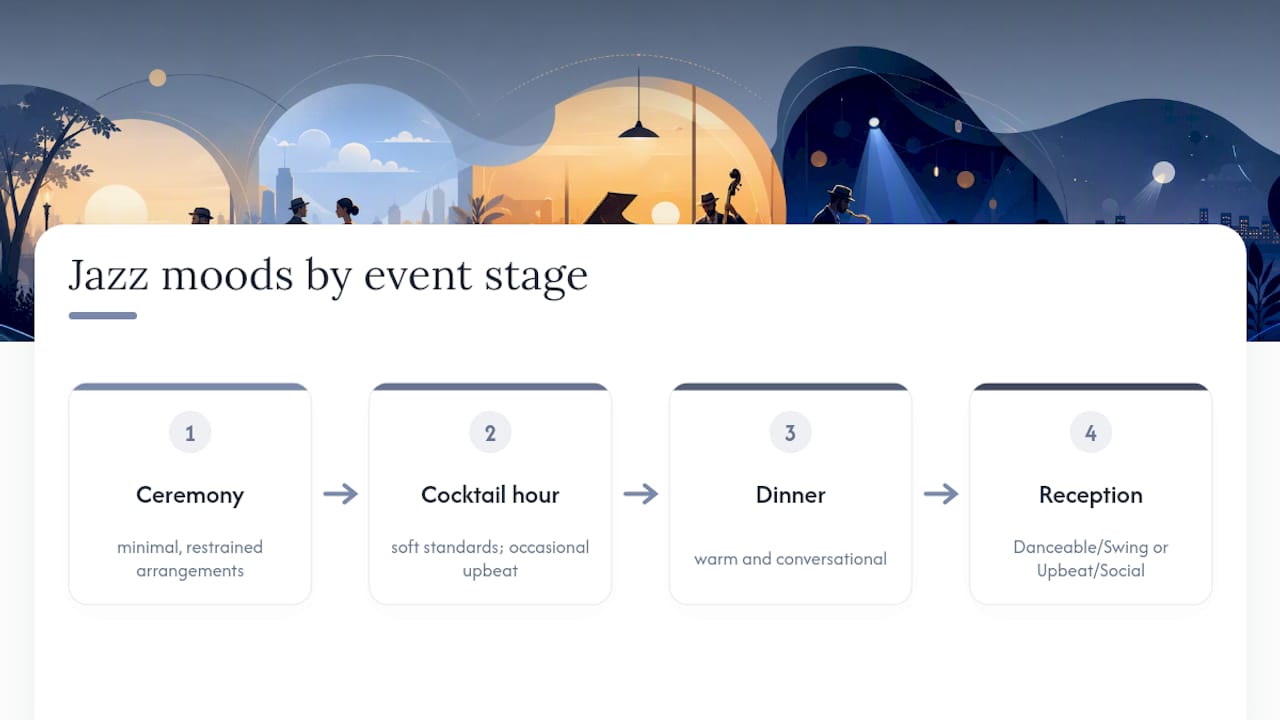
How do I pick the right jazz mood for a wedding or corporate event? Break the event into stages: ceremony calls for minimal, restrained arrangements; cocktail hour builds from soft standards to occasional upbeat tunes; dinner stays warm and conversational; and the reception opens into Danceable/Swing or Upbeat/Social once guests are ready to move.
Sources
- List of jazz genres
- Dictionary
- Mood Music — AllMusic
- Jazz moods & moments (Spotify genre page)
- Freejazzlessons